First party fraud prevention on the claims side cannot stop the payment, because by the time a customer disputes it the money has moved. What it can do is make the outcome predictable: a claim that the bank's own records contradict is denied, with a letter that lists those records, and a claim the records cannot settle is paid. That second half is not a concession. The Electronic Fund Transfer Act puts the burden of proof on the bank, and Federal Reserve examiners spell out what follows: "if the institution cannot establish that the disputed EFT transaction was authorized, the institution must credit the consumer’s account." Botminds' First-Party Fraud Detection is built for that program. Its agents assemble the evidence, propose payment below a confidence floor and review every proposed denial for fairness; people decide; and a monthly review shows whether similar claims were treated alike. This guide covers how to roll such a program out so investigators trust it.
The sample bank's claims policy, as versioned settings
0.75
confidence floor: below it the agents propose payment, never denial
5
reasons that may never carry a denial, locked in policy
Day 8of 10
flagged claims decided, with escalation at day 7
0
denials resting on a reason the rules do not allow: the design target
What first party fraud prevention can do after the payment
Prevention before the payment, such as device binding, step-up authentication and payment holds, belongs to the fraud team, and a customer who makes a payment himself passes every one of those checks. After the payment, the levers are different and narrower: decide each claim on evidence, decide similar claims alike, and decide what follows a confirmed false claim under a written policy.
The deterrent, if there is one, is certainty. A customer who disputes a payment he sent from his own phone, on his own network, to someone he has paid fourteen times, should receive a letter that says so in plain words, with his right to the documents. No regulator or research study we can rely on measures how much such letters deter repeat claims, so this guide does not put a number on it. What can be measured is whether the bank applied the same standard to every claim, and that is where a prevention program earns or loses trust.
What follows a confirmed false claim should be decided separately from the claim. In the sample, a checked denial can lead to a referral to the BSA Officer, a senior review of the customer's new claims for 180 days, or an account action, each proposed to the person who decides it. None of them changes how the next claim is investigated: each is still decided on its own records.
Should uncertain claims be paid?
Yes. The rule already says so, and the statute raises the stakes. Where a bank does not provisionally recredit within ten business days and either did not make a good-faith investigation or had no reasonable basis for believing there was no error, the consumer is entitled to treble damages (15 U.S.C. 1693f(e)(1)). An uncertain denial is the case that statute describes.
A confidence floor turns the rule into a setting. In the sample bank, the evidence agent's confidence below 0.75 means the agents propose payment; a fairness agent can return a denial or require payment but can never deny; and the September review counted no denials below the floor. The floor is not a model's verdict. It is a policy line, approved by the Compliance Officer, that says how much contradiction the bank needs before it will put its name to a finding of no error.
The floor also catches drafts that only looked strong. One sample claim, a $129.99 ACH debit the customer said she had cancelled, was drafted for denial on the strength of her two earlier claims. The fairness review set those aside, the confidence fell to 0.71, and the proposal became payment.
Does paying uncertain claims encourage first party fraud?
There is no reliable public evidence either way, and the question rests on a false choice. Paying a claim the bank cannot disprove is what Regulation E requires; the alternative is not a stricter policy but a violation. The bank's real choice is how hard it works to find the evidence that settles a claim, and how consistently it denies when it finds it.
That is where prevention spending pays. A claim that would have been paid because nobody had time to read the device and sign-in logs is a cost of the process, not of the rule. Botminds estimates that pulling and pairing the records for one flagged claim takes about 65 investigator minutes by hand and about 10 with the agents; the estimate is ours and deliberately modest. A desk that can read every record on every flagged claim pays fewer false claims and denies no genuine ones on a shortcut, which is the subject of our first party fraud detection buyer's guide.
Why investigators resist a confidence floor, and what answers them
Experienced investigators resist a floor for good reasons: they have seen false claims paid, they know their customers, and they distrust a number that overrules them. Three things answer those reasons better than an instruction does.
First, the investigator keeps the decision. In the sample, agents propose, explain and cite; only an investigator can deny, and only a different supervisor can approve. Second, the investigator can disagree on the record. Each pair can be questioned or set aside with a reason, and each override is counted by reason code, so a disagreement becomes information rather than insubordination. Third, the comparison is shown. Before a person sees a proposed denial, the agents set it beside similar claims and say what made the paid ones different.
"31 were denied and 7 paid; each of the 7 had a new device in the week before or a reported impostor contact."
The sample bank's fairness review, on one proposed denial
That sentence does more for trust than any accuracy figure. It tells the investigator that the bank has a standard, what the standard is, and that this claim meets it. In the same month, investigators paid six claims the agents had proposed to deny: three because the customer brought new information, two because a household member had the phone, and one for another reason. That is the floor working in both directions.
The monthly measures that keep a denial policy honest
Measure outcomes by group, the reasons removed before anyone decided, and the places people disagreed with the agents. A single accuracy number hides exactly the drift a prevention program exists to catch.
What to measure every month, and what each catches
| Measure | What it catches | Sample bank, September |
|---|---|---|
| Denial rate of flagged claims, by program and channel | One partner, branch or channel treated more harshly than the rest | 45% overall; one partner at 62% |
| Denial rate by transfer type | A transfer type where a shortcut has crept in | P2P 49%, debit card 38%, ACH 47%, ATM 50%; none more than 10 points from the overall rate |
| Reasons struck before review | Investigators or templates leaning on forbidden reasons | 25 struck; earlier claims alone the most common, 14 |
| Overrides, by reason code | Where the agents and people disagree, and why | 9: six denials turned to payment, three pairs set aside |
| Denials below the floor | The policy line being crossed | 0 |
| Denials reopened after review | Errors found before a customer or examiner finds them | 1, a $164.00 claim |
Denial rate of flagged claims by program, one month
How do you know a denial policy is fair? Read the outlier
By re-reading the denials behind any rate that stands out, not by arguing about the rate. In the sample, the agents re-read all eight denials for the outlying partner. Its customers reported later than the bank's own, a median of 9 days against 3, and reporting time is not a reason the policy allows. Five denials stood on device, network and payment records. Two had mentioned reporting time but stood without it, so their wording was corrected. One, a $164.00 claim, rested on reporting time; without it the evidence was moderate, so it was reopened and payment proposed.
A month of decisions, checked for consistency
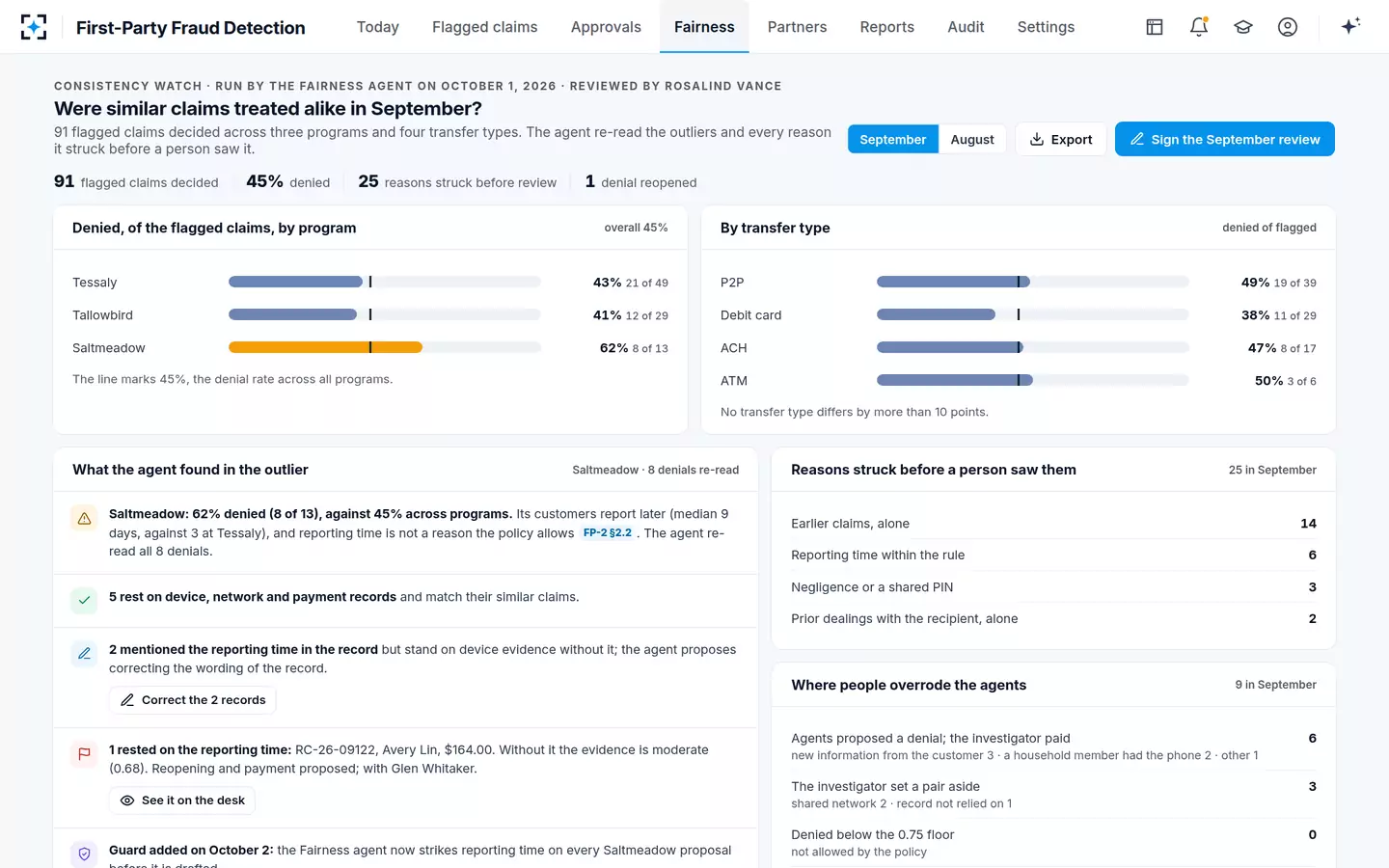
The fix went beyond the case. From October 2, the fairness review strikes reporting time from every proposal for that partner's customers before a draft is written. A rate that differs is not proof of unfairness, and this one turned out to be mostly sound; the value of the review is that it found the one denial that was not, before a customer or an examiner did. The CFPB has shown what happens otherwise: when examiners found claims denied on a single improper ground, the institutions found and repaid every consumer denied the same way (Supervisory Highlights 24).
Who owns the controls when model-risk guidance stops short?
The bank does, explicitly. The interagency model-risk guidance of April 2026 places generative and agentic AI outside its scope, and it says of itself that it sets no enforceable standards and prescribes nothing, which leaves the work to each institution. A bank deploying agents on Reg E claims therefore has to write its own controls and be ready to show them.
In the sample those controls are concrete. Prompts and models are versioned, and a new version runs on the previous month's claims before it goes live, so its proposals can be compared with what people decided. Threshold changes, including the floor, need the Compliance Officer's approval. Every pair and agent statement opens its source passage, and every override is counted. Who sits in each seat, and why the checker never checks his own work, is in the dispute fraud specialist guide.
A rollout plan that earns trust
Start where the stakes are zero: on claims the desk has already decided. A team that sees the agents' proposals beside its own past decisions, and reads every disagreement, knows within weeks whether to trust the floor and the never-a-reason list.
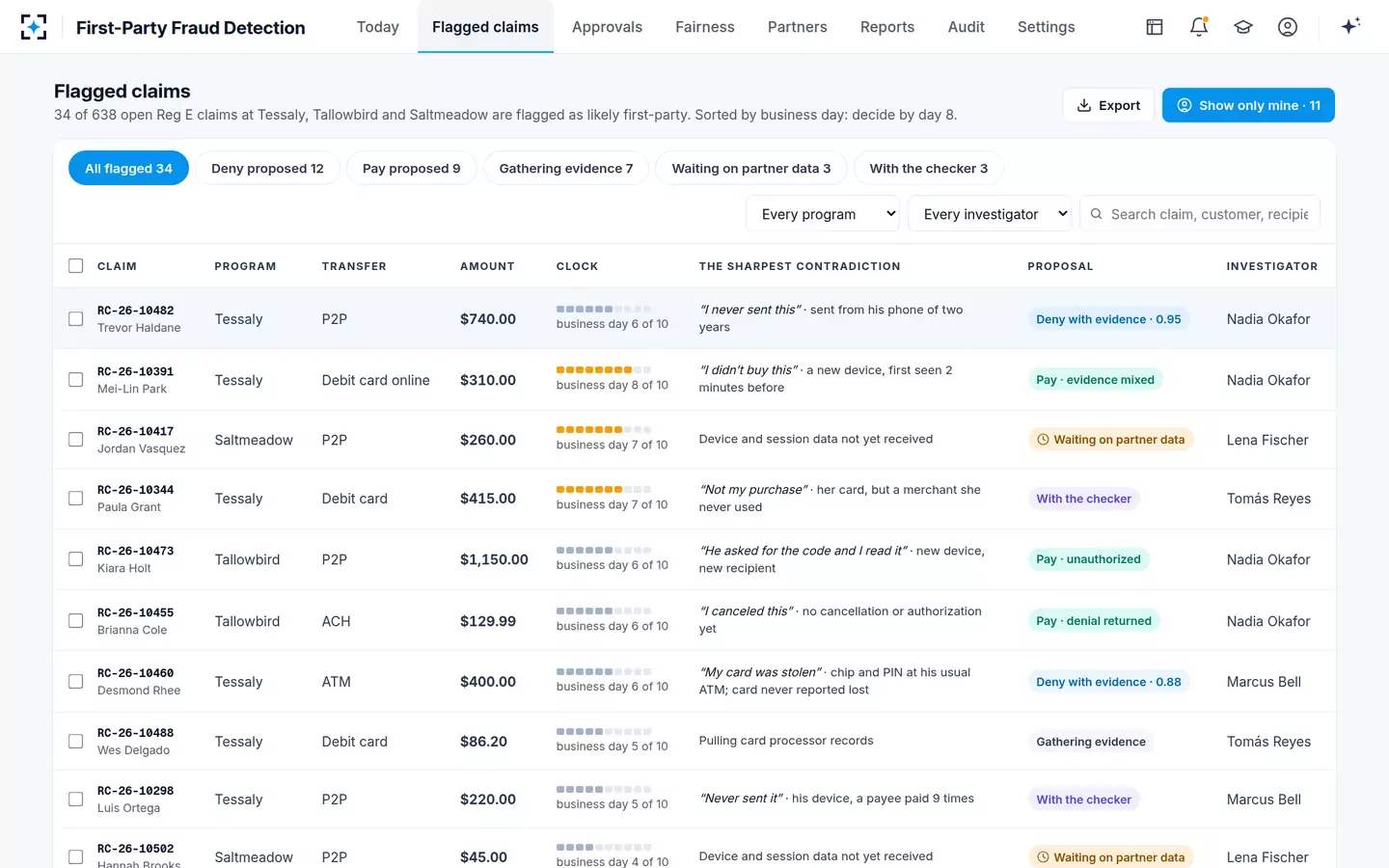
The flagged queue the desk works once live
Rolling out first party fraud prevention on Reg E claims
- Run on past flagged claims first.
Compare every proposal with what the desk decided. Read each disagreement; count them by reason.
- Write the never-a-reason list as a setting.
Earlier claims alone, reporting time within the rule, negligence or a shared PIN, prior dealings alone, a missing police report. Lock it.
- Set the floor with compliance, and version it.
Below it, propose payment. Record every change, who proposed it and who approved it.
- Put a second person on every denial from day one.
Someone who did not prepare it, reading the same pairs.
- Decide flagged claims early on the clock.
Day 8 of 10 in the sample, with escalation at day 7, so pressure never forces a shortcut.
- Protect the clock from partner data.
For a sponsor bank: no partner data by day 8 means provisional credit, never a denial.
- Sign a monthly consistency review.
Rates by group, reasons struck, overrides, reopened denials. Re-read every outlier.
- Keep the customer’s view clean.
Findings and the right to documents; never fraud, flag or any sign of a referral.
What to look for in first party fraud prevention software, and where the solution fits
Look for a tool that makes "pay when unsure" a visible, versioned rule; shows the comparison with similar claims on every proposed denial; counts overrides by reason; and produces the monthly review your compliance officer signs. Ask how it behaves when a fintech partner's data is late, and what the customer sees. Ask, above all, to watch it pay a claim.
Botminds' First-Party Fraud Detection does those things for Reg E claims on consumer deposit accounts, including P2P, debit card, ACH and ATM transfers and sponsor-bank partner programs. It does not prevent fraud before the payment, handle credit card disputes under Regulation Z, or publish a rate of first-party fraud; and its agents never decide, post, send or refer. It is configured from the bank's own claims policy, letter templates and a sample of past claims, and the first step is the one at the top of the checklist: run it on your own past flagged claims. The claim behind this guide can be followed screen by screen from First-Party Fraud Detection, and the arithmetic of what each wrong answer costs is in first party fraud in banking.
Questions people ask
How do banks prevent first party fraud on Reg E claims?
By denying claims the bank's own records contradict, with a letter that lists those records, and by deciding similar claims alike. Confirmed false claims can lead to closer review of future claims, an account action or a suspicious activity referral under the bank's policy, kept apart from the customer's letter.
How do you get investigators to trust a fraud model?
Keep the decision with them, let them question or set aside any piece of evidence with a reason, count their overrides, and show the comparison with similar claims on every proposed denial. In the sample, investigators turned six proposed denials into payments in one month, each with a recorded reason.
What should a dispute team measure every month?
Denial rates of flagged claims by program, channel and transfer type; the reasons struck before review; overrides by reason code; denials below the confidence floor, which should be zero; and denials reopened after review.
Is a confidence floor required by Regulation E?
No; it is a policy setting. It puts into practice the rule that a bank which cannot establish a transfer was authorized must credit the customer, and it gives examiners a written line to test the bank's denials against.
How long does a rollout take?
That depends on how many past claims the team reviews and how many disagreements it reads; we do not publish a standard figure. The sequence matters more than the calendar: past claims first, then live claims with every denial checked, then the monthly review.