First party fraud detection software, on a Reg E claim, helps a dispute team find the claims in which the customer made the transfer himself, or knows who did, and prove it from the bank's own records before a claim is denied. It is harder than it sounds. The Electronic Fund Transfer Act puts the burden of proof on the bank, the CFPB has cited denials that rested on a single signal, and the records that settle one claim sit in four or five systems. Botminds' First-Party Fraud Detection is software for dispute investigators: its agents set each thing the customer said beside the record that answers it, look for signs the claim is genuine before anything else, and leave every denial to two people. This guide is for the team choosing such a tool.
It covers what detection means once a payment has been made, the shortcuts examiners have already rejected, how the work divides between software and people, a buyer's checklist, and an honest account of where the solution fits and where it does not. Product examples come from a fictional sample bank; every regulatory statement links to the rule or the regulator's own words.
What a first-party denial has to survive
10
business days to decide the claim, or credit the customer provisionally and take up to 45 days
3
business days to send a written explanation once the bank finds no error
5
single-signal denial practices the CFPB has cited since 2014
3×
actual damages where a bank knowingly and wilfully concluded no error that its evidence could not support
First party fraud detection on a dispute is a different job from account opening
At account opening, first-party fraud detection asks whether an applicant intends to repay or is who they claim to be. On a Reg E dispute the question is narrower and harder to get wrong quietly: did this customer, or someone acting with his authority, make this transfer? The answer has to be reached on the regulation's clock and explained to the customer in writing.
The Federal Reserve's FraudClassifier model puts a synthetic identity and a false dispute on the same branch, the one for an authorized party acting fraudulently, and labels the dispute kind a false claim: a deliberate lie told to get a payment or to avoid one. The branch is shared; the evidence is not. Account-opening tools read identity data and bureau files. Dispute tools read the bank's own history of the account: which device sent the payment, from which network, to whom, and what happened on the account in the days before.
The output differs too. A score that holds an application costs the bank a customer it might have wanted. A denied Reg E claim leaves a customer without money the law may say is his, and it produces a letter that an examiner can read years later. That is why the rest of this guide treats detection as building a case that a second person can check, not as a number.
How do banks detect first party fraud in a Reg E claim?
They compare what the customer says with records the bank already holds, statement by statement. The Official Interpretation of Regulation E lists what an investigation may draw on, among them the account's transaction history for a reasonable period before the alleged error, and where the transfer or the payee sits relative to the customer's home and usual area. It also sets a floor: a bank may not stop at the payment instructions when its own records about the account could help resolve the claim (comment 11(c)(4)-5).
In practice those records are device registrations and sign-in sessions from digital banking, payment history from the core and the P2P network, card authorizations from the processor, and earlier claims from case management. For a sponsor bank, add the fintech partner's device and session data, which the same comment reaches when it mentions information held by the bank's third-party service providers.
Take a fictional sample claim as it runs through the solution. Trevor Haldane, a customer of Tessaly Community Bank since 2019, disputes a $740.00 P2P payment to Kyle Ostrander: "I never sent this payment." The agents split his app form and his phone call into six statements and pair each with the record that answers it.
Each statement beside the record that answers it
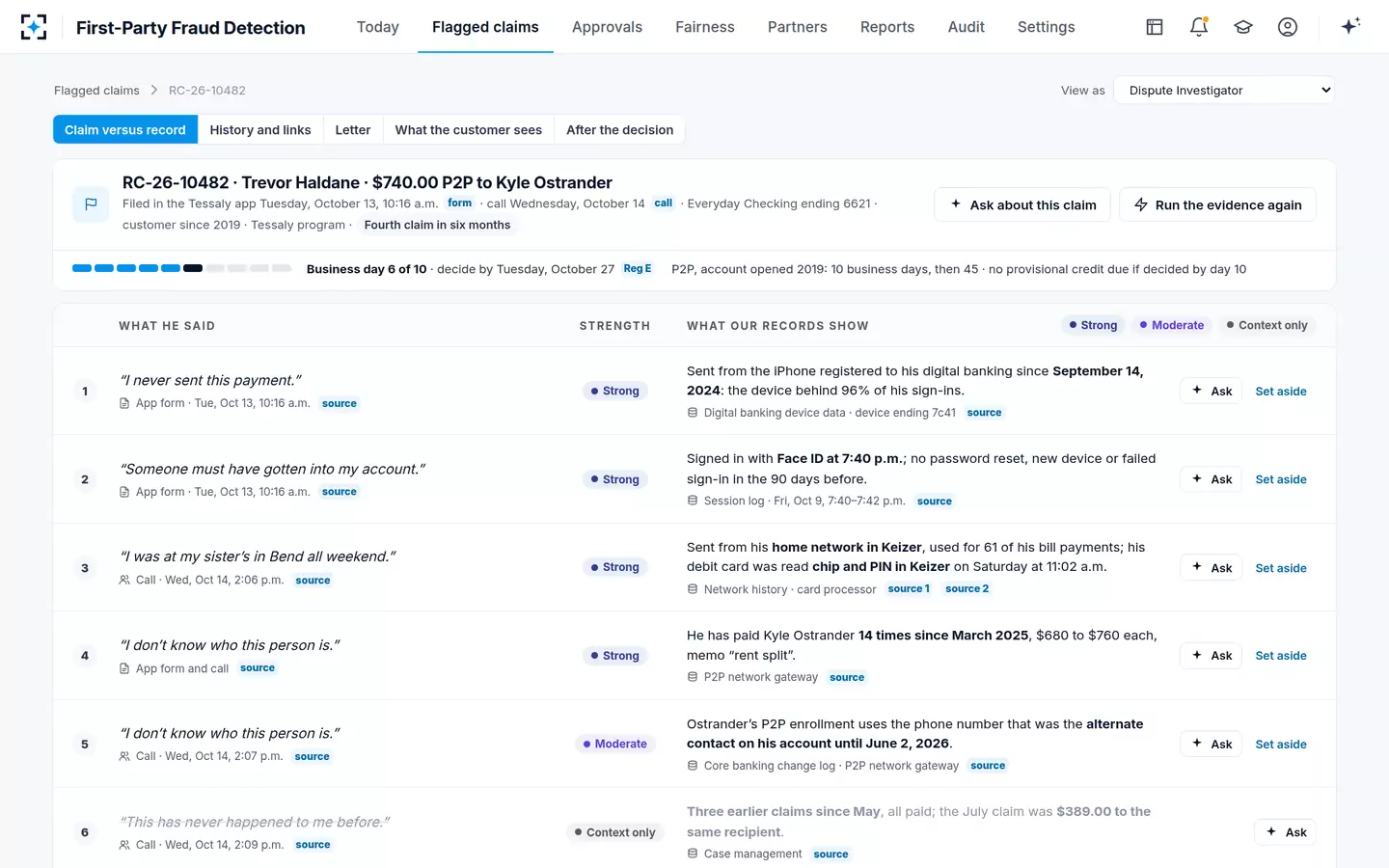
The method matters more than any one row. "I was at my sister's in Bend all weekend" is answered by two independent records, the home network and a chip-and-PIN purchase in Keizer the next morning. "I don't know who this person is" is answered by 14 earlier payments with a shared memo. The last pair, his earlier claims, is shown but labelled context only: it says nothing about who sent this payment.
Which single signals have regulators already rejected?
At least five. In supervisory reports and one consent order, the CFPB has cited denials that rested on a known device, an earlier relationship with the recipient or the merchant, a customer who could not explain how his PIN was taken, and a missing affidavit. None of these facts is irrelevant. What was rejected each time was letting one of them stand in for the investigation.
Five shortcuts the CFPB has cited
| Signal used alone | What the CFPB found | Where |
|---|---|---|
| The device is one the bank knows | Refunds denied because the activity came from a device that regularly used the account; the CFPB found the company wrongly concluded the transfers were authorized. | Block, Inc. consent order, January 2025 |
| The customer has paid this recipient before | Refunds at times denied because the customer had paid the recipient before, with nothing else relied on. | Block, Inc. consent order, January 2025 |
| The customer has used this merchant before | Claims denied only because the customer had bought from the merchant before, instead of a reasonable investigation. | Supervisory Highlights, Summer 2021 |
| The customer cannot explain how the PIN was taken | A stolen-card claim denied because the customer could not say how his PIN was compromised. | Supervisory Highlights, Fall 2014 |
| No affidavit came back | Claims denied without looking at their merits because the customer did not return an affidavit. | Supervisory Highlights, Spring 2022 |
Read the first two rows against Trevor's claim. His denial leans on a device the bank knows and a recipient he has paid before, which is exactly the pair Block was faulted for using alone. The difference is everything else in the file: the network and card location that contradict his alibi, the absence of any takeover sign, and a written search for what would have made the claim genuine. A buyer should ask any vendor which of its features could become one of these rows if a busy investigator trusted it on its own.
The table is also a warning about scores. A model that learns from past denials will learn whatever shortcut produced them. If a desk denied every claim from a known device for two years, a score trained on that desk will rank known-device claims as likely false, and the shortcut returns with a number attached. We set out the full list of reasons that cannot carry a denial, with what each rule allows instead, in Reg E denial reasons.
Why the search starts with the customer's side
Because the law puts the burden on the bank. In any action over a consumer's liability, it is the bank that must show the transfer was authorized (15 U.S.C. 1693g(b)), and Federal Reserve examiners draw the practical consequence: a disputed transfer the bank cannot show was authorized has to be credited to the customer (Consumer Compliance Outlook, October 2025).
So a detector that only collects reasons to deny is collecting half the evidence it needs. The other half is the set of facts that would make the claim genuine: a new or changed device, a password or PIN reset, failed sign-ins, a call or text from someone posing as the bank, a SIM or carrier change, a phone reported lost. The CFPB's EFT FAQs treat the impostor case as unauthorized: when a customer is tricked into sharing access information and a third party then uses it, the transfer is an unauthorized EFT.
The genuine-claim checks come before the proposal
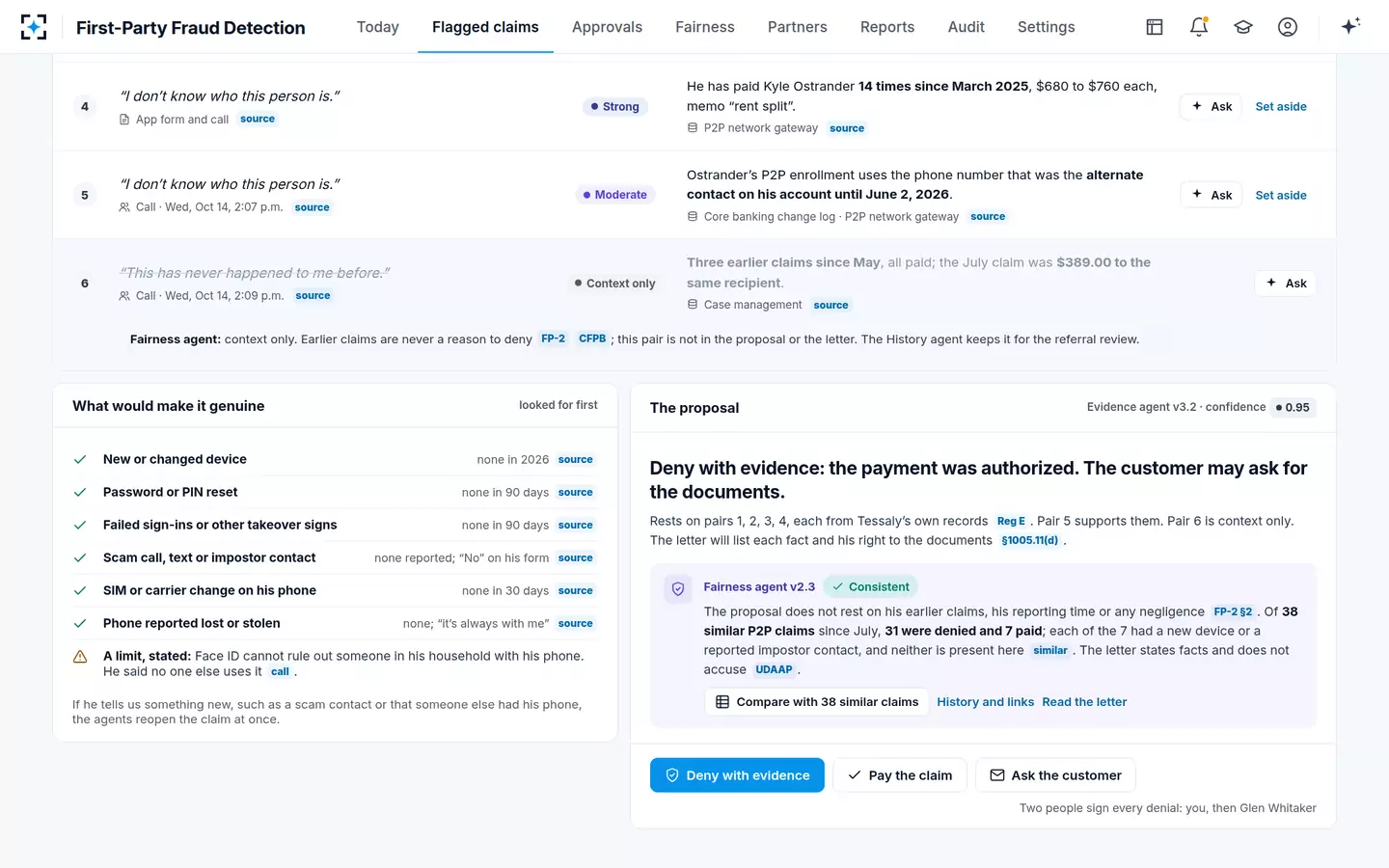
The same desk shows why this order matters. On the morning Trevor's claim was ready, two other flagged claims went the other way. Kiara Holt's $1,150.00 transfer was sent from a new device two minutes after a one-time code reached her phone, and she said "He asked for the code and I read it to him": an impostor-induced transfer, proposed for payment. Mei-Lin Park's $310.00 online card purchase came from a device first seen two minutes before it, shipped to an address that was not hers: evidence mixed, proposed for payment. All three sat in the same flagged queue; only the search for the genuine side told them apart.
"Face ID cannot rule out someone in his household with his phone."
The stated limit beside the sample proposal
That sentence is the honest edge of device evidence. A registered phone and a biometric sign-in show that the phone and its owner's face or a household member holding it were present; they do not show who pressed send. Software should say so on the screen, and the investigator should ask the customer about it before a denial, as our guide to claims involving a family member sets out.
Can first party fraud be detected automatically?
The finding can be automated; the deciding should not be. Pulling records from five systems, pairing them with statements, comparing a claim with similar ones and drafting a letter are mechanical and slow by hand. Choosing to deny, signing the denial and referring a customer for suspicious activity are judgments the bank answers for. In Botminds' First-Party Fraud Detection, seven agents do the first kind of work and two people do the second.
First-Party Fraud Detection: agents build the case, people decide it
Agent
Intake agentSplits the app form, call or partner ticket into numbered statements, classifies the transfer and starts the Reg E clock.
Never: rejects a claim or asks for a police report.
Agent
Evidence agentPairs each statement with device, sign-in, network, card and P2P records, labels its strength and looks first for signs the claim is genuine.
Never: decides. Below its confidence floor it proposes payment.
Agent
History agentFinds earlier claims and links between customer and recipient across the bank and its fintech partners.
Never: offers history as a reason for a denial.
Agent
Fairness agentStrikes reasons the policy forbids, compares the claim with similar ones and checks the wording of the letter.
Never: denies. It can only return a denial or require payment.
A person decides
Dispute InvestigatorReads every pair, asks about or sets one aside, and decides: deny with evidence, pay, or ask the customer.
Agent
Letter agentDrafts the result letter: each finding relied on, in plain words, and the right to the documents.
Never: sends, or mentions earlier claims, referrals or fraud.
A person decides
Disputes SupervisorChecks the denial beside its pairs, the fairness note and the letter, then approves or returns it. Never offered work he prepared.
The controls around the agents matter as much as the chain. Banks cannot lean on model-risk guidance for them: the interagency guidance the OCC, the Federal Reserve Board and the FDIC issued on April 17, 2026 leaves generative and agentic AI out of scope, as new and still changing quickly; whether a customer risk rating model is a model examines what that leaves to the bank. In the solution each agent is versioned, every statement it makes opens its source passage, a new version runs on the previous month's claims before it goes live, and threshold changes need the Compliance Officer's approval. When a person overrides an agent, the reason code is counted. For a card-dispute view of the same boundary, see whether AI can decide a card fraud dispute.
The fairness review that sits between the agents and the investigator
Before a person sees a proposed denial, a separate agent reviews it for two things: reasons the bank's policy never allows, and consistency with similar claims. In the sample bank's policy the never-allowed list has five entries: earlier claims alone, reporting time within the rule, negligence or a shared PIN, prior dealings with the recipient alone, and a missing police report.
On Trevor's claim the review set his earlier claims aside and kept them out of the letter. It then compared 38 P2P claims since July with the same pattern, sent from the customer's registered device to a recipient paid five or more times before. Thirty-one were denied and seven paid, and each of the seven had a new device added days before or a reported impostor call or text. Trevor's had neither, so a denial treats him as the 31 were treated.
The same review returned a draft that failed. A $129.99 ACH claim from a customer who said she had cancelled a membership had been drafted for denial on the strength of her two earlier claims. Without them, no cancellation and no authorization had yet been found, the confidence fell to 0.71, under the 0.75 floor, and the agents proposed payment instead. How a dispute team uses this monthly, and why paying below the floor is the law's own default, is the subject of our first party fraud prevention guide.
What to look for in first party fraud detection software
Look for software that produces a case, not a verdict: each conclusion tied to a record a supervisor can open, the genuine-claim search shown, forbidden reasons kept out, and a letter that says what the bank found. Many disputes desks today work from a fraud score and a set of rules. That arrangement is fast to flag and slow to defend.
Two ways to flag a likely first-party claim
A score and a rule set: Features of the claim and customer, combined into one number.
Statement against record: One thing the customer said, beside the record that answers it.
A score and a rule set: Similar to claims denied before, including any shortcut those denials used.
Statement against record: Several independent records contradict the customer, each one cited.
A score and a rule set: Takeover and scam signs are inputs that lower the score.
Statement against record: Looked for first and listed, with the source for each "none found".
A score and a rule set: Earlier claims and known devices often carry weight in the score.
Statement against record: Struck before a person sees the proposal; shown only as context.
A score and a rule set: A template with a sentence of findings.
Statement against record: Each finding in plain words, and the right to the documents.
A score and a rule set: Approves a summary.
Statement against record: Checks the same pairs the investigator read.
Questions to put to any first party fraud detection vendor
- Show me one denied claim, end to end.
Every reason in the letter should open the record behind it. If it opens a score, ask what the examiner will read.
- Where does the search for a genuine claim appear?
New device, reset, failed sign-ins, scam contact, SIM change, lost phone: each needs a result and a source, not a blank.
- Which reasons can never reach a denial, and who can change the list?
The list should be a setting with versions, changed only with the compliance officer’s approval.
- What happens when the evidence is mixed?
Ask for the floor below which the system proposes payment, and for the number of denials made under it last month. The target is zero.
- Can it compare a denial with similar claims?
Same transfer type, same pattern, same period, with what made the paid ones different.
- What does the customer see?
Plain findings and the right to documents, never the words fraud or flag, and never any sign of a referral.
- How is a new version tested before it reaches live claims?
On past claims, with the differences reviewed by a person.
- What does it do when a fintech partner’s data is late?
The Reg E clock does not stop for a partner. Missing data should push toward provisional credit, never toward denial.
Where Botminds' First-Party Fraud Detection fits, and where it does not
It fits a bank or credit union that investigates Reg E claims on consumer accounts, including P2P, debit card, ACH and ATM transfers, and that wants likely false claims denied on evidence while uncertain claims are paid. It reads from the systems a disputes team already uses: the core, digital banking's device and sign-in data, the P2P network gateway, the card processor, case management, and for a sponsor bank, each fintech partner's feeds under its program agreement.
The queue a dispute investigator works from
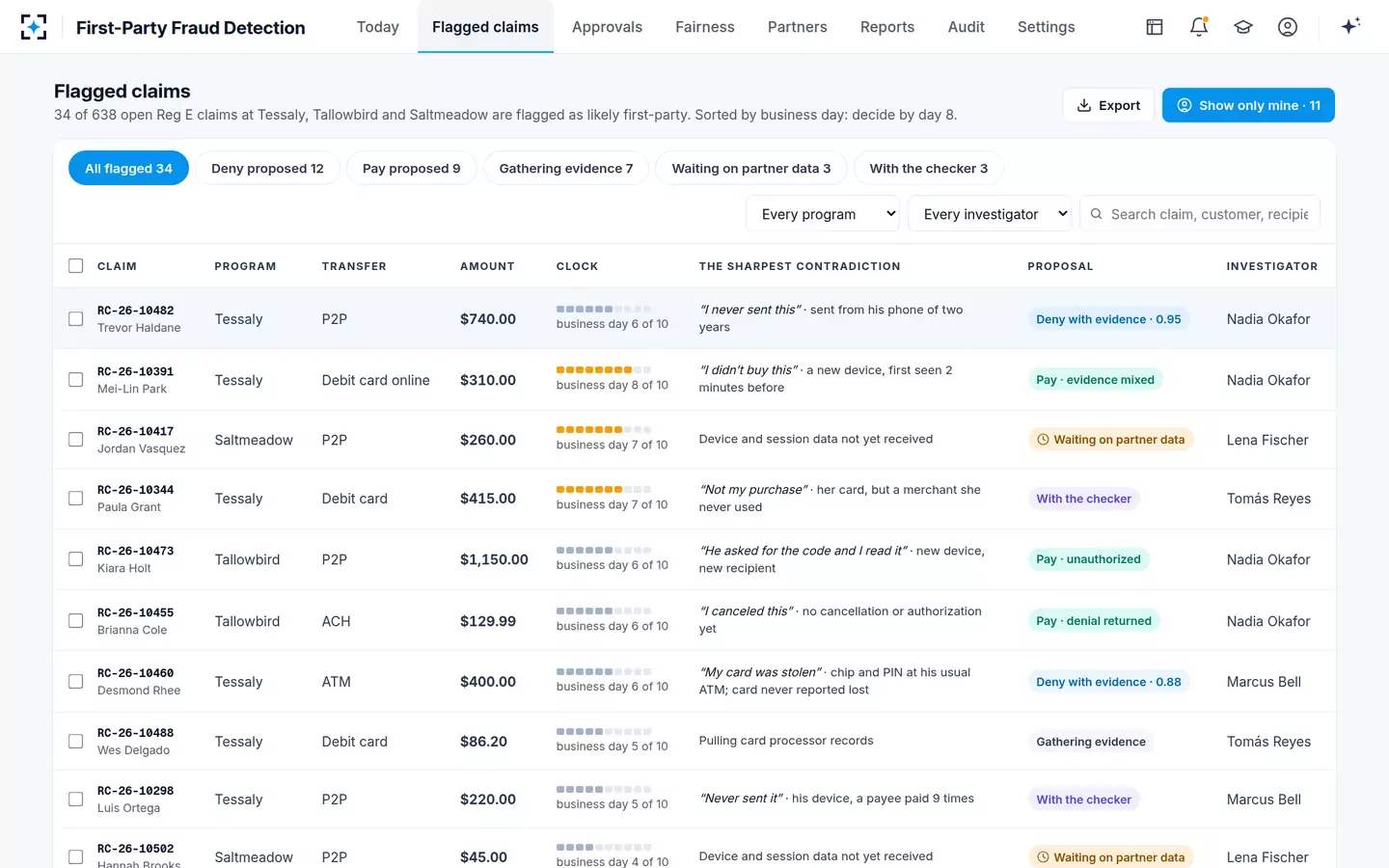
It does not detect fraud at account opening, synthetic identities or bust-outs; those need identity and credit data it does not read. It does not handle Regulation Z credit card disputes or network chargebacks, which belong to card dispute management. It does not decide, post, debit, send a letter or file a referral: every one of those waits for a named person. It does not tell a bank how much first-party fraud it has; no regulator or research body publishes a measure we can rely on, and the solution reports only what it finds in the bank's own claims.
It is built from the bank's own claims policy, letter templates and a sample of past claims, and the first step is to run it on a set of the bank's past flagged claims and compare its proposals with what the desk decided. Its design target is stated as a target: no denial resting on a reason the rules do not allow. By policy, no claim below the confidence floor is denied. To see the claim above screen by screen, start from First-Party Fraud Detection.
Questions people ask
Can a bank deny a Reg E claim as first-party fraud?
Yes, when its investigation shows the customer authorized the transfer, or made it, alone or with someone acting with him, with intent to defraud, which Regulation E excludes from unauthorized transfers. The bank carries the burden of showing it, must review its own records, and must explain its findings in writing with the customer's right to the documents.
What are first party fraud indicators on a dispute?
Records that contradict what the customer says: a payment sent from his long-registered device after a normal sign-in, from his home network, to a recipient he has paid many times, with no reset, new device or scam contact before it. Each indicator is one part of a case; the CFPB has cited denials that relied on a known device or an earlier relationship with the recipient alone.
Should AI deny a fraud claim?
No. Software can gather and compare the evidence and draft the letter, but the EFTA places the burden of proof and the liability for a knowing, unsupported "no error" on the bank. In the solution, agents can return a denial or require payment; only an investigator can deny, and a different supervisor checks every denial.
How is first party fraud detection on claims different from account opening?
Account-opening detection judges a new applicant from identity and credit data. Claim detection judges one disputed transfer from the bank's own account history, on a 10-business-day clock, and must end in a written explanation the customer can challenge.
Does first party fraud detection software replace the investigator?
It replaces the hunting, not the judgment. Botminds estimates that pulling and pairing the records for one flagged claim takes about 65 investigator minutes by hand and about 10 with the agents, an estimate we keep modest, with the investigator still reading every pair and deciding.
What does a wrong answer cost?
Paying a false claim costs its amount, and once a credit is final the bank generally cannot reverse it. Denying a genuine one can cost the refund with interest and fees, remediation of every similar denial, statutory or treble damages and enforcement. We price both in first party fraud in banking.