First party fraud in banking is fraud committed by the account holder rather than a stranger. On the deposit side it usually arrives as a dispute: the customer reports a debit card, ACH or P2P transfer as unauthorized when he made it himself, or knows who did. A bank handling that claim can be wrong in two directions. It can pay a claim the customer made up, or deny one a genuine victim filed, and the law prices those mistakes very differently. Botminds' First-Party Fraud Detection is built around that asymmetry: agents set each thing the customer said beside the bank's own records, a fairness review checks every proposed denial, and claims the evidence cannot settle are paid. This page prices both wrong answers from the rules and the enforcement record.
Two wrong answers to a first-party claim, side by side
Paying a claim the customer made up: The amount of the transfer.
Denying a claim a genuine victim filed: The amount, with interest and any fees the bank charged because of the error.
Paying a claim the customer made up: A provisional credit can be reversed with notice; once the credit is final, generally not.
Denying a claim a genuine victim filed: Yes, and it must be: the error is corrected, and examiners have required banks to find every customer denied the same way.
Paying a claim the customer made up: Nothing. Regulation E sets no penalty for paying a claim.
Denying a claim a genuine victim filed: Actual damages plus statutory damages, treble damages in defined cases, costs and attorney’s fees.
Paying a claim the customer made up: Usually only the disputes desk and the loss line.
Denying a claim a genuine victim filed: The customer first, then complaint handlers and examiners.
Paying a claim the customer made up: Claim by claim.
Denying a claim a genuine victim filed: Through a policy or template that repeats the same reason on every similar claim.
What is first party fraud in banking?
It is fraud in which the person who holds the account is the one acting dishonestly. The Federal Reserve's FraudClassifier model, built by an industry work group to give banks a common vocabulary, puts it on the branch where the party entitled to make the payment makes it intending to defraud, and splits that branch three ways: embezzlement, synthetic identity, and the false claim, a deliberate lie told to get a payment or to escape one.
In consumer deposit disputes, the false claim takes a few recurring shapes. The customer sent a P2P payment and later says he never did. He made a card purchase, received the goods and reports the charge as fraud. A relative or friend he let use his card or phone made the transfer, and he reports a stranger. Regulation E's definition anticipates each: an unauthorized transfer must be made by someone without actual authority and bring the consumer no benefit, and the term excludes transfers by someone the consumer gave the access device to, until he tells the bank that person's transfers are no longer authorized, and transfers the consumer, or anyone acting with him, made with intent to defraud (12 CFR 1005.2(m)).
On the lending side, first-party fraud more often means a borrower who never meant to repay, or an identity assembled to borrow; that is a different investigation with different data, and the synthetic identity series covers it. This page stays with disputes, where the question is always one transfer and one statement. The definitions themselves, and the words Regulation E uses for them, are set out in what Reg E says about friendly fraud.
How common is first party fraud? Why this page gives no figure
No regulator, academic study or non-profit body we can rely on publishes a measured share of Reg E claims that are false. The figures that circulate come from card networks, vendors and surveys of their customers, and we do not repeat them. A bank that needs the number has to take it from its own decided claims, and even then it measures what its investigators concluded, not what customers did.
The public data that does exist points at the other error. Consumers reported $15.9 billion in fraud losses to the FTC in 2025, up from over $12 billion the year before, according to the Commission's March 2026 testimony; that is money lost by customers to other people. At the Federal Reserve, Regulation E accounted for 761 of the 954 violations cited after consumer complaint investigations at the banks it supervises from 2020 to 2024, 79.8% of the total, and the largest number involved error resolution. The measured risk is a bank getting a claim wrong against its customer.
What is measured is the bank's error, not the customer's
$15.9B
in fraud losses consumers reported to the FTC in 2025
3 million reports
79.8%
of violations cited after Federal Reserve complaint investigations, 2020–2024, were Regulation E
926
error resolution complaints the Federal Reserve closed in 2024, 11.08% of all
1,307
fraud and forgery complaints the Federal Reserve closed in 2024, 15.64% of all
The first wrong answer: paying a claim the customer made up
Paying a false claim costs the amount of the transfer and the time spent on it, and once the bank has made the credit final it generally cannot take it back. Regulation E gives the bank a window: if it credited provisionally and then finds no error, it may debit the credit after notice, honouring the customer's checks and preauthorized transfers for five business days (12 CFR 1005.11(d)(2)).
After that window closes, the money is gone. Federal Reserve examiners put it plainly: once a bank tells the customer a provisional credit is final, it can generally neither reopen the investigation nor take the credit back, even if it later learns the customer authorized the payment; reversal of provisional credit covers the narrow window before that. The price of a wrong payment is therefore fixed at the decision, which is also why it is easy to under-count: no complaint, no examiner finding, only a write-off.
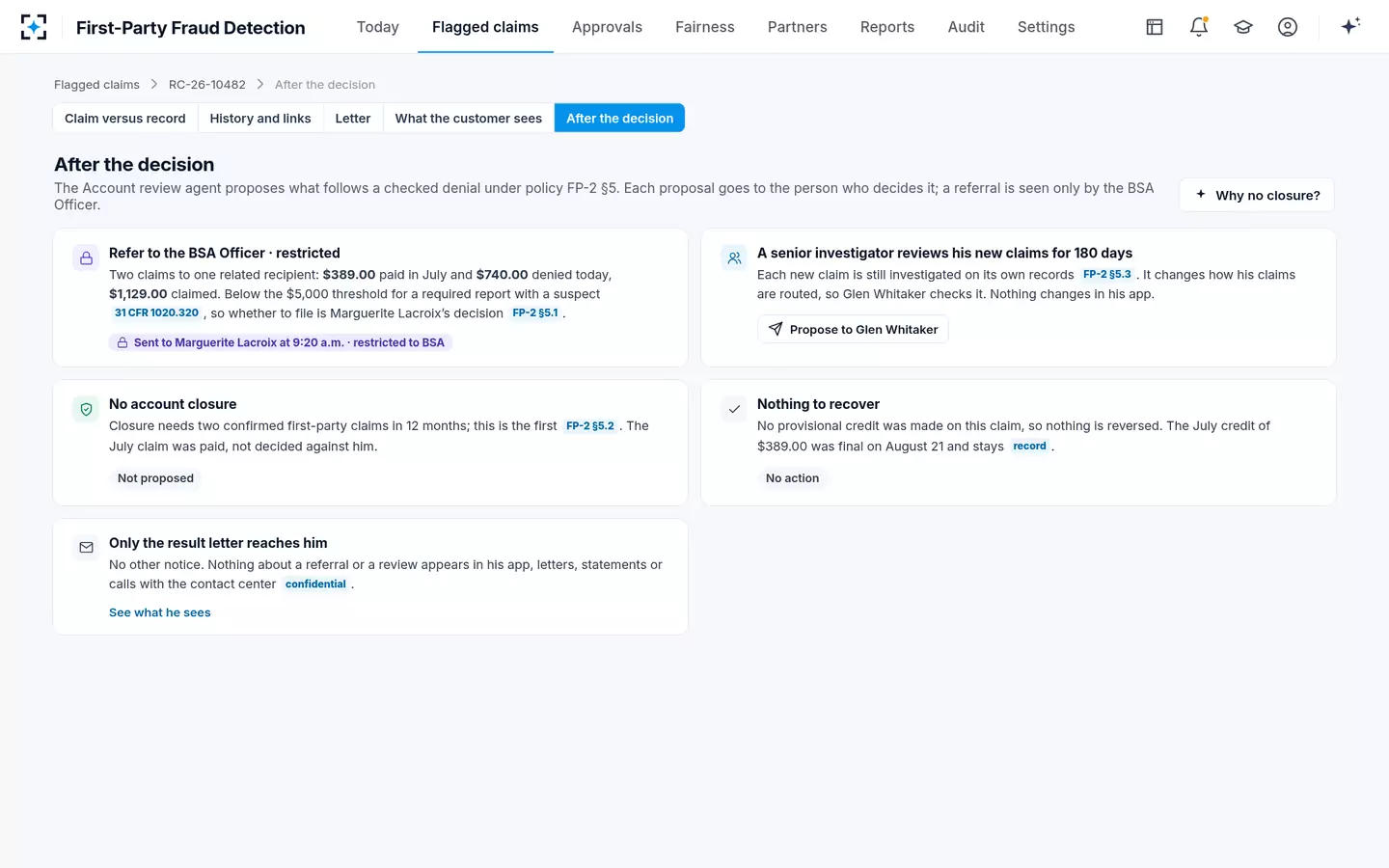
Take a fictional sample bank, Tessaly Community Bank, as it runs First-Party Fraud Detection. In July its customer Trevor Haldane disputed a $389.00 P2P payment; the desk paid it and the credit became final on August 21. In October he disputed a $740.00 payment to the same recipient, his fourth claim in six months. The agents' review of what follows the October decision records the July credit as final and untouched: nothing to recover.
After a checked denial: a referral, a review, and nothing to recover
The second wrong answer: denying a genuine victim
A wrong denial is an uncorrected error, and Regulation E's correction is not just the amount. When a bank finds an error it must correct it in full, crediting any interest and refunding any fees it charged as a result (comment 11(c)-6). A customer who was overdrawn because of the disputed payment is owed the overdraft fees too.
The harder cost is that a wrong denial is rarely alone. Denials are produced by a policy, a template or a habit, so the reason that failed one customer has usually been applied to others. When the CFPB found institutions denying Reg E claims solely because the customer had dealt with the merchant before, the institutions had to find and repay every consumer whose claim had been wrongly denied on that ground (Supervisory Highlights 24). When others denied claims because no affidavit came back, they "implemented remediation programs for affected consumers" (Supervisory Highlights 26).
What does a wrongful denial cost beyond the refund?
Statutory damages, possible treble damages, the customer's legal costs, and in the worst cases an enforcement order. The Electronic Fund Transfer Act makes a bank that fails to comply liable for actual damages plus, in an individual action, between $100 and $1,000, and in a class action up to $500,000 or 1% of the bank's net worth, whichever is less, with costs and a reasonable attorney's fee (15 U.S.C. 1693m).
Section 1693f(e) triples the damages in two cases that read like descriptions of a careless first-party denial: where the bank did not provisionally recredit within ten days and did not make a good-faith investigation or had no reasonable basis for believing the account was not in error, and where it knowingly and wilfully found no error when the evidence it had could not reasonably support that finding. Reg E violation penalties sets out each multiplier and cap.
The price list for a wrong Reg E denial, from the statute and one order
$100–$1,000
statutory damages in an individual action, on top of actual damages
$500,000
or 1% of net worth, whichever is less: the class-action cap on statutory damages
3×
actual damages where the bank knowingly and wilfully concluded no error against the evidence
$55M
civil money penalty in the CFPB’s January 2025 order against Block, with $75M to $120M in redress
The enforcement climate shifts; the statute does not. The CFPB's own review of 2025 records that it dismissed or withdrew as plaintiff in 19 public actions and terminated or modified 22 orders or issued no-action letters, but the private right of action in section 1693m is unchanged, and Federal Reserve complaint investigations still cite Regulation E more than every other rule combined. A denial policy that is cheap only while enforcement is quiet is not cheap.
Can a bank take back a paid false claim?
Not through Regulation E once the credit is final, as shown above. What the bank can do is decide what follows the claim under its own policy: review the customer's future claims more closely, act on the account, and consider whether the pattern is suspicious activity. None of these changes the decided claim, and none of them may leak into how the next claim is decided.
Suspicious activity has its own rules. A bank must file a suspicious activity report on a transaction of $5,000 or more, alone or in aggregate, that meets the suspicion tests in 31 CFR 1020.320(a)(2), and it may file below that. Whatever it files is confidential: no one at the bank may disclose a report, or anything that would reveal that one exists. In the sample, Trevor's two claims to the same recipient total $1,129.00, below the line, so whether to file is the BSA Officer's decision, and the referral is visible only to her. His account is not closed: the sample bank's policy needs two confirmed first-party claims in twelve months, and the paid July claim was never decided against him.
Setting a denial threshold with both prices in view
Because a wrong denial costs several times the claim and can repeat across every similar case, the evidence a bank requires before denying should be well above "more likely than not", and claims below a floor should be paid. That is not generosity. The EFTA puts the burden of proof on the bank, and a transfer the bank cannot show was authorized is, in Federal Reserve examiners' reading, one it has to credit.
Two expected costs to weigh before choosing a denial threshold
Expected cost of denying
P(genuine) × (amount + interest and fees + share of remediation + damages exposure)
The probability the customer is telling the truth, times everything a wrong denial brings with it. Remediation is a share of every similar denial, not just this one.
Compliance and legal
Expected cost of paying
P(false) × amount
The probability the claim is false, times the transfer. Once the credit is final it is fixed.
Disputes and finance
Investigation cost
minutes per claim × loaded rate
The same on both paths; what changes it is how long the records take to gather and read.
Disputes operations
Deterrence
unmeasured
Consistent, evidence-based denials may discourage repeat claims. No regulator or research study we can rely on measures the effect, so it should not be priced as a number.
Fraud strategy
The sample bank turns this into settings, each with a version and the Compliance Officer's approval: a confidence floor of 0.75 below which the agents propose payment, a written list of reasons that may never carry a denial, and a monthly check that similar claims were treated alike. These are design settings of the sample, not measured results. How a team earns its investigators' trust in a floor like that is covered in first party fraud prevention.
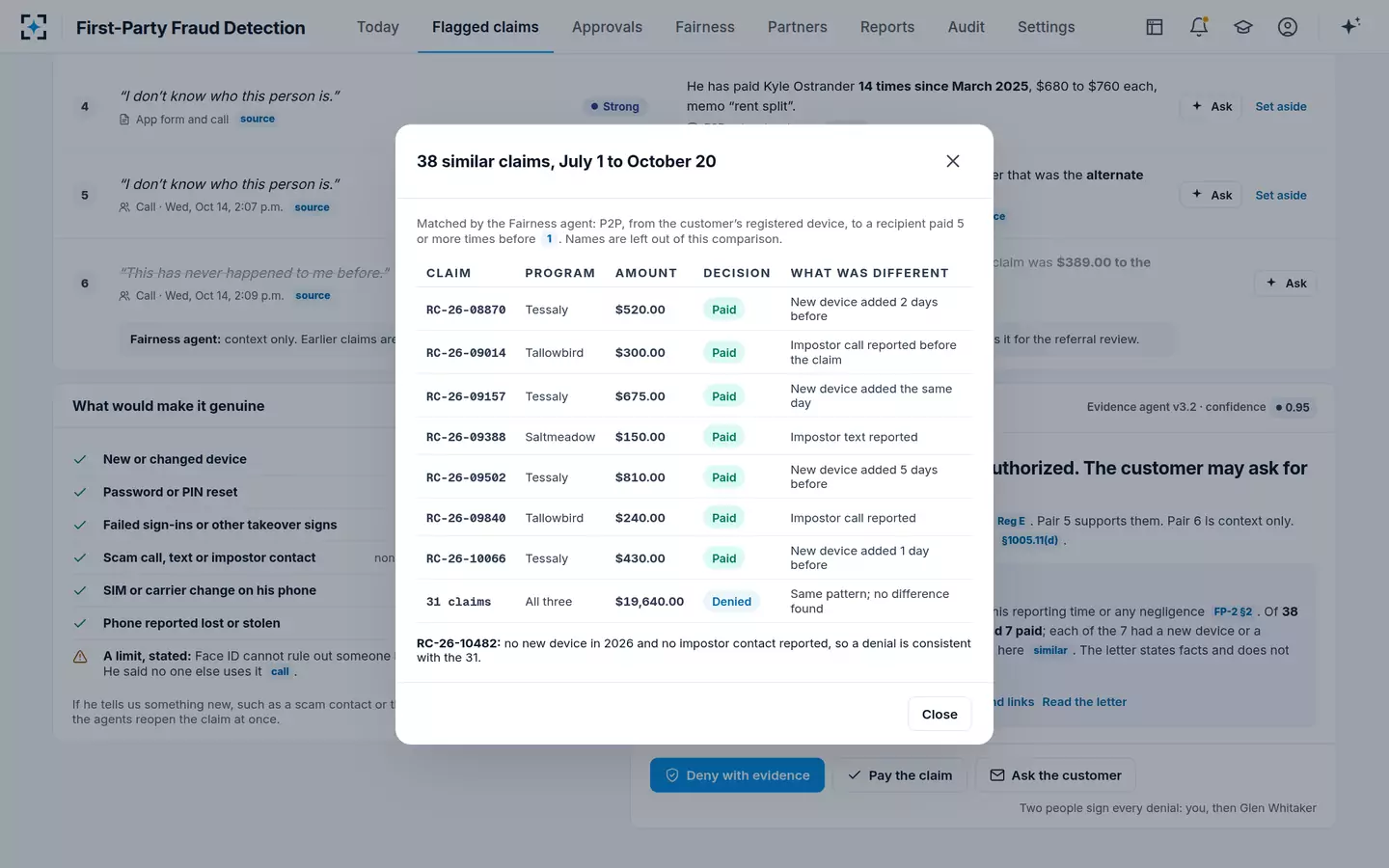
Consistency is also a cost control. A denial that matches how the bank decided similar claims is cheaper to defend, and one that does not is the first to surface in a complaint. Before a person saw Trevor's proposed denial, the agents compared it with 38 similar P2P claims.
Thirty-eight similar claims, and what made the paid ones different
Where the investigator's time goes, and what changes it
Investigation cost is the same on both paths, and on a flagged claim most of it is gathering, not judging. Botminds' estimate for one flagged claim, kept deliberately modest, puts the work at about 65 investigator minutes by hand, most of it spent reading device and sign-in data, pulling payment history and chasing a fintech partner's records by email. With the agents assembling and pairing the records, the estimate is about 10 minutes, and the investigator still reads every pair and decides.
One flagged claim, by hand and with the agents: an estimate
- Split5
- Devices and sign-ins15
- Card and P2P history10
- Earlier claims, links10
- Partner data by email10
- Decision and letter15
- Reading6
- Decide4
Time matters to the error rates as well as the budget. A rushed investigator is the one who reaches for a single signal, and the shortcuts examiners cite are the ones that save time. The list of those, and what each rule allows instead, is in Reg E denial reasons.
What follows each decision on a first-party claim
| Decision | What the bank owes or may do | What the customer is told |
|---|---|---|
| Deny with evidence | A written explanation within three business days of finishing, with the right to the documents relied on; a referral or account review under policy, never named to the customer. | The finding, the records it rests on in plain words, and how to ask for the documents. |
| Pay the claim | Correct within one business day, with interest and fees where they apply. | That the error was corrected, and the amount. |
| Pay after a provisional credit | The credit becomes final; the bank generally cannot reopen it later. | That the credit is final. |
| Ask the customer | The clock keeps running; the bank may not delay the investigation waiting for an answer. | A plain question, never a demand for a police report. |
Questions people ask
What is an example of first party fraud in banking?
A customer sends a P2P payment to someone he knows, then reports it as unauthorized and asks for a refund. The Federal Reserve's own example is a customer who bought goods online, received them, and told her bank she never made the purchase, which its model classes as a false claim by an authorized party.
How much does first party fraud cost banks?
No regulator, academic or non-profit source publishes a reliable figure, and we do not repeat vendor estimates. What can be priced is each wrong answer: a paid false claim costs its amount, while a wrong denial can add interest and fees, remediation of similar denials, statutory damages of $100 to $1,000 per individual action and, in defined cases, treble damages.
Can a bank reverse a provisional credit after finding the claim was false?
Yes, if it has not yet made the credit final: it may debit the credit after notifying the customer and must honour checks and preauthorized transfers for five business days. Once it has told the customer the credit is final, it generally cannot reopen the claim.
What is the difference between first party and third party fraud?
In first party fraud the customer, or someone acting with him, made the transfer he disputes. In third party fraud someone else made it, by taking over the account, stealing a card or tricking the customer into sharing a code, which the CFPB treats as an unauthorized transfer the bank must investigate and, when confirmed, reimburse within Regulation E's liability limits.
Should a bank close the account of a customer who filed a false claim?
That is a policy decision, separate from the claim, and it should never be mentioned in the result letter. In the sample bank, closure needs two confirmed first-party claims in twelve months, and every new claim is still investigated on its own records.