A Reg E audit checklist is the set of tests an internal auditor or compliance tester runs over a bank's or credit union's Regulation E error-resolution work: whether notices were dated and investigated promptly, whether provisional credit was timely, complete and usable, whether results, denials and reversals carried the required content on time, and whether denials met the institution's burden of proof. The interagency examination procedures expect the audit to cover "all provisions of Regulation E as applicable", including work done by service providers, with "an audit trail that supports the findings." The weak point in most programs is not the list but its power: a quarterly sample rarely contains the defect that matters. This guide builds the checklist from the defects regulators have published, shows how to plant them to measure whether monitoring catches them, and explains how Botminds' Reg E Dispute Management tests the timing of every closed claim.
Complaint investigations still turn up Reg E violations every year
What should a Reg E audit include?
A Reg E audit should include the program (policies, procedures, training, third-party oversight), the transactions (closed and open error files tested against every deadline and content rule), and the evidence (that the institution can show what it did and when). The interagency procedures reproduced in the FDIC's consumer compliance examination manual set out what examiners look for in an institution's own audit: whether its scope reaches every key process, including the work outsourced to service providers, whether "testing includes risk-based samples covering product types and decision centers," whether significant deficiencies reach management or the board, and whether "the frequency of review is appropriate."
On the transaction side, the same procedures ask examiners to determine whether the institution "investigates alleged errors and notifies consumers of the results within allotted time frames and, when appropriate, provisionally re-credits the account," and whether it follows the required procedures after finding an error or no error. Section 1005.13(b) adds the evidence requirement: evidence of compliance must be kept for at least two years (12 CFR 1005.13); what that evidence has to contain for a denied claim is set out in Reg E documentation. An audit that cannot reconstruct a claim's dates from retained evidence has found a violation of its own.
What are the most common Reg E violations examiners cite?
The most common Reg E violations are late or conditioned investigations, missing or incomplete provisional credit, late or incomplete notices, generic denial explanations without the right to request documents, and reversals without the required notice. The Federal Reserve's review of 2024 supervisory data (Consumer Compliance Outlook, First Issue 2026) found each of them, and the CFPB's Supervisory Highlights add a long list of specific provisional-credit failures.
Two items from the CFPB's Summer 2021 edition show how specific the published list is. Examiners cited institutions for "Posting the provisional credit to the wrong account, by failing to ensure that the ownership of the credited account matched the account that should have received the credit," and for "Excluding interest from the provisional credit" (CFPB Supervisory Highlights, Issue 24). Neither shows up in a test that only checks whether a credit date sits inside ten business days. Both are exactly the kind of defect that a planted test claim can carry.
The planted-defect set: published violations, and how to plant each one
| Defect | Who cited it | How to plant it | What a passing test catches |
|---|---|---|---|
| Notice dated from the form, not the first call | Federal Reserve 2024; CFPB 2021 (incorrect dates) | A claim whose phone contact precedes its form by a day or more | Notice date not equal to first contact |
| Investigation held for a form, affidavit or police report | Federal Reserve 2025; CFPB 2022 (affidavits) | A claim marked pending a document before any investigation step | Any wait on a consumer document before day 1 work |
| No provisional credit by day 10 (or 20) | Federal Reserve 2024; CFPB 2021 | An open investigation past day 10 with no credit and no exception | Missing credit without a valid written-confirmation exception |
| Credit to the wrong account | CFPB 2021 | A credit posted to a joint member’s other account | Credited account owner not equal to disputed account owner |
| Credit without interest or fees | CFPB 2021; Federal Reserve 2025 | An interest-bearing account credited for principal only | Credit amount below error plus interest and fees charged |
| Credit notice late or without date and amount | Federal Reserve 2024; CFPB 2021 | A notice on the third business day, or one giving a timeframe | Notice later than two business days, or no specific date |
| Funds credited but held | Federal Reserve 2024 | A credit posted with a hold code | Any restriction on credited funds before the result |
| Result outside 45 or 90 days, or the wrong one used | CFPB 2021 | A point-of-sale claim run on 45, an ATM claim run on 90 | Clock chosen not equal to clock the rule gives |
| Denial with “no error” and no right to documents | Federal Reserve 2024; CFPB 2022 | A denial letter from a retired template | Missing explanation or right-to-documents line |
| Reversal without notice or honoring period | Federal Reserve 2024; CFPB 2021 | A debit of provisional credit with no notice | Debit without date, amount and five-business-day honoring |
The planted-defect test: how to measure what your monitoring misses
A planted-defect test measures monitoring the way a fire drill measures an alarm: put known defects into the population, run the monitoring as it normally runs, and count which ones it reports. The number that matters is the catch rate per defect type, because a program that finds every late credit but no wrong-account credit has a blind spot that no overall pass rate will show.
The method is simple to run. Copy a set of closed claims into a test environment. Alter each copy to carry exactly one defect from the table above, keeping a key that only the tester holds. Mix them into an ordinary month's closures. Run every check the program uses: automated reports, the compliance sample, the second review. Then score each defect type as caught or missed. A defect that the program misses is not a finding about one claim; it is a finding about the test itself, and it goes into the audit report as a control gap.
Two design rules keep the test honest. Plant each defect type several times, because a single plant tells you little about a sampling program that might simply not have drawn it. And plant defects in the places the published findings came from: vendor-generated notices, posting systems and templates, not only the specialist's own work. The Federal Reserve attributed many 2024 violations to third-party templates and vendor delays, and the interagency procedures expect an audit's scope to reach them.
How do you test Reg E provisional credit timing?
Test provisional credit as five separate facts, not one date. For every claim whose investigation ran past business day 10 (20 for a new account): was the account credited by that day; for the full amount of the alleged error with interest where the account earns it, less at most $50 and only where 1005.6 allows; to the right account; with full use of the funds; and was the consumer told the amount and date within two business days of the credit? Each fact has its own failure in the published findings.
The exception needs its own test. An institution need not credit if it required written confirmation of an oral notice and did not receive it within 10 business days, but only if it told the consumer of the requirement and the address during the call. A tester should treat every "no credit, confirmation not received" claim as unproven until the call shows the disclosure. Claims that started in writing cannot use the exception at all.
How do you test denied Reg E claims?
Test every denial against the burden of proof, not only against the letter template. When the error alleged is an unauthorized transfer, the Electronic Fund Transfer Act puts the burden on the institution to show it was authorized, and the Federal Reserve's October 2025 examiner insights spell out the test: "For each previously denied allegation within the selected sample, the institution can confirm that employees reviewed all relevant information within the institution’s records and that the findings of the investigation met the institution’s burden of proof to establish that an error did not occur" (Consumer Compliance Outlook, Third Issue 2025).
In practice the tester asks three questions of each denial. What evidence in the institution's own records supports authorization: device, location, chip or PIN data, history? Did the reason given rest on something the rule does not allow, such as a prior relationship with the merchant, a missing affidavit or the consumer's negligence? And does the written explanation state the findings in words the consumer can follow, with the right to request the documents relied on? The CFPB's Spring 2022 edition records institutions that left that right out and then "failed to fulfill consumers’ subsequent requests" for the documents (CFPB Supervisory Highlights, Issue 26).
How many Reg E claims should be sampled, and can every claim be tested?
Timing can be tested on every claim, because it is arithmetic on dates the institution already holds; sampling is for the judgements that need a person. Neither Regulation E nor the interagency procedures fix a sample size; they ask only that samples follow risk and reach every product type and decision center. The arithmetic shows why a sample is weak for timing. If 3 of 2,512 monthly closures have a timing defect, a random sample of 60 contains at least one of them only about 7% of the time; a sample of 250 does so about 27% of the time.
Sampling closed claims vs testing every closure
A monthly sample: Found only if drawn: about a 7% chance for 3 defects in 2,512 with a sample of 60
Every closure, every month: Every exception listed, for a person to review
A monthly sample: Read by a tester, claim by claim
Every closure, every month: Required elements checked by machine on every letter; a sample read by a person for tone and accuracy
A monthly sample: Reviewed if drawn
Every closure, every month: Every denial reviewed, or a sample weighted toward the riskiest products and decision centers
A monthly sample: Rarely in the sample frame
Every closure, every month: In scope, because the posting and notice dates come from the same data
A monthly sample: Workpapers for the sampled claims
Every closure, every month: A test file for the whole population, with each exception and its remediation
The rest of the checklist follows from that split. Run the date tests on the full population. Run the content checks on every letter by machine and on a sample by a person. Review every denial if volume allows; if it does not, weight the sample toward products and decision centers where denials are most frequent. And plant defects at least once a year to prove the whole arrangement catches what it claims to.
Every September closure tested for timing, a sample read for letters
What the examiner will ask to see
Examiners start from documents and then test files, so the audit should prepare the same set. The interagency procedures list what examiners obtain: disclosure forms, procedural manuals and written policies, periodic statements, the error resolution files, the form letters sent when a consumer asks about or disputes a transfer, any contract that divides compliance duties with a third party, and the consumer complaint files. Complaint files deserve attention: the Federal Reserve's complaint data show that error resolution was 11.08% of all complaints it closed in 2024, and the Federal Reserve's review of 2024 violations lists complaint review among its sound practices, to catch Regulation E errors that monitoring and audits missed.
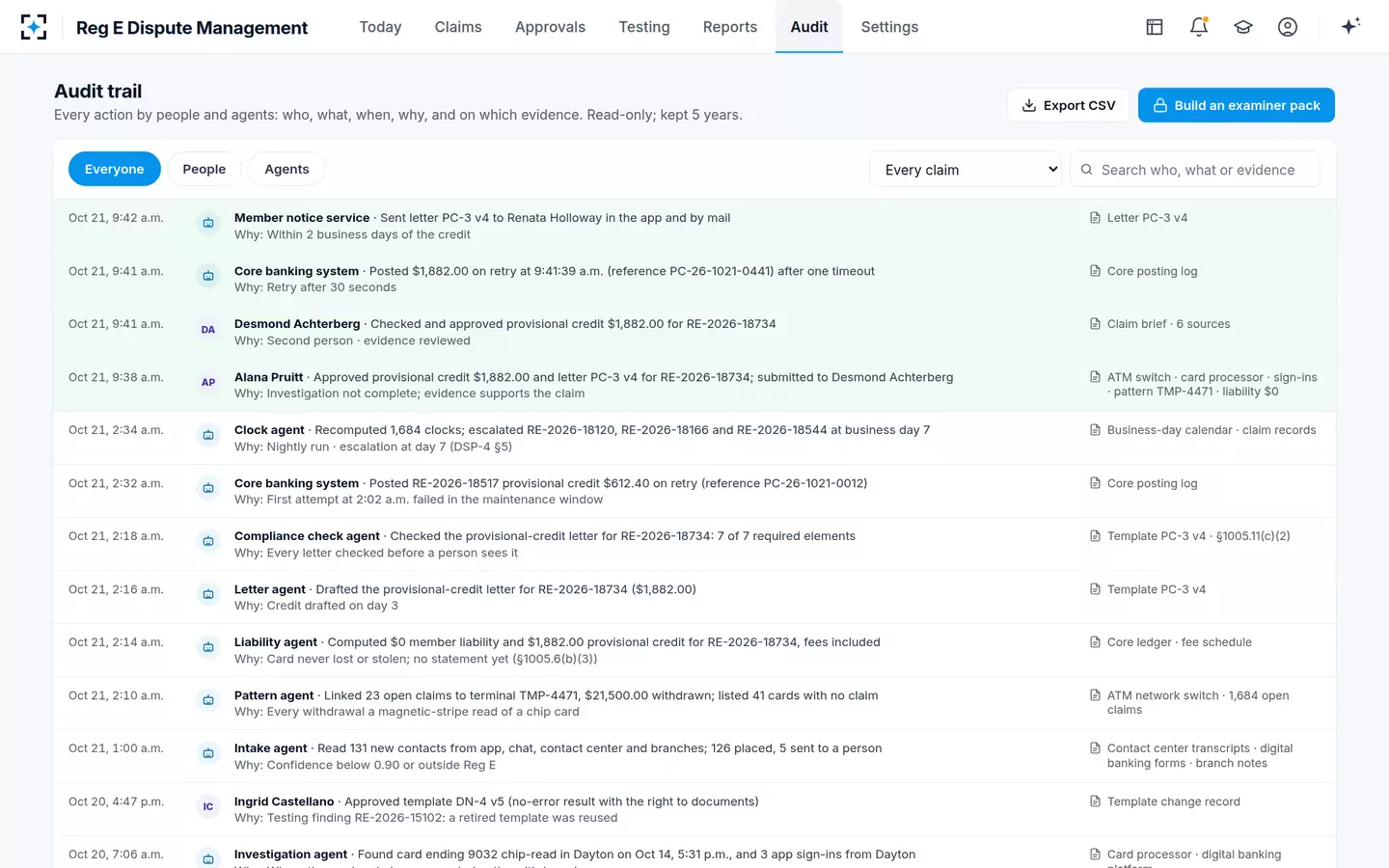
Who did what, when, why and on which evidence
The Reg E audit checklist: tests to run every cycle
Reg E audit checklist for error resolution
- Notice date equals first contact
Compare each claim’s notice date with call, chat, message and branch history.
- No condition before investigating
No wait for a form, affidavit, police report, branch visit or merchant contact.
- Written confirmation used correctly
Only on oral notices, disclosed with the address during the call.
- Right clock for the transfer
10 and 45, 20 and 90 for new accounts, 10 and 90 for point-of-sale and foreign-initiated; ATMs never get 90 for being in a store.
- Decision or credit by business day 10 or 20
Counted on the institution’s own business-day calendar.
- Credit complete and correct
Full amount with interest; at most $50 withheld and only where 1005.6 allows; right account; no hold.
- Credit notice within two business days
With the amount and a specific date, not a timeframe.
- Result within 45 or 90 days
Calendar days from the notice.
- Correction within one business day
Including interest and the institution’s own fees.
- Report within three business days
Including, where a credit was given, that it is final.
- Denials meet the burden of proof
Evidence from the institution’s own records; no reliance on negligence or prior merchant dealings alone.
- Denial letters complete
Written explanation of findings and the right to request the documents relied on.
- Document requests fulfilled
Promptly, in understandable form, with codes explained.
- Reversals noticed
Date and amount, and five business days of honoring checks and preauthorized transfers without overdraft charges.
- Vendor work in scope
Postings and notices by third parties tested like the institution’s own.
- Evidence kept two years
Enough to reconstruct every date above.
- Complaints reconciled to claims
Every complaint about a dispute traced to a claim, or to a missed notice.
- Planted defects caught
At least once a year, each defect type planted several times and scored.
Testing with Reg E Dispute Management
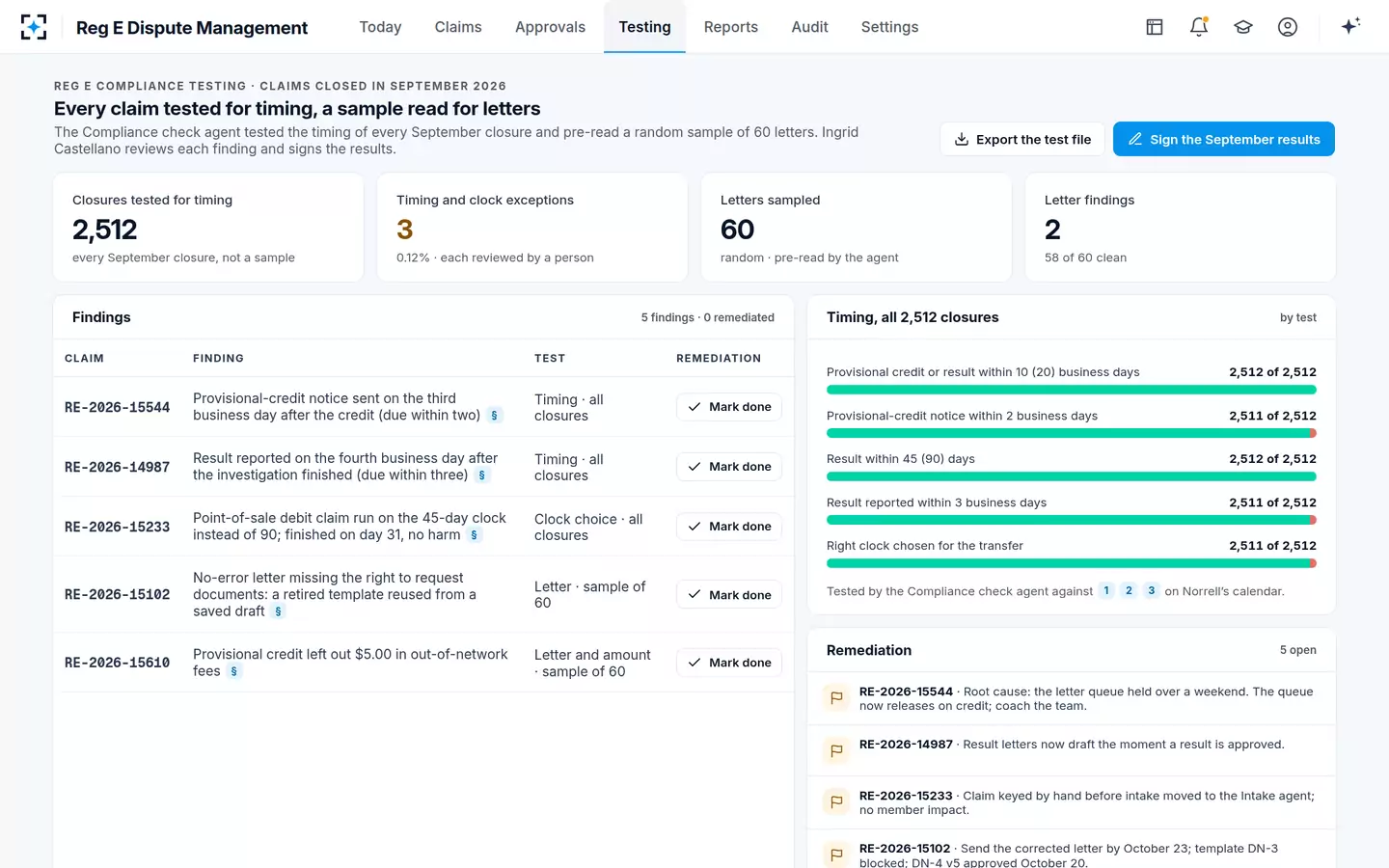
Reg E Dispute Management runs the date tests on every closed claim each month and checks every letter's required elements before a person sees it, so the compliance officer's time goes to the exceptions and to the judgements a machine should not make. In the solution's fictional sample month, all 2,512 September closures were tested for timing and 3 exceptions (0.12%) were listed, each reviewed by a person; 60 letters were sampled and pre-read, with 2 findings.
One sample month of Reg E testing, every closure included
2,512
closures tested for timing: every one, not a sample
3
timing and clock exceptions, each reviewed by a person
60
letters sampled and pre-read by the agent
2
letter findings, each with a remediation
The sample month's findings are a fair picture of what full-population testing turns up: a notice sent on the third business day when two were allowed, a result reported on the fourth, a point-of-sale claim run on the 45-day clock instead of 90, a denial letter from a retired template without the right-to-documents line, and a credit that left out $5.00 of fees. None is dramatic. All are the kind of finding an examiner cites, and none would have been likely to appear in a sample of 60. The letter rules behind two of them are set out in Reg E letter samples, and the cost of the ones that slip through in Reg E violation penalties.
Questions people ask
What are the Regulation E examination procedures?
They are the interagency procedures examiners use, reproduced in the FDIC’s consumer compliance examination manual. They review management, policies, audit scope and training first, then transaction-test error resolution files, form letters, third-party agreements and complaint files against 1005.6 and 1005.11.
How often should a Reg E audit be done?
Regulation E sets no frequency; examiners judge whether "the frequency of review is appropriate" for the institution’s risk. A common pattern is an annual independent audit, with monthly compliance monitoring of timing and letters in between.
What is the difference between a Reg E audit and Reg E monitoring?
Monitoring is the compliance function’s routine testing of claims as they close; an audit is an independent check that the program, including its monitoring, works. A planted-defect test belongs to the audit, because it measures whether monitoring catches what it should.
Do examiners test claims handled by a vendor?
Yes. The interagency procedures expect the audit’s scope to include functions carried out by third-party service providers, and the Federal Reserve traced many 2024 violations to vendor templates and late vendor notices.
How long must Reg E dispute files be kept?
Section 1005.13(b) requires evidence of compliance for at least two years from the date the action was required, and longer when the institution knows it is under investigation or has been sued under the Act.