Reg E dispute tracking software is the system a bank or credit union uses to log each Regulation E notice of error, compute its deadlines, record the provisional credit and the result, and generate the notices the rule requires. It is necessary and it is not sufficient: when Federal Reserve examiners reviewed their 2024 findings, generic "no error" letters were traced to thin templates in the tracking systems themselves, and the larger failures (late investigations, missing evidence, credits without full use of funds) happened in work no tracker performs. Botminds' Reg E Dispute Management sits on the other side of that line: its agents read the notice, pull the evidence from the institution's own systems, compute liability and draft each letter, and a dispute specialist and a second person decide. The useful way to choose software is therefore task by task, not screen by screen.
The Reg E dispute workflow, task by task: who should own each one
| Task | A tracker | Agents | A person |
|---|---|---|---|
| Date the notice | Stores the date someone keys in, often the form’s | Reads calls, chats, forms and branch notes; proposes the first contact that describes the error, with the passage | Confirms any reading below the confidence threshold |
| Pick the clock | Applies the clock chosen from a drop-down | Classifies the transfer and account: 10 and 45 days, 20 and 90, or 10 and 90 | Owns exceptions, such as a possible business account |
| Gather evidence from own records | Holds attachments someone uploads | Pulls processor, switch, ACH, sign-in and core history; lays each finding on the claim with its source | Opens the sources behind any proposed “no error” |
| Liability and provisional credit | Records an amount | Applies 1005.6 to the dates; computes the credit with interest and fees, showing the arithmetic | Approves the credit, with a reason |
| Letters | Merges fields into a template | Drafts each notice from approved templates and checks every required element before a person sees it | Approves and signs; a second person checks |
| Decide error or no error | Records the outcome | Proposes, never decides | Decides, and owns the explanation |
| Test the program | Exports a list to sample | Tests every closure for timing each month | Reviews findings and signs the results |
What is Reg E dispute tracking software, and what should it do?
At minimum, a Reg E tracking system should hold one case per notice, with the notice date, the transfers in dispute, the clock that applies, every deadline that follows from it, the provisional credit (amount, date, notice sent), the result and the letters, and an audit history of who changed what. Those are the facts an examiner samples, and 12 CFR 1005.11 defines every one of them. Section 1005.13(b) then requires the evidence of compliance to be kept for at least two years.
What separates a good tracker from a liability is what happens to each of those fields before it is typed in. A notice date keyed from the dispute form instead of the first call produces a deadline that looks compliant and is not. A clock chosen from a drop-down produces a 45-day deadline on a point-of-sale claim that the rule would have given 90 days, or the reverse. The tracker faithfully counts from the wrong start. That is why the task view in the table above matters more than the tracker's dashboard.
What did examiners find wrong with dispute tracking templates?
Federal Reserve examiners found that templates produced by dispute tracking systems and vendors left out required content, and that institutions could not prove the notices they did send were on time. The review of 2024 supervisory data in Consumer Compliance Outlook describes three failures. Provisional-credit notices went out late because a vendor was slow to generate and deliver them. Template notices from third-party software "did not include required information and/or information necessary for the institution to monitor compliance." And where notices were given orally, institutions "failed to appropriately document the date on which the notifications were made."
In some cases, the institution failed to provide an adequate explanation, using generic language, such as “no error.” These violations were the result of insufficient templates generated by the institution’s dispute tracking system.
Federal Reserve examiners, Consumer Compliance Outlook, First Issue 2026
The article's sound practice is a buying criterion in all but name: "when third-party software is used to generate required notices, institutions should ensure that templates for those notices are accurate and include the necessary information to monitor and evidence compliance." A template that prints the date of a provisional credit but does not store it in a field a test can read fails the second half of that sentence.
Automation can make this worse at scale. The CFPB's January 2025 order against Block, the operator of Cash App, describes template responses called macros that "often misstated consumers’ error resolution rights under Regulation E," with "insufficient quality control for macros’ content," and "bulk “inquiry” macros just to clear queues for unresolved old cases" (CFPB consent order 2025-CFPB-0001). A system that can send a thousand letters an hour needs a check on each letter's content before it leaves, not a quarterly sample afterwards.
Which Reg E tasks can be automated, and which stay with a person?
Reading, gathering, arithmetic and drafting can be automated; deciding whether an error occurred, approving money and signing the explanation should stay with people. The line follows the rule. Regulation E puts the burden of proof on the institution for an unauthorized transfer and expects a reasonable investigation of its own records; the CFPB's EFT FAQs say "The investigation must be reasonable, including a reasonable review of relevant information within the financial institution’s own records," and cite a bank that summarily denied disputes when consumers had prior transactions with the same merchant (CFPB, Electronic Fund Transfers FAQs). Gathering that information is mechanical. Weighing it is a judgement the institution must be able to explain in writing.
One claim in Reg E Dispute Management: agents gather and draft, people decide
Agent
Intake agentReads the call, chat, form or branch note; fixes the notice date at the first contact that describes the error; tests coverage and picks the clock.
Never: rejects a notice, or asks for a police report or written confirmation first
Agent
Investigation agentPulls card processor authorizations, ATM switch reads, ACH entries, person-to-person records and digital banking sign-ins; places each finding on the claim with its source and a confidence.
Never: decides an error, or contacts a member or merchant
Agent
Liability and Letter agentsApply 1005.6 to the dates; compute the credit with fees and interest; draft the notice from an approved template; the Compliance check agent tests every required element.
Never: withhold credit, or send a letter
A person decides
Dispute specialistApproves, edits or returns the credit and letter with a reason code; decides error or no error.
A person decides
Card and payment services managerChecks each credit, result, reversal and notice as the second person; no one checks their own work.
Who must approve a provisional credit or a denial?
Regulation E does not say who inside the institution approves a credit or a denial; it says what must happen and by when. The approval design is a control the institution chooses, and examiners judge it by results. The Federal Reserve lists "a second review by experienced Regulation E staff" among sound practices because a single reviewer's misunderstanding, such as treating a PIN written on the card as the consumer's fault, becomes a violation on every claim that reviewer touches.
A workable design separates the person who prepares from the person who checks for anything that moves money or tells the consumer a result: provisional credits, final results, reversals, letters and routing a claim out of Regulation E altogether. Denials deserve the closest look, because the rule's written-explanation requirement in 1005.11(d)(1) applies only to them and to different-error findings, and because a denial is where the burden of proof bites. If software allows an approver to check their own work, that is worth knowing before purchase.
How do you track Reg E deadlines without a spreadsheet?
Deadlines should be computed, not entered: from the notice date, the transfer type, the account's first-deposit date and the institution's own business-day calendar. Each claim then carries a set of dates that follow from those inputs: provisional credit or result by business day 10 (or 20), the credit notice within two business days of crediting, the result within 45 or 90 calendar days, the report within three business days of completing the investigation, the correction within one business day of deciding. When any input changes, every date should change with it, visibly.
Every open claim sorted by the days it has left
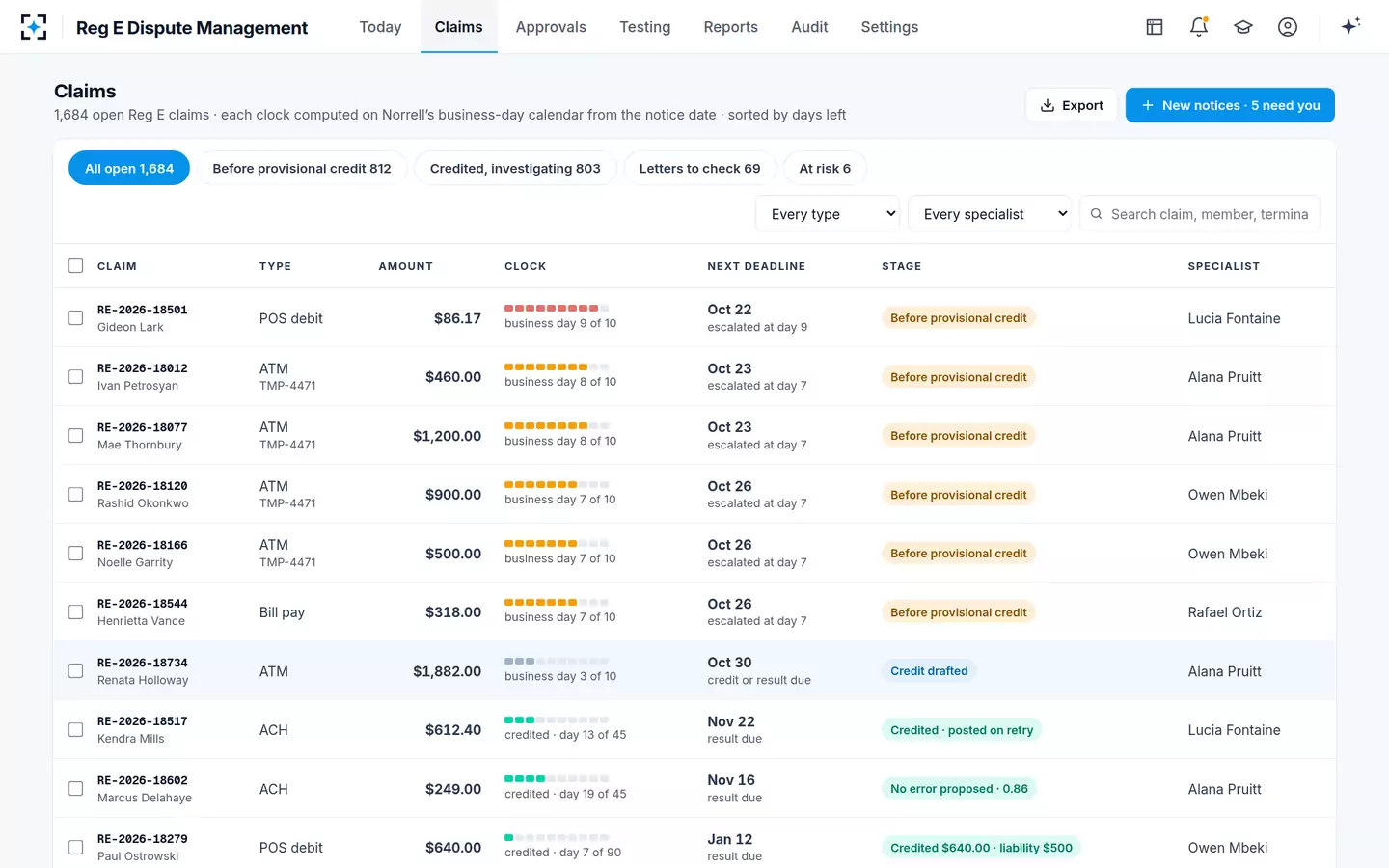
Escalation is the other half. A tracker that shows red on day 10 is reporting a violation, not preventing one. The solution escalates to the manager at business day 7 and to the head of the department at day 9 in its sample configuration; those days are settings an institution chooses and changes with an approval, while the rule's own deadlines stay locked. For how the days themselves are counted, including Saturdays and holidays, see the Reg E error resolution calculator.
Where the days go before provisional credit, by hand and with agents
Most of the ten business days are spent gathering and waiting, not deciding. The solution's own estimate for a typical card or ATM claim puts about three of nine business days into pulling records from the core, the card processor, the ATM switch and digital banking, and two more into waiting while the same terminal sits behind other claims. Those are the days agents can give back; approval and posting shrink least, by design.
Where a Reg E claim's business days go before the provisional-credit decision
By hand: about 9 business days
- Logging the notice, picking the clock · 11.1%
- Pulling records from four systems · 33.3%
- Waiting behind claims on the same terminal · 22.2%
- Liability and the credit · 11.1%
- Letter and its elements · 11.1%
- Approval, check, posting · 11.1%
With the agents: about 2 business days
- Logging the notice, picking the clock · 10%
- Pulling records · 25%
- Waiting behind the same terminal · 15%
- Liability and the credit · 10%
- Letter and its elements · 15%
- Approval, check, posting · 25%
The design target that follows is a provisional-credit decision by business day 3 of 10, not on the last day the rule allows. Deciding early is not generosity: a claim credited on day 3 cannot become a late-credit violation if a core posting fails, a holiday intervenes or the specialist is out, and the consumer has the money while the investigation runs, as 1005.11(c)(2)(ii) requires.
What to ask a vendor of Reg E dispute tracking software
Buy on evidence that the tasks above are handled, not on a demonstration of a clean queue. The questions below are designed to expose the gaps examiners keep finding. Ask the vendor to answer them on your own closed claims rather than on its demonstration data.
Ten questions for any Reg E dispute tracking software vendor
- Where does the notice date come from?
Keyed by staff, taken from the form, or read from the first contact in your call, chat and branch history? Ask to see a claim where the call and the form differ.
- How is the clock chosen?
Point-of-sale debit, ATM, foreign-initiated and new-account claims each change it. Ask how an ATM inside a store is treated.
- Whose calendar counts the days?
Your institution’s business days, including a Saturday that is or is not a business day for you, not a generic holiday list.
- Which of your systems does it read?
Core history, card processor, ATM switch, ACH, digital banking sign-ins. Uploads by hand are not reading.
- Does provisional credit include interest and the fees charged with the transfers?
Examiners cite credits that leave out interest; corrections must refund the institution’s fees.
- What does each letter contain, and who checks it before it goes?
Dates, not timeframes; the right to request documents on every denial; the five-business-day honoring language on every reversal.
- Can anyone check their own work?
Prepare and check should be different people for money and for results.
- How are templates changed?
Versioned, approved by compliance, and impossible to reuse once retired.
- Can it test every closure, not a sample?
Timing tests on every claim each month, with exceptions listed for a person to review.
- What can an examiner see?
Who did what, when, why and on which evidence, exportable without rebuilding it.
Where Reg E Dispute Management fits, and where it does not
Reg E Dispute Management is built for the consumer side of Regulation E error resolution: debit card and ATM claims, ACH debits, person-to-person and bill-pay transfers on consumer accounts, from the notice to the final letter. Its seven agents read, gather, compute and draft; a specialist decides and a manager checks; settings changes go through the compliance officer. It is not a chargeback system: when a card claim needs a network claim against a merchant or another issuer, it hands the evidence pack to card dispute management, which works the recovery. It is not for credit card billing errors under Regulation Z; the difference between the two clocks is laid out in Reg E vs Reg Z disputes.
Agents with versions, thresholds and override reasons
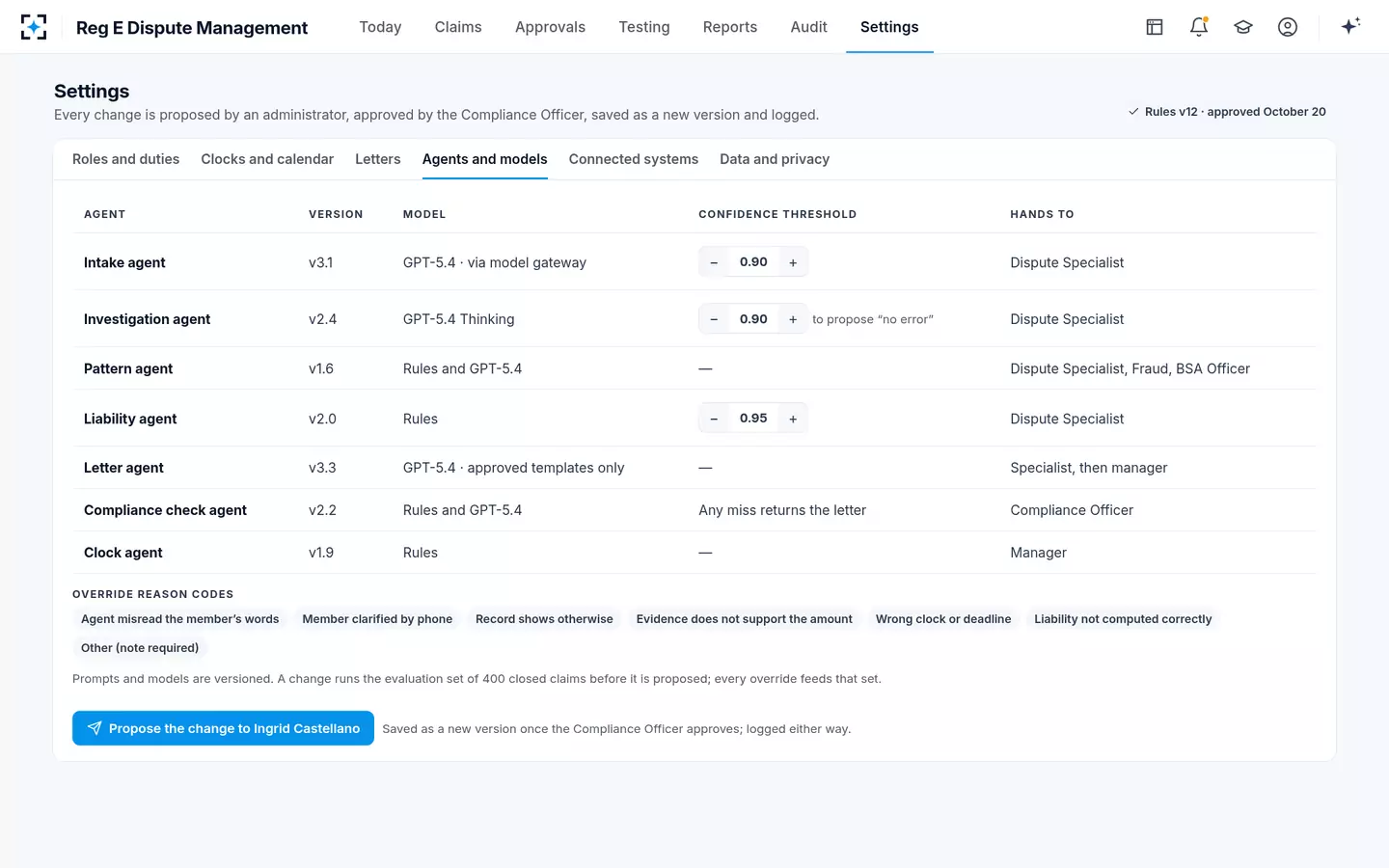
Two limits matter in a buying decision. Business accounts are outside Regulation E, so the solution routes them to the institution's business dispute process with the reason, and that routing needs a second person; it does not resolve them. And the agents never decide an error, deny a claim, post money, send a letter or change a deadline. An institution looking for software that closes claims without a person will not find it here. One looking for software whose every claim is on its legal clock, with the evidence and the letter ready for a decision, is the reader this solution was built for.
Questions people ask
Can software send Reg E letters automatically?
It can, and the risk is that it sends wrong ones at scale: the CFPB found Block’s automated macros misstated consumers’ rights. A safer design drafts each letter from an approved template, checks every required element and date before a person sees it, and sends only after a person approves. Reg E Dispute Management never sends a letter on its own.
Does Reg E require a dispute tracking system?
No. Regulation E requires the deadlines, notices and investigation, and 1005.13(b) requires evidence of compliance to be kept for at least two years. A tracking system is how most institutions meet those duties at volume and prove it to an examiner.
What should a Reg E dispute workflow include?
Intake and notice dating, coverage and clock selection, evidence gathering from the institution’s own records, liability and provisional credit, the credit notice, the investigation and decision, the result and its letter, any reversal with its notice, and monthly testing. Each step has a deadline or a content rule in 1005.11.
Can a tracker handle Reg Z credit card disputes too?
Many trackers can hold both, but the rules differ: Regulation Z counts in days and billing cycles and has no provisional-credit duty. Reg E Dispute Management covers Regulation E; credit card billing errors and network chargebacks belong to card dispute management.
How do you evaluate Reg E tracking software before buying?
Run it on a set of your own closed claims and compare its notice dates, clocks, credits and letters with what your team did and what the rule required. Disagreements are the useful output: each one is either a software gap or a finding your monitoring missed.