The Reg E 60 day rule says that a bank or credit union must follow Regulation E's error-resolution procedures for a notice of error it receives "no later than 60 days after the institution sends the periodic statement or provides the passbook documentation" on which the error first appeared (12 CFR 1005.11(b)(1)(i)). The 60 days therefore run from when the statement was sent, not from the date of the transaction, and a card network rule that counts 60 days from the transaction does not shorten them. The rule is also narrower than many staff believe: a notice after day 60 ends the duty to run the error-resolution process, but the liability limits in 12 CFR 1005.6 still protect the consumer for unauthorized transfers before the 61st day. Botminds' Reg E Dispute Management fixes the notice date at the first contact that describes the error, and its Liability agent applies 1005.6 to the statement and notice dates, so each claim is tested against the right 60 days.
One purchase, two calendars: the network's 60 days and Regulation E's
Mon, Aug 3
Network ruleDebit card purchase posts. The network count starts here.
Regulation EPurchase posts. Nothing starts yet.
Wed, Sep 2
Network ruleDay 30 of the network window.
Regulation EStatement showing the purchase is sent. Day 0 of the Regulation E window.
Fri, Oct 2
Network ruleDay 60: the network window closes.
Regulation EDay 30. Notice still timely.
Tue, Oct 20
Network ruleMember calls: 18 days late for the network.
Regulation EMember calls: day 48, timely. Full error resolution applies.
Sun, Nov 1
Network rule—
Regulation EDay 60: the last day a notice of this error is timely under 1005.11(b)(1)(i).
Is the Reg E 60 days from the transaction or the statement?
From the statement. The rule ties the window to the date the institution "sends the periodic statement" on which the alleged error "is first reflected," so a transfer early in a statement cycle can give the consumer close to 90 days from the transaction, and one on the last day of the cycle close to 60. The model notice of rights tells consumers the same thing in plain words: "We must hear from you no later than 60 days after we sent the FIRST statement on which the problem or error appeared." The capital letters are in the regulation's own model form.
Two details in the commentary move the start date. When a consumer has arranged for statements to be held for pickup, the statement "is deemed to have been transmitted on the date the financial institution first makes the statement available to the consumer" (comment 11(b)(1)-3). And when the notice is based on documentation or clarification the consumer asked for, it is timely if received within 60 days "after the institution sends the information requested" (1005.11(b)(3)). A third detail moves the end date: the notice is received when the consumer gives it, which is usually a phone call, not when a form arrives. The CFPB lists incorrect notice dates among the error-resolution violations its examiners keep finding.
Which 60 days? Every 60-day period in a Reg E claim, and where it starts
| Period | Starts when | What it decides | Source |
|---|---|---|---|
| Notice of error window | The statement first showing the error is sent | Whether 1005.11’s procedures apply at all | 1005.11(b)(1)(i) |
| Statements held for pickup | The statement is first made available | The start of the notice window | Comment 11(b)(1)-3 |
| No statement provided | The date the statement should have been sent | Whether a request for a copy is an error | Comment 11(b)(1)-4 |
| After requested documentation | The institution sends the information | Timeliness of a notice based on it | 1005.11(b)(3) |
| Liability for later unauthorized transfers | The statement showing an unauthorized transfer is sent | Liability for transfers after day 60 and before notice | 1005.6(b)(3) |
| Reasserting a withdrawn error | The original 60-day period | Whether the consumer may reassert | Comment 11(e)-1 |
| A card network’s dispute window | Often the transaction date | The institution’s recovery against the merchant’s side, not the consumer’s rights | Network rules; CFPB EFT FAQs |
Do network rules override Reg E timing?
No. The CFPB's EFT FAQs answer the question directly: private network rules may add protection, but less protective ones leave a financial institution's Regulation E obligations unchanged, and the first example the Bureau gives is this window. Some networks count 60 days from the transaction; Regulation E counts 60 days from the statement, and the consumer keeps Regulation E's window whatever the network says (CFPB, EFT FAQs, Error Resolution Q3).
While certain payment network rules may impose alternative timing requirements or limitations, network rules do not excuse institutions from complying with the applicable Regulation E timelines to complete the error investigation and make a determination.
CFPB, Supervisory Highlights, Issue 24 (Summer 2021)
The CFPB has also acted against a related shortcut, treating the chargeback process as if it were the Regulation E investigation: in January 2025 it found that Block had used card network chargebacks in place of the investigations EFTA and Regulation E require (CFPB, Block, Inc.). The network window governs whether the institution can recover the money from the other side; Regulation E governs what it owes its consumer. When the two disagree, the institution may owe the consumer a claim it can no longer charge back, which is a cost, not a defence. The network side is covered in chargeback reason codes for Reg E and Reg Z.
A card network's dispute window and Regulation E's 60 days, compared
A network rule: Institutions that agreed to the network’s rules
Regulation E: Every financial institution holding a consumer account, by law
A network rule: The institution’s right to recover from the merchant’s side
Regulation E: The consumer’s right to an investigation, provisional credit and a result
A network rule: Often the transaction date
Regulation E: The date the statement first showing the error is sent
A network rule: Cannot reduce consumer protection
Regulation E: Applies in full; an agreement cannot waive EFTA rights
A network rule: The institution may lose its recovery
Regulation E: The institution still owes the 1005.6 liability limits for earlier transfers
What happens if a customer disputes after 60 days?
If the notice arrives more than 60 days after the statement that first showed the error, the institution does not have to follow 1005.11's procedures: no 10-business-day clock, no provisional credit, no result letter. But that is all the late notice cuts off. Comment 11(b)(1)-7 adds the qualification that matters: "Where the consumer's assertion of error involves an unauthorized EFT, however, the institution must comply with § 1005.6 before it may impose any liability on the consumer." The consumer still gets the liability limits, and the institution still bears the burden of proving the conditions for liability (15 U.S.C. 1693g(b)).
Many institutions choose to investigate late claims anyway, because the liability analysis requires most of the same evidence and a refusal to look is hard to defend in a complaint. Whatever the policy, the decision that a notice is late must rest on the statement's send date and the first contact's date, both of which the institution holds; a late finding based on the transaction date or the form date is the error, not the notice.
Does the 60 day rule apply to liability?
Only to unauthorized transfers that happen after the 60 days. Federal Reserve examiners have found this to be one of the most persistent misunderstandings in error resolution.
Examiners have found that some institutions mistakenly believe this timing requirement for error notices also applies to the limits on a consumer’s liability for unauthorized transactions.
Federal Reserve examiners, Consumer Compliance Outlook, Third Issue 2025
Section 1005.6(b)(3) is the liability rule that uses 60 days. A consumer who does not report an unauthorized transfer that appears on a statement within 60 days of its transmittal may be liable for unauthorized transfers "that occur after the close of the 60 days and before notice to the institution," and only those the institution "establishes would not have occurred had the consumer notified the institution within the 60-day period." Transfers before that point stay under the first two tiers: $50 if the consumer reported within two business days of learning of a lost or stolen card, $500 if later. The examiners' worked example shows the arithmetic (12 CFR 1005.6).
A late notice still leaves the liability limits: $50 + $450 + $800 = $1,300, not $1,800
Within two business days of the loss
$50 of the $400
Card lost January 1, 2025, noticed that day; $400 taken January 2
1005.6(b)(2)(i)
After two business days, before day 60
$450 of the $600
$600 taken January 6; the $500 tier caps the first two terms at $500
1005.6(b)(2)(ii)
After day 60 from the statement
$800
Statement sent February 5; $800 taken April 10, after day 60 (April 6); notice April 30
1005.6(b)(3)
Transfers made without an access device follow a stricter version for the institution. Comment 6(b)(3)-2 says the first two tiers do not apply to them, and gives the case of an unauthorized $200 debit: "If the consumer notifies the institution within 60 days of the transmittal of the periodic statement that shows the unauthorized transfer, the consumer has no liability." Only a further transfer after day 60, and before notice, can fall on the consumer.
What if the bank never sent a statement?
Then the 60 days have not started, for the transfer that is not yet on a statement. A notice about a transfer that no statement has shown is timely by definition, and under 1005.6(b)(3) there is no statement-based liability to apply. Where the institution failed to provide a statement it should have sent, comment 11(b)(1)-4 treats a request for a copy as governed by 1005.11 if the consumer asks within 60 days "from the date on which the statement should have been transmitted."
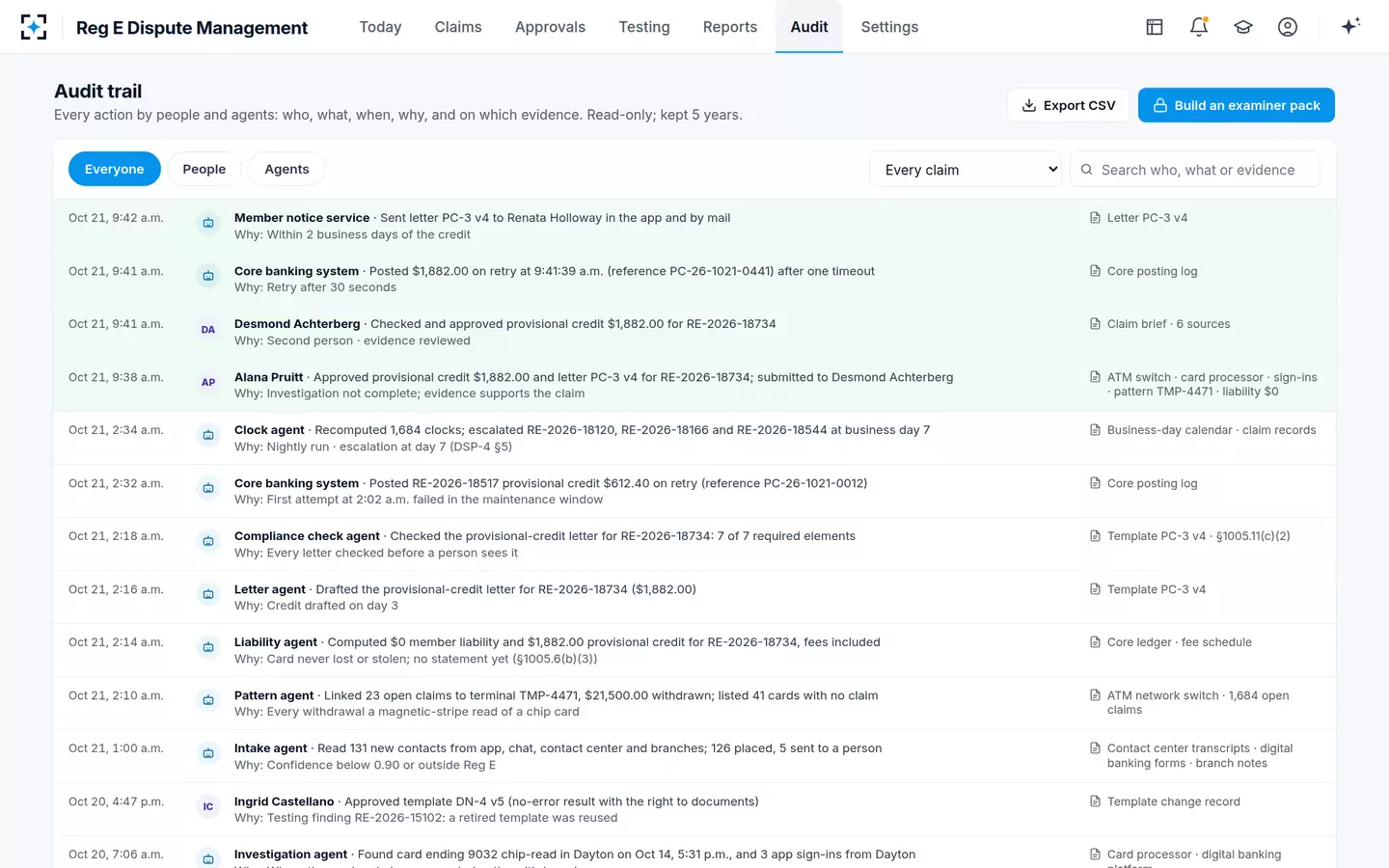
The solution's fictional sample claim shows the first case. The member reported four ATM withdrawals the day after the last one; no statement had yet shown them, and her card was never lost or stolen, so the Liability agent put her liability at $0 under 1005.6(b)(3) and drafted the provisional credit in full, with the fees charged with the withdrawals.
The liability decision, with the rule and the reason on the record
What are extenuating circumstances under Reg E?
Extenuating circumstances are reasons for a consumer's delay that oblige the institution to extend the time limits "to a reasonable period" (1005.6(b)(4)). The commentary's examples are "the consumer's extended travel or hospitalization" (comment 6(b)(4)-1); the statute uses the same examples in 1693g(a). The Federal Reserve's summary table lists the 60-day notice window as one that "can be extended for extenuating circumstances" (Consumer Compliance Outlook, Third Issue 2025).
The rule names examples, not a closed list, so the policy question is who decides and how the decision is recorded. A consumer who was in hospital for a month, or abroad without access to statements, should not lose protection to a clock that ran while they could not act; the commentary also accepts notice from someone acting for a hospitalised consumer. A defensible practice asks the consumer what kept them from reporting, records the answer, and has a second person approve any refusal to extend.
How to test a late-notice decision before it stands
A finding that a notice was late removes most of the consumer's protections under 1005.11, so it deserves the same second look as a denial. Four checks catch nearly every wrong one. First, the statement date: take it from the statement production file or the date the statement was made available online, not from the cycle-end date printed on it, because the rule counts from when the statement was sent. Second, the notice date: search every channel for the first contact that described the error, including calls logged under another reason such as a card block.
Third, the liability: for an unauthorized transfer, compute what 1005.6 allows rather than refusing the whole amount, and record which transfers fall before and after day 60. Fourth, the reason for delay: ask whether travel, hospitalisation or anything comparable kept the consumer from reporting, and record the answer and who decided. A late finding that passes all four is defensible; one that fails any of them is a likely complaint and, in a pattern, a likely examination finding.
Dating the notice in Reg E Dispute Management
Every 60-day test depends on two dates the institution already holds: when the statement was sent, and when the consumer first described the error. Reg E Dispute Management's Intake agent reads calls, chats, app forms and branch notes and fixes the notice date at the first contact that describes the error, citing the passage; when the reading is uncertain, a person confirms it. The Liability agent then applies 1005.6 to the loss, notice and statement dates and shows its arithmetic, so a late notice is a finding with its dates on the screen, not a rejection made at the front desk.
The first contact, not the form, sets the notice date
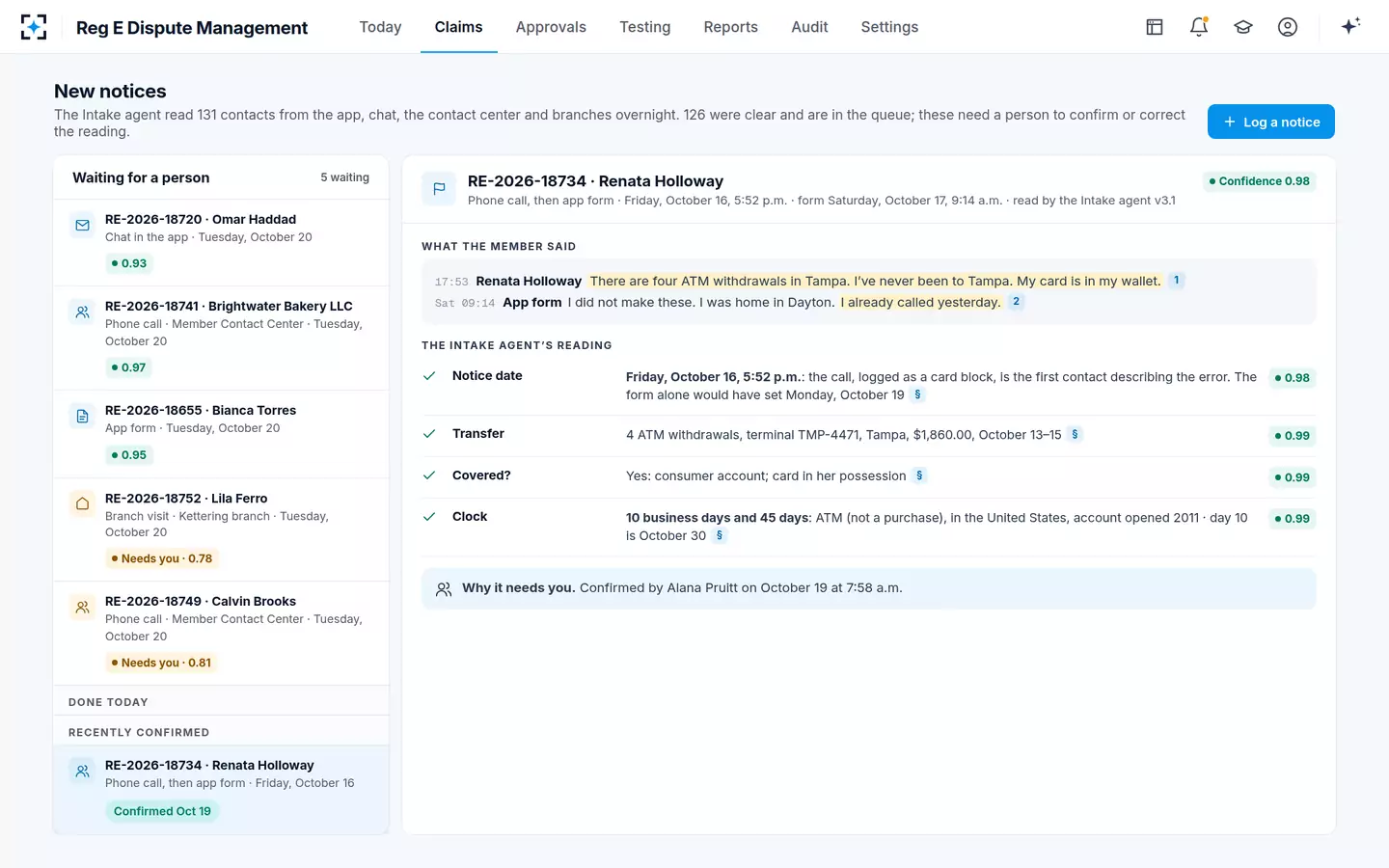
Dating from the first contact matters most near the line: a notice called in on day 59 and confirmed by form on day 62 is timely, and only the call proves it. What frontline staff must log is in Reg E training, and how the business days are counted once the notice is in is in the Reg E error resolution calculator.
Questions people ask
Which 60 days is it under Reg E?
For error resolution, the 60 days after the institution sent the statement on which the error first appeared. For liability, the 60 days after transmittal of the statement showing an unauthorized transfer, which limits the consumer’s exposure only for transfers after that period.
Can a bank refuse a Reg E claim after 60 days?
It can decline to follow 1005.11’s procedures for a notice received more than 60 days after the statement. It cannot impose liability for an unauthorized transfer except under 1005.6, which still caps liability for transfers before the 61st day.
Does a phone call within 60 days count if the form comes later?
Yes. The notice may be oral, and its date is the date of the call. A form that arrives after day 60 does not make a timely call late, which is why the first contact should be recorded with its date and time.
Does the 60-day rule apply to ACH debits?
Yes. ACH debits to consumer accounts are electronic fund transfers, and the same 60-day window applies. Under comment 6(b)(3)-2, a consumer who reports an unauthorized ACH debit within 60 days of the statement has no liability for it.
Do weekends extend the 60 days?
No; the 60 days are calendar days counted from the statement’s transmittal, and Regulation E does not move the end date off a weekend. A cautious policy treats a notice arriving on the next business day after a weekend day 60 as timely rather than litigating the point.