On instant payments, a recall and a return are two halves of one exchange. The recall is the sending bank's return request, an ISO 20022 camt.056 asking the receiving bank to send back all or part of a payment it has already settled; the return is the receiving bank's payment return, a pacs.004 that actually moves the money back. FedNow and RTP payments are irrevocable, so the sending bank can only ask and the receiving bank decides. The FedNow Service's operating procedures ask the receiving bank to answer each request with a camt.029 as soon as possible and no later than midnight Eastern on the next business day: accepted, partly accepted, rejected, or pending investigation, with a final answer to a pending request within 10 business days. For a bank that receives hundreds of these requests a month, the work is less about any one answer than about meeting every clock in the queue, and noticing when a request is really telling you something about your own customer.
This page is written from the receiving side. Its examples come from Wire & Instant Payment Recall, Botminds' software for fraud recalls and the return requests other banks send, in which agents propose an answer to each request from the balance and the reason and a maker and a checker decide; the bank, its customers and the requesting banks are fictional sample data.
What the agents proposed for nine instant payment return requests in the sample queue
Nine open FedNow and RTP return requests, as proposed
- Accept and return in full · 56%
- Partial: only $140 left · 11%
- Ask our customer · 11%
- A person decides: confidence 0.72 · 11%
- Decline: nothing left · 11%
Instant payments: recall vs return
The words describe different messages with different senders. A recall, in FedNow's terms a return request, is a nonvalue message from the bank that sent the payment; it moves no money. A return is a value message from the bank that received the payment; it moves the money back and settles like any other instant payment. A return can also happen without any request, when the receiving bank cannot apply a payment it received, or finds it was fraud and sends it back on its own with a fraud reason code.
A FedNow return request and a FedNow payment return, side by side
Return request (the recall): camt.056
Payment return (the money back): pacs.004
Return request (the recall): The bank that sent the original payment
Payment return (the money back): The bank that received it
Return request (the recall): No: a nonvalue message
Payment return (the money back): Yes: it settles like an instant payment
Return request (the recall): Reason code FRAD; not subject to the 60-day guideline
Payment return (the money back): Reason code FR01 when the receiver itself returns a fraudulent payment
Return request (the recall): A camt.029 from the receiving bank
Payment return (the money back): Nothing: it is the answer
The distinction matters operationally because the two halves have different owners. The answer to a request is a decision about someone else's claim on your customer's money, which needs judgment and often a hold; the payment return is a movement of money, which needs a maker and a checker. A bank that treats a request as a payments task alone misses the first part. The sending side of the same exchange is described in the wire recall request, field by field.
Can an instant payment be recalled?
It can be asked for, never reversed by the sender. The Philadelphia Fed's Consumer Compliance Outlook lists both FedNow and RTP as irrevocable, credit-push-only services that settle instantly around the clock; it put participation at 1,477 institutions on FedNow and 1,056 on RTP as of September 2025. Under Operating Circular 8, a Reserve Bank has no obligation to cancel a FedNow payment because it receives a request for return, and whether a request is effective at the receiving bank is governed by UCC 4A-211, which leaves the decision with that bank.
What the receiving bank cannot do is ignore the request. Operating Circular 8 sets the expectation for any nonvalue message about an exception such as an error or an unauthorized transfer: "Each FedNow Participant that receives a Nonvalue Message communicating about one of these exceptions shall coordinate with the sending FedNow Participant and use reasonable efforts to aid that FedNow Participant in its investigation into the nature of the exception and to remediate such exception."
How fast must a bank respond to a FedNow return request?
By midnight Eastern on the next standard business day, under the procedures' response guidelines, which the Federal Reserve Banks describe as "strongly recommended". For a final answer, accepted, partly accepted or rejected, the table says: "As soon as possible, but no later than midnight (ET) of the next standard business day (M-F, except holidays)." A bank that needs longer can send a pending answer by the same deadline, and then has a further window: "Final response to PDCR will be IPAY, PECR or RJCR as soon as the FI has concluded the investigation for further information, or within 10 standard business days (M-F, except holidays)".
The FedNow clock on a return request, counted in standard business days
- Answer≤ 1 day
- Pending≤ 1 day
- Investigate, then answer finally≤ 10 business days
The clock runs in business days, but requests arrive every day, because the service does. A request received on a Saturday morning is due by midnight on Monday, unless Monday is a holiday. The sample bank's own setting is tighter than the guideline: every instant payment return request answered within one business day, which it met for 629 of 648 requests in its sample month. A specialist accepts the agents' proposals in bulk and a supervisor approves each batch.
The four answers, and when each fits
Each answer is a camt.029 with a status code. The choice is usually made by two facts, the reason given and the balance in the account, with a third, the account's own history, deciding the hard cases.
The four answers a receiving bank can give to a FedNow return request
| Answer | Code | When it fits | What follows |
|---|---|---|---|
| Accepted | IPAY | The reason is clear and the money is still there, such as a duplicate or a fraud report on an intact balance | A payment return (pacs.004) sent immediately, simultaneously with the answer |
| Partly executed | PECR | Only part of the money is left, or only part is owed | A payment return for the part, sent immediately |
| Rejected | RJCR | Nothing is left, or the request has no basis | A reason for the rejection; no money moves |
| Pending investigation | PDCR | The bank needs to hold, check its customer or ask questions | A final answer within 10 business days: IPAY, PECR or RJCR |
The procedures also settle two questions that come up daily. A partial return is allowed: "If the Participant decides to accept the return request, the return can either be for the full amount of the original payment received or a portion of it." And a return of a FedNow payment should go back through FedNow, so both banks can reconcile it against the original.
Can a bank refuse a return request?
Yes, with a reason. An instant payment that has been accepted is the receiving bank's customer's money until something gives the bank grounds to return it, and UCC 4A-211, which governs whether a request is effective, lets a beneficiary's bank cancel an accepted order only for an unauthorized order or a sender's mistake such as a duplicate or a payment to someone not entitled to it. A customer who simply wants a payment back after a dispute with the recipient has no recall the receiving bank can grant on its own; the receiving bank can ask its own customer, which is what "ask our customer" means in the sample queue.
Refusing well is part of the duty to coordinate. A rejection that says "no funds remain" or "beneficiary disputes the claim" gives the sending bank something to act on; a rejection with no reason leaves it guessing. The legal grounds are set out in more detail in what a wire recall is.
The inbound queue: hundreds a month, each with its own clock
For many banks the inbound side is the larger job. The sample bank receives and sends about 900 instant payment return requests a month; on the day shown below, 42 were open and 9 were due by the next afternoon. Most are routine: a duplicate, a wrong amount, a fraud report on a balance that is still intact. A few are not, and the queue's job is to separate them quickly enough that the routine ones meet the clock and the hard ones get a person's time.
Instant payment return requests, proposed one by one and approved as a batch
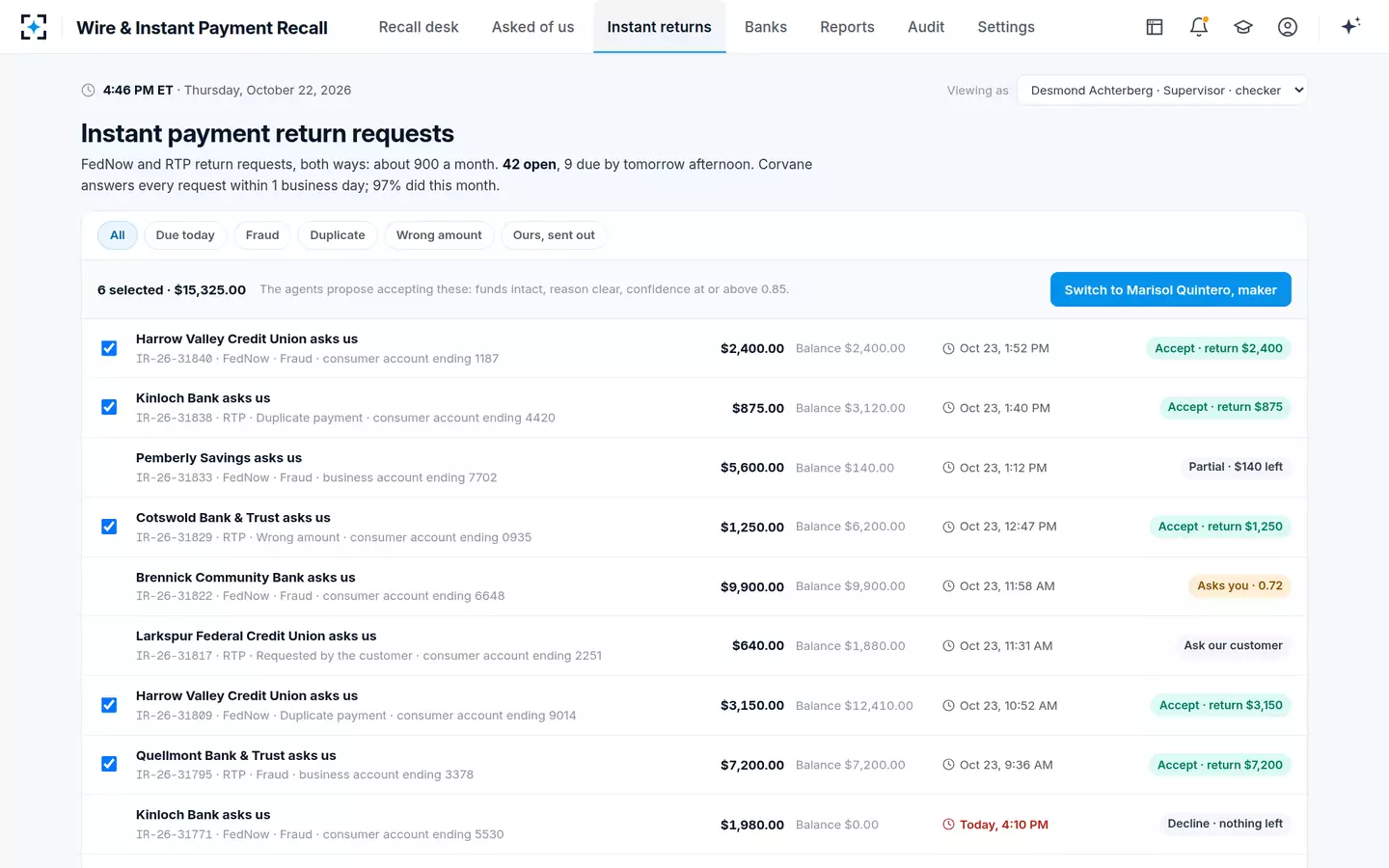
The proposals follow a rule a supervisor could write down: accept when the funds are intact, the reason is clear and the agent's confidence is at or above 0.85; propose a partial return when only part is left; decline when nothing is; ask the customer when the request is the sender's customer changing its mind; and send anything below the threshold to a person. The specialist accepts proposals in bulk, and the batch needs a supervisor's approval before any money moves.
When the request is a fraud signal about your own customer
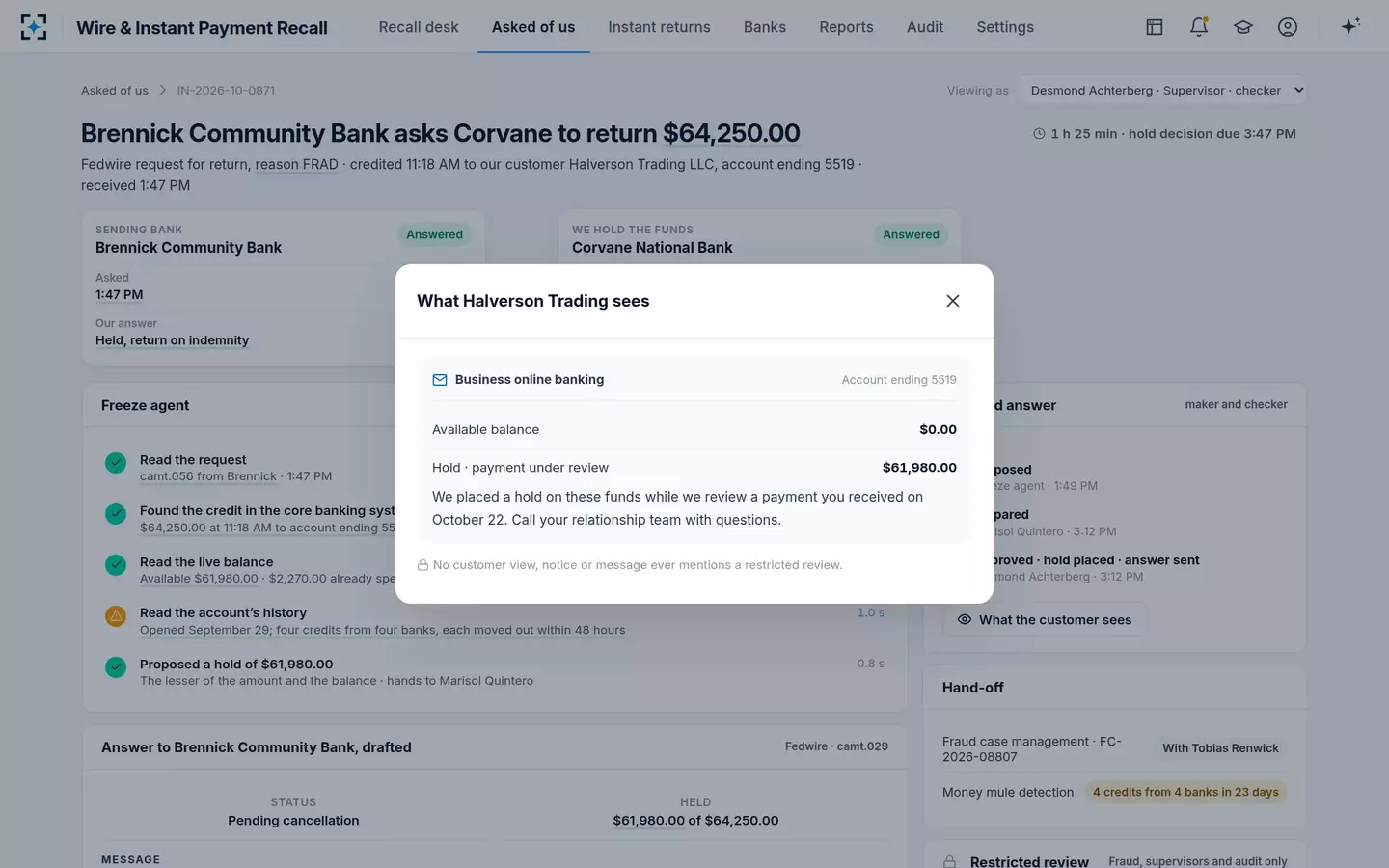
A fraud request is an accusation about an account at your bank. Read that way, the most valuable fact in it is often not the amount asked for but what it reveals about the account the money landed in. In the sample, another bank's Fedwire request asked for $64,250.00 credited that morning to a business customer. The agent found $61,980.00 still available and an account opened on September 29 that had received four credits from four different banks, each moved out within 48 hours. It proposed a hold of $61,980.00, the lesser of the amount and the balance, drafted a pending answer, and sent the account to the fraud case and to money mule review, which is the work of Money Mule Detection.
The sample's hold decision was due two hours after the request arrived, a setting the bank chose for fraud requests. The instant payment guideline allows until the next business day, but a pattern like that one argues for holding first and investigating second. The same rules, applied in reverse, are the ones a sending bank hopes the other side will apply to its own recall, as traced in how long a wire recall takes.
What the customer may be told
That a payment is under review, and nothing that would reveal a suspicious activity report. Under 31 CFR 1020.320(e) a suspicious activity report, and anything that would show one exists, stays confidential except where that paragraph allows; a grand jury subpoena for bank records shows how tightly the line is drawn. A hold notice to a customer whose account received a fraud request therefore says what is held and how to ask about it, and stops there.
What the account holder sees: a hold and a plain notice, nothing about a review
Does Reg E apply to FedNow payments?
To consumer transfers, yes, and that changes what a consumer can claim from their own bank, though not what the receiving bank must return. The Consumer Compliance Outlook puts it this way: "to the extent that a fund transfer initiated to or from a consumer account using the FedNow Service or RTP is an EFT under Regulation E, that transfer would be subject to the EFTA and Regulation E." The article explains that under Regulation J, where the Electronic Fund Transfer Act and the FedNow rules conflict, the Act prevails.
For the receiving bank, the practical consequence is indirect. A consumer who reports an unauthorized FedNow transfer to their own bank may be owed an investigation and a refund under Regulation E even if the receiving bank never returns a cent, so the sending bank has every reason to send a return request quickly, and a rejection with a clear reason helps it close its own file. Regulation E's own clocks and notices are a separate subject from the interbank request.
Answering an inbound instant payment return request
- Find the credit and read the live balance first
Everything else depends on what is still there.
- Read the reason, and the account behind it
A fraud request on a new account with credits from several banks is a fraud case at your bank, not just a payments task.
- Hold before you investigate when the pattern says so
The lesser of the amount asked and the balance, decided by a maker and a checker.
- Answer by midnight ET on the next business day
With a final answer, or “pending” and a final one within 10 business days.
- Return through the same service, in full or in part
A pacs.004 sent with the answer, never more than came in.
- Give a reason when you reject
The sending bank has to explain the outcome to its own customer.
- Tell your customer only what is held
Nothing that would reveal a suspicious activity report.
Questions people ask
What is a return request?
It is the FedNow name for a recall: a camt.056 message in which the bank that sent an instant payment asks the bank that received it to return all or part of it. It moves no money; if the receiving bank agrees, it sends a separate payment return.
Can an RTP payment be recalled for fraud?
It can be the subject of a request, like a FedNow payment: RTP payments are irrevocable, so the sending bank asks and the receiving bank decides. The RTP network's own rules and timings are published by its operator and are not covered on this page.
What happens if the receiving bank never answers?
Under the FedNow procedures, if no answer arrives by midnight Eastern on the next standard business day, the sender may send another return request. Operating Circular 8 also obliges the receiving participant to coordinate and use reasonable efforts to help the sender investigate.
Should the money go back through FedNow?
Yes. The procedures say payment returns for funds first sent through the FedNow Service should be returned through it, so that both banks can reconcile the return against the original payment.
Is a FedNow return request the same as a Fedwire recall?
Both use a camt.056 answered by a camt.029, and both leave the decision with the receiving bank. FedNow publishes response guidelines and a 60-day guideline for non-fraud requests; the Fedwire format guidance names no answer time.