When a grand jury subpoena for bank records arrives, the bank has two jobs: produce the records the subpoena demands, and review the customer named in it, because the FFIEC examination manual says "the receipt of a grand jury subpoena should cause a bank to review account activity for the relevant customer." The subpoena does not, on its own, require a SAR. If the review finds suspicious activity, the SAR describes that activity and leaves the subpoena out. Throughout, the bank says nothing to the customer: for money laundering, structuring and the other crimes listed in the Right to Financial Privacy Act, no employee may tell anyone named in a grand jury subpoena that it exists, and a separate criminal statute punishes telling the customer. Botminds' AML Case Management runs the review in a restricted workspace that people outside the financial intelligence unit cannot see into, and logs every opening of the case.
Examples on this page come from a fictional sample bank, Corvane National Bank; every customer, person and case in them is invented. This guide describes the rules a bank's AML team works under; it is not legal advice on any particular subpoena.
After a grand jury subpoena: what may appear in a SAR, what may not, and why
The customer's account activity the bank found on its own review
May go in the SAR
The SAR should reference "only those facts and activities that support a finding of suspicious transactions identified by the bank."
Records produced to the grand jury, as records
Facts only
The underlying transactions can be described; the fact that they were produced to a grand jury cannot.
That a grand jury subpoena was received, or what it asked for
Stays out
Law enforcement discourages any reference to the subpoena, given the confidentiality of grand jury proceedings.
That a National Security Letter was received
Stays out
The SAR "should not contain any reference to the receipt or existence of the NSL"; disclosure is barred by 12 USC 3414.
That FinCEN sent a 314(a) request naming the customer
Stays out
A bank may not disclose to anyone but FinCEN that FinCEN has requested information under 314(a).
The bank's internal case number and contact
May go in the SAR
Helps law enforcement reach the bank about supporting documentation.
What happens when a bank receives a grand jury subpoena? Two tracks: produce, and review
A grand jury subpoena starts two tracks that should run apart. The production track belongs to whoever handles legal process at the bank, often a subpoena or legal processing team: it confirms the subpoena, searches for the records, produces them by the return date and keeps a copy of what went out. The review track belongs to the AML team: it looks at the named customer's activity with fresh eyes, because the FFIEC manual treats a law enforcement inquiry as a reason to look. Banks "should establish policies, procedures, and processes for identifying subjects of law enforcement requests, monitoring the transaction activity of those subjects when appropriate, identifying unusual or potentially suspicious activity related to those subjects, and filing, as appropriate, SARs related to those subjects" (FFIEC manual, Law Enforcement Inquiries and Requests).
The review also reaches the customer's risk profile. The FFIEC manual lists the "Receipt of law enforcement inquiries and requests such as criminal subpoenas, National Security Letters (NSL), and section 314(a) requests" among the events that may prompt a bank to update a customer's information and risk profile (FFIEC manual, Customer Due Diligence). Keeping the two tracks apart matters because the production team does not need to know what the AML review finds, and the AML case should not become a place where the subpoena's contents circulate.
The day a grand jury subpoena for bank records arrives
- Log it with restricted access
Who received it, when, the return date and the customer named; visible only to the people handling it.
- Produce the records on the legal track
Search, copy and deliver by the return date; keep a record of exactly what was produced.
- Open an AML review of the named customer
Activity, counterparties, linked customers and any earlier alerts or SARs.
- Re-assess the customer's risk profile
A law enforcement inquiry is a recognised trigger for updating it.
- Tell no one outside the team
Not the customer, not anyone named in the subpoena, not the relationship manager.
- If a SAR follows, leave the subpoena out
Describe the suspicious activity the bank identified, and nothing about the grand jury.
Does a subpoena trigger a SAR? Not by itself
A grand jury subpoena does not, by itself, require a SAR. The FFIEC manual is direct: "Mere receipt of any law enforcement inquiry does not, by itself, require the filing of a SAR by the bank. Nonetheless, a law enforcement inquiry may be relevant to a bank's overall risk assessment of its customers and accounts." What decides the question is the review. If the bank, looking at the customer's activity, knows, suspects or has reason to suspect that a transaction meets one of the SAR rule's definitions, the usual 30-day clock applies from that determination; if it does not, there is nothing to file.
This is a common place for a well-meaning team to go wrong in both directions. Filing a SAR whose only content is "the bank received a subpoena" adds nothing law enforcement does not already know, and makes a reference to the subpoena hard to avoid. Ignoring the subpoena because "law enforcement already knows" misses the point of the review: the bank may hold activity the agency has not seen, on accounts the subpoena did not name.
Can a bank tell a customer about a subpoena? Not for the crimes that matter here
For grand jury subpoenas in money laundering, structuring, drug and bank crime investigations, no. The Right to Financial Privacy Act provides that no officer, director, employee, agent or attorney of a financial institution "shall, directly or indirectly, notify any person named in a grand jury subpoena served on such institution in connection with an investigation relating to a possible" crime against a financial institution, a drug offence, money laundering under 18 USC 1956 or 1957, unlicensed money transmitting, or BSA violations including structuring, "about the existence or contents of such subpoena, or information that has been furnished to the grand jury in response to such subpoena" (12 USC 3420(b)).
A separate criminal statute backs that up. Under 18 USC 1510(b), an officer of a financial institution who notifies a customer whose records are sought by a federal grand jury subpoena for a listed offence, or any other person named in it, about its existence or contents faces a fine or up to one year in prison; doing so "with the intent to obstruct a judicial proceeding" carries up to five years (18 USC 1510(b)). For grand jury subpoenas outside those crimes, the RFPA's general notice rules do not apply, and a court may order the bank not to notify the customer (12 USC 3413(i)).
What telling the customer can cost, and what producing records pays
1year
maximum prison term for a bank officer who notifies a customer about a grand jury subpoena for a listed offence
5years
maximum when the notice is given with intent to obstruct a judicial proceeding
$22an hour
reimbursement for clerical search and processing time under Regulation S; $30 for a supervisor or computer specialist
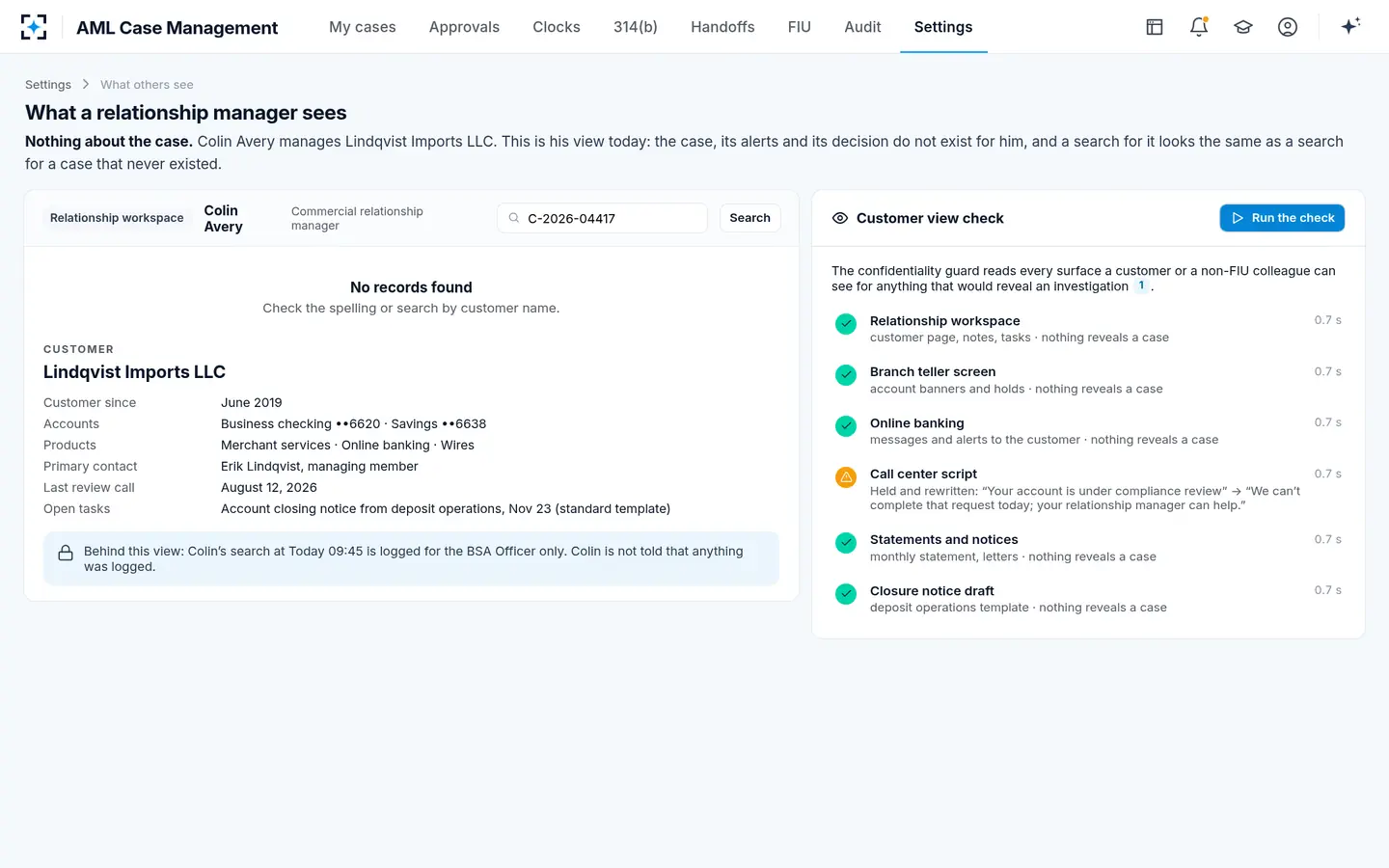
The practical risk inside a bank is rarely a deliberate tip-off. It is a relationship manager who sees a hold, a call-center script that says "your account is under review," or a closure letter that arrives the week after a subpoena. In the sample bank, the confidentiality guard checks six customer-facing surfaces for anything that would reveal an investigation, and the relationship manager's search for the case returns "No records found," the same as for a case that never existed.
AML Case Management's restricted workspace: the relationship manager finds nothing
Can you mention a subpoena in a SAR narrative? What may travel and what may not
No. The FFIEC manual reports that "Due to the confidentiality of grand jury proceedings, if a bank files a SAR after receiving a grand jury subpoena, law enforcement discourages banks from including any reference to the receipt or existence of the grand jury subpoena in the SAR. Rather, the SAR should reference only those facts and activities that support a finding of suspicious transactions identified by the bank." The same applies more strictly to National Security Letters, and to 314(a) requests, whose existence a bank may disclose only to FinCEN.
The distinction that lets a narrative stay useful is between the subpoena and the activity. The deposits, the wires and the counterparties the bank found are facts it can describe, whether or not the same records went to the grand jury. What it cannot say is that a grand jury wanted them. An investigator who builds the narrative from the bank's own review, rather than from the subpoena's list of accounts, writes a SAR that stands on its own.
How should banks respond to a subpoena for a SAR? Decline, cite the rule, tell FinCEN
A subpoena that asks for a SAR itself, or for anything that would reveal one, must be declined. The SAR rule is specific: "Any bank, and any director, officer, employee, or agent of any bank, that is subpoenaed or otherwise requested to disclose a SAR or any information that would reveal the existence of a SAR, shall decline to produce the SAR or such information, citing this section and 31 U.S.C. 5318(g)(2)(A)(i), and shall notify FinCEN of any such request and the response thereto" (31 CFR 1020.320(e)). The FFIEC manual adds that the bank's federal banking agency should be told as well.
The rule has an important exception. FinCEN, law enforcement and the bank's supervisors may obtain a SAR and its supporting documentation, and for supporting documentation they need no subpoena at all; what counts as supporting documentation, and who may request it is set out with the sample report. The decline applies to everyone else: civil litigants, private parties and anyone asking in a way that would reveal a SAR to a person not entitled to know.
Four requests an AML team receives, and how each is handled
| Request | Who sends it | Can the customer be told? | Mention it in a SAR? |
|---|---|---|---|
| Federal grand jury subpoena for records | A prosecutor, on behalf of a grand jury | No, for money laundering, structuring, drug and bank crimes (12 USC 3420(b)); a court may order silence for others | No; describe only the activity the bank found |
| National Security Letter | The FBI and certain other federal authorities | No (12 USC 3414) | No reference to its receipt or existence |
| 314(a) request | FinCEN, for a law enforcement agency | No; disclosure only to FinCEN | Not the request; the activity the review found |
| Request for SAR supporting documentation | FinCEN, law enforcement or a supervisory agency | No; it would reveal a SAR | Not applicable; provided without legal process once the requester is verified |
What is a National Security Letter to a bank?
A National Security Letter is a written investigative demand that the FBI and certain other federal authorities may issue in counterintelligence and counterterrorism investigations; under the Right to Financial Privacy Act it can reach a bank's financial records. The FFIEC manual calls NSLs "highly confidential documents," says examiners "will not review or sample specific NSLs," and notes that under 12 USC 3414 "no bank, or officer, employee or agent of the institution, can disclose to any person that a government authority or the FBI has sought or obtained access to records through a Right to Financial Privacy Act NSL." Like a grand jury subpoena, an NSL does not by itself require a SAR; if a SAR follows, it "should not contain any reference to the receipt or existence of the NSL." Questions go to the bank's local FBI field office.
How far back can bank records be subpoenaed? As far back as the bank kept them
A grand jury subpoena can ask for records from any period it describes; what limits the answer is what the bank still holds. The Bank Secrecy Act's general rule is that the records it requires are kept for five years and stored so they can be retrieved within a reasonable time (31 CFR 1010.430(d); the guide to BSA record retention lists each rule's period). Many banks keep some records longer under their own policies or other laws, and a legal hold stops anything relevant from being destroyed once a subpoena or investigation is known. For 314(a), the lookback is fixed by regulation instead: accounts for the preceding twelve months and transactions for the preceding six.
Who pays for producing the records? Reimbursement under the Right to Financial Privacy Act
The government usually does. The Right to Financial Privacy Act requires a government authority to pay a financial institution "a fee for reimbursement for such costs as are reasonably necessary and which have been directly incurred in searching for, reproducing, or transporting" records (12 USC 3415), and that section applies to grand jury subpoenas. The Federal Reserve's Regulation S sets the rates: $22 an hour for clerical and technical search and processing time, $30 for a manager or a computer support specialist when one is needed, and $0.25 a page for photocopies. Reimbursement does not cover "analysis of material or legal advice," and there is none for records "required to be reported in accordance with any federal statute," such as BSA reports (12 CFR part 219).
Inside the FIU: keeping the review restricted and the record complete
A subpoena review is an ordinary Level 2 case with an extra secret. In AML Case Management it would be worked the same way as any other: the case builder assembles the customer's activity, profile, counterparties and earlier alerts and SARs; the link finder looks for related customers; the investigator decides whether anything is suspicious and a senior investigator approves the decision, file or no-file. The difference is what never enters the shared parts of the file: the subpoena itself stays with the people handling it, and the recommendation is built from the bank's own findings.
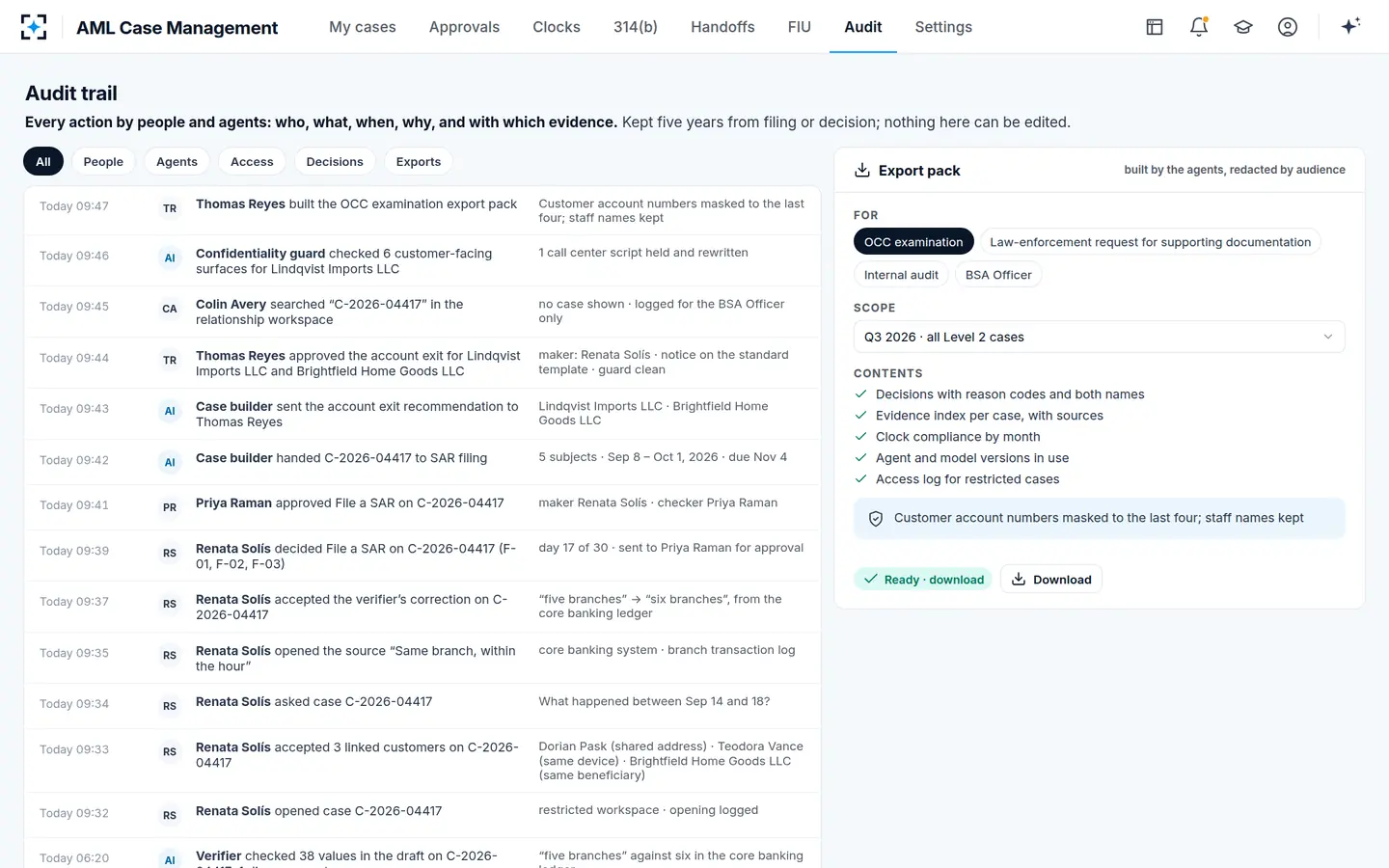
The audit trail is what lets the bank prove later that the secret held. Every opening of the case is logged with who, when and why; every search from outside the unit is logged for the BSA officer; every export is built for its audience. If law enforcement later asks for supporting documentation for a SAR filed after the review, the export pack contains that SAR's evidence, masked as the audience requires, and nothing about the grand jury. A related request, a letter asking the bank to keep the account open, is covered in what FinCEN expects of a keep open letter. The solution is at AML Case Management.
The audit trail: every opening, search and export, by person and by agent
Questions people ask
Does a grand jury subpoena mean the customer is being charged?
No. A grand jury subpoena means a grand jury investigation wants records; the customer may be a subject, a witness or simply someone whose transactions touch the investigation. That uncertainty is one reason the FFIEC manual says receipt of a subpoena does not by itself require a SAR.
Should a bank close an account after receiving a grand jury subpoena?
Not automatically. The decision to keep or close an account is the bank's, under its own standards, but FinCEN recommends that a bank aware through a subpoena that an account is under investigation notify law enforcement before deciding the account's status, and any closure notice must not reveal the subpoena.
Can the AML team see the subpoena?
The people reviewing the customer need to know that a law enforcement inquiry exists and which customer it names, so they can look at the right activity. They do not need the subpoena's full contents, and keeping those with the legal team limits the number of people who could reveal it.
Is a grand jury subpoena the same as a request for SAR supporting documentation?
No. A grand jury subpoena is legal process for records; a request for SAR supporting documentation comes from FinCEN, law enforcement or a supervisor and needs no legal process. A subpoena that asks for a SAR itself must be declined and reported to FinCEN.
What if a civil subpoena asks for SARs?
The bank declines to produce the SAR or anything that would reveal it, cites 31 CFR 1020.320(e) and 31 USC 5318(g)(2)(A)(i), and notifies FinCEN of the request and the response. The underlying transaction records may still be produced if the subpoena reaches them, without anything that would reveal a SAR.