A keep open letter is a written request from a law enforcement agency asking a bank to keep a customer's account open, despite suspicious activity, so the agency can keep following the money. FinCEN's guidance, FIN-2007-G002, says the bank should insist on a written request, from a supervisory agent or a prosecutor, that states its purpose and lasts "not to exceed six months," and that the bank keep it on file for at least five years after it expires. Since January 2021 a statute, 31 USC 5333, protects a bank that keeps an account open in line with such a request from liability under the Bank Secrecy Act, provided the request was routed through FinCEN and carries a termination date. Neither the guidance nor the statute changes the duty to file Suspicious Activity Reports: the bank keeps monitoring and keeps filing. For a Level 2 investigator in Botminds' AML Case Management, the keep-open request is evidence on the case and a condition on any account exit.
Where this guide uses examples, they come from a fictional sample bank, Corvane National Bank; its customers, people and cases are invented.
A keep open letter, from request to expiry, with the bank's SAR duty running alongside
Law enforcement
- BeforeA federal agency tells FinCEN it intends to ask; a state, tribal or local agency needs FinCEN's concurrence.
- Day 0Sends a written, dated request with the purpose and a termination date, signed by a supervisor or a prosecutor.
- Within 2 business daysSends FinCEN a copy and tells it whether the bank has implemented the request.
- At expiryMay send a new request; without one, the request and its safe harbor end.
The bank
- On receiptVerifies the requester, logs the request with the case and the account, and decides whether to keep the account open.
- While in forceKeeps the account within the request's parameters and keeps monitoring it.
- ThroughoutFiles a SAR when new suspicious activity is detected; the request changes none of that.
- At expiryDecides again under its own standards, and keeps the request on file at least five years after it expires.
What is a keep open letter? A written request, not an order
A keep open letter is a request, and the bank remains free to refuse it. FinCEN's 2007 guidance is explicit: "Ultimately, the decision to maintain or close an account should be made by a financial institution in accordance with its own standards and guidelines. Although there is no requirement that a financial institution maintain a particular account relationship, financial institutions should be mindful that complying with such a request may further law enforcement efforts to combat money laundering, terrorist financing, and other crimes" (FIN-2007-G002). The FFIEC examination manual repeats the same words in its section on continuing activity.
The reason law enforcement asks is practical. Closing an account tells the customer something has changed, and may push the money to a bank that is not watching. Keeping it open lets the agency see where the money goes next, often through the SARs the bank keeps filing. The cost falls on the bank: an account it would otherwise exit stays on its books, with the risk that brings.
Can law enforcement ask a bank to keep an account open? Yes, and the bank still decides
Yes: federal, state, tribal and local law enforcement agencies can all ask, and the 2021 statute recognises each, with different routes through FinCEN. A federal agency must notify FinCEN of its intent before submitting the written request; a state, tribal or local agency needs FinCEN's concurrence. The requesting agency must then, "not later than 2 business days after the date on which the request is submitted," send FinCEN a copy and "alert FinCEN as to whether the financial institution has implemented the request" (31 USC 5333(d), in section 6306 of the AML Act).
Those routing rules protect the bank as much as the investigation. A request that did not go through FinCEN may still be genuine, but it does not carry the statutory safe harbor. And the statute expressly allows a federal or state agency "verifying the validity of a keep open request" with the agency that submitted it, which is what a bank's procedures should do too before relying on a letter.
What must a keep open request include? FinCEN's list and the statute's
A keep open request should be in writing, come from someone with authority, say what it is for, and carry an end date. FinCEN's guidance names who should sign: for a federal agency, "a supervisory agent or ... an attorney within a United States Attorney's Office or another office of the Department of Justice"; for a state or local agency, "a supervisor of the state or local law enforcement agency or ... an attorney within a state or local prosecutor's office." The statute adds the one element it makes mandatory: every request "shall include a termination date after which that request shall no longer apply."
What a keep open letter should contain before the bank relies on it
- It is in writing
FinCEN: the bank "should ask for a written request." An oral request is a reason to ask for one.
- The right signer
A supervisory agent or a federal prosecutor; for state or local agencies, a supervisor or a state or local prosecutor.
- The account or relationship it covers
Specific enough that operations can tell which accounts must not be closed.
- The purpose
For example, monitoring; FinCEN asks that the purpose be stated.
- A duration of six months at most, and a termination date
Six months is FinCEN's limit; the statute requires a termination date for the safe harbor.
- Evidence it went through FinCEN
Prior notice for a federal agency, FinCEN's concurrence for a state, tribal or local one.
The statute also told Treasury to issue guidance "on the required elements of a keep open request." We could not find that guidance published as of October 2026; the 2007 guidance remains on FinCEN's site and is the most specific statement of what a request should contain.
How long does a keep open letter last? Six months, renewable, with a termination date
A keep open letter lasts as long as it says, and FinCEN's guidance caps that at six months: the request "should also indicate the duration for the request, not to exceed six months," and "law enforcement may issue subsequent requests for account maintenance after the expiration of the initial request." There is no limit on renewals in the guidance or the statute, but each renewal is a new request with its own termination date.
The termination date is the edge of the bank's protection. The statute's safe harbor does not extend to anything the bank does "before the date of the keep open request" or "after the termination date stated in the keep open request." A bank that keeps an account open for three weeks after a letter expires, waiting for a renewal that has not arrived, is back to deciding on its own standards for those three weeks.
Does a keep open letter protect the bank? The safe harbor in 31 USC 5333
Since January 1, 2021, yes, within limits. Where the request meets the statute's routing conditions, "the financial institution shall not be liable under this subchapter for maintaining that account or transaction consistent with the parameters and timing of the request," and "no Federal or State department or agency may take any adverse supervisory action under this subchapter with respect to the financial institution solely for maintaining that account or transaction consistent with the parameters of the request" (31 USC 5333(a)). "This subchapter" is the Bank Secrecy Act's reporting and recordkeeping subchapter of title 31.
A keep open letter under FinCEN's 2007 guidance and under the 2021 statute
FIN-2007-G002 (2007): A written request, signed by a supervisor or a prosecutor, stating its purpose.
31 USC 5333 (2021): A written request, routed through FinCEN, with a termination date.
FIN-2007-G002 (2007): Not to exceed six months; later requests allowed.
31 USC 5333 (2021): Until the termination date the request states.
FIN-2007-G002 (2007): None stated; the decision to keep the account is the bank's.
31 USC 5333 (2021): No liability under the BSA subchapter, and no adverse supervisory action solely for keeping the account, within the request's parameters and timing.
FIN-2007-G002 (2007): Unchanged: the bank must comply with all BSA reporting, including SARs.
31 USC 5333 (2021): Unchanged: nothing relieves the bank of reporting suspicious transactions under 5318(g).
FIN-2007-G002 (2007): Keep documentation at least five years after the request expires.
31 USC 5333 (2021): The agency sends FinCEN a copy within two business days.
Read the limits closely. The safe harbor covers keeping the account, nothing more. It does not cover activity the bank fails to report, actions outside the request's parameters, or the time before the request or after its termination date. And it is a safe harbor under the BSA; it says nothing about other risks of keeping a customer, such as losses from fraud on the account.
Do you still file SARs on a keep open account? Yes, every one
Yes. FinCEN's guidance says a bank that keeps the account "is required to comply with all applicable Bank Secrecy Act recordkeeping and reporting requirements, including the requirement to file Suspicious Activity Reports, even if the bank is keeping an account open or maintaining a customer relationship at the request of law enforcement." The statute says the same in its own words: nothing in it may be construed "to relieve a financial institution from complying with any reporting requirements," "including the reporting of suspicious transactions."
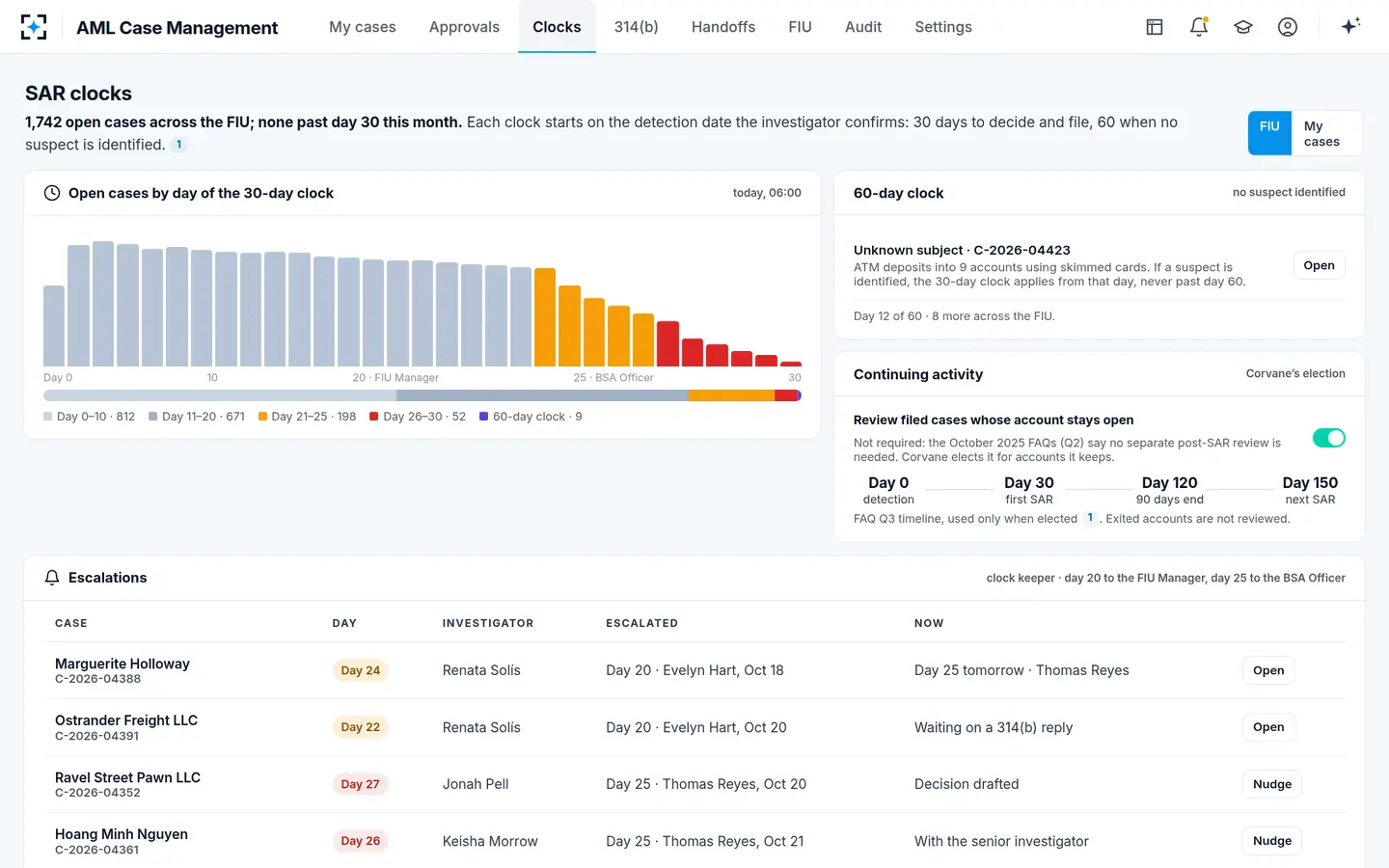
What has changed is how a bank may organise that reporting. Since October 9, 2025, the interagency SAR FAQs have said that no separate post-SAR review of a customer is required to see whether the activity has continued, and that the 90-day continuing-activity cycle is optional; banks may instead rely on their risk-based monitoring (SAR FAQs, Q2 and Q3). A keep-open account is exactly where a bank may choose to keep the elective cycle anyway: law enforcement has said it is watching, and a continuing SAR, which the filing instructions say should give the amount for the period and the cumulative amount across related reports, is how the bank shows what it saw (SAR Filing Instructions).
SAR clocks in AML Case Management, with continuing-activity reviews only where the bank elects them
Who handles a keep-open request inside the bank?
A keep-open request touches four seats: whoever receives it, the BSA officer who decides, the investigators who keep working the account, and the operations staff who would otherwise close it. Because the letter itself reveals that law enforcement is investigating the customer, it belongs inside the financial intelligence unit with the same restrictions as a case. FinCEN's guidance adds one more step that is easy to miss: "If a financial institution is aware – through a subpoena, 314(a) request, National Security Letter, or similar communication – that an account is under investigation, FinCEN recommends that the financial institution notify law enforcement before making any decision regarding the status of the account."
Who does what with a keep open letter
| Seat | What they do | What they must not do |
|---|---|---|
| Whoever receives it (often legal or the BSA office) | Logs it, verifies the requester with the agency, links it to the customer and any case | Forward it to the branch or the relationship manager |
| BSA officer | Decides whether to keep the account, on the bank's own standards, and records why | Treat the letter as an order the bank must follow |
| Level 2 investigator | Keeps monitoring the account and files SARs on new suspicious activity | Mention the letter in a SAR narrative or to the customer |
| Deposit operations | Holds any exit already in motion on the covered accounts | Send a closure notice until the BSA officer clears it |
| Records management | Keeps the request at least five years after it expires | Purge it with the account file |
Keep-open requests and account exits: where the two meet
The point where a keep-open request most often goes wrong is the account exit, because exits are usually decided in one place and executed in another. A bank that files repeat SARs on a customer will, sooner or later, decide whether to keep the relationship; the FFIEC manual asks for procedures on "Criteria for whether and, if so, when to close the account" and "Criteria for when to notify law enforcement, if appropriate" (FFIEC manual). An exit approved without checking for an active keep-open request can undo months of an investigation in one closure letter.
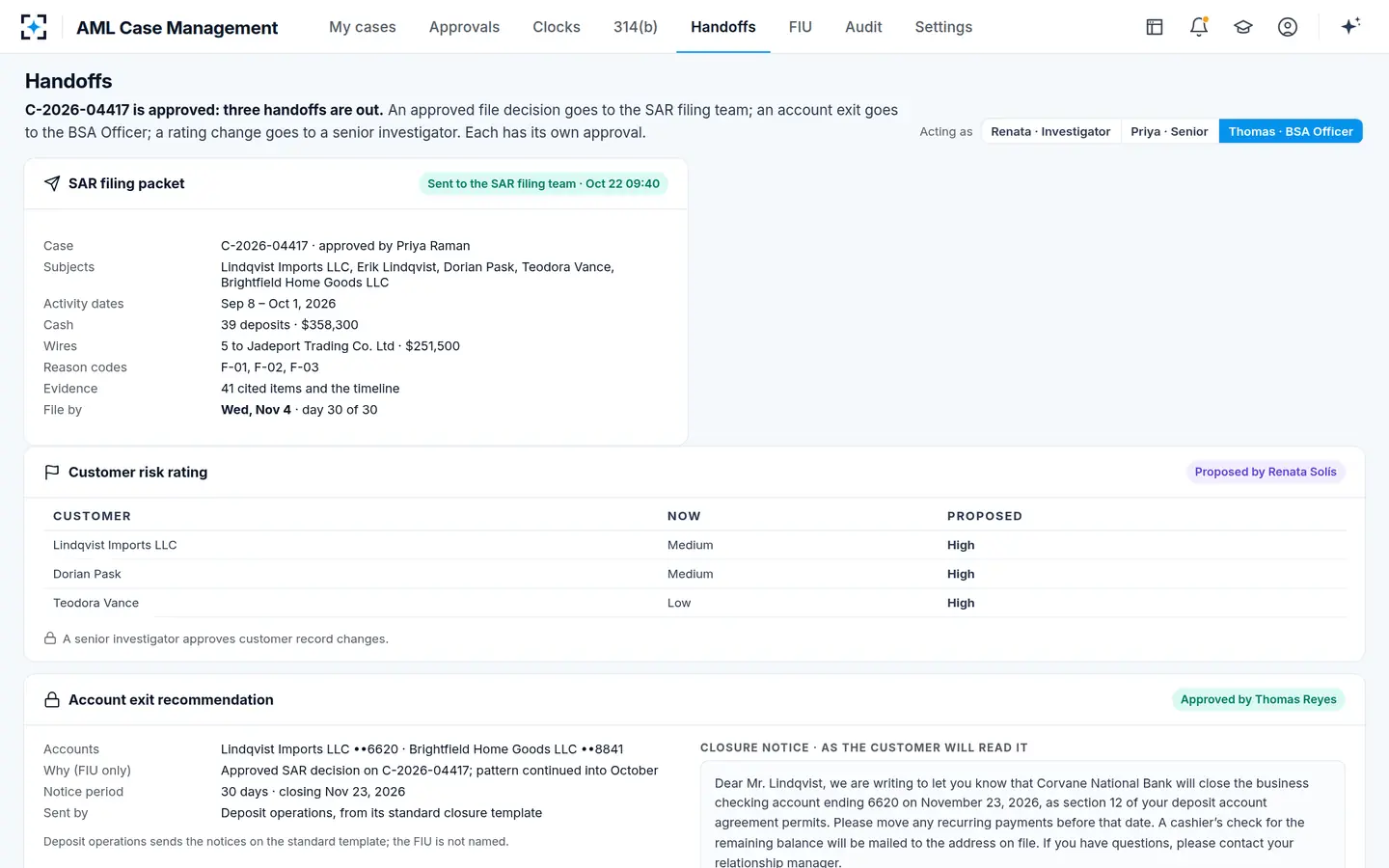
In the sample bank, an account exit is never automatic. After the Lindqvist Imports case was approved for filing, the agents drafted an exit recommendation for two accounts, and the BSA officer, Thomas Reyes, approved it with a 30-day notice on deposit operations' standard template, which names no reason and no unit. That approval is the natural place for a bank to check for an active keep-open request on the customer, and the audit trail records the approval, who gave it and why. The sample solution does not claim more than that: holding and tracking the letter itself is the bank's procedure.
Hand-offs after a decision: SAR filing, rating changes and an account exit the BSA officer approves
What stays on the file, and for how long
The keep open letter itself should be kept "for at least five years after the request has expired," FinCEN recommends, though "there is no recordkeeping requirement under the Bank Secrecy Act for this type of correspondence." Any SAR filed while the account stayed open, and its supporting documentation, is kept five years from filing under the SAR rule (31 CFR 1020.320(d)). Neither the letter nor the fact of the investigation may appear in a SAR narrative or reach the customer; the rules for grand jury subpoenas work the same way for the same reason, and the seats on a Level 2 desk show who carries each part. The solution is at AML Case Management.
Questions people ask
Does a bank have to honour a keep open letter?
No. FinCEN's 2007 guidance says there is no requirement that a financial institution maintain a particular account relationship, and the decision to keep or close an account is the bank's, under its own standards. The statutory safe harbor applies only if the bank chooses to keep the account in line with the request.
Can a bank tell the customer about a keep open letter?
It should not. The letter shows that law enforcement is investigating the customer, and telling the customer could obstruct that investigation and, where a SAR has been filed, reveal it. Requests are kept inside the financial intelligence unit, like case files.
What happens when a keep open letter expires?
The request and the statutory safe harbor end on the termination date. Law enforcement may send a new request; if none arrives, the bank decides on its own standards whether to keep the account, and keeps the expired letter on file for at least five years.
Should a SAR narrative mention a keep open letter?
No. The SAR should describe the suspicious activity the bank observed. FFIEC guidance on law enforcement inquiries advises leaving out references to grand jury subpoenas and National Security Letters, and the same reasoning applies to a request whose existence reveals an investigation.
Is a keep open letter the same as a 314(a) request?
No. A 314(a) request is FinCEN's broadcast asking banks to search for accounts and transactions of named subjects and report matches within two weeks. A keep open letter is a specific agency's request about a specific account. A 314(a) match can, however, tell a bank that an account is under investigation, which FinCEN says should prompt it to contact law enforcement before deciding to close.