AML case management software is the system in which escalated alerts become investigations: it holds the evidence, routes the case through the bank's procedures, records who decided what, tracks the SAR clock and hands approved decisions to the filing team. What it costs a bank is mostly not the software. The dominant cost of a Level 2 program is investigator hours, so the real comparison is between three ways of buying those hours: investigators working by hand in-house, contracted investigators, or investigators whose gathering is done by agents. Botminds' AML Case Management is the third: agents build the cited case file, draw the money as a timeline, propose linked customers and check every number in the draft, while an investigator decides and a second one approves. Priced on the same caseload with public wage data, the hours it removes, not its licence, decide whether it pays.
Every figure below is either a published one, linked where it appears, or an estimate whose maker and method are stated. The sample bank in the screenshots, Corvane National Bank, and everyone in it are fictional.
What is AML case management software, and what does it really cost?
AML case management software turns an escalated alert into a case with an owner, a clock, evidence and a decision trail. The category ranges from a case module bundled with a transaction monitoring system, to a standalone workflow tool, to software that does part of the investigation itself. Licence prices are private and vary with users and volume, so no public source states them, and this guide will not guess. What can be priced from public data is the work the software surrounds.
That work is large. In a 2020 study of eleven banks, GAO found that direct BSA compliance costs in 2018 ranged from roughly $14,000 to roughly $21 million a bank, and that customer identity verification and suspicious activity reporting were the most costly areas, at 29% and 28% of compliance costs on average (GAO-20-574; GAO notes the sample is not generalizable). Most of a suspicious activity reporting budget is people: analysts, investigators, decision makers and the filing team.
What the public record says about the cost of investigating
28%
of direct BSA compliance costs went to suspicious activity reporting, on average, at eleven banks GAO studied
1.98hours
of filer time per SAR, FinCEN's estimate for completing and filing the form alone
750
more staff Bank of America estimated it needed when a lower alert threshold doubled its monthly investigations
Where the money goes: investigator hours, not licences
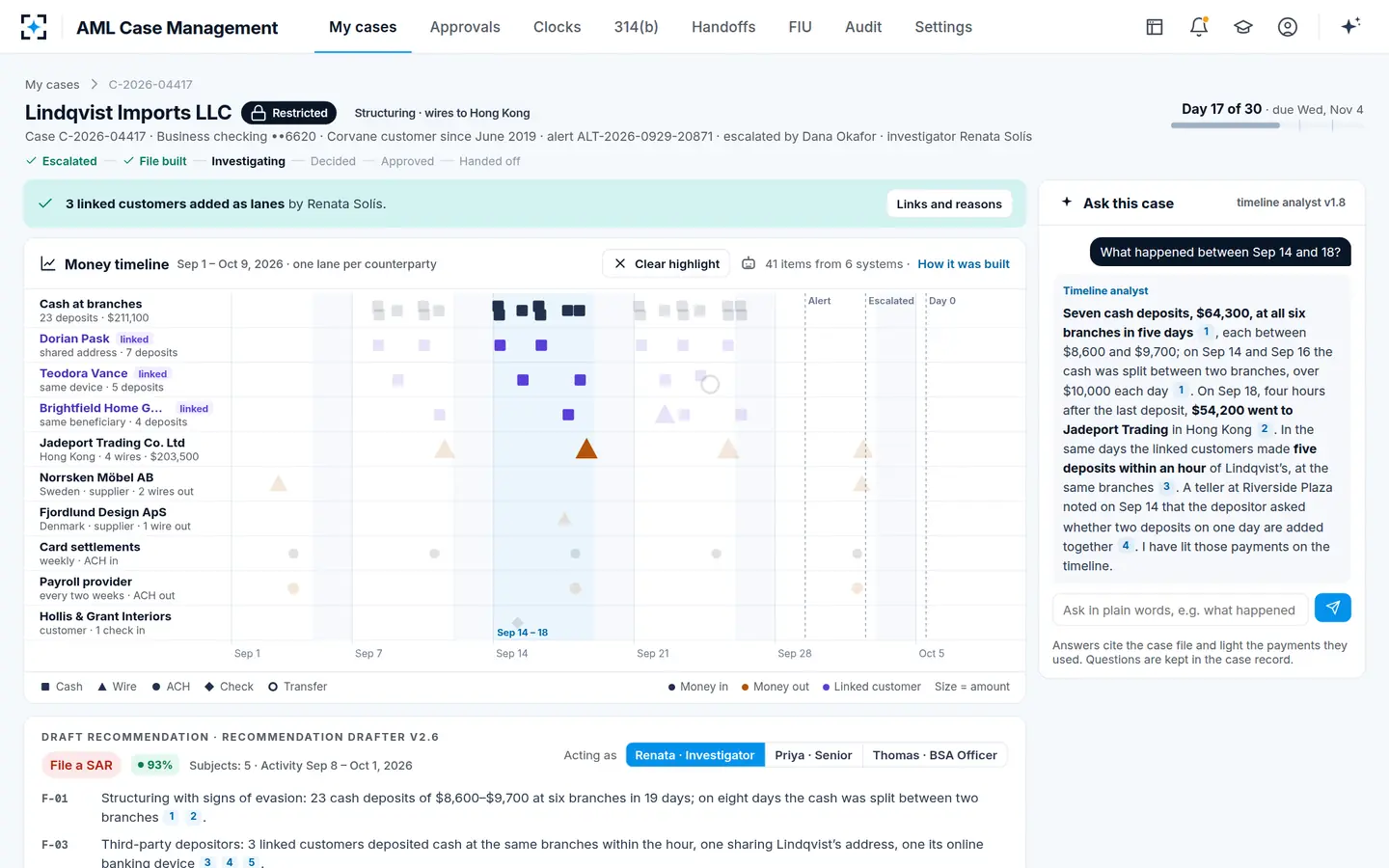
Inside the hours, gathering is the largest share. Botminds' own estimate for one escalated structuring case of moderate complexity puts it at 3 of 5.5 hours by hand: pulling statements, wires and the profile from each system, finding deposit tickets, teller notes and prior SARs, and searching for other customers one query at a time. Laying out the pattern and writing and checking the recommendation take 2 hours more, and the senior investigator's review half an hour.
AML case management software changes the mix of an investigator's hours, not just the total
By hand · 5.5 hours a case
- Gathering · 55%
- Pattern, writing, checking · 36%
- Senior review · 9%
With AML Case Management · 2.5 hours a case
- Gathering · 60%
- Pattern, writing, checking · 28%
- Senior review · 12%
The second bar is the honest one. Agents do not remove gathering; they move it from retrieval to review, which still takes the investigator time. What they remove more completely is the arithmetic: laying out 64 rows of activity and recomputing totals for the recommendation falls from 2 hours to 0.7, because the timeline is drawn and every value is checked against its source by a second agent. The senior investigator's review shrinks least, by design. It is the step the solution is built to protect.
Three ways to staff Level 2 investigations, priced on the same caseload
Priced on an illustrative caseload, agent-assisted investigation costs less than half as much in investigator labour as working by hand, and contractors cost more unless their rate is below the bank's own loaded rate. The inputs are public where they can be: a median wage of $81,100 for the federal job group that includes fraud and financial crimes investigators (O*NET, 2025), loaded by the 1.42 benefit factor FinCEN itself uses to cost bank compliance work (FinCEN paperwork notice), which gives about $55 an hour.
Annual investigator labour for 5,000 escalated cases, three ways (estimated)
Read the gap between the second and third bars as a ceiling, not a saving. On this caseload, $0.83 million a year of investigator time is what an agent-assisted approach frees. The software subscription, the work to connect it to the bank's systems, and the cost of validating and overseeing it all have to come out of that before anything is saved. A bank with a quarter of the caseload has a quarter of the ceiling, and a case management tool that only routes work, without doing any of the gathering, frees very little of it.
How many AML investigators does a bank need? A formula, not a ratio
There is no regulatory ratio of investigators to accounts or alerts. The FFIEC manual's standard is qualitative: a bank "should assign adequate staff to the identification, evaluation, and reporting of potentially suspicious activities, taking into account the bank's overall risk profile and the volume of transactions." Turning that into a headcount takes three of the bank's own numbers: escalated cases a year, hours a case, and productive case hours a year per investigator. Headcount is the first times the second, divided by the third.
The enforcement record shows what happens when the inputs drift. Bank of America's 2026 consent order records that a lower alert threshold "would result in an increase of 16,000 U.S. investigations each month, representing 'double [the] prior ongoing monthly volume'," requiring "an 'incremental 750' personnel to support such volumes going forward (in addition to 800 consultants required to complete the one-time lookback)" (FinCEN, Bank of America consent order). That is about 21 investigations a month for each added person, our arithmetic; the order does not say all 750 were investigators.
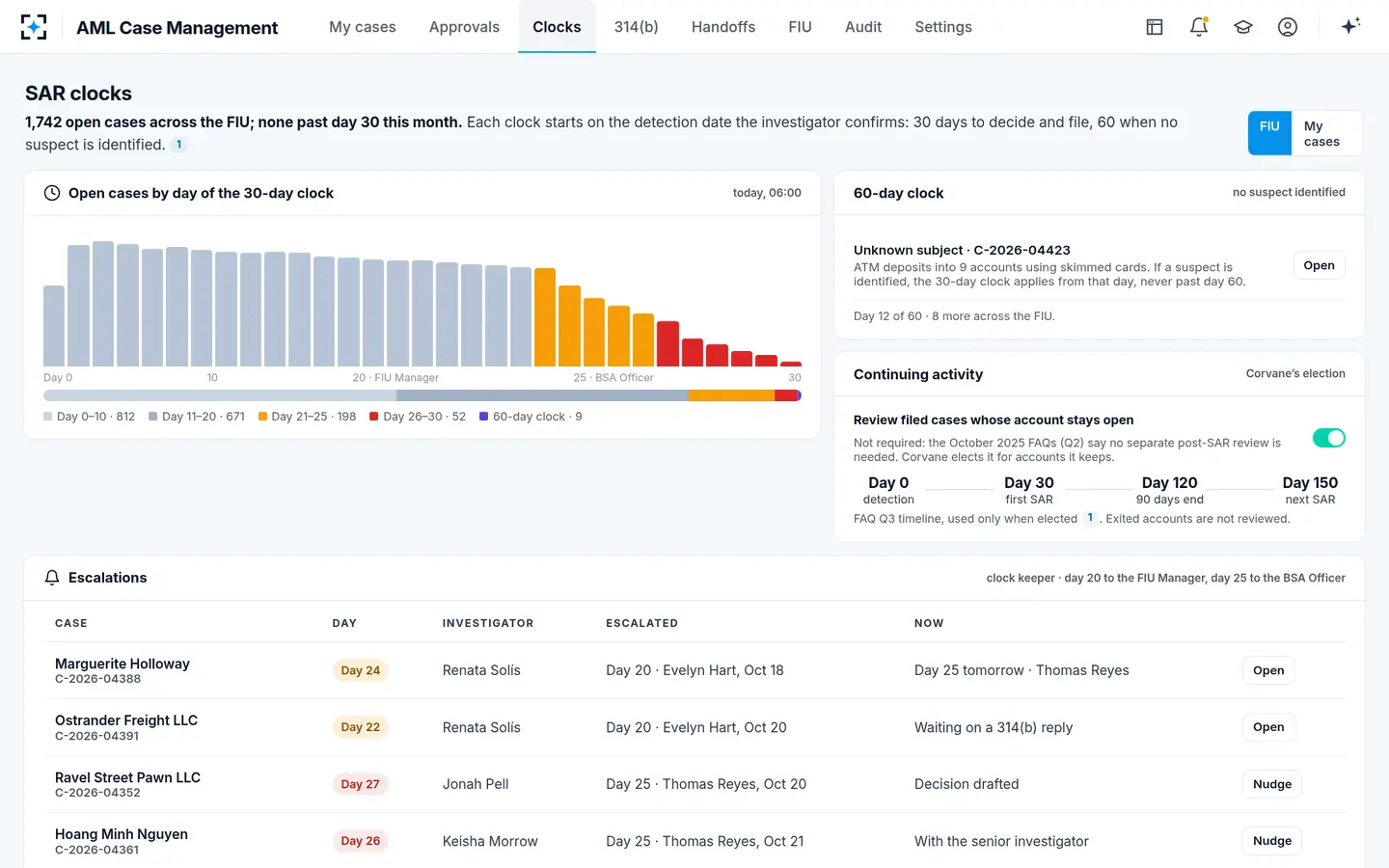
Staffing is visible on the clock: open cases by day across the unit
Should we outsource AML investigations? What USAA's contractor model shows
Outsourcing can add capacity quickly, but it cannot move responsibility, and leaning on it for the core of the function has ended badly. The interagency third-party guidance in force since 2023 says a bank that uses a third party stays as responsible for meeting its obligations as if it did the work itself (2023 third-party guidance). A replacement was proposed in September 2026; until it is final, the 2023 text applies.
USAA Federal Savings Bank is the clearest record of the risk. FinCEN found that in 2018 the bank "determined that it needed 178 permanent, full-time positions to fully staff its compliance functions," that by early 2021 it had 62 of them vacant, among them the head of its Financial Intelligence Unit, and that contractors filled about three-quarters of its compliance staffing (FinCEN, USAA consent order). The same order records a backlog of about 90,000 unreviewed alerts and 6,900 unreviewed cases by the end of 2021, a $140 million penalty, and at least 3,873 SARs not filed on time or accurately.
In-house, contracted or agent-assisted: how the three options differ beyond price
| Question | In-house, by hand | Contractors | In-house with agents |
|---|---|---|---|
| How the cost behaves | Fixed; grows in steps of one hire | Variable; a premium per hour, fast to add | Mostly fixed; software plus fewer hours a case |
| How fast capacity can grow | Months: hiring and training | Weeks | Hours a case fall at once; headcount still grows with volume |
| Who knows the customers | The bank's own staff | People who may leave with the knowledge | The bank's staff, with the evidence kept in cited files |
| Responsibility | The bank | Still the bank, under the 2023 guidance | The bank; agents may not decide or approve |
| What examiners test | The decision process and its records | The same, plus oversight of the third party | The same, plus how the bank evaluated the tool |
| Main risk | Backlog when volume jumps | Dependence, as USAA's 76% shows | Trusting output nobody checked; mitigated by citations and a second-model check |
Build vs buy AML case management: what the 2026 proposal does and does not require
No rule requires a bank to buy AML case management software, or any particular technology. FinCEN's April 2026 proposed AML/CFT program rule says so directly: it names no technology and requires none (FinCEN proposed rule, 91 FR 18704). The proposal is still proposed, its comment period closed on June 9, 2026, and it replaced a July 2024 proposal that FinCEN withdrew. Today's program rule, unchanged since 2020, does not name technology either.
Building in-house is therefore a legitimate choice, and some large banks make it. The cost of building is rarely the first version. It is connecting every source system, keeping those connections working as systems change, and proving to examiners how the tool reached what it shows. On model risk, the revised interagency guidance of April 17, 2026 excludes deterministic, rule-based processes from the definition of a model and leaves generative and agentic AI outside its scope as too new and fast-changing (OCC Bulletin 2026-13; the guide to risk rating models reads the guidance line by line). That leaves the bank's own evaluation, not a supervisory checklist, as the test for an agent-assisted tool, whoever builds it. Twelve questions to ask about an AML case management system turns that evaluation into a list.
The full cost of AML case management software, term by term
A full cost comparison has four terms, and only one of them is on a price list. The labour term is the one this guide priced. The others are the bank's to fill in with its own quotes and its own risk appetite.
What an agent-assisted AML case management tool has to beat
Investigator hours freed
cases a year × (hours by hand − hours with agents) × loaded hourly rate
On 5,000 cases at $55.37 an hour and 3 hours freed a case: about $0.83M a year.
FIU manager, from the bank's own case data
Software and connections
subscription + connecting core, payments, imaging, onboarding and case systems
Quoted by the vendor; connections often cost as much attention as the licence.
COO and IT
Validation and oversight
initial evaluation + quality sampling + approvals of setting changes
The bank evaluates the tool before relying on it, as the 2018 joint statement expects.
BSA officer and model risk
Backlog and lookback avoided
likelihood of a backlog × cost of remediation
Not priced here. USAA and Bank of America show what a lookback can take: hundreds of consultants.
Chief risk officer
Where AML Case Management fits, and where it does not
The solution pays where Level 2 volume is steady, the evidence sits in several systems, and gathering is the part of the job that eats the clock. It is built for banks that file under the 30-day rule with investigators working cases continuously: the case builder reads six systems, the link finder searches across all customers, and the verifier checks every amount, so the hours freed grow with the caseload. It also helps where the risk is backlog rather than cost: the clock keeper escalates at day 20 and day 25, so the FIU manager can rebalance before a SAR is late.
It is the wrong purchase in three situations. A bank that escalates a few cases a month frees too few hours to cover any subscription; a careful investigator with read access to the core system is the cheaper answer. A bank whose problem is alert generation, with scenarios that miss activity or flood the queue, needs its transaction monitoring tuned first; case management starts after the alert. And a bank that cannot give the agents read access to its systems of record will get a case file with gaps, which the solution names but cannot fill. What to have in place before agents start lists those systems. The solution itself is at AML Case Management.
What the hours buy: a case that opens as a money timeline
Questions people ask
How much does AML case management software cost?
Vendors price privately, by users, volume and modules, so there is no public benchmark worth quoting. The better question is what it saves: price your own caseload at your own loaded investigator rate, estimate the hours a case the tool removes, and compare the result with the quote, including the cost of connecting it to your systems and validating it.
What does an AML investigator cost?
O*NET puts the 2025 median wage for the federal job group that includes fraud and financial crimes investigators at $81,100 a year, or $38.99 an hour. Loaded with the 1.42 benefit factor FinCEN uses in its own cost estimates, that is about $55 an hour. Pay varies widely by market and seniority; senior investigators and decision makers cost more.
What is the difference between AML case management software and transaction monitoring?
Transaction monitoring generates alerts from rules or models; case management is where people work the alerts that are escalated, gather evidence, decide and hand off. Some products do both. Case management cannot fix a monitoring system that misses activity, because the case starts only after an alert.
Does using AI for AML investigations increase regulatory risk?
The current rules neither require nor forbid it. The agencies' 2018 joint statement says a pilot that fails should not, by itself, draw supervisory criticism, and FinCEN's April 2026 proposal, not yet final, would add that responsible experimentation does not create additional enforcement risk. The bank still owns every decision and must evaluate the tool before relying on it.
How long does it take for AML case management software to pay back?
It depends almost entirely on volume and hours a case. On the illustration above, the labour a year freed is about $0.83 million on 5,000 cases; on 500 cases it is a tenth of that. A pilot on cases the bank has already decided, compared with what its investigators found, is the quickest way to measure the hours on the bank's own work.