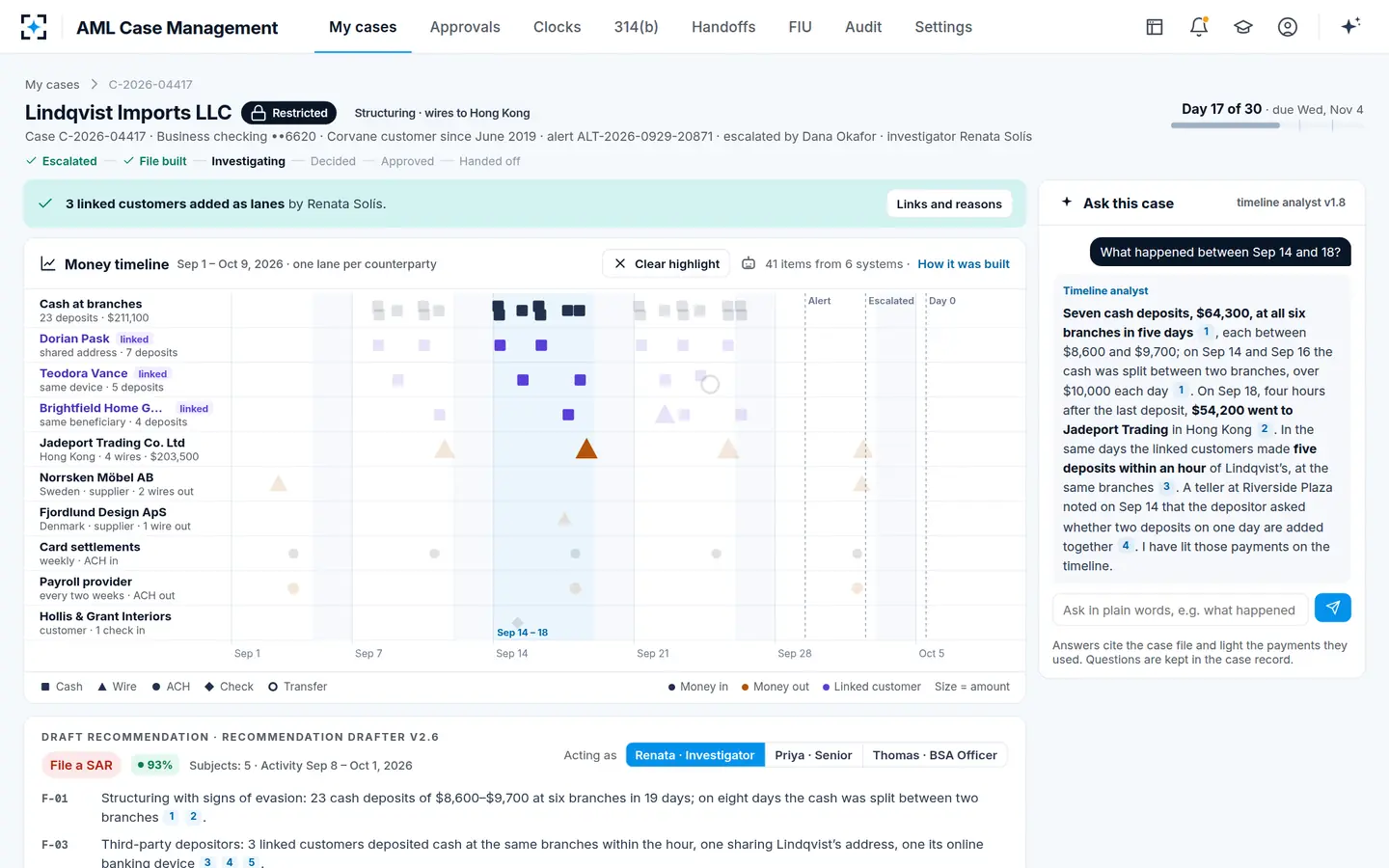
The difference between a funnel account and a pass-through account is the source and the geography of the money. FinCEN defines a funnel account as "an individual or business account in one geographic area that receives multiple cash deposits, often in amounts below the cash reporting threshold, and from which the funds are withdrawn in a different geographic area with little time elapsing between the deposits and withdrawals." A pass-through account has no regulatory definition: it describes any account where money arrives and leaves again quickly, leaving little behind, whatever the source. Every funnel account is a pass-through account, but payroll, settlement and sweep accounts pass money through every day for good reasons. What separates them is evidence an investigator has to assemble: who put the money in, where, in what form, and whether where it went fits the customer's business. Botminds' AML Case Management lays that evidence out as a money timeline for Level 2 investigators, with every counterparty in its own lane.
The worked example on this page uses fictional sample data: Corvane National Bank and its customer Lindqvist Imports LLC are invented.
Funnel account vs pass-through account: how the money moves
Funnel account
Pass-through account
What is a funnel account? FinCEN's definition, part by part
A funnel account is defined by four features, each of which an investigator can test. FinCEN's 2014 advisory, still posted on its site, describes an account "in one geographic area," receiving "multiple cash deposits," "often in amounts below the cash reporting threshold," with funds "withdrawn in a different geographic area with little time elapsing" (FIN-2014-A005). The first feature is about the account's home, the second and third about how money arrives, the fourth about where and how fast it leaves.
Treasury's 2026 National Money Laundering Risk Assessment adds two features from law enforcement's experience. Funnel accounts are "often held in the name of nominees," and professional launderers "tend to open funnel accounts at large banks with national footprints so their couriers can deposit bulk cash from anywhere in the country" (2026 NMLRA). The assessment also notes that the threshold is not a constant: where accounts are held by nominees at several banks and deposits are made with fake identification, launderers "may choose to deposit cash without regard to reporting thresholds."
Small, disparate deposits at different locations can initially appear legitimate at a local level. Only at an aggregated level does the pattern of funneling reveal itself, generally after money has been moved from the account.
U.S. Treasury, 2026 National Money Laundering Risk Assessment
That sentence is the investigator's problem in one line. A branch sees one deposit of $8,900. The account, seen whole, receives dozens in several states. The network, seen whole, may route several accounts into one beneficiary. A funnel is visible only to someone who looks across branches, accounts and counterparties at once.
Funnel account vs pass-through account: the differences, row by row
The two patterns share speed and differ in almost everything else. A pass-through account is defined only by money moving through it quickly; a funnel account adds cash, many depositors, distance and, usually, amounts kept under the reporting threshold. That makes "pass-through" a description of behaviour that needs explaining, and "funnel account" a typology FinCEN asks banks to name when they report it.
A funnel account is a pass-through account with a cash, geography and nominee signature
Funnel account: FinCEN, in Advisory FIN-2014-A005.
Pass-through account: No regulatory definition; a description of fast in-and-out activity.
Funnel account: Cash, often under $10,000, from several depositors at distant branches.
Pass-through account: Any form: wires, ACH, checks, money orders, card or app receipts, cash.
Funnel account: Withdrawn in another region, or wired or checked to businesses unrelated to the account holder's trade.
Pass-through account: Out within hours or days, to wherever the customer pays.
Funnel account: A business with real branches or routes depositing takings in several places.
Pass-through account: Payroll, settlement, escrow and sweep accounts; payment processors.
Funnel account: Depositors and places that do not fit the customer, and debits unrelated to the stated business.
Pass-through account: Flows inconsistent with the customer's business or history.
Funnel account: "Funnel Account"; "TBML" and "MX Restriction" where they apply.
Pass-through account: None of its own; the typology behind it decides the terms.
What is a pass-through account? A pattern to explain, not a product
A pass-through account is an account through which funds move without staying, and the phrase is used for behaviour rather than for a type of account a bank sells. The FFIEC manual's red flags describe its suspicious form: "Many small, incoming transfers of funds are received, or deposits are made using checks and money orders. Almost immediately, all or most of the transfers or deposits are wired to another city or country in a manner inconsistent with the customer's business or history" (FFIEC Appendix F). The last clause carries the test. Money moving through quickly is not the flag; money moving through in a way the customer's business does not explain is.
Enforcement records use the phrase for very different schemes. FinCEN's 2023 order against Shinhan Bank America describes a customer who "engaged in a pattern of pass-through activity indicative of tax evasion," with about $4.7 million cycling from a real estate business account to a non-profit's account and on to the personal accounts of the non-profit's signers (FinCEN, Shinhan order). The 2026 risk assessment describes a 2025 indictment alleging that two men took over elderly victims' accounts and moved the money "through pass-through accounts created in the victims' names." Neither involved cash funnelled from distant branches.
One term is easy to confuse with both. A payable-through account is a defined correspondent banking product: "a correspondent account maintained by a covered financial institution for a foreign bank by means of which the foreign bank permits its customers to engage, either directly or through a subaccount, in banking activities usual in connection with the business of banking in the United States" (31 CFR 1010.610). It is a correspondent-banking risk with its own due diligence rules, not a retail laundering pattern.
What are funnel account red flags? The advisory's six, and what each looks like in a case
FinCEN's advisory lists six red flags for funnel accounts used in trade-based money laundering, and insists that none of them, alone, clearly indicates trade-based money laundering. The table checks each against the sample case, which shows how rarely a real case matches a typology cleanly.
Funnel account red flags, checked against the sample case
| Red flag in FIN-2014-A005 | In the sample case? | Evidence |
|---|---|---|
| Cash deposits under $10,000 by unidentified persons at branches outside the account's region | Partly | 23 deposits of $8,600 to $9,700 at six branches; all of them the bank's own local branches, not out of region |
| Business account: deposits in a region where the business does not operate | No | The branches are in the customer's market |
| Depositors know little about the business, the account holder or the source of the cash | Not tested | A teller noted the depositor asked whether two deposits on one day are added together |
| Debits unrelated to the stated business | Yes | $203,500 in four wires to a Hong Kong trading company absent from the profile, with no invoice; regular suppliers paid less |
| Checks with different handwriting on the payee and amount lines than on the signature | No | No checks drawn on the account in the period |
| Wires or checks cleared through a Mexican bank's US correspondent account | No | Wires went to Hong Kong |
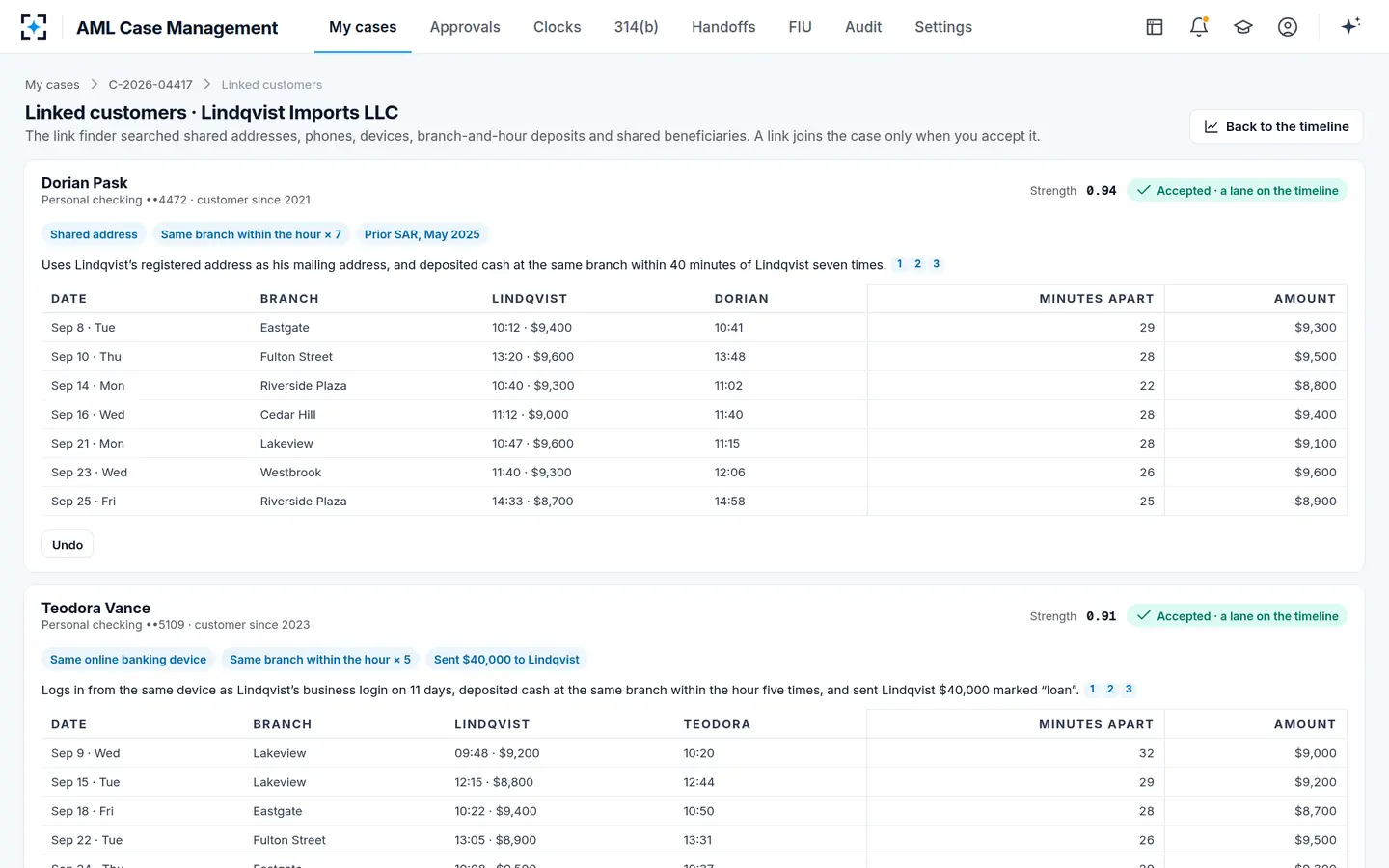
The sample case is not a textbook funnel account. It is something investigators see more often: cash structured below the threshold across branches, wires that do not fit the business, and, as the link finder showed, three other customers whose cash went in at the same branches within the hour and whose money ended up at the same Hong Kong account. At the level of the network it funnels; at the level of the account it passes through. A report that named only one of those would miss half the case.
How is a funnel account used in trade-based money laundering?
In trade-based money laundering, the funnel account's outflows buy goods instead of being withdrawn as cash. FinCEN's advisory describes four steps: a business owner colluding with a criminal organization opens an account at a bank whose accounts "can readily receive cash deposits in multiple states"; couriers deposit drug proceeds at distant branches, keeping deposits "below $10,000 in order for transactors to avoid identification and record keeping requirements"; an intermediary wires or writes checks from the account to businesses selling goods; and the goods are shipped abroad and sold for local currency, which goes to the organization. The advisory notes this "differs from traditional funnel account activity where cash would otherwise be withdrawn."
GAO's 2025 report on synthetic drugs found the pattern still in use, citing Treasury's 2024 risk assessment that "Funnel accounts remain a key tool for moving funds across the Mexican border," and describing accounts opened for Chinese money laundering networks that "operate as funnel accounts: couriers deposit funds that are quickly withdrawn and used to purchase cashier's checks made out to third parties not associated with the account" (GAO-26-107918).
AML Case Management's money timeline: one lane per counterparty
Is a funnel account illegal? When near-threshold cash becomes structuring
An account is not illegal; what is done through it can be. Structuring is a federal crime in any amount: no person may, "for the purpose of evading the reporting requirements," structure "any transaction with one or more domestic financial institutions" (31 USC 5324). The FFIEC manual adds that the transactions "need not exceed the $10,000 CTR filing threshold at any one bank on any single day in order to constitute structuring" (FFIEC Appendix G).
For the bank, the question is narrower than the crime. Since October 9, 2025, the interagency SAR FAQs say that cash at or near $10,000 alone does not require a SAR; the bank files when it knows, suspects or has reason to suspect the transactions were designed to evade reporting (SAR FAQs, Q1). The FFIEC manual's own example makes the same point: "if a customer deposits $9,900 in currency on Monday and deposits $9,900 in currency on Wednesday, it should not be assumed that structuring has occurred." What turns a pattern into evidence of design is everything around the amounts: split days, third-party depositors, a question to the teller about how deposits are added up.
Research suggests investigators should not assume launderers know a bank's internal thresholds. A peer-reviewed study of one large Danish bank's transactions found no sign of smurfing, and so no sign that the bank's thresholds had leaked, while showing its method could detect smurfing affecting as little as 0.1 to 0.5% of transactions in simulation (Jensen, Ferwerda and Wewer, 2025). The $10,000 reporting threshold is public, and it is the one structuring works around.
Telling them apart on a real case: five questions that separate the patterns
Five questions separate a funnel from a legitimate pass-through, and each has an answer in the bank's own data. The order matters: start with whether the flow fits the customer, because a payroll account that passes money through is explained before any typology is needed.
Five questions that tell a funnel account from a legitimate pass-through account
- Does the flow fit the customer's business?
Compare inflows and outflows with the profile's expected activity and the customer's known suppliers and payees.
- Who put the money in, and where?
Deposit tickets, teller notes and branch logs show whether depositors are the customer, its staff or strangers at distant branches.
- What form did it arrive in?
Cash from many hands points one way; payroll funding by wire from the employer points another.
- Where did it go, and how fast?
Withdrawals in another region, or payments to businesses unrelated to the trade, within days.
- Who else does the same thing?
Other customers depositing at the same branches and hours, sharing an address or device, or paying the same beneficiary.
The fifth question is the one investigators most often cannot answer by hand, because it means searching every customer for shared addresses, devices, beneficiaries and same-branch, same-hour deposits. In the solution the link finder runs those searches and proposes links with their reasons, and the investigator decides which are real.
The fifth question, answered: customers who deposited at the same branch within the hour
What SAR key terms are used for funnel accounts?
FinCEN asks filers to name the pattern so its analysts can find it. The 2014 advisory requests the term "MX Restriction" for activity connected to Mexico's restrictions on US cash, and adds that "including specific reference to the terms 'Funnel Account' and or 'TBML' in the Narrative and Suspicious Activity Information sections of SARs is also requested." The terms go in the narrative and in the "Other" fields of the suspicious activity categories. Key terms help only when the narrative explains the pattern; how the sample case was worked from alert to decision is in an AML case study, day by day, and the full sequence of steps in the AML investigation steps. The solution is at AML Case Management.
Questions people ask
What is FinCEN's funnel account advisory?
It is FIN-2014-A005, issued May 28, 2014, "Update on U.S. Currency Restrictions in Mexico: Funnel Accounts and TBML." It defines a funnel account, describes how funnel accounts finance trade-based money laundering after Mexico restricted US cash deposits in 2010, lists red flags and requests the SAR key terms "MX Restriction", "Funnel Account" and "TBML".
Can a funnel account be a business account?
Yes. The advisory says accounts receiving out-of-state deposits "can be either individual or business accounts," and gives the example of a Southern California produce company's account receiving small cash deposits in Chicago, Indianapolis and Minneapolis, with wires going to a textile manufacturer in China.
Is a pass-through account the same as a money mule account?
Not necessarily. A money mule account is one whose holder moves money for someone else, knowingly or not, and it often behaves as a pass-through account. But pass-through describes only the speed of the flow; a mule account is defined by who controls the money. Investigators establish the second from depositors, devices and the holder's own account history.
Do funnel accounts always use deposits under $10,000?
No. Treasury's 2026 risk assessment says that where launderers use nominee accounts at several banks and fake identification, they may deposit cash without regard to reporting thresholds. Amounts under $10,000 are common, not defining.
Should a bank close a funnel account?
That is the bank's decision under its own standards; the FFIEC manual leaves closure to the bank and expects procedures for escalating repeat SAR filings. If law enforcement asks the bank to keep the account open, the request should be in writing, and the bank must still file SARs on what it sees.