The best published wire fraud recovery rate is a freeze rate. In 2025 the FBI's Internet Crime Complaint Center (IC3) froze $679,013,183 of $1,163,919,846 in attempted theft that its Recovery Asset Team handled, a 58% success rate, through a process called the Financial Fraud Kill Chain. FinCEN's Rapid Response Program, which chases money sent abroad, had $362.6 million reported to it in fiscal 2025 and saw $182.2 million, 50%, frozen by its partners, of which $95.5 million was returned to victims within the year. None of these numbers is the share of all wire fraud recovered: they count only cases reported to those programs, and frozen is not the same as returned. What they agree on is time. FinCEN says it is most likely to stop or recover funds when a fraudulent wire reaches law enforcement within 72 hours, so recovery is a function of hours, and a bank can price the hours it controls.
This page reads the published numbers carefully and then turns to what a bank can measure on its own book. The worked figures at the end come from Wire & Instant Payment Recall, Botminds' software for recalling fraudulent wires and instant payments, run on a fictional bank with sample data; they are not a customer's results.
Wire fraud recovery rates, as the FBI and FinCEN publish them
58%
of attempted theft frozen through the FBI’s Financial Fraud Kill Chain in 2025
$1.16billion
attempted theft in 3,900 kill chain incidents in 2025
50%
of $362.6 million reported to FinCEN’s Rapid Response Program frozen in fiscal 2025
72hours
from the transaction: FinCEN’s window for reporting to law enforcement
What percentage of wire fraud is recovered?
Nobody publishes that number, and it would be hard to measure. Most wire fraud never reaches a national program: a bank recalls a payment directly, or a loss is written off without a complaint, and neither appears in the FBI's or FinCEN's figures. What exists are the success rates of the two federal channels that help banks freeze money: the IC3's Financial Fraud Kill Chain for transfers that reach it, and FinCEN's Rapid Response Program for funds that went abroad. Both measure freezes at the receiving bank after law enforcement asks, and both depend on how quickly the case reached them.
The scale of what never reaches them can be bounded. The IC3 recorded $3,046,598,558 in business email compromise losses in 2025, from 24,768 complaints. Its kill chain handled $1,163,919,846 of attempted theft of every kind that year. Even if every kill chain dollar had been business email compromise, which it was not, most of the reported losses never went through the process at all. For those losses the only recovery effort was the banks' own recalls, and no national figure measures how those went.
Frozen is not returned: four published rates for recovering fraudulent transfers
Frozen is not recovered: reading the published numbers
A freeze stops the money leaving the receiving account; recovery is the money arriving back with the victim. Between the two sit the receiving bank's own review, any claim by its customer, the sending bank's indemnity and, for funds abroad, a foreign authority's process. FinCEN's fiscal 2025 figures show the gap plainly. Of the $362.6 million reported to the Rapid Response Program, $182.2 million was frozen, and "$95.5.M out of the $182.2M that was frozen was returned to victims in FY25", as FinCEN's report prints it. The program's April 2026 fact sheet gives a second view: since January 20, 2025, more than $268.2 million interdicted and $157.3 million recovered, so roughly three dollars in five that were stopped came back (our arithmetic). Either way, a freeze is the start of recovery, not the end of it.
Where the money reported to FinCEN’s Rapid Response Program went in fiscal 2025
$362.6 million reported to the program
- Returned to victims in FY25 · 26%
- Frozen, not returned within FY25 · 24%
- Not frozen · 50%
The second reason to read carefully is that the case mix changes. The IC3 says that in the past most kill chain incidents were business email compromise, but that in 2025 the process saw a rise in tech support and account takeover cases, some with dozens of transactions to different banks at once. A fall from 66% in 2024 to 58% in 2025 may reflect harder cases as much as slower reporting; the report does not say which, and nothing here should be read as a trend in how well banks recall wires.
What is the Financial Fraud Kill Chain, and how much does the FBI recover?
The Financial Fraud Kill Chain is the FBI's process for asking banks to freeze money that victims report through the IC3, run by the IC3's Recovery Asset Team, set up in 2018, which works between banks and FBI field offices. For transfers abroad the team works through FinCEN and the FBI's legal attachés. In 2025 it handled 3,900 kill chain incidents with $1,163,919,846 in attempted theft and froze $679,013,183, which the report calls a 58% success rate. In 2024 the comparable figures were 3,020 complaints, $848.4 million attempted and a 66% success rate. These are freezes requested by law enforcement after a complaint, and they complement a bank's own recall rather than replace it. Stopping a fraudulent wire before it leaves the bank, which no freeze rate measures, is the work of Wire Fraud Prevention.
The cases the report describes show what the rate depends on. In one from August 2025, buyers closing on a home wired over $449,000 on instructions from an email impersonating their lawyers. Their lawyers tried the recipient bank directly without success; once the IC3 complaint was filed, the team asked for a freeze, and "The RAT received notification from the recipient bank that the full amount was still in the account and on hold." The money had not moved, and the right request reached the right desk.
Recovery rates differ with the victim and the scheme
The 58% is an average over very different cases, and the report breaks out two groups. For businesses and organizations in the 16 critical infrastructure sectors, the team initiated 655 incidents with $261,451,001 in reported losses and froze $146,561,094, a 56% success rate. For victims aged 60 and over, it handled 642 incidents with $65,367,648 in reported losses and helped freeze $32,865,655, about half (our arithmetic); most of those were tech support and account takeover scams rather than email compromise. A bank comparing its own rate with the national figure should compare like with like: a commercial customer's email-compromise wire reported the same afternoon is a different case from an older customer's scam payments spread over weeks.
What is the FinCEN Rapid Response Program?
It is FinCEN's channel for funds sent abroad. When law enforcement refers a victim's complaint involving a foreign beneficiary account, FinCEN asks the foreign financial intelligence unit to stop and return the money under that country's own powers. Since 2015, by FinCEN's April 2026 fact sheet, the program has helped interdict $1.8 billion and recover over $1 billion for 5,790 US victims, in cases involving 96 foreign jurisdictions. Business email compromise was the largest typology of funds frozen in fiscal 2025, at $90,954,662.26 of the $182.2 million.
The fact sheet is direct about the clock: "FinCEN is most likely to be able to interdict or recover funds when fraudulently induced wire transfers are reported to law enforcement within 72 hours of the transaction." FinCEN's 2019 advisory on email compromise had set the bar tighter, saying it "has had greater success in recovering funds when victims or financial institutions report BEC-unauthorized and fraudulently induced wire transfers to law enforcement within 24 hours." The two statements come from different years and are not a change of rule; together they say that a day is better than three.
Are international wires harder to recover?
The published data cannot say how much harder, because it gives the amount frozen by route but not the amount attempted. What it does show is that international cases are fewer and larger. In 2025 the IC3's domestic process handled 3,574 incidents and froze $507,042,623; its international process handled 326 incidents and froze $171,970,560, about $527,500 per incident against about $141,900 domestically. International freezes also depend on a foreign authority acting under its own law, which a US bank cannot direct.
Domestic and international kill chain freezes, 2024 and 2025
| Domestic | International | |
|---|---|---|
| Incidents or complaints, 2025 | 3,574 | 326 |
| Frozen, 2025 | $507,042,623 | $171,970,560 |
| Frozen per incident, 2025 (our arithmetic) | ≈ $141,900 | ≈ $527,500 |
| Complaints, 2024 | 2,651 | 369 |
| Frozen, 2024 | $469.1 million | $92.5 million |
Does speed affect wire recovery?
Every source cited on this page that addresses it says yes, and the mechanism is simple: the recall can only freeze what is still in the first account. FinCEN's 72-hour and 24-hour statements, the IC3's advice to contact the bank immediately, and its cases where the full amount was still on hold all point the same way. What none of them publishes is a curve, how much recovery falls with each hour, and a bank should be wary of anyone who quotes one without a source.
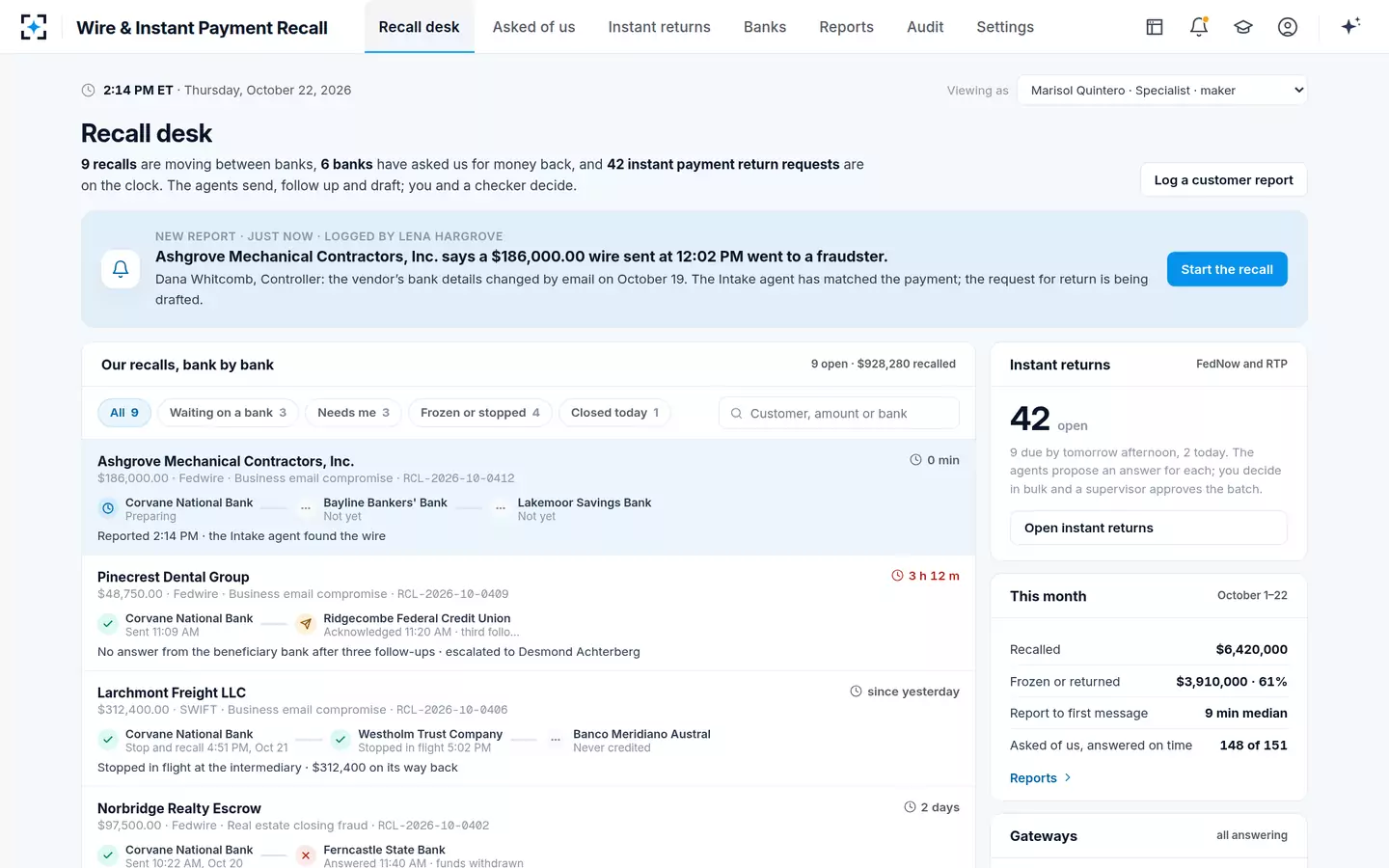
A bank can draw its own. In the sample recall on the solution's other pages, the money sat untouched in the beneficiary's account for 89 minutes before $38,500 left by wire, and the request arrived 2 hours 23 minutes after the payment, because the customer reported 2 hours 12 minutes after sending it. $142,000 of $186,000 was frozen. Had the request arrived an hour later, nothing on the screen says how much more would have gone; that is exactly the figure a bank learns only by recording, recall by recall, how long the money stayed and when the request arrived. The minute-by-minute trace is in how long a wire recall takes.
Pricing an hour of delay on your own book
The cost of delay is the money that leaves the first account between when the bank could have asked and when it did. That can be estimated from the bank's own recalls without any industry figure, by recording three times on every recall: when the payment arrived at the beneficiary's bank, when each amount left that account (the other bank's answer usually says), and when the request arrived. The structure below is how to set it up; the values have to come from your own records.
What an hour of delay costs on one wire recall: the terms to fill from your own records
Frozen on the first hop
amount still in the account when the request arrives × that bank’s freeze rate
From the answer message and the bank’s record across past recalls.
Recall desk
Recovered on later hops
onward amounts × the share recovered through the next bank or law enforcement
Usually small; track it separately so it does not flatter the first number.
Fraud investigations
Moved before the request
amounts that left the account before the request arrived
The answer usually lists them with times; this is the term delay grows.
Recall desk
Cost of the return
indemnity exposure + fees + staff time
The receiving bank’s losses and expenses the sender may owe under UCC 4A-211.
Payment operations and legal
What the sample bank’s own recovery rate looks like
A bank's own rate is the one that means something to its board, and it is easy to keep once every recall has the same fields. On the sample bank's recall desk, the month to date reads $6,420,000 recalled and $3,910,000 frozen or returned, 61%, with a median of 9 minutes from a customer's report to the first message, and 148 of 151 requests from other banks answered on time. These are sample figures on a fictional bank, shown to illustrate the measures, not a benchmark.
The recall desk keeps the recovery rate as it goes
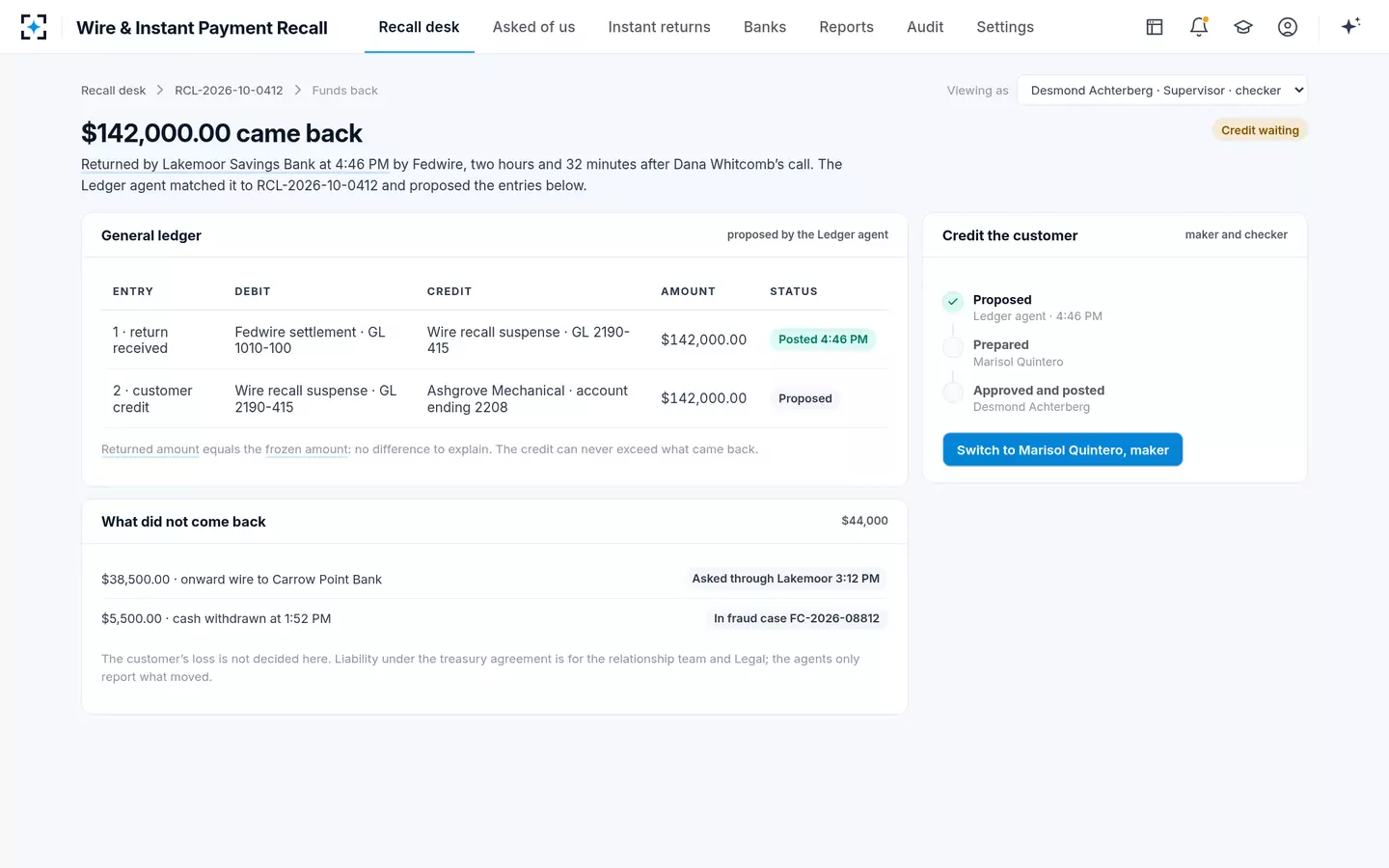
The useful split is between what came back and what did not, with the reason. On the sample recall, $142,000 came back the same afternoon and $44,000 did not: $38,500 because it had already been wired to another bank and $5,500 because it had been withdrawn in cash before the customer called. A rate that records the reason for every dollar not recovered tells a bank whether its problem is late reports, slow requests, or banks that do not answer.
What came back, and what did not, with the reason for each dollar
The numbers a recall desk should report
Five measures, kept on every recall, give a bank its own recovery rate and the reasons behind it. None needs an industry benchmark to be useful; each tells management where the next hour can be won.
Five measures for a wire recall desk’s own recovery rate
- Report to request sent, in minutes
The part the bank controls entirely. Median and the slowest tenth.
- Payment to report, in hours
How late customers find out; the case for prevention and customer education.
- Share frozen, and share returned
Kept apart, as the federal programs do, so a freeze waiting on paperwork is not counted as money back.
- Reason for every dollar not recovered
Gone before the report, gone before the request, refused, onward hop, or cash.
- Answer time by counterparty bank
Which banks answer in minutes, which need a call, and which need their BSA officer.
The same measures make the case for, or against, new tooling: a buyer should ask any vendor which of them the product records without retyping, as set out in payment recovery software, tested on a second hop.
Questions people ask
What is the difference between frozen and recovered funds?
Frozen funds are held at the receiving bank and can no longer leave the account; recovered funds have been returned to the victim. In FinCEN's fiscal 2025 figures, $182.2 million was frozen and $95.5 million of it returned within the year. A frozen balance can still take days or longer to come back, for example while the sending bank signs an indemnity or a foreign authority acts.
What is the IC3 Recovery Asset Team?
A team at the FBI's Internet Crime Complaint Center, set up in 2018, that works with banks and FBI field offices to freeze funds after a complaint. In 2025 it handled 3,900 Financial Fraud Kill Chain incidents and froze 58% of the attempted theft. It can follow second-hop transfers when the complaint includes their details.
Does the 58% include money banks recalled on their own?
No. It covers only incidents the Recovery Asset Team handled through the kill chain process. A bank that recalls a wire directly, without a complaint reaching the team, does not appear in the figure, which is one reason a bank's own recovery rate can differ widely from it.
Why did the FBI's rate fall from 66% to 58%?
The report does not say. It does note that 2025 saw more tech support and account takeover cases, some with many transactions to different banks at once, where earlier years were mostly business email compromise. Read the two years as different case mixes, not a measure of banks' recall speed.
How should a bank measure its own recall recovery rate?
Record, on every recall, the amount at risk, what was frozen, what was returned and the reason for every dollar that was not, alongside the minutes from report to request. The share returned, split by those minutes, is the bank's own evidence of what an hour costs.