Can a fraud wire transfer be reversed? Not by the sending bank alone. Once the beneficiary's bank has accepted a wire, it comes back only if that bank agrees to return it and the money is still in the account, so whether a fraudulent wire can be reversed depends on speed and on one fact: the beneficiary account number, where it came from and what the receiving bank knew about it. Article 4A of the Uniform Commercial Code lets the beneficiary's bank rely on the number even when the name on the payment does not match, and in 2025 the Fourth Circuit held in Studco v. 1st Advantage that a receiving institution is not liable for doing so unless it actually knew of the mismatch. The Supreme Court declined to hear the case on October 6, 2025. A fraud wire is therefore reversed through a recall, not through a claim that the other bank should have noticed.
This page follows that number from the email that planted it to the account that received the money, and shows what a recall needs to prove about it. The worked example comes from Wire & Instant Payment Recall, Botminds' software for recalling fraudulent wires and instant payments, run on a fictional bank, customer and counterparties with sample data.
The account number problem in a business email compromise, in four numbers
$558,868.71
paid in four ACH transfers to a number from a spoofed email, in Studco
51days
from the first spoofed email to the day the receiving credit union heard of the scam
$0
recovered: the court records that none of the money came back
$3.05billion
business email compromise losses reported to the FBI’s IC3 in 2025, from 24,768 complaints
Can a fraud wire transfer be reversed?
Only with the receiving bank's cooperation, and only for what is left. A wire is not a card payment: there is no chargeback, and for a business customer no consumer-protection rule that makes the sending bank refund a payment the customer itself authorized. FinCEN put the problem plainly in its advisory on email compromise schemes: "Such transactions are often irrevocable, which renders financial institutions and their customers unable to cancel payments or recall the funds." What remains is a request for return, sent on the payment's rail to the bank that holds the money, asking it to freeze and return the funds.
The request can still work: a beneficiary's bank that is told quickly, with evidence, can freeze an account it has reason to doubt. In 2025 the FBI's Recovery Asset Team froze $679 million of $1.16 billion in attempted theft that reached it, 58%, though that counts freezes, not money returned, and covers only cases reported to it. The sending bank's part is to send the request in minutes and to make it convincing, and that starts with the account number. The national figures are read in detail in the wire fraud recovery rate.
Was the wire authorized? Two kinds of fraud, two sets of rules
The first question about any fraud wire is who gave the payment order, because the law treats the two answers very differently. The Federal Reserve's FraudClassifier model sorts payment fraud by who initiated the payment, and two of its categories describe the usual fraud wire: "Authorized Party Was Manipulated", where the customer's own staff sent the wire after being deceived, and "Unauthorized Party Modified Payment Information", where someone else changed or sent the order.
A business email compromise that changes a supplier's bank details usually lands in the first category: the customer authorized the wire, to the wrong account. If instead a criminal used the customer's own credentials to send it, the order may be unauthorized, and Article 4A then asks whether the bank followed a security procedure the customer agreed to. Under UCC 4A-202(b), an order the bank accepted under such a procedure is the customer's order "whether or not authorized, if (i) the security procedure is a commercially reasonable method of providing security against unauthorized payment orders" and the bank acted in good faith and complied with it. Who bears the loss in each case is a liability question for the prevention side, set out in what UCC 4A puts on each side of a wire fraud. Either way, the recall is the same: get to the money first.
Where the number came from: an email, not the supplier
In an email compromise, the beneficiary account number is the fraud. Everything else on the payment, the supplier's name, the invoice number, the amount, is real. The facts in Studco are typical. A metal fabricator in New York that had done business with its Ohio steel supplier for over nine years received an email in October 2018 saying the supplier had changed banks, with a new account number at a credit union in Virginia. The court notes that the email came from the domain "Olysteel.net" instead of the supplier's "Olysteel.com", that the sender's address did not match the signature block, and that the fabricator did not verify the change. Four payments totalling $558,868.71 followed.
The beneficiary account number’s path in an email compromise, and what checked it at each step
- 1
The fraudster
Sends “new bank details” from an address made to look like the supplier’s.
Checks: Nothing. This is where the number is born.
- 2
The customer’s payables team
Updates the supplier record and keys the payment: the real supplier’s name, the new account number.
Checks: The only point where a phone call to a known number can catch it, before the wire is sent.
- 3
The sending bank
Authenticates the customer under the agreed security procedure and executes the order.
Checks: That the order came from the customer, not whose account the number is.
- 4
The rail and any intermediary
Carry the number and the name in the payment message.
Checks: Format and routing.
- 5
The beneficiary’s bank
Credits the account the number identifies.
Checks: Under UCC 4A-207, it may rely on the number and need not compare the name.
- 6
The account holder
Moves the money on, by wire, cash or both.
Checks: In Studco, a recruited account holder who believed the work was real.
The account at the other end usually belongs to someone the fraudster recruited, not to the fraudster. In Studco it was held by a long-time customer of the credit union who had answered an advertisement for a job as an assistant to real estate professionals and evidently believed the deposits and withdrawals were legitimate business. The receiving bank's customer was a victim too, which is one reason a receiving bank weighing a recall request looks at the account's own history, not just the incoming payment.
What the beneficiary's bank checks, and what it may ignore
It credits the account the number identifies, and the law says that is enough. A payment order names the beneficiary twice, by name and by account number, and when the two point to different people UCC 4A-207(b)(1) settles which one wins: a beneficiary's bank that does not know the name and number belong to different people may pay the account the number identifies, and it has no duty to check that they match. The UCC 4A-207 guide covers the rule from the investigations side.
What the sender assumes about the account number, and what the beneficiary’s bank actually checks
What the sending customer assumes: The supplier’s name on the payment protects it: a bank will not credit a stranger.
What Article 4A lets the beneficiary’s bank do: It may rely on the number and need not compare the name (4A-207(b)(1)).
What the sending customer assumes: Any bank whose system flags a mismatch will stop the payment.
What Article 4A lets the beneficiary’s bank do: No liability for crediting by number unless a person there actually knew of the mismatch (Studco, 2025).
What the sending customer assumes: The bank that let the fraudster’s account take the money.
What Article 4A lets the beneficiary’s bank do: Refund claims run along the chain, from each sender to the bank it paid, starting with the customer’s own bank.
What the sending customer assumes: The payment can be reversed once the fraud is clear.
What Article 4A lets the beneficiary’s bank do: Only by a recall the beneficiary’s bank agrees to, and only from what is still in the account.
What did the Studco case decide?
That a receiving institution which credits an account by its number is not liable for a name mismatch unless it actually knew of it. The district court had found the credit union liable for $558,868.71 plus fees, reasoning that reasonable routines would have caught the mismatch. The Fourth Circuit reversed on March 26, 2025, amended April 2: "a bank such as 1st Advantage has no liability under § 8.4A-207 unless it had actual knowledge of the misdescription." Knowledge, the court said, means actual knowledge, not what the bank could have learned with due diligence.
The facts make the holding sharper. The credit union's system did flag every one of the four deposits, but, in the court's words, it produced hundreds to thousands of name-mismatch warnings a day and told no one about any of them, and nobody read them. The court treated that as the design of the system, not a failure of it: requiring individual review of every such discrepancy "would impede the efficient transfer of funds, imposing gridlock on the financial system." The Supreme Court denied review on October 6, 2025.
Two details matter when the case is cited for wires. The payments in Studco were ACH credit transfers, which the court decided under Article 4A as Virginia enacted it; the rule in 4A-207 is the same for a wire. And the decision is binding precedent only in the Fourth Circuit, though the court cited an Eleventh Circuit decision that rejected the same due-diligence argument.
"The policy of the Uniform Commercial Code is clearly to facilitate funds transfers by enabling the beneficiary’s bank to rely solely on valid account numbers when making deposits and not requiring it to examine and address every discrepancy."
U.S. Court of Appeals for the Fourth Circuit, Studco v. 1st Advantage (2025)
Why a name mismatch rarely saves the sender
Because the claims run along the chain, and the person who could have checked the number was the sender. Judge Wynn, concurring in Studco, agreed with the result for a second reason: Article 4A's refund rules apply between the parties to each payment order, so a sender may, quoting the Second Circuit, "seek refund only from the receiving bank it paid". The fabricator's claim, if it had one, lay against its own bank, which would then look to the next bank.
That claim is narrower than it looks. Under 4A-207(c), a customer that is not a bank can escape paying for an order that described the beneficiary inconsistently only if it proves the person identified by number was not entitled to the money, and even then the customer must still pay its bank if the bank proves the customer was told, before the order was accepted, that the beneficiary's bank might pay by number. A signed writing with that notice satisfies the bank's burden, so the clause in your own funds-transfer agreement is worth reading before a loss, not after. None of this returns money that has left the account, which is why the recall matters more than the claim.
Following the number into the recall
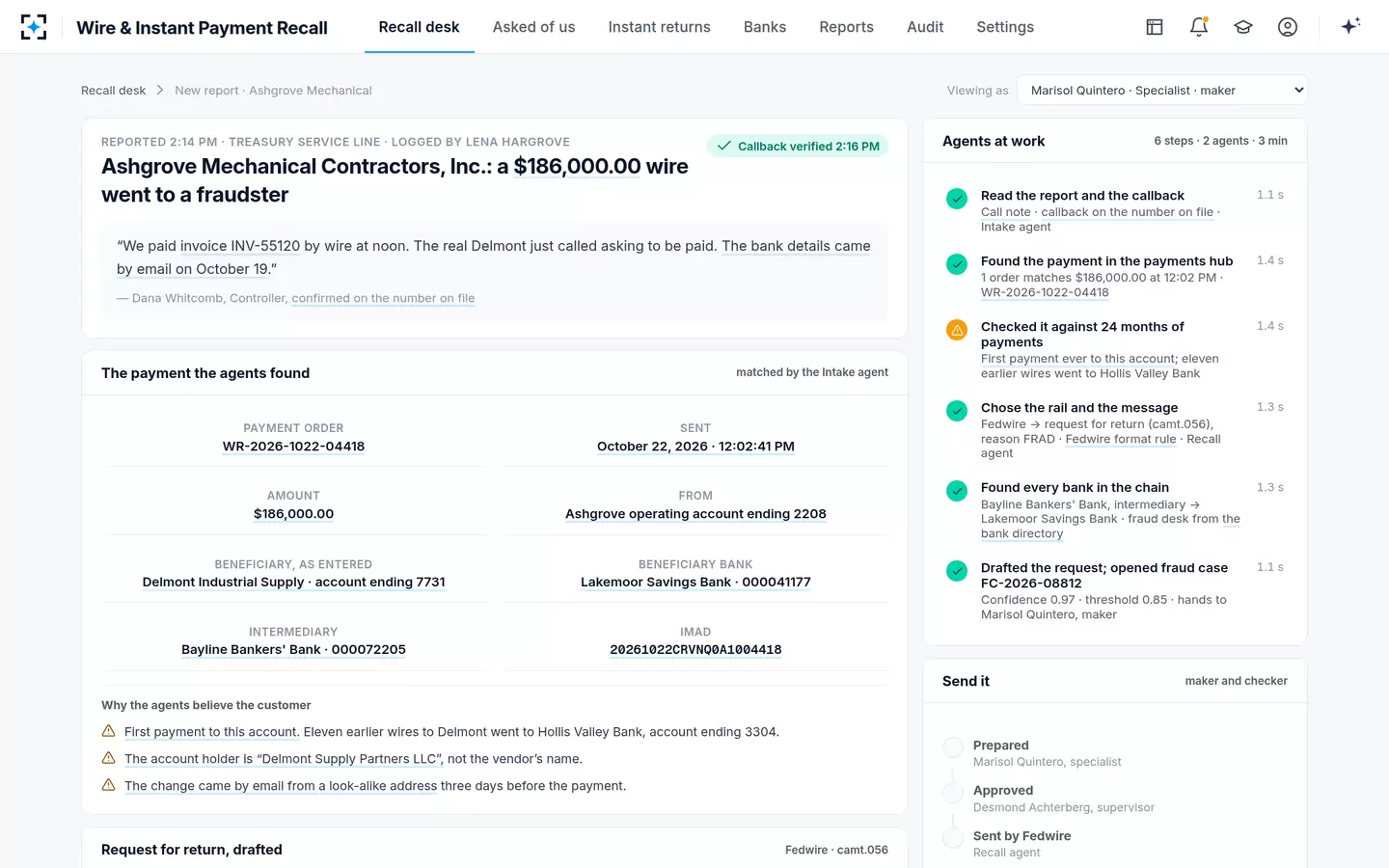
The recall should say why the number is wrong, in terms the beneficiary's bank can test. A request that says only "fraud, please return" gives that bank nothing to weigh against its own customer. One that says this is the first payment ever to this account, that eleven earlier payments to the same supplier went to a different bank, and that the change arrived by email from a look-alike address three days before, gives it reasons to freeze while it checks.
In the sample recall, Ashgrove Mechanical Contractors reported at 2:14 PM that its $186,000.00 Fedwire payment to "Delmont Industrial Supply" had gone to a fraudster. The Intake agent found the payment order and compared the account with 24 months of Ashgrove's payments. It was the first payment to that account, the eleven earlier wires to Delmont had all gone to Hollis Valley Bank, and the new details had come by email on October 19 from a look-alike address. Those findings went into the drafted request with reason FRAD, and the confidence of 0.97 cleared the agent's 0.85 threshold, so it went to a person to prepare rather than back for questions.
From the customer’s call to a drafted wire recall request, with the reasons the number is wrong
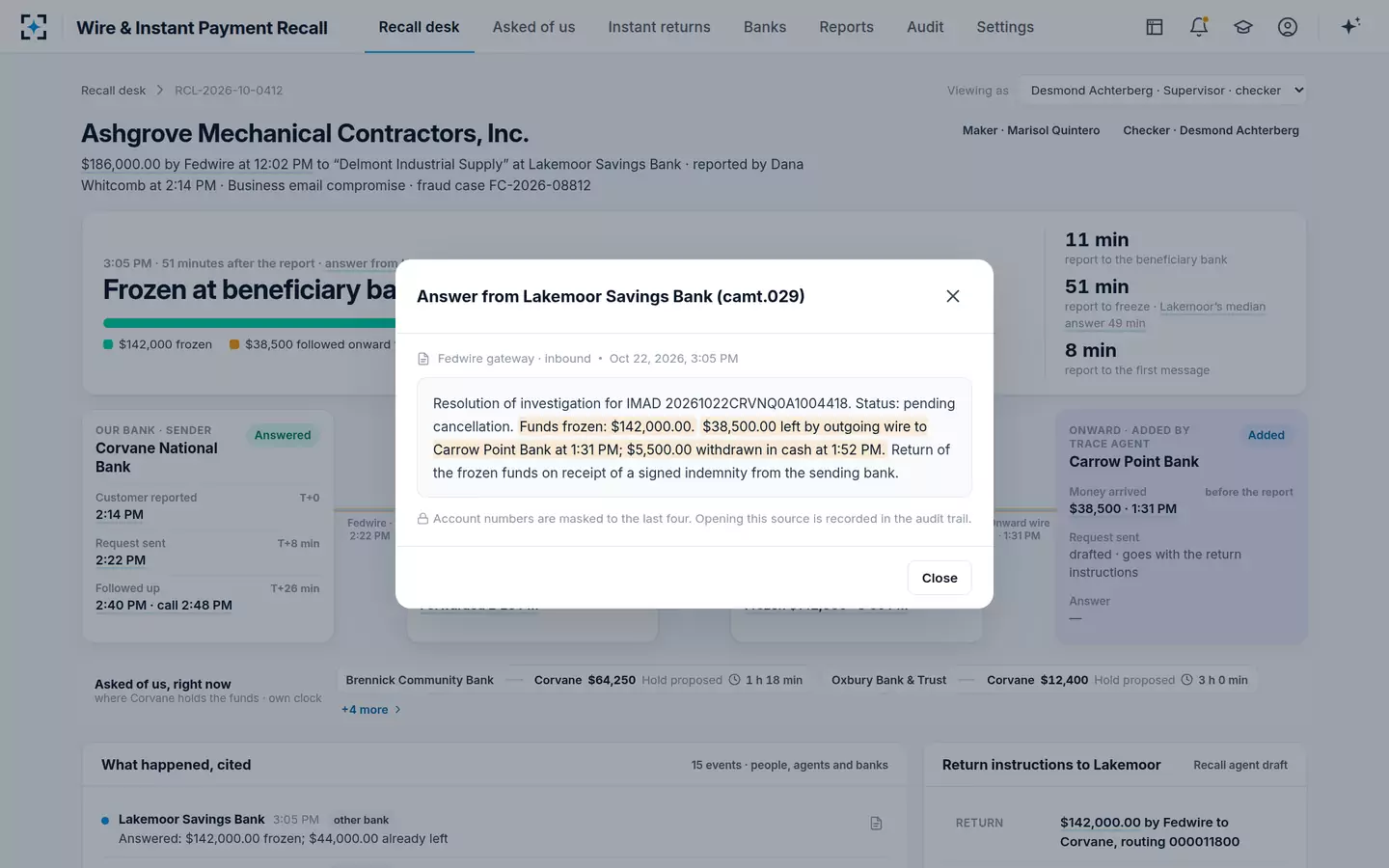
The number's history also decides where the recall goes next. When the beneficiary's bank answers, its answer says what is left and where the rest went, and each onward account becomes a new number to follow. In the sample, Lakemoor Savings Bank answered at 3:05 PM that $142,000.00 was frozen and $38,500.00 had left by wire to a second bank at 1:31 PM.
The answer behind the number: what the beneficiary’s bank froze, and where the rest went
Who bears the loss when nothing comes back?
When the customer's own staff authorized the wire, generally the customer, unless a bank failed a duty it owed that customer. In Studco, nothing was recovered, the scammers were never identified, and the fabricator paid its supplier again for the four invoices, so it carried the whole loss. Against the receiving credit union it had no claim without actual knowledge. Against its own bank, Article 4A's questions are whether the order was authorized or verified under a commercially reasonable security procedure, and what the funds-transfer agreement said; those are the questions the prevention side answers before a wire goes, including the callback procedures that test a changed account number, not the recall desk after.
For the recall desk the lesson is narrower and more useful. Recovering the money is worth more than any later argument about who should have caught the number, and the evidence that makes a recall persuasive, the number's history, is the same evidence a later claim would need. The sample bank's recall screen keeps both: what was frozen and returned, and, for the $44,000 that was not, a fraud case with the onward wire and the cash withdrawal recorded. The legal mechanics of the request itself are set out in what a wire recall is, and the message that carries it in the wire recall request, field by field.
What a recall file should prove about the account number
Six facts, each with its source, make a recall request about a changed account number both quick to act on and hard to dismiss.
What a fraud wire recall should prove about the account number
- The account’s history with this customer
First payment ever to this account, or not; and where earlier payments to the same supplier went.
- How the number arrived
The email or document that changed the details, the sending address and its date, kept as the customer received it.
- That the supplier did not send it
The supplier’s own confirmation, through a known contact, that its bank details have not changed.
- The payment’s exact references
Payment order, IMAD and time, so the beneficiary’s bank can find the credit in seconds.
- What the customer’s callback confirmed
Who called back, on which number on file, and when.
- Where the money went next
Every onward account named in the other bank’s answer, each followed as a new number.
Questions people ask
Does the bank check the account name on a wire?
The sending bank checks that the order came from its customer, not whose account the number belongs to. The beneficiary's bank may credit by number alone: under UCC 4A-207 it need not determine whether the name and number match, and after Studco it is not liable for a mismatch in the Fourth Circuit unless it actually knew.
What is UCC 4A-207?
The Article 4A section on misdescription of the beneficiary. If a payment order's name and account number point to different people, the beneficiary's bank may rely on the number unless it knows of the conflict, and the section then sets who must pay for the order and who may recover the money from the person paid.
Can I get my money back from a wire transfer scam?
Sometimes, if your bank recalls the wire before the money leaves the receiving account. Report to your bank immediately, answer its callback and file a complaint at ic3.gov the same day; the FBI's Recovery Asset Team froze 58% of the attempted theft reported to its kill chain process in 2025. Funds already withdrawn or moved abroad are much harder to reach.
Was the wire unauthorized if our employee was tricked into sending it?
Generally no. The Federal Reserve's FraudClassifier calls that case an authorized party that was manipulated, and Article 4A treats an order your own staff gave as your order. An order a criminal sent using your credentials is different, and turns on whether the bank followed a commercially reasonable security procedure you agreed to.
What did the Studco case decide?
The Fourth Circuit held in 2025 that a receiving institution that credits an account by its number has no liability for a name mismatch unless it had actual knowledge of it, even if its systems generated unread warnings. The Supreme Court denied review on October 6, 2025, so the ruling stands in the Fourth Circuit.