How long a wire recall takes has no fixed answer, because it lasts as long as the slowest bank in the chain takes to answer, plus whatever the sending bank's own checks and approvals add. Article 4A, the law that governs most US wires, sets no deadline for the beneficiary's bank to reply, and the Federal Reserve's Fedwire guidance on these messages tells a bank to answer a request for return with a camt.029 without naming a time. Instant payments are the exception: the FedNow Service's operating procedures ask the receiving bank to answer a return request by midnight Eastern on the next business day. In the sample recall traced below, the request reached the beneficiary's bank 11 minutes after the customer's call, $142,000 of $186,000 was frozen at 51 minutes, and the frozen money was back 2 hours 32 minutes after the call. The other $44,000 had left before anyone knew to look.
The recall runs through Wire & Instant Payment Recall, Botminds' software for fraud recalls on Fedwire, SWIFT, FedNow and RTP, in which agents draft the request, keep a clock on every bank and follow money that moves on, and people approve every send, hold, return and credit. The bank, its customer, the other banks and every time and amount are fictional sample data, not a measurement at any bank.
One sample wire recall in Wire & Instant Payment Recall, from the call to the money back
8min
from the customer’s call to the request for return leaving by Fedwire
11min
to the request reaching the beneficiary’s bank, through an intermediary
51min
to the answer: $142,000 of $186,000 frozen
2 h 32min
to the frozen money arriving back at the sending bank
How long does a wire recall take?
Think of it as four clocks in a row, only one of which the sending bank controls. The first is internal: verifying the customer, finding the payment, drafting the request and getting it approved. The second is transit: the minutes the message takes to pass any intermediary bank. The third is the beneficiary bank's answer, which is where most of the elapsed time usually goes, and the fourth is the return itself, which waits on whatever the beneficiary's bank asks for before it sends the money back, typically an indemnity.
In the sample, those four clocks took 8, 3, 40 and 101 minutes. The fourth looks long, but by then the money was frozen and safe; the race was already decided in the first 51 minutes. That is the useful way to read any recall's timing. The minutes that matter are the ones before a freeze, and the way to shorten them is to shrink the internal clock and to notice early when another bank's clock has stopped.
Where the time went in one sample wire recall, and where the money went before it began
- Arrived, untouched89 min
- $38,500 gone21 min
- $5,500 gone22 min
- Request11 min
- Waiting on the beneficiary’s bank40 min
- Indemnity signed, then the return101 min
Before the call: the 132 minutes nobody at the bank could see
Every recall starts late, because it starts when the customer finds out. Ashgrove Mechanical Contractors sent $186,000.00 by Fedwire at 12:02 PM to what its staff thought was their supplier's new account. The details had arrived by email three days earlier from an address made to look like the supplier's. Two hours and twelve minutes passed before the real supplier asked to be paid and Ashgrove's controller called the bank.
The money did not sit still in that time. At 1:31 PM, $38,500 left the beneficiary's account by wire to another bank, and at 1:52 PM, $5,500 was taken in cash. Nobody at the sending bank could have stopped either one, and nothing on this page claims otherwise: no recall desk can act before the report. What a desk controls starts at 2:14 PM, and the rest of this page is about those minutes.
Minute 0 to 8: verifying, finding and approving
The sending bank's own clock is the one most often longer than it needs to be. The customer's report has to be confirmed by a callback on the number on file, the payment has to be found among the day's wires, and a request for return has to be drafted, prepared by one person and approved by another before it can leave. Done by hand from a call note and a payments screen, each of those steps can wait on someone. The sample bank measured an average of 2 hours 38 minutes from report to first message in 2025, before it used the agents.
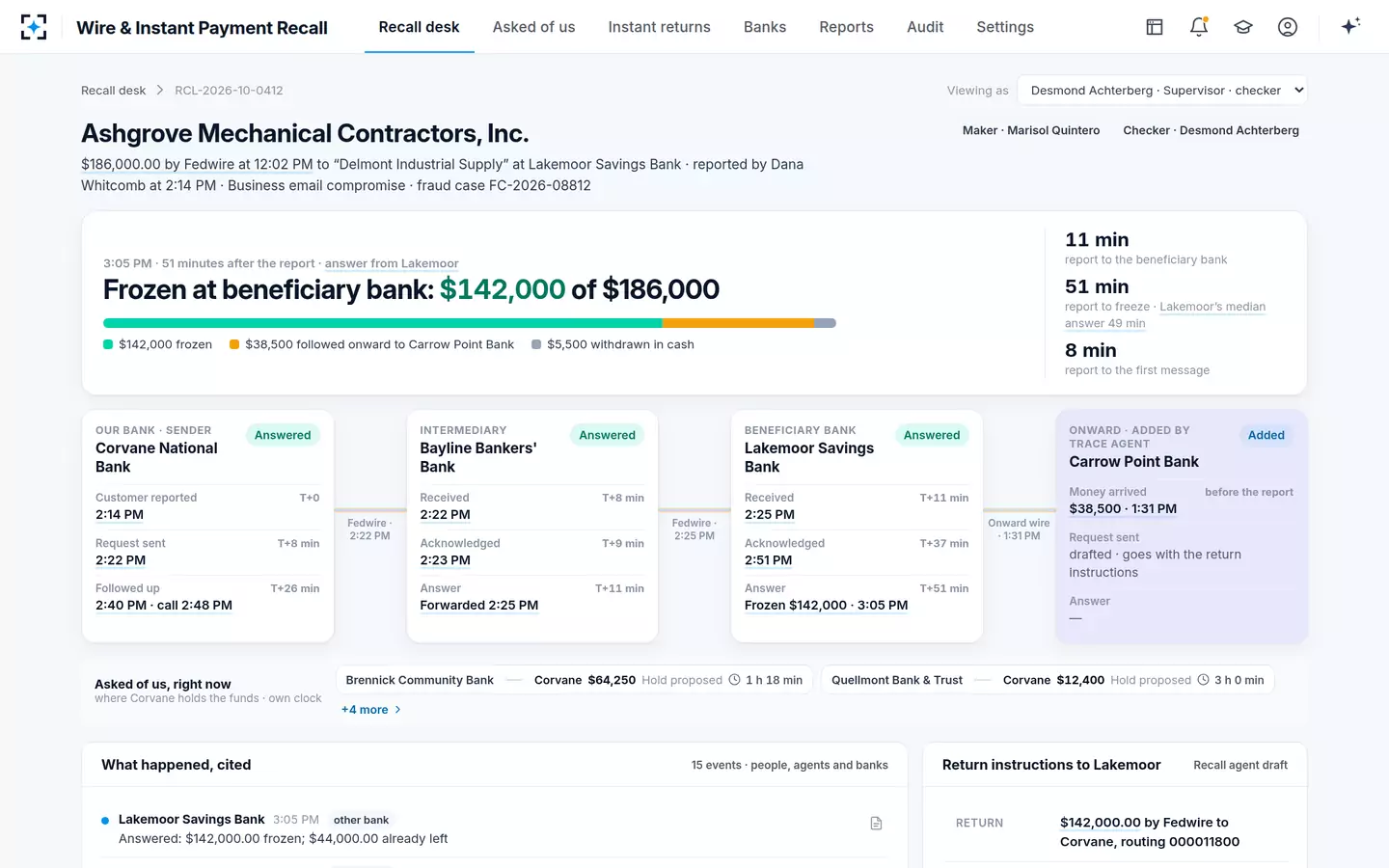
In the sample, the callback was logged at 2:16 PM. The agents had the payment order, its IMAD and a two-year comparison of Ashgrove's payments within three minutes, and a drafted request with reason FRAD, meaning fraud. Marisol Quintero prepared it at 2:19 PM, Desmond Achterberg approved it at 2:21 PM, and Fedwire carried it at 2:22 PM. Eight minutes is a sample result on fictional data. The point of it is that nothing in the internal clock needs to take an hour if the payment, the request and the approver are all on one screen.
The wire recall as a relay: each bank in the chain with its own clock
Minute 8 to 11: the intermediary hop
When the beneficiary's bank does not hold its own Fedwire account, the payment and the recall pass through a correspondent, and that bank's speed is part of the clock. Under Article 4A, cancelling an order that an intermediary bank has already accepted is not effective unless that intermediary also makes a conforming cancellation of the order it sent on, so the intermediary has to pass the request on, not just note it. In the sample, Bayline Bankers' Bank received the request at 2:22 PM, acknowledged it at 2:23 PM and forwarded it at 2:25 PM. In the sample bank's records, Bayline acknowledges in a minute and answers in three, which is what an intermediary that handles recalls routinely can look like.
How long do banks take to answer a recall?
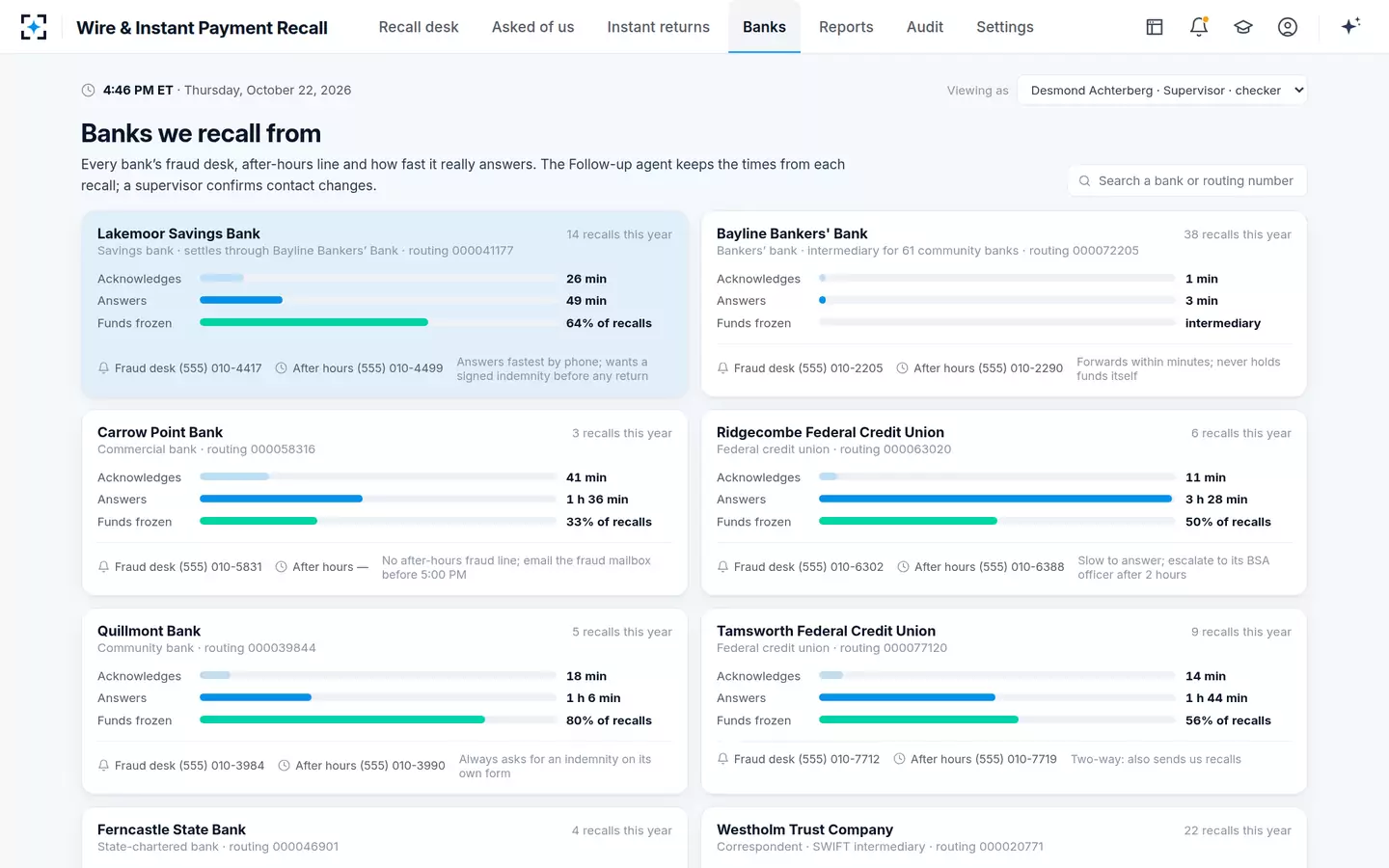
Anywhere from minutes to the next day, and the only way to know is to measure each bank. We found no government or research source that publishes beneficiary banks' answer times on wire recalls, and nothing in Article 4A obliges an answer by a deadline. A bank that keeps its own times learns which counterparties answer in half an hour, which need a phone call, and which escalate only when someone asks for their BSA officer.
How long five banks take to answer a wire recall, in the sample bank’s own records
Instant payments have a published clock. The FedNow procedures ask the receiving bank for an answer by midnight Eastern on the next standard business day, and if none comes, the sender may send another return request. A bank that marks the request pending has a further window to finish its investigation. How those answers work from the receiving side is in instant payments recall vs return.
Every bank’s fraud desk, and how fast it really answers
Minute 11 to 51: the follow-up clock
Silence is the most expensive state a recall can be in, because a request sitting unread at the beneficiary's bank looks, from the sending bank, exactly like one being worked. The sample bank's settings turn silence into steps. At 15 minutes without an acknowledgment, a second message and an email to the bank's fraud mailbox. At 30, a phone call with a script. At 60, the supervisor. Outside 7:00 AM to 6:00 PM Eastern and at weekends, the other bank's after-hours line and the bank's own on-call supervisor.
The follow-up clock the sample bank runs on every bank in the chain
Agent
At 15 minutes of silenceSends a second message on the rail and emails the bank’s fraud mailbox; at Lakemoor that was 2:40 PM.
Never: contacts the customer.
Agent
When a call is dueAsks the specialist to call the fraud desk, with a script and the bank’s known best channel; at Lakemoor, 2:44 PM.
Never: waits past a clock instead of escalating.
A person decides
Payment recovery specialistCalls the fraud desk; Lakemoor acknowledged at 2:51 PM, three minutes after her call.
Never: promises the other bank anything the bank has not approved.
A person decides
At 60 minutes, the supervisorTakes over the escalation, including the other bank’s BSA officer where that bank’s record says to.
Never: approves a step he prepared.
Lakemoor answered at 3:05 PM with a camt.029, the ISO 20022 answer message: pending cancellation, $142,000.00 frozen, $38,500.00 gone by wire to Carrow Point Bank at 1:31 PM, $5,500.00 gone in cash at 1:52 PM, and the frozen funds returnable on receipt of a signed indemnity from the sending bank. That is 51 minutes after the call and 40 after the request arrived, close to Lakemoor's 49-minute median. It is also a reminder that an answer is often not a clean yes or no: here it was part frozen, part gone, with a condition attached.
What is a second hop, and how long does it add?
A second hop is a transfer out of the first account the money landed in, to another bank. It adds a whole new chain, with its own bank, its own answer time and a harder route, because the sending bank has no relationship with the second bank and the onward wire was not its payment. In the sample, the $38,500 that left for Carrow Point Bank was a payment ordered by Lakemoor's own customer. The fastest route back was to ask Lakemoor to recall its 1:31 PM wire, which the sample bank put into its return instructions, and to give law enforcement the details.
The FBI's Recovery Asset Team can reach further than a bank can. Its 2025 report says that in the domestic Financial Fraud Kill Chain, the team will "expand the FFKC process beyond the initial recipient bank" when it is given details of second-hop transactions to other domestic or international accounts, "to request freezes on as much of the lost funds as possible." One case in the same report shows why speed on the first hop matters: the owner of a recipient account, a victim of an overpayment scam, had been told to forward $1 million to an account in Hong Kong, and the team turned to its international process with FinCEN. Every hop that happens before the first freeze lengthens the recall and makes recovery harder. How a buyer should test a recall tool against exactly this case is in payment recovery software, tested on a second hop.
Minute 51 to 2 hours 32: the indemnity and the return
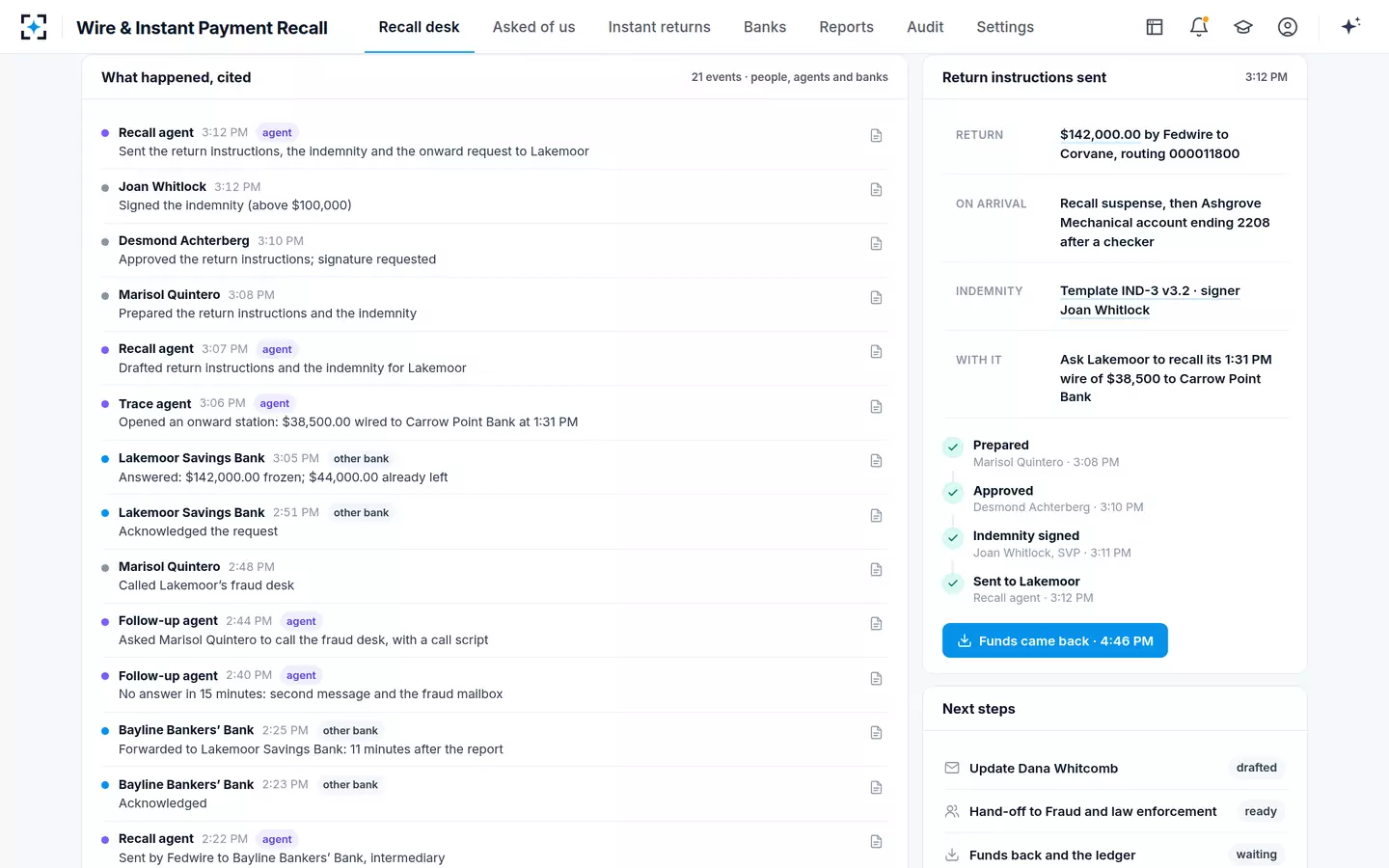
Once money is frozen, the clock is mostly paperwork, but it is paperwork with signatures. Lakemoor would return the $142,000 only against a signed indemnity, so the Recall agent drafted return instructions with the indemnity and the request about the onward wire at 3:07 PM. Marisol prepared them at 3:08 PM, Desmond approved them at 3:10 PM, and because the amount was above the sample bank's $100,000 line, Joan Whitlock, the SVP of payment operations, signed the indemnity at 3:11 PM. The instructions reached Lakemoor at 3:12 PM.
Lakemoor returned $142,000.00 by Fedwire at 4:46 PM. The sample bank's agent matched it to the recall and posted it to a wire recall suspense account, and the credit to Ashgrove's account then waited for a maker and a checker. The $44,000 that did not come back stayed on the screen, split between the onward wire still being pursued and the cash, which went to the fraud case.
Return instructions and the indemnity: prepared, approved, signed, sent
"Return of the frozen funds on receipt of a signed indemnity from the sending bank."
Lakemoor Savings Bank’s answer in the sample recall (fictional)
Can a wire be recalled after it is credited?
It can be asked for, and that is what most fraud recalls are. By the time a customer notices, the beneficiary's bank will typically have accepted the payment, which Article 4A ties to events such as receiving payment for the order or crediting the beneficiary and telling it so. Once it has, cancellation needs that bank's agreement and works only in the cases Article 4A lists, which include an order sent to a beneficiary not entitled to the money. If the bank agrees and cancels, it may try to recover from its own customer anything already paid out, under the law of mistake and restitution. Whether the money is still there is a separate question from whether the law allows cancellation, and in practice it is the one that decides the outcome. The legal line between cancellation and recall is drawn in what a wire recall is.
How quickly should a recall be sent?
As soon as the report is verified, and in the same minutes as the report to law enforcement, not after the recall fails. FinCEN's Rapid Response Program puts its own window at 72 hours from the transaction for reports to law enforcement, and advises victims to contact their bank first and to file with the FBI's Internet Crime Complaint Center. A bank's recall works on a much shorter clock than that, because it depends on the money still being in the first account. In the sample, the onward wire left 89 minutes after the payment arrived; a desk that takes an hour to send its request has used a large part of that margin on its own process.
The most reliable way to shorten the whole recall is therefore to shorten the part the bank controls, and to make silence at another bank visible within minutes. Where the money goes once it is frozen, and what share of attempted losses is frozen nationally, is the subject of the wire fraud recovery rate.
Questions people ask
How long do you have to recall a wire?
There is no deadline for asking, but the useful window is the time before the money leaves the first account. Under Article 4A a payment order that is never accepted is cancelled by law after five funds-transfer business days, which helps only when a payment is stuck. For FedNow, the procedures ask for return requests within 60 calendar days of settlement, a guideline that does not apply to requests reporting fraud.
What happens after a recall request is sent?
The receiving bank acknowledges it, investigates its customer's account and answers: the funds are returned, refused, partly returned, or still under review. A frozen balance may be returned only against conditions, such as an indemnity from the sending bank. The sending bank then posts the return and credits its customer, and anything that did not come back stays with the fraud case.
Why does the beneficiary bank take so long to answer?
It has to find the credit, check its own customer's balance and activity and decide whether to freeze, a decision that may sit with its fraud or BSA team rather than the wire room. In the sample bank's records, median answer times ranged from 3 minutes at an intermediary to 3 hours 28 minutes at one credit union. Keeping each bank's times shows where a phone call will help.
Does a weekend stop a wire recall?
For Fedwire, largely yes today: the service runs on business days, and the Federal Reserve plans to add a Sunday operating day in 2028 or 2029. FedNow runs every day of the year, and its next-business-day answer guideline counts Monday to Friday. Fraud desks' after-hours lines are what keep a weekend recall moving.
Can the customer do anything to speed it up?
Report at once, answer the bank's callback and keep the emails that changed the payment details. Filing a complaint at ic3.gov the same day gives the FBI's Recovery Asset Team what it needs to ask other banks for freezes, including on second hops.