A wire recall request is the message a sending bank sends to the bank holding a payment, asking it to return all or part of the money. Since Fedwire moved to ISO 20022 in July 2025, and on the FedNow Service from its start, that request is a camt.056, answered by a camt.029; if the receiving bank agrees, the money comes back as a pacs.004 payment return. What makes a request work is not the message type but its contents: the references that let the other bank find the original credit in seconds, the reason code that says this is fraud, the amount asked back, who to call, and the sender's position on the indemnity the receiving bank will want. A request that carries those gets read and acted on; one that says "please return, fraud" and nothing else waits in a queue. For fraud reports on FedNow, the procedures exempt the request from their 60-day guideline and use reason code FRAD.
This page takes a fraud request apart field by field, using a request drafted in Wire & Instant Payment Recall, Botminds' software that drafts and sends recall requests on Fedwire, SWIFT, FedNow and RTP and puts every send before a maker and a checker. The bank, customer and payment are fictional sample data. Field names are given in plain words; each rail's technical specifications name the exact message elements.
A fraud wire recall request, field by field: what each part does, with the sample’s values
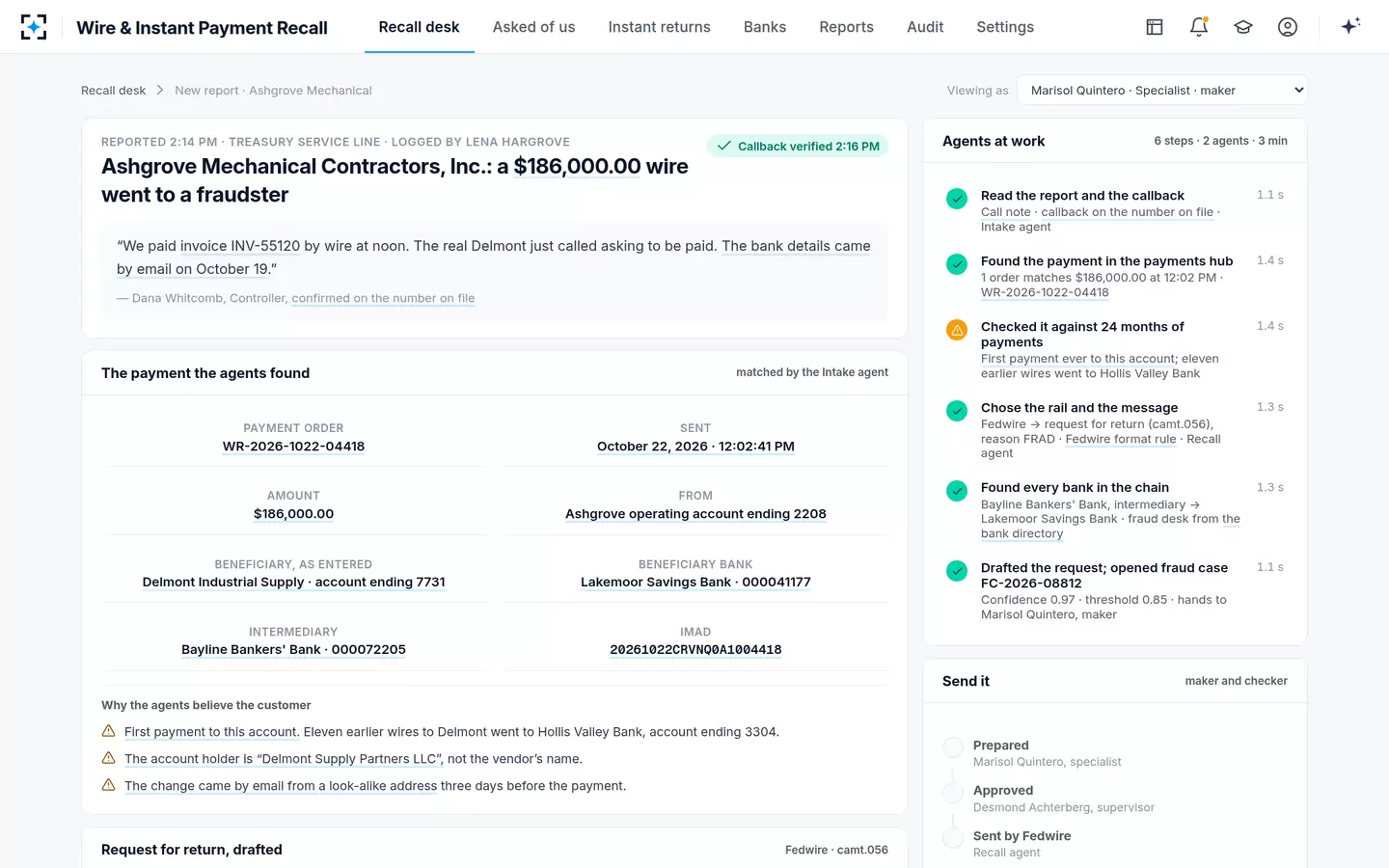
The original payment’s reference
Lets the receiving bank find the credit at once. On Fedwire, the original IMAD; on FedNow, a reference to the original pacs.008.
IMAD 20261022CRVNQ0A1004418
The end-to-end reference
The UETR that every value message must carry, so the payment can be followed across banks.
Copied from the payment order, never retyped
Amount, currency and date of the original
Confirms the match and shows what is at stake.
$186,000.00 · October 22, 2026, 12:02 PM
Amount asked back
All of it, or a portion if part is already accounted for.
$186,000.00, the full amount
Reason code
Says why. For fraud, FRAD; the code also reports the fraud on FedNow.
FRAD
Who is asking
The party that originated the request, so the answer and any return go to the right place.
Corvane National Bank, recall desk
Why it is fraud
The facts the other bank can test against its own account records.
First payment to this account; details changed by email from a look-alike address; callback verified
How to reach the desk
A named fraud contact and an after-hours number, because the next step is often a call.
Fraud desk and after-hours line
The indemnity position
On FedNow, whether the request disclaims the sender’s 4A-211 indemnity; on Fedwire, whether one will follow.
Indemnity to follow with return instructions
What is a wire recall request?
It is the formal half of a recall: the message, on the payment's own rail, that puts the request in the receiving bank's queue with the original payment's references. The phone call to the other bank's fraud desk and the email to its fraud mailbox are the informal half, and they work far better when the person on the other end can find the request in front of them. On FedNow, the operating procedures describe the message simply: "Participants use a return request to ask another Participant to return a portion or full amount of a previously settled pacs.008 or pacs.009 message."
A recall request is not a cancellation the other bank must obey. Once a payment has been accepted, the receiving bank decides, and Article 4A limits the grounds on which a beneficiary's bank can cancel at all. The legal position is set out in what a wire recall is; this page is about getting the message right.
What is camt.056?
camt.056 is the ISO 20022 message for asking another bank to cancel or return a payment. On Fedwire, the Federal Reserve Banks' guidance tells participants to send a camt.056 to request the return of a payment that has already settled and to answer one with a camt.029, including when they refuse. On FedNow the same message is the return request, and its answer, also a camt.029, can say the request is accepted, rejected, pending investigation or partly executed.
Three things about the message matter more than its name. It is a nonvalue message, so it moves no money; the money comes back only if the receiving bank sends a pacs.004. It must point to the original payment, and on FedNow the burden is the sender's: "The Participant that sends the return request (camt.056) is responsible for appropriately referring to the original pacs.008 within the message." And it identifies who is asking. The Fedwire guidance is precise on that last point: "In the camt.056 the Originator is the party who originated the request for the payment return".
The fields that tie the request to the payment
A receiving bank can act on a request only after it has found the credit, so the references come first. On Fedwire, that means the original message's IMAD, the input message accountability data that identifies it on Fedwire, and its UETR. The Fedwire guidance makes the UETR, the Unique End-to-End Transaction Reference, a required field on every value message (pacs.008, pacs.009 and pacs.004), so that one identifier follows the payment from end to end; IMAD vs OMAD explains how it sits beside Fedwire's own references. On FedNow, the request must carry the details of the original pacs.008, and the service validates the message before passing it on.
In the sample, the request for Ashgrove Mechanical Contractors' $186,000.00 payment carried IMAD 20261022CRVNQ0A1004418, copied by the agent from the payments hub rather than retyped. That is not a small point. A request with a mistyped reference sends the receiving bank searching by amount and date, and in a day of wires that search is where minutes go.
The request drafted from the payment order, with the reasons beside it
What reason code is used for fraud?
FRAD. The FedNow procedures say so in as many words, and add that the request does double duty: a camt.056 with FRAD also meets the service's fraud reporting requirement, and a receiving bank that finds fraud on a payment it received can return the money with a pacs.004 carrying reason code FR01. The procedures also refer to codes from the Federal Reserve's FraudClassifier model, which sorts fraud by who initiated the payment and how: for warranty claims they ask for a classifier code in the message's Additional Information element to show the type of suspected fraud and the suspicious actor, consistent with how FRAD is used to report fraud on a credit transfer.
"If a Participant sends an instant payment and later identifies fraud, it can send a camt.056 and include reason code FRAD."
FedNow Service Operating Procedures, April 2026
The fraud-related codes the published FedNow procedures name
| Code | Message | Used when | What it also does |
|---|---|---|---|
| FRAD | camt.056 return request | The sender later identifies fraud on an instant payment it sent | Meets the FedNow fraud reporting requirement; not subject to the 60-day guideline |
| FR01 | pacs.004 payment return | The receiver returns an instant payment it identified as fraud | Meets the fraud reporting requirement |
| WNTB | camt.056 return request | A payment made in response to a request for payment breached the warranty | Claim within 95 calendar days; not a cancellation request under Article 4A |
How long after a payment can a return be requested?
On FedNow, within 60 calendar days of settlement as a guideline, unless the request reports fraud. The procedures are explicit: "Camt.056 messages used to report fraud or an RFP warranty breach are not subject to the 60-day guideline." The Fedwire format guidance sets no time limit for a request for return, and Article 4A sets none for asking either.
The limit that matters for fraud is practical, not legal: the request has to arrive while the money is still in the account. In the sample, $38,500 of the $186,000 left the beneficiary's account 89 minutes after it arrived, before the customer had noticed anything. A request that complies with every guideline and arrives the next morning can be perfectly formed and still recover nothing. How the minutes add up in a real recall is traced in how long a wire recall takes.
What is camt.029, and what comes back?
The camt.029 is the receiving bank's answer. On FedNow it says one of four things: the request is accepted and the funds will be returned, rejected, pending investigation, or partly executed with a portion returned. On Fedwire it is the message a bank uses to say whether it will refuse. The money itself comes back separately, as a pacs.004, and the receiving bank names itself in that message as the party that agreed to return the payment.
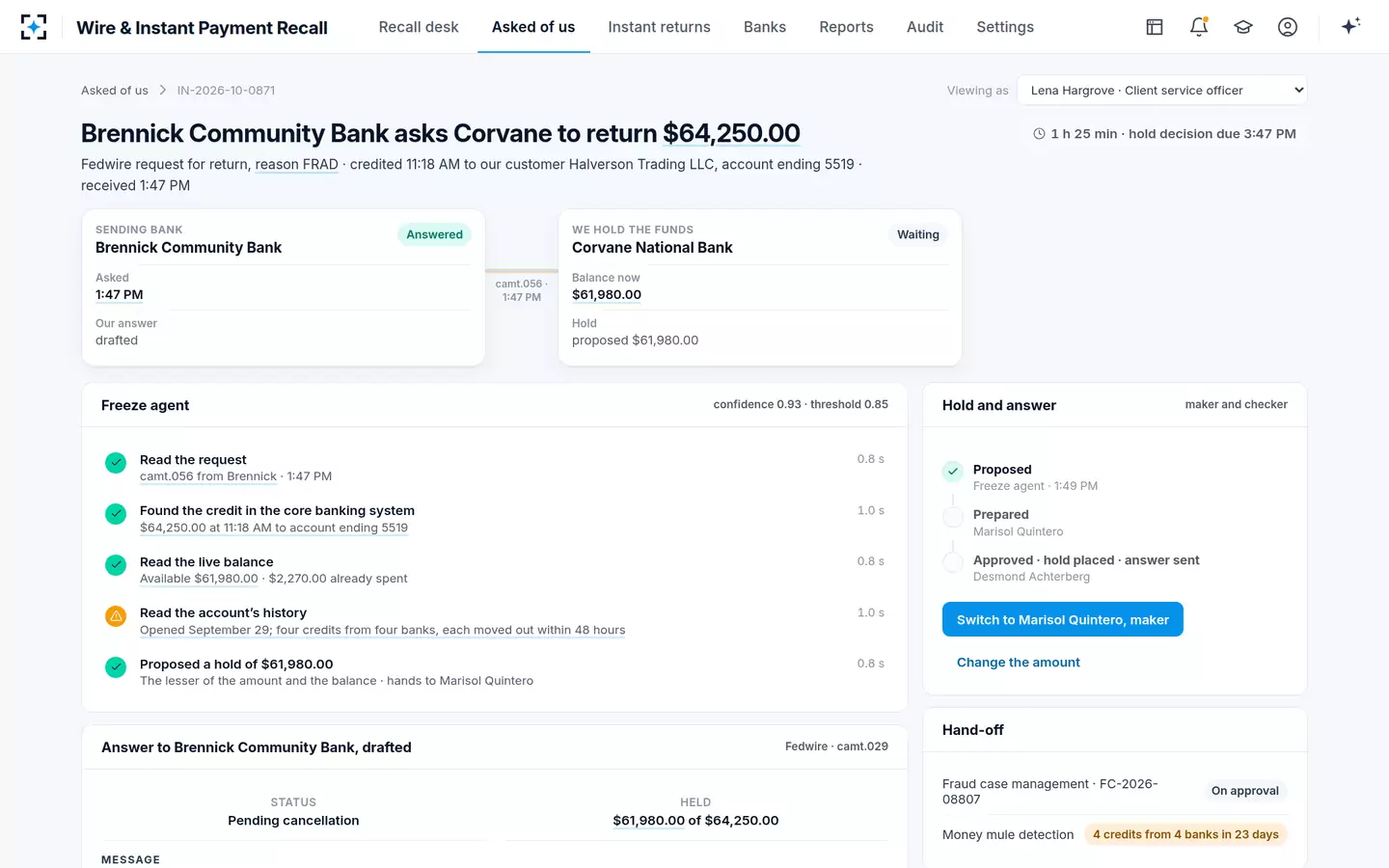
In practice the answer can carry much more than a status. The sample's answer from the beneficiary's bank said: pending cancellation, $142,000.00 frozen, $38,500.00 gone by wire to another bank at 1:31 PM, $5,500.00 taken in cash at 1:52 PM, and the frozen funds returnable on receipt of a signed indemnity from the sending bank. Each of those facts starts a new task. How a receiving bank chooses among the four answers is set out from its side in instant payments recall vs return.
A request received from another bank, and the camt.029 answer drafted for it
What a request needs that the message cannot carry
Three things travel alongside the camt.056, not inside it. The first is a person: a call to the receiving bank's fraud desk once the message is in its queue, because an unread request does nothing. The second is the indemnity. On FedNow, Operating Circular 8 says a participant sending a request for return may be liable under 4A-211 unless it disclaims that indemnity in the message as the technical specifications describe, so the indemnity position is a field to decide before sending. On Fedwire, the beneficiary's bank may ask for a signed letter before it returns frozen money, as the sample's did. The third is evidence the other bank may want in writing: the email that changed the bank details, the callback record, a law enforcement complaint number.
A recall request that gets acted on, and one that waits
A request that waits: Amount and date only, or a mistyped IMAD.
A request that gets acted on: The original IMAD and UETR, copied from the payment order.
A request that waits: “Fraud, please return.”
A request that gets acted on: FRAD, with the facts: first payment to this account, emailed change from a look-alike address, callback verified.
A request that waits: The wire room’s general mailbox.
A request that gets acted on: A named fraud contact, a direct line and an after-hours number.
A request that waits: Not mentioned, so the other bank has to ask and wait.
A request that gets acted on: Stated: disclaimed on FedNow, or to follow with return instructions on Fedwire.
A request that waits: Whenever someone remembers.
A request that gets acted on: A second message and the fraud mailbox at 15 minutes, a call at 30, in the sample bank’s settings.
Before you send: the checks a checker should make
A recall request commits the bank, so it deserves the same second look as a payment. The checker's job is not to redo the specialist's work but to confirm the few facts that, if wrong, waste the request or expose the bank.
What the checker confirms before a fraud recall request leaves
- The callback happened, on the number on file
Not the number the caller gave. Without it, the request may itself be the fraud.
- The references match the payment order
IMAD or original message, UETR, amount and date, copied rather than retyped.
- The reason code fits the facts
FRAD for fraud; a duplicate or wrong amount is a different request with a different code.
- The amount asked back is right
The full amount, or the part not already accounted for.
- The indemnity position is decided
Disclaimed or not on FedNow; who will sign on Fedwire if the other bank asks.
- The contact details reach a person tonight
A fraud desk and an after-hours line, not a general mailbox.
- The checker did not prepare it
In the sample bank’s settings, the software will not let anyone approve their own request.
What to look for in a tool that drafts recall requests
The drafting itself is the easy part; any template can produce a camt.056. The hard parts are getting the references from the payment record without retyping, choosing the right rail and message when a bank uses several gateways, writing the reasons in terms the other bank can test, deciding the indemnity position under the bank's own rules, and putting the request before two different people in minutes. A buyer should ask to see a request drafted from a real past payment, with the references traced to their source, and should check that the tool records the other bank's acknowledgment and answer against the request, because that is what later shows an examiner what happened.
In the sample, the agents found the payment order, chose Fedwire and the request message, drafted the reasons and reached a confidence of 0.97 against a threshold of 0.85 in about three minutes; a specialist prepared the request at 2:19 PM and a supervisor approved it at 2:21 PM. Those times are sample data on a fictional bank. What any tool cannot do is make the other bank read the request, which is why the contact sheet and follow-up clock matter as much as the message, as set out in the contact sheet and message map.
Questions people ask
How do you send a Fedwire return request?
Through the bank's Fedwire connection, as a camt.056 that refers to the original payment by its IMAD and UETR and states the amount and reason. The receiving participant answers with a camt.029 and, if it agrees, returns the money with a pacs.004 payment return.
What information is in a recall request?
The original payment's references, amount and date, the amount asked back, a reason code, the party making the request, and enough explanation and contact detail for the receiving bank to act. On FedNow, the request should also state whether the sender disclaims its 4A-211 indemnity, as the technical specifications describe.
Can a recall request ask for only part of the payment?
Yes. The FedNow procedures describe a return request as asking for a portion or the full amount, and a receiving bank that agrees can return all of it or part, answering that the request was partly executed. In a fraud recall, part can be all that is left.
Does the receiving bank have to acknowledge a FedNow return request?
Yes. The procedures require the receiving institution to send a receipt acknowledgement for nonvalue messages including camt.056, separate from its answer. If no answer arrives by midnight Eastern on the next standard business day, the sender may send another request.
What happens if a FedNow request fails validation?
The FedNow Service checks the message's signature, size, syntax, sender and uniqueness before passing it on. If it fails, the service rejects it with an error message or a negative camt.029 listing the errors, and the sender corrects it and sends a new message with a new identifier.