A wire recall is the sending bank's request that the bank now holding a payment stop it and return the money, most often because the customer was tricked into sending it to a fraudster. It is a request, not a right. Under UCC Article 4A, the law that governs wires in the United States and that Regulation J applies to Fedwire, a sender can cancel a payment order before the receiving bank accepts it. After acceptance, cancellation works only if that bank agrees or a system rule allows it, and at the beneficiary's bank only if the order was unauthorized or resulted from the sender's mistake: a duplicate, a payment to someone not entitled to it, or too much. A recall is how a sending bank asks for that agreement, in the ISO 20022 message called a request for return (camt.056). The rest of this page sets out where the line between cancellation and recall falls, why it matters, and what each costs.
The examples come from Wire & Instant Payment Recall, Botminds' software that sends fraud recalls on Fedwire, SWIFT and instant payment rails, follows up with every bank in the chain and answers the requests other banks send in, with a maker and a checker on every step. The bank and its customers in the screens are fictional sample data. Nothing here is legal advice; Article 4A is enacted state by state.
Wire cancellation and wire recall, side by side under UCC 4A-211
Cancellation before acceptance: Before the receiving bank accepts the order: before the sending bank executes it, or before the next bank does.
Recall after acceptance: After the order has been accepted, which for the beneficiary’s bank may be the moment it is credited or paid for.
Cancellation before acceptance: The sender’s, if the bank receives it in time to act on it.
Recall after acceptance: The receiving bank’s: it must agree, unless a funds-transfer system rule allows cancellation without agreement.
Cancellation before acceptance: None beyond timing and the security procedure.
Recall after acceptance: At the beneficiary’s bank: an unauthorized order, a duplicate, a beneficiary not entitled, or too much.
Cancellation before acceptance: A cancellation through the sending bank’s own channel, before execution.
Recall after acceptance: A request for return (camt.056) on the rail, answered by a camt.029.
Cancellation before acceptance: Little.
Recall after acceptance: Liability for the agreeing bank’s losses and expenses, often confirmed in an indemnity.
What is a wire recall?
In operational terms, it is everything a sending bank does to get back a wire that has already been accepted: the request for return on the rail, the follow-up with each bank in the chain, the indemnity, the return and the credit to the customer. In legal terms, it is an attempt to make a cancellation effective after acceptance, which Article 4A allows only with the receiving bank's agreement. Article 4A speaks of cancellation; banks speak of recalls, and the FedNow procedures call the two messages a "return request" and a "return request response".
Most fraud recalls are recalls in this second sense. By the time a customer realizes an email changed a supplier's bank details, the money has normally reached the beneficiary's bank and been accepted there. That is why the beneficiary's bank's fraud desk, not the sending bank, decides how much comes back. How fast that typically happens is traced in how long a wire recall takes.
Cancellation and recall: the line is acceptance
Before a bank accepts a payment order, the sender can cancel it on its own. UCC 4A-211(b) makes a cancellation effective if it reaches the receiving bank in time, and in a form, that gives the bank a reasonable opportunity to act on it before it accepts the order. Where a security procedure applies, the cancellation must be verified under it too. A customer who notices a mistake while the wire is still queued at its own bank is cancelling, not recalling.
After acceptance, the position reverses. "After a payment order has been accepted, cancellation or amendment of the order is not effective unless the receiving bank agrees or a funds-transfer system rule allows cancellation or amendment without agreement of the bank." Every bank in the chain accepts in turn, so the question is always which bank holds the order now and whether it has accepted it.
When does a beneficiary's bank accept a wire?
Earlier than many customers assume. Under UCC 4A-209(b), "a beneficiary's bank accepts a payment order at the earliest of the following times": when it pays the beneficiary or notifies the beneficiary that the order arrived or the account was credited; when it receives payment of the entire amount of the sender's order; or, in some cases, when the next funds-transfer business day opens. A bank other than the beneficiary's bank accepts when it executes the order, that is, when it sends its own order on.
For a recall desk this means two practical things. The sending bank's own acceptance happens the moment it releases the wire, so a customer's cancellation after release can only work as a request passed down the chain. And at the beneficiary's bank, acceptance usually comes with the credit, before anyone has reason to doubt the payment, so a fraud recall nearly always asks a bank to undo an acceptance it has already made.
Where the payment order is decides what the sender can still do
| Where the order is | Can the sender stop it alone? | What it takes | Article 4A |
|---|---|---|---|
| Not yet executed by the sending bank | Yes, if the bank can act in time | A verified cancellation received before execution | 4A-211(a), (b) |
| Accepted by an intermediary bank | No | The intermediary agrees and makes a conforming cancellation of the order it sent on | 4A-211(c), (c)(1) |
| Accepted by the beneficiary’s bank | No | That bank agrees, and the order was unauthorized or a listed sender’s mistake | 4A-211(c), (c)(2) |
| Paid out by the beneficiary’s bank | No | As above; the bank may then recover from its customer under mistake and restitution law | 4A-211(c)(2) |
| Never accepted by anyone | Not needed | Cancelled by operation of law after five funds-transfer business days | 4A-211(d) |
Can a wire be cancelled after it is sent?
Only as far as it has not yet been accepted, and in practice that window is short. Once the sending bank executes the order, it has accepted it, and the next bank in the chain has to agree. If the next bank is an intermediary that has already passed the order on, a cancellation works only if it also makes "a conforming cancellation or amendment of the payment order issued by the receiving bank", so the request has to travel bank by bank.
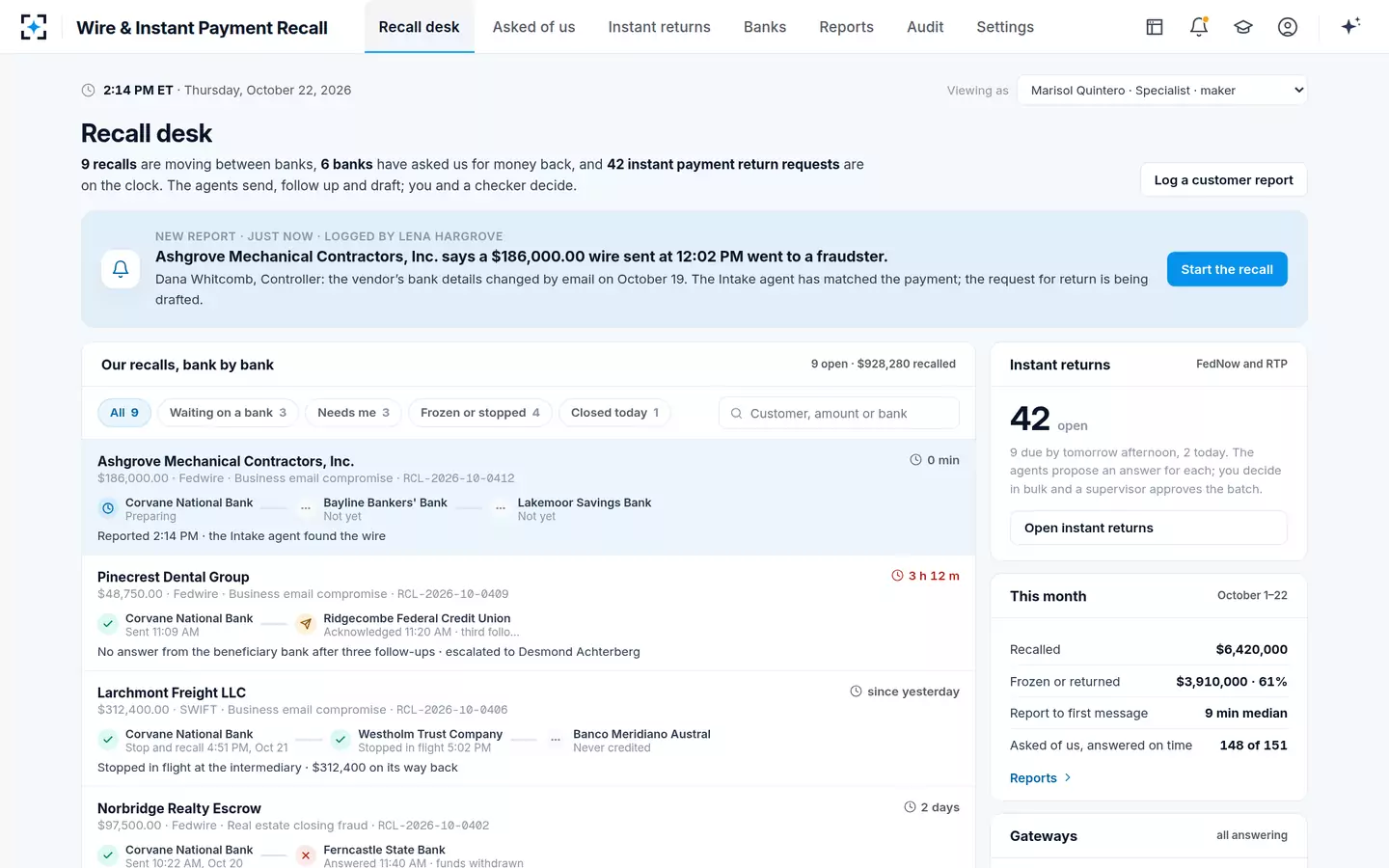
Sometimes it catches the payment before the end of the chain. On the sample bank's recall desk, one SWIFT payment of $312,400 for a freight company was the subject of a stop and recall sent at 4:51 PM the day before; the intermediary stopped it in flight at 5:02 PM, and the beneficiary's bank never credited it. That is the cheapest kind of recall: an intermediary's agreement to cancel before the beneficiary's bank accepts. It needs the customer to notice before the payment completes its journey.
One recall stopped in flight at the intermediary, others waiting on the beneficiary’s bank
Does the beneficiary bank have to return the funds?
No. Article 4A gives the beneficiary's bank a choice, and limits it. The bank must agree before a cancellation is effective, and even with its agreement, UCC 4A-211(c)(2) allows cancellation of an order it has accepted only on the grounds the section lists. A funds-transfer system's rules cannot widen those grounds: "A funds-transfer system rule is not effective to the extent it conflicts with subsection (c)(2)."
The only grounds on which a beneficiary’s bank can cancel an order it has accepted
An unauthorized order
The payment was issued in execution of an order the customer never authorized, such as one sent with stolen credentials.
In fraud: Account takeover
A duplicate
The sender’s mistake produced a second order for a payment already made.
In fraud: Rarely fraud
A beneficiary not entitled to the money
The sender’s mistake produced an order paying someone not entitled to receive payment from the originator.
In fraud: Email compromise: paying the fraudster instead of the supplier
Too much
The sender’s mistake produced an order for more than the beneficiary was entitled to receive.
In fraud: Rarely fraud
Outside those grounds, a cancellation cannot be made effective, even if everyone agrees. A customer who has simply changed its mind about a supplier, or disputes the quality of goods, has no recall under 4A-211 once the beneficiary's bank has accepted; any money back would have to come from the beneficiary returning it. Routine operational cancellations of duplicates and wrong amounts are the daily work of payment investigations, covered by Payment Investigations Case Management; this page is about fraud.
Is a fraudulent wire a “mistake” under 4A-211?
It usually fits one of the listed grounds, but which one depends on who sent the order. If a criminal sent the payment order using the customer's credentials, the order may be unauthorized, the first ground. If the customer's own staff sent it after an email changed a supplier's bank details, the order was authorized, and the case rests on a mistake by a sender that resulted in an order "that orders payment to a beneficiary not entitled to receive payment from the originator". The holder of the fraudster's account was not entitled to the supplier's money; the customer's mistake was about who it was paying.
That reading is ours, not a court's, and it is the kind of question a bank's counsel should settle in advance and write into the recall procedure and the indemnity template. In practice the ground matters less than two facts the beneficiary's bank can check at once: whether the money is still in the account, and whether the account's history makes the fraud believable. The evidence that makes the second case is set out in can a fraud wire transfer be reversed.
Fedwire, FedNow and the rules on top
Article 4A applies to Fedwire through federal regulation. Regulation J says of its Fedwire subpart: "This subpart incorporates the provisions of Article 4A set forth in appendix A of this part." The Reserve Banks' operating circulars then add the operating detail. For FedNow, Operating Circular 8 is explicit that the Federal Reserve is a carrier, not a decider: whatever 4A-211 says, a Reserve Bank need not cancel or change a payment order because a participant has asked it to. Whether a request is effective at the receiving participant is governed by 4A-211.
Instant payments add a twist that changes the vocabulary more than the law. FedNow and RTP payments are irrevocable, as the Philadelphia Fed's Consumer Compliance Outlook notes, and settle instantly, so by the time anyone notices a fraud the payment has long since completed: every fraud request on an instant payment is a request for return. How a receiving bank should answer those requests is the subject of instant payments recall vs return.
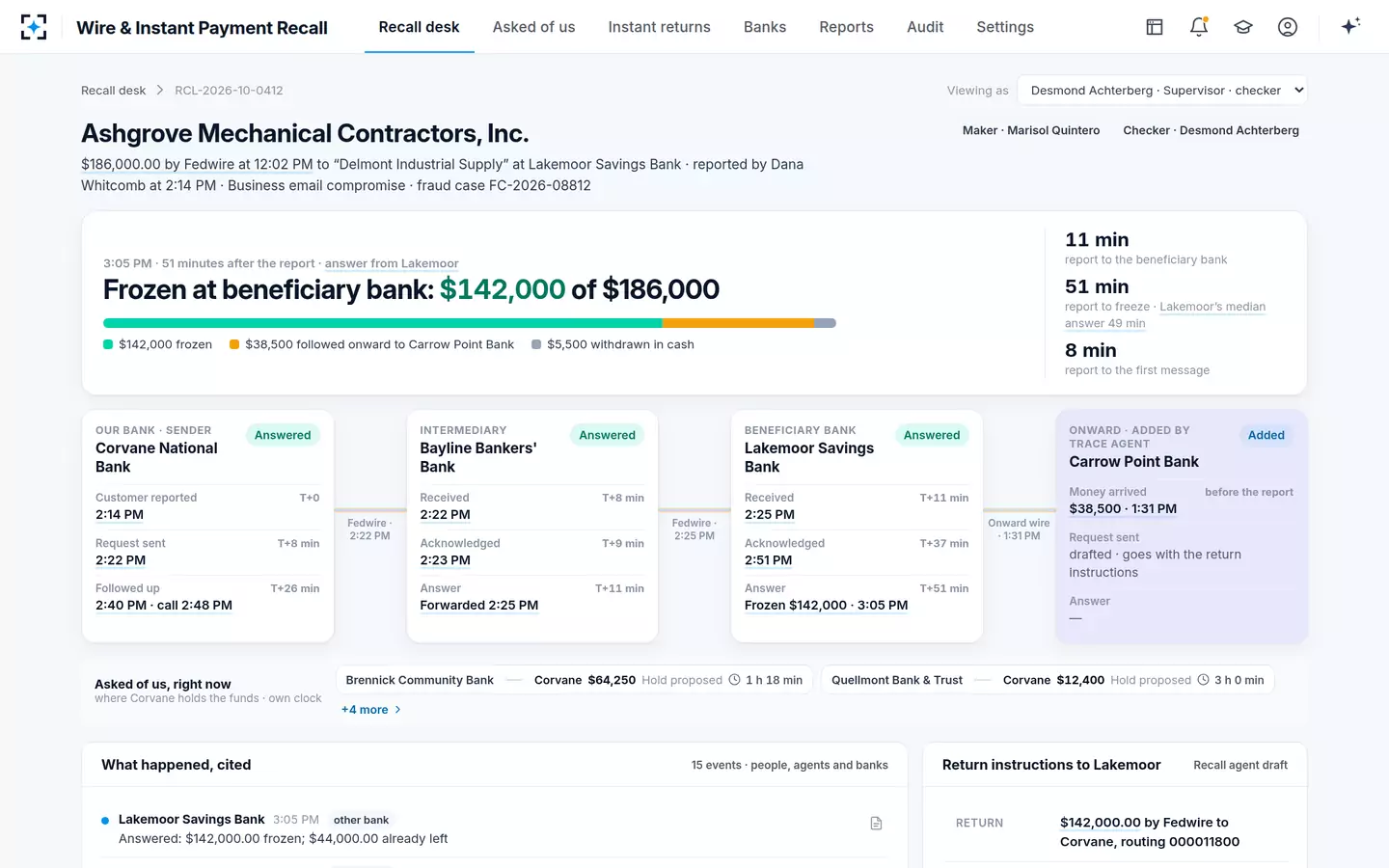
Every bank in the chain accepts in turn: the relay of a Fedwire recall
What a recall can still do after the money has moved
More than nothing, and less than a reversal. If the beneficiary's bank agrees and the cancellation is effective, the acceptance falls away with it, and the bank may try to recover from its own customer what it already paid out, under the law of mistake and restitution. If the money has left the account, the recall's job becomes finding where it went: the beneficiary's bank's answer usually says, and each onward account becomes a new request or a lead for law enforcement.
"If an accepted payment order is canceled, the acceptance is nullified and no person has any right or obligation based on the acceptance."
UCC 4A-211(e)
In the sample recall, the beneficiary's bank froze $142,000 of $186,000 and reported that $38,500 had left by wire to another bank and $5,500 in cash. The recall then asked the beneficiary's bank to recall its own onward wire, since the sending bank had no relationship with the second bank, and the fraud case took the cash withdrawal. A recall that stops at the first bank leaves the second hop to chance.
Who pays the costs of a recall?
The sender, whether or not the cancellation works. Under 4A-211(f), unless an agreement or a funds-transfer system rule says otherwise, a sender whose cancellation a receiving bank agrees to after acceptance is liable for that bank's losses and expenses, including reasonable attorney's fees, from the cancellation or the attempt. That is the legal root of the indemnity a beneficiary's bank asks for before it returns frozen funds, and of the rule in Operating Circular 8 that a FedNow request may create 4A-211 liability unless the message disclaims it. Who should sign that promise, and when to disclaim it, is covered in the recall and hold harmless letter.
Five things to establish before calling a request a recall
- Where is the order now?
Still at your bank, accepted by an intermediary, or accepted by the beneficiary’s bank. The answer decides whether you are cancelling or asking.
- Was it authorized?
A criminal using the customer’s credentials, or the customer’s own staff deceived. Each points to a different 4A-211(c)(2) ground.
- Which ground applies?
Unauthorized, duplicate, beneficiary not entitled, or too much. A change of mind is none of them.
- Is the money still there?
The beneficiary’s bank will check first; your request should give it the references to check in seconds.
- Who signs for the cost?
The indemnity, or the FedNow disclaimer, decided by someone with authority before the request goes.
Questions people ask
Is a wire recall the same as a reversal?
No. A reversal suggests the sending bank can undo the payment; it cannot once the payment has been accepted. A recall asks the bank holding the money to agree to cancel and return it, and the money comes back as a new payment, a return, only if that bank agrees.
What is the difference between a wire recall and a cancellation?
Timing and who decides. A cancellation received before the bank accepts the order is effective on the sender's say-so. After acceptance, the same request becomes a recall: effective only with the receiving bank's agreement and, at the beneficiary's bank, only on the grounds UCC 4A-211(c)(2) lists.
What happens to a wire that is never accepted?
Article 4A cancels it automatically: an unaccepted payment order is cancelled by operation of law at the close of the fifth funds-transfer business day of the receiving bank after its execution or payment date. A wire stuck in a queue therefore does not stay pending indefinitely.
Why would the beneficiary's bank agree to a recall?
Because the sender takes on its losses and expenses, often confirmed in an indemnity, and because it may have its own reasons to doubt the account. A bank that sees a new account receiving credits from several banks and moving them out quickly has a fraud problem of its own, whatever the recall says.
Does a funds-transfer system's rule let a bank cancel without agreement?
A system rule can allow cancellation after acceptance without the receiving bank's agreement, but 4A-211(h) stops such a rule from overriding the grounds in subsection (c)(2) at the beneficiary's bank. The Federal Reserve, for its part, says a Reserve Bank has no obligation to cancel a FedNow payment at all.