UCC 4A-207 is the rule for a wire whose beneficiary name and account number identify different people. If the beneficiary's bank does not know they differ, it may rely on the number and credit that account, and it need not check whether the name matches. If it knows, or pays the person named instead, different rules apply. The section then decides who carries the loss and who may recover the money from the person who received it. For a payment investigator answering "our customer was not credited", 4A-207 decides whether the bank did anything wrong at all, which is why a reply conceding a mistake is a legal decision and not a clerical one. Botminds' Payment Investigations is software for that desk: agents read the request, find the posting and lay the facts against the rule, and a person decides what the bank will say about its own conduct.
What the agents in Payment Investigations do with a name and number mismatch, and where they stop
Agent
Reading agentReads the camt.110, MT 199 or email, and extracts the payment reference, amount, the named beneficiary and the account number, with a confidence on each.
Never: Guesses a field below 0.85 confidence; it asks the analyst.
Agent
Research agentFinds the posting, who holds the account the number points to, whether the named beneficiary holds another account, the name-check log and the balances, citing each record.
Never: Places a hold or posts an entry; it is read-only.
Agent
Rules agentSets the facts against 4A-207, Regulation J and the correspondent agreement, and proposes a course, such as correcting the posting or returning the funds, with its reasons and citations.
Never: Decides. A proposal below 0.70 confidence goes to the team lead.
Agent
Drafting and Correction agentsDraft the reply, the answer to any cancellation request and the value-dated entries, and mark any draft that admits liability or moves money.
Never: Sends a reply that admits liability, or posts without a checker.
A person decides
Payment investigation analystDecides what the bank will say about its own conduct; can ask the agents why, edit with an override reason, or reject the proposal with a reason code.
A person decides
Team leadApproves the set on the same evidence with a reason, or returns it with a reason code; corrections above the lead's limit go to the Head of E&I.
What does UCC 4A-207 say?
It answers three questions in order: whether the order points at anyone real, whether the name and number point at the same person, and whether the bank knew. The answers decide whether the beneficiary's bank accepted the order, who has rights to the money and who absorbs the loss. Subsection (a) covers a name, number or other identification that "refers to a nonexistent or unidentifiable person or account": no one has rights as beneficiary and acceptance cannot occur. Subsection (b) covers the case investigators meet most, where the order names a beneficiary and gives an account number and the two identify different persons.
UCC 4A-207, read as three questions
Step 1
Does the name, number or other identification point to a person or account that does not exist or cannot be identified?
Step 2
Does the order identify the beneficiary both by name and by number, and do they identify different persons?
Step 3
Did the beneficiary's bank know the name and number referred to different persons, or pay the person named?
The rule exists because the alternative is slow. Banks post incoming wires by account number, and Article 4A lets them: the Fourth Circuit, quoting the Eleventh, described the process as one "which is intended to be quick and automated". A bank that had to compare every name with every account holder before crediting would hold payments and make mistakes of its own, with names abbreviated, misspelled or written as trade names. The price of that speed is that a wrong number sends the money to the wrong customer, and 4A-207 says who bears that price.
Can a bank rely on the account number alone?
Yes, unless it knows that the name and the number refer to different people. The text is direct: "if the beneficiary's bank does not know that the name and number refer to different persons, it may rely on the number as the proper identification of the beneficiary of the order. The beneficiary's bank need not determine whether the name and number refer to the same person." (4A-207(b)(1)).
Two things in that sentence matter to an investigator. "Need not determine" means the bank has no duty to check, so the absence of a check is not a breach. And "does not know" means the exception turns on what the bank actually knew when it paid, which is a question of fact about the case in hand. If the bank "pays the person identified by name or knows that the name and number identify different persons", subsection (b)(2) takes over: no one has rights as beneficiary except the person paid, and only if that person was entitled to the payment from the originator. Otherwise acceptance cannot occur, the funds transfer is not completed, and the senders up the chain are not obliged to pay for it (4A-402).
What "knows" means: actual knowledge and the Studco case
It means actual knowledge, not what the bank could have found out. The Uniform Commercial Code defines it in one line: "'Knowledge' means actual knowledge." (UCC 1-202(b)). For an organization, notice or knowledge counts for a transaction from the time it reaches the individual conducting it, or would have reached them had the organization kept reasonable routines for passing on significant information (1-202(f)).
A recent appellate case tested that against software. In Studco Building Systems v. 1st Advantage Federal Credit Union, decided by the Fourth Circuit on March 26, 2025, a fraudster redirected four ACH credits totalling $558,868.71 to an account held by someone other than the named payee. The credit union's monitoring system flagged the mismatch on every deposit, but, in the court's words, it "generated hundreds to thousands of warnings related to mismatched names on a daily basis, but the system did not notify anyone when a warning was generated". No one read the warnings. The district court had found the credit union liable for lacking reasonable routines; the Fourth Circuit reversed.
"The beneficiary's bank therefore has no duty to adopt reasonable routines to check for conflicting names."
U.S. Court of Appeals for the Fourth Circuit, Studco Building Systems US, LLC v. 1st Advantage Federal Credit Union, March 26, 2025
The Supreme Court declined to hear the case in October 2025. The decision applies Virginia's enactment of Article 4A to ACH credits, and it binds only the Fourth Circuit, so a bank elsewhere should not treat it as settled law. But its logic is the one an investigator needs: an automated flag that no person reads is not the bank knowing. A flag that a person reads before the money is released can be. A bank that adds name checking and routes the alerts to people is changing its position under 4A-207, and should decide deliberately what those people do with an alert.
Who carries the loss when the name and number name different people?
When the bank paid by number without knowing, the loss runs back towards the originator, and the money is recovered from whoever received it. Subsection (c) says a bank originator "is obliged to pay its order". A non-bank originator is not obliged to pay if it proves the person identified by number was not entitled to the payment, unless its bank proves the originator had notice, before the order was accepted, that payment might be made by number even if it named someone else. The originator's bank meets that burden if it proves the originator signed a writing saying so, which is why a wire agreement may carry that clause.
Subsection (d) then sends everyone to the person who got the money: the amount "may be recovered from that person to the extent allowed by the law governing mistake and restitution", by the originator if it had to pay, or by the originator's bank if the originator did not. So the investigator's first practical question is not who was at fault but whether the money is still there.
The same mismatch, two legal positions
The bank did not know: 4A-207(b)(1): The holder of the account the number identifies; the bank may rely on the number.
The bank knew, or paid the named person: 4A-207(b)(2): No one, except the person paid, and only if that person was entitled to the payment from the originator.
The bank did not know: 4A-207(b)(1): Can occur in the ordinary way, under 4A-209.
The bank knew, or paid the named person: 4A-207(b)(2): Cannot occur if no person has rights as beneficiary.
The bank did not know: 4A-207(b)(1): A bank originator must pay; a non-bank originator is excused if the account holder was not entitled, unless it had signed notice.
The bank knew, or paid the named person: 4A-207(b)(2): With no acceptance the transfer is not completed, and senders are not obliged to pay for it (4A-402).
The bank did not know: 4A-207(b)(1): From the person paid, under mistake and restitution: by the originator, or by its bank (4A-207(d)).
The bank knew, or paid the named person: 4A-207(b)(2): Subsections (c) and (d) do not apply; they cover only a payment the bank was permitted to make by number.
A sample case: a name check that passed at 0.81
The solution's own sample case shows why the question needs a person. In it, a fictional German bank, Halberd Bank AG, sends USD 48,250.00 for its customer's invoice to Marlowe Tool & Die LLC at Corvane National Bank, a fictional U.S. bank. The order gives Marlowe's name and the account number …4417. That number belongs to a different customer, Marlow Tool Supply Inc.; Marlowe Tool & Die's own account is …4471. Corvane posts by number. Its name check compares the two names, scores them 0.81 against an auto-pass threshold of 0.80, and passes them with no review.
Three days later Halberd sends an investigation request saying the beneficiary was never credited, then a cancellation request asking for the funds back "if the beneficiary cannot be credited". The research agent finds the posting, the two accounts and the name-check score, each cited to its record, and confirms the balance in …4417 still covers the amount.
The rules agent's proposal, with the balance check and the cited sources
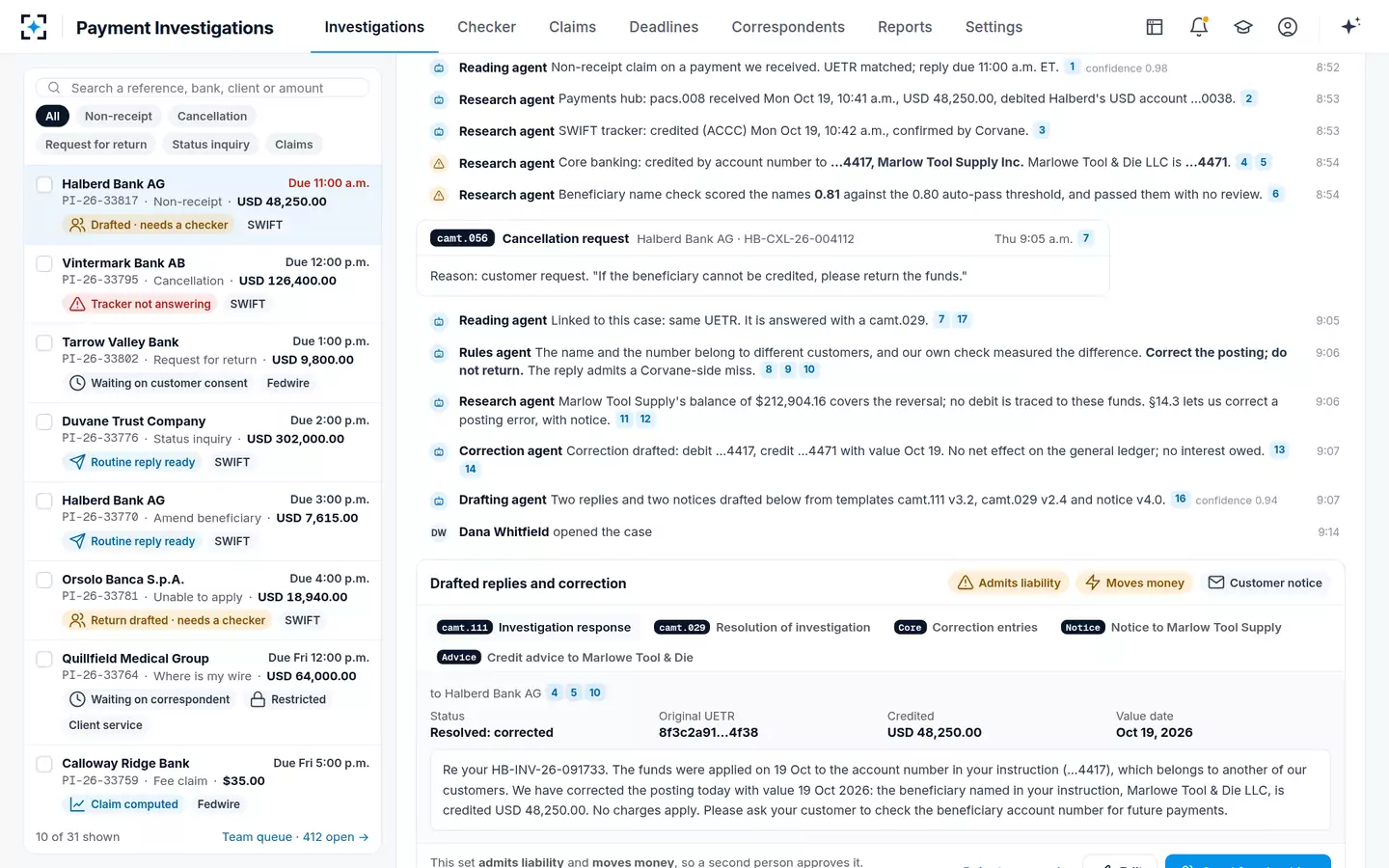
Here the rules agent goes further than 4A-207 requires. It proposes correcting the posting, which the account agreement allows, and it proposes a reply that admits a miss on the bank's side because the bank's own check had scored the names. A lawyer could argue the other way: the instruction carried the wrong number, the check passed the names, and nobody at the bank read a warning, which on Studco's reasoning is not knowledge. Correcting may still be the right business decision, because the money is still in the wrong account and the bank's customer relationship with Halberd matters. Whether the reply should say the bank was at fault is a different decision, with consequences for every similar case.
Why "our error" is a decision only a person may write
Because the words in a reply become evidence. A camt.111 or a letter saying the bank misapplied a payment can be produced in a claim, cited by a correspondent in the next dispute, and read by an examiner as the bank's view of its own controls. If 4A-207 let the bank rely on the number, that sentence gives away a position the law gave it. If the bank did know, saying so plainly may be right and may limit the damage. Either way it is a judgement about facts, law, the agreement and the relationship, and it belongs to someone who can be asked why.
The drafted set, marked before anyone can send it
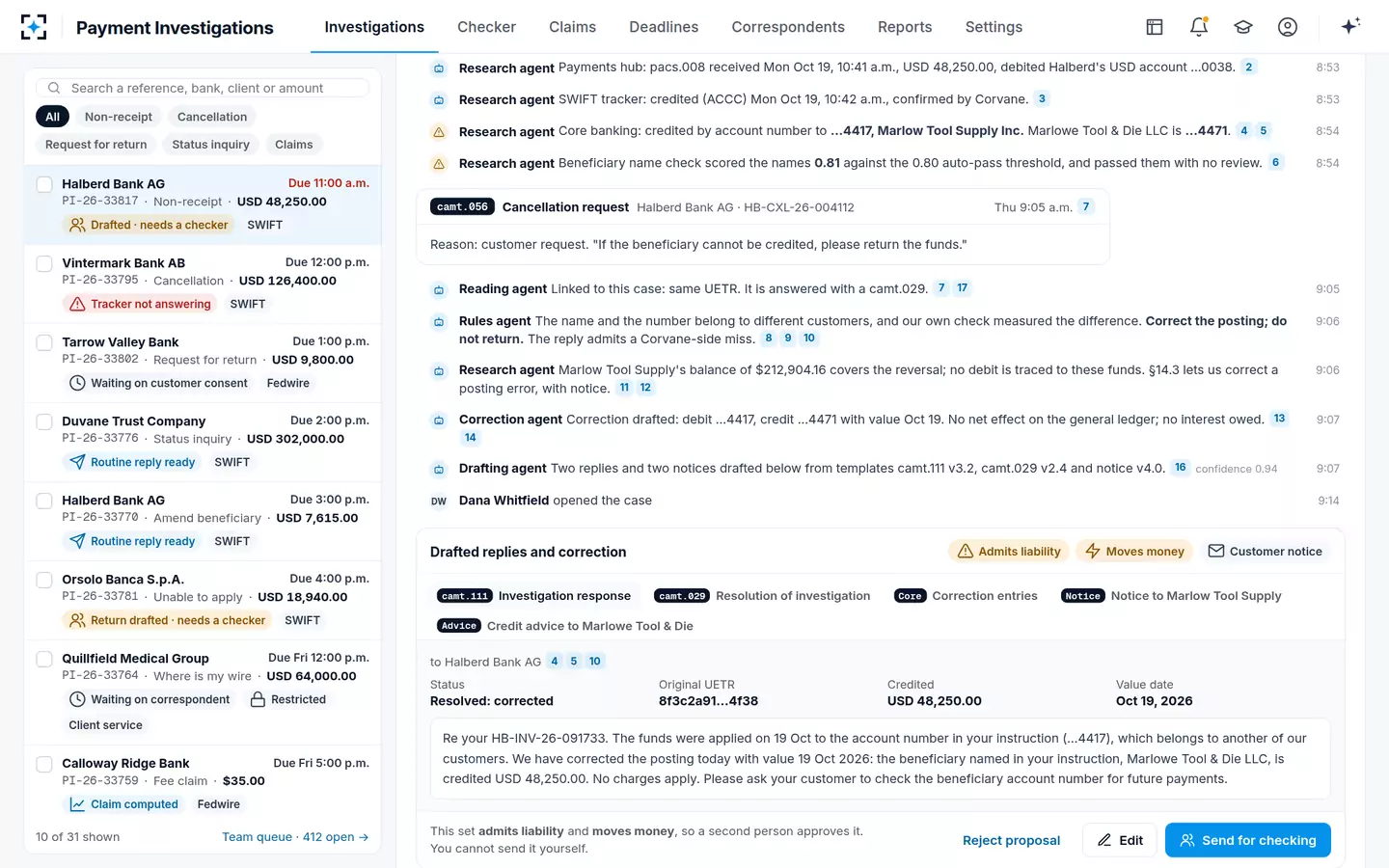
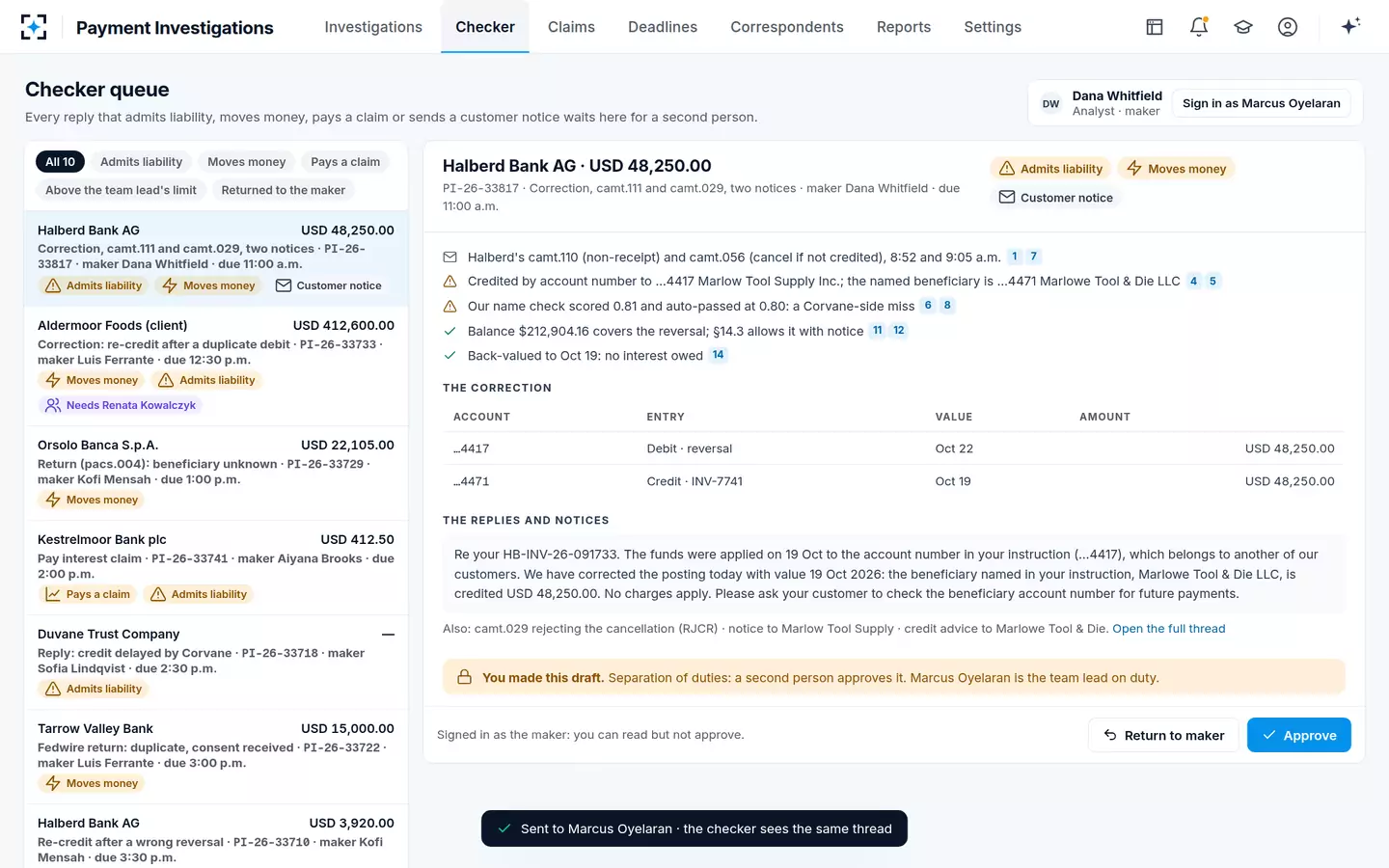
The design follows from that. In Payment Investigations, any draft that says the bank misapplied, delayed or wrongly charged a payment counts as admitting liability, and that setting is locked on. Such a draft cannot be sent by the person who prepared it: it goes to a team lead, who sees the same thread, citations and entries. Whether the wording concedes fault, or simply states what happened, as the sample's draft does when it says the funds "were applied on 19 Oct to the account number in your instruction (...4417), which belongs to another of our customers", is the analyst's and the checker's choice, and the case keeps who chose what and why. How that record should look to an examiner is covered in the wire investigation case file.
What the agents in Payment Investigations may do, and where they stop
The agents may find, compare, cite and draft; they may not decide, send or post. That split is not caution for its own sake. Each step the agents take is checkable against a record: a posting, a balance, a log, a clause. The step they do not take is the one no record settles, because it depends on how the law applies to these facts and on what the bank wants to say.
The maker cannot approve her own draft
The same boundary applies to the next step the sample takes. After the case, a trends agent notices that six of Halberd's 14 cases in 90 days were name and number mismatches and proposes raising the name-check threshold to 0.90. It does not change the setting: the administrator and the Head of E&I must both approve. That is the right owner for a change that, after Studco, alters what the bank's people will be told and therefore what the bank may be taken to know. To test any tool on a case like this before buying it, see five test cases for a payment investigation tool.
Does FATF's revised Recommendation 16 change name matching?
Not U.S. law, and not 4A-207, but it points the industry the other way. In June 2025 the Financial Action Task Force revised its standard on payment transparency to require financial institutions to use technologies against fraud and error, including verification of recipients' banking information, with countries expected to implement by the end of 2030. Its June 2026 consultation on guidance asks how to detect misdirected payments using the alignment checks the revised standard foresees.
For U.S. banks the rule today remains that a beneficiary's bank may rely on the number. What will change as name checks spread is the factual question 4A-207 asks: more alerts, read by more people, at more points before funds are released. Each alert a person reads is a moment the bank may come to know. That is an argument for designing who sees an alert, and what they must do, before the volume arrives.
For the payer's side of the same problem, a misdirected payment that started with a fraudulent change of bank details, see can a fraud wire transfer be reversed, from Botminds' Wire Recall Management. For a non-receipt claim followed from the call to the reply, see wire transfer completed but not received.
Questions people ask
Does a bank have to match the beneficiary name on a wire?
Not under UCC 4A-207. The beneficiary's bank may rely on the account number and "need not determine whether the name and number refer to the same person", unless it knows they refer to different people. A bank may still run name checks as a fraud and service control, and the international standard is moving towards recipient verification by 2030.
What is misdescription of beneficiary?
It is the title of UCC 4A-207: a payment order whose name, account number or other identification of the beneficiary refers to someone who does not exist or cannot be identified, or whose name and number identify different persons. The section decides whether the beneficiary's bank accepted the order and who carries the loss.
Who is liable when a wire goes to the wrong account?
If the beneficiary's bank credited the account the number identified without knowing it belonged to someone else, it is not liable under 4A-207 for following the number. A bank originator must still pay its order; a non-bank originator may be excused unless it had signed notice that payment could be made by number. The money is then recovered from the person who received it, under the law of mistake and restitution.
Did Studco change the law?
It confirmed how one court reads it. The Fourth Circuit held in March 2025 that "knowledge" in 4A-207 means actual knowledge, so automated mismatch warnings that no one read did not make the credit union liable, and the Supreme Court declined review in October 2025. Courts in other circuits are not bound by it.
Can the originator get the money back from the wrong account holder?
Yes, subject to the law of mistake and restitution. Under 4A-207(d), the originator recovers if it had to pay its order; if it did not, its bank has the right to recover. In practice the speed matters most: money still in the account can be recovered far more easily than money already withdrawn.
Does 4A-207 apply to ACH payments?
It can. Article 4A covers credit transfers that are not governed by the Electronic Fund Transfer Act, and Studco itself concerned business ACH credits under Virginia's enactment. Consumer electronic fund transfers are governed by the EFTA and Regulation E instead (UCC 4A-108).