A payment investigation job description usually reads: research and resolve inquiries on wire transfers, answer correspondent banks and clients, process cancellations, returns and claims, and meet service deadlines. That is accurate, and it hides the shape of the work. A payment investigator spends less time finding answers than waiting for them: on the bank at the other end of the wire, on the beneficiary's bank, on the bank's own compliance team and on the client, and no rule obliges any of them to reply on the investigator's timetable. The job is managing those waits against a deadline someone else set, and knowing which replies are routine and which are a decision about the bank's money. Botminds' Payment Investigations is software built for that desk: agents read each request, find the payment across the bank's systems and draft the reply, and people decide what is sent.
Who a payment investigator waits on, and for what
Today
Sends a request for information or a follow-up and waits. Nothing in the Fedwire rules makes the other bank answer it.
With agents
The request is drafted from a template; the case shows it is waiting on the correspondent, and the deadline agent raises it before the requester's deadline.
Still theirs: Whether to chase by message, by phone or through the relationship manager.
Today
Waits to learn whether the payment was credited, to whom, and when the beneficiary was told.
With agents
Where the bank is itself the beneficiary's bank, the posting, the name check and the balance are found and cited on the case.
Still theirs: Agreeing to a cancellation after acceptance, which only that bank can do.
Today
A cancellation or return request is sent through Fedwire and the investigator waits for the receiving bank, not the Fed, to act.
With agents
Requests in and out sit in the case thread, linked by the payment's reference, and a person decides what is sent.
Still theirs: The decision to give, or withhold, the indemnity.
Today
A case touching a sanctions hit or a referral waits for a decision the investigator may not describe to the client.
With agents
Restricted wording is kept out of every client and correspondent draft, and the case shows only what the analyst may see.
Still theirs: Every word about a referral, which never leaves Financial Crimes.
Today
Waits for the client to confirm details, consent to a debit, or say whether the beneficiary has now been paid.
With agents
A client service officer gets the status in plain words and a drafted email, while the case waits.
Still theirs: The relationship, and any promise of a date.
Today
A reply that admits fault or moves money waits for a second signature, sometimes by email with a screenshot attached.
With agents
The checker sees the same thread, citations and entries as the maker, and approves or returns with a reason.
Still theirs: The approval itself; the maker cannot approve their own draft.
What does a payment investigator do?
A payment investigator answers the questions that come back after a payment has been sent or received, and corrects what went wrong. Most fall into a handful of kinds: where is the payment, please cancel or return it, the beneficiary was not credited, the amount or the beneficiary was wrong, the payment cannot be applied, and you owe us interest or a fee. Each arrives from a correspondent bank, a client, a branch or another department, often with a deadline written into the request.
The scale behind those questions is large even when the error rate is small. The Fedwire Funds Service alone settled 217.3 million transfers worth $1.148 quadrillion in 2025, an average of 869,187 a day at $5.28 million each. Every transfer that a client cannot find, that lands on the wrong account or that arrives a day late becomes a case for someone in the bank, in a team a bank may call payment investigations, wire investigations or exceptions and investigations (E&I).
The work divides cleanly. Research is finding the payment and its story in the bank's own systems. Determination is deciding what the facts mean under the funds-transfer rules and the agreements. Resolution is the reply, the correction, the return or the claim. Only the research inside the bank's own systems is fully in the investigator's control; everything else involves someone else, which is why waiting fills so much of the day. The steps and the rule behind each are set out in the payment investigation process, step by step.
The job description, line by line, against the rule behind it
Every line in a typical posting maps to a rule that decides how the line is done. Reading the posting that way tells a hiring manager what to test for, and tells a candidate what the job really asks.
A payment investigation job description, and the rule behind each line
| What the posting says | What it means in practice | The rule that decides it |
|---|---|---|
| Research inquiries on incoming and outgoing wires | Find the payment in the hub, the gateways, the core and the general ledger, and establish when each bank accepted it. | UCC 4A-209: a beneficiary's bank accepts at the earliest of paying or notifying the beneficiary, receiving payment of the order, or the next day's opening with the order covered. |
| Process cancellation and recall requests | Send or answer a request to cancel or return, and know when it can still work. | UCC 4A-211 and Operating Circular 6 §8.1.4: after acceptance, cancellation needs the receiving bank's agreement. |
| Resolve non-receipt and misapplied payments | Prove where the money went, and whether the name and the number named the same customer. | UCC 4A-207 on misdescription; UCC 4A-404 on the beneficiary bank's duty to pay and give notice. |
| Handle compensation and fee claims | Compute interest for days lost and decide whether the claim is owed. | UCC 4A-305 and 4A-506: interest at the federal funds rate on a 360-day year, unless an agreement or a system rule sets it. |
| Communicate with correspondents and clients | Write replies that answer the question without saying what may not be said. | 31 CFR 1020.320(e): a suspicious activity report, and anything that would reveal one, stays confidential. |
| Meet service levels and escalate | Work to the requester's deadline and the bank's own, and raise what will miss. | The bank's agreements and policy; examiners look at the aging of open items. |
Two lines on that list are not research at all. Deciding that the bank misapplied a payment, and paying a claim, commit the bank's money and sometimes its liability. A posting that lists them beside updating the case tool is describing two different jobs: one any trained analyst can do, and one that should always carry a second signature. How the name-and-number question is decided, and why only a person may concede it, is the subject of UCC 4A-207 for investigators.
Who does a payment investigator wait on?
On most cases, on at least one party outside the investigator's team, and sometimes three. A non-receipt claim on an outgoing wire waits on the beneficiary's bank to say what it did with the payment. A cancellation waits on the receiving bank's agreement. A case touching a sanctions alert waits on compliance. A correction that debits a customer waits on a second approver, and sometimes on the customer's consent.
Each wait has its own clock, and most are not the investigator's. The requester sets one: a correspondent asking for a reply by 17:00 Frankfurt time has set a deadline that runs on a different day boundary. The law sets others. A beneficiary's bank that accepts a payment for an account must notify the beneficiary before midnight of the next funds-transfer business day after the payment date, or pay interest for the gap. An order the receiving bank never accepts is cancelled by operation of law at the close of the fifth funds-transfer business day after its execution or payment date. An investigator who keeps those clocks in a spreadsheet beside the case tool is doing two jobs at once.
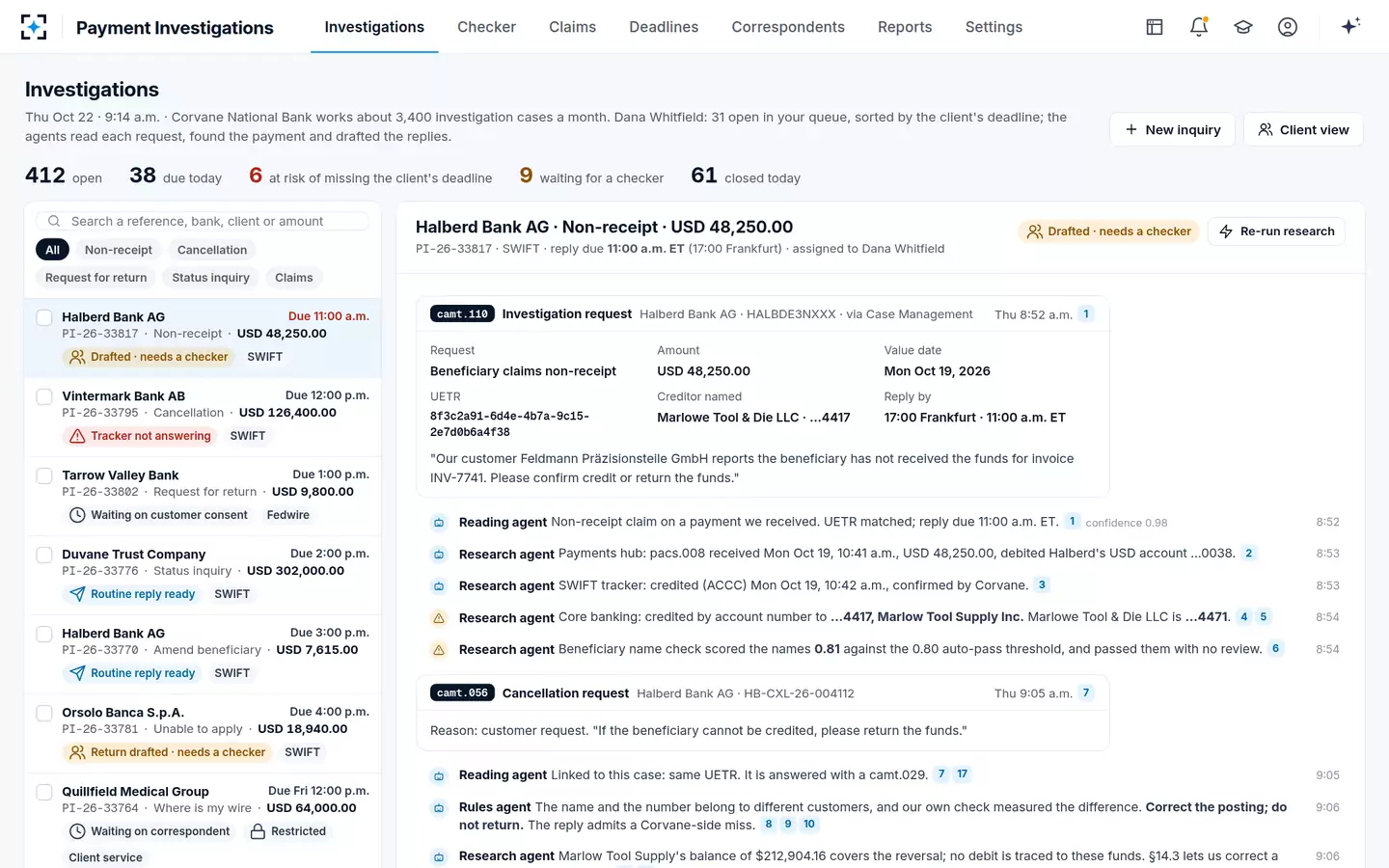
One investigator's queue, sorted by the requester's deadline
No one has to answer: what Operating Circular 6 says about inquiries
The Fedwire rules carry requests for information but do not make anyone respond to them. Operating Circular 6, which governs the Fedwire Funds Service, describes the messages that move no money, which include "requests for payment, requests for information, requests for return of funds, and other administrative messages", and then says this:
"This operating circular does not impose any obligation on Funds Participants to respond to Nonvalue Messages."
Federal Reserve Banks, Operating Circular No. 6, §8.1.3 (effective January 5, 2026)
So an investigator's request for information reaches the other bank as surely as a payment does, and then the matter is between the two banks: their agreements, their relationship and their own service standards. That is why investigation teams keep follow-up dates, escalate through relationship managers and track which counterparties answer slowly. It is also why a desk's backlog is partly a measure of its counterparties.
Cancellations are the sharpest case. The circular says a Reserve Bank has no obligation to cancel or amend a payment order even if asked; its "only obligation is to send the Message to the Funds Participant identified by the sender of the Message as the Funds Participant to receive it" (§8.1.4). Whether the request works is a question of UCC 4A-211. Once the receiving bank has accepted the order, cancellation needs that bank's agreement, and at the beneficiary's bank it is available only for an unauthorized order, a duplicate, a payment to the wrong beneficiary or an overpayment (4A-211(c)). The same section of the circular adds that a bank requesting cancellation "may be liable under section 4A-211 of Article 4A unless the request states 'NO INDEMNITY.'" The investigator who sends that request is making a commitment on the bank's behalf, so whoever approves it should know which kind of request went out. Fraud recalls, where speed decides recovery, are a separate discipline; Botminds' Wire Recall Management is built for them.
The wait inside the bank, and what the investigator may not say
Some of the longest waits are internal, and some cannot be explained to the person waiting. A payment held for a sanctions review, or a case that Financial Crimes is looking at, may sit with compliance while the client calls every day. The investigator may not be able to say why. Federal rules make a suspicious activity report, and any information that would reveal one, confidential, so a careless "it's with our fraud team" in a client email can be a disclosure problem, not just a service problem.
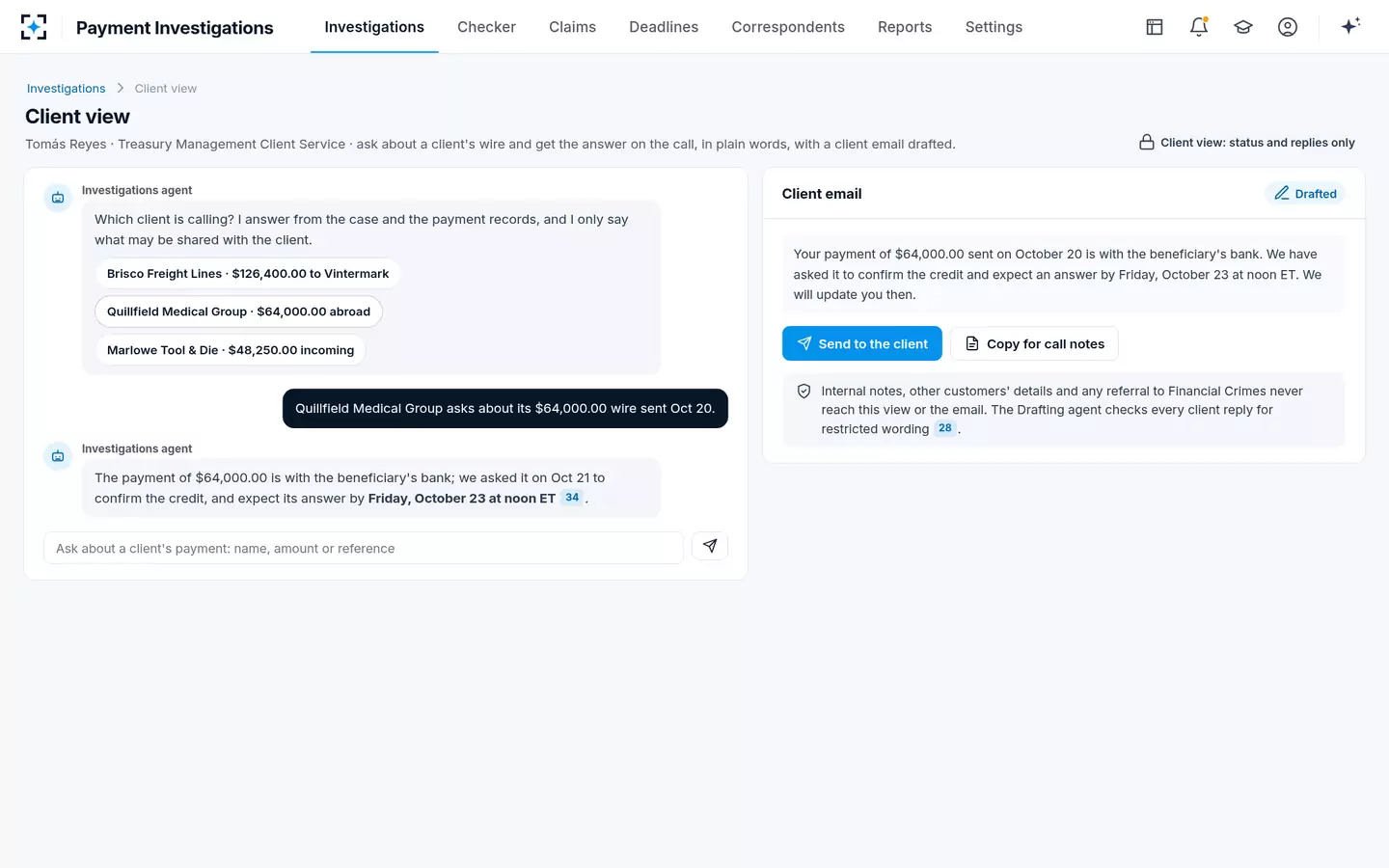
That turns a writing task into a judgement. The investigator has to give the client a true status ("the payment is under review and we will update you by Friday") without the word that gives the review away, and has to keep that discipline in every reply, including the ones to correspondents, which may be forwarded on. It is one reason the job asks for more than knowledge of message formats. In Payment Investigations, client service officers see a status-only view, and the drafting agent removes restricted wording from anything a client or correspondent will read.
What client service can see, and what never reaches it
What skills does a payment investigation job need?
The skills that matter are the ones that let an investigator act on a wait instead of simply enduring it. Knowing the message formats lets them ask the right question the first time. Knowing the acceptance and cancellation rules tells them which waits can end in success and which cannot. Knowing the clocks lets them escalate before the deadline rather than after it.
Skills a payment investigation job needs, and why each saves a wait
- Read the payment messages, not just the screens
Fedwire has run on ISO 20022 since July 14, 2025, with pacs.008 and pacs.009 for payments, pacs.004 for returns, pacs.002 for status, camt.056 and camt.029 for return requests and refusals, and camt.110 and camt.111 for investigations.
- Know when each bank accepted the payment
Acceptance decides whether a cancellation can still work and who owes the beneficiary; at a beneficiary's bank it can happen by paying, by notifying, or at the next day's opening (UCC 4A-209).
- Tell a routine reply from a liability decision
A status answer can go out at once; a reply saying the bank misapplied, delayed or wrongly charged a payment needs a second person.
- Keep three clocks at once
The requester's deadline, the bank's own service level and the legal clocks: next-day notice, the fifth-day lapse of an unaccepted order, the 90-day reporting duty on an erroneous order.
- Write for a reader who may forward it
Answer the question exactly, in the requester's terms, without internal notes or anything that would reveal a referral.
- Compute what a delay costs
Interest at the federal funds rate on a 360-day year, for the days lost, is arithmetic an investigator should be able to check by hand.
- Spot the repeat
The same correspondent sending the same problem is a relationship conversation, not ten separate cases.
Interview questions follow from the list. Ask a candidate when a beneficiary's bank accepts a payment order. Ask what a camt.029 tells you that a phone call does not. Give them a client email and a compliance note and ask for the reply. The answers show whether someone has done the work or only read about it.
How managers and examiners judge the desk
Managers judge an investigation desk on its open items and how old they are, and examiners look at the same thing. In the FFIEC's retail payment systems examination procedures, written for ACH, examiners are told to "assess the effectiveness of the investigation unit to address customer inquiries and control return items, rejected/unposted items, differences, etc." and to determine whether the unit "periodically generates aging reports of outstanding items for management" (FFIEC, Retail Payment Systems booklet, April 2016). The FFIEC's wholesale booklet, which covers wires, expects officers to review corrections, reversals and other adjustments, and management to receive aging of open items (Wholesale Payment Systems, July 2004).
For the person in the seat, that means the case history is part of the job. Every lookup, every message sent, every approval and every wait should be visible to someone who was not there, months later. A desk where the evidence lives in personal inboxes can resolve cases well and still fail that test. What a file has to show for an examiner to follow it is set out in the wire investigation case file.
What does a payment investigation specialist earn?
No official statistic answers that directly, because the Bureau of Labor Statistics has no occupation called payment investigator. Its Occupational Employment and Wage Statistics place this work inside broader groups, so the nearest public figures are proxies, and they describe whole occupations, not this desk.
Proxy occupations in credit intermediation, May 2025
18,730
financial clerks, all other, employed in credit intermediation
mean annual wage $57,660
25,210
financial specialists, all other, in the same industry
mean annual wage $80,860
19,850
compliance officers in the same industry
mean annual wage $94,090
The spread between the clerk and specialist figures matches the split in the work. Research and routine replies sit closer to the clerical group; determination, claims and the second signature sit closer to the specialist and compliance groups. A team that wants senior people to spend their time on the decisions, rather than on finding the payment, is making a staffing argument as much as a technology one.
Where agents take the chasing off the desk in Payment Investigations
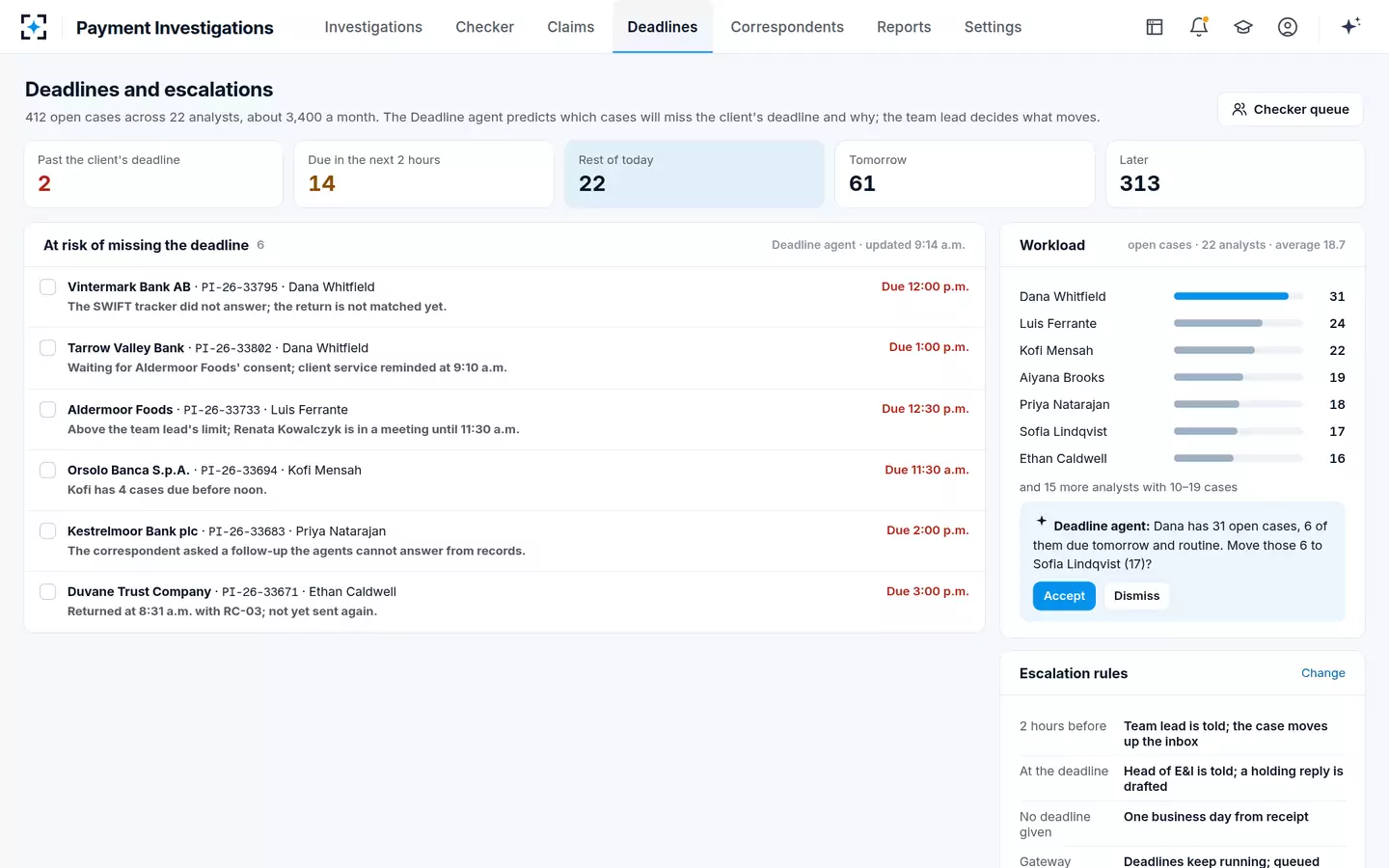
Software cannot make another bank answer. What it can do is remove the work around the wait: reading the request, finding the payment, keeping the clocks and drafting the follow-up, so that the investigator's time goes to the judgement. In Payment Investigations, a reading agent extracts the payment reference, the amount, the parties and the requester's deadline from a structured message or a free-text email, with a confidence on each field, and asks when it is unsure. A research agent finds the payment in the payments hub, the gateways, the core banking system and the general ledger, citing each record. A deadline agent watches every requester's deadline, predicts which cases will miss and why, and proposes how to rebalance work; it never reassigns a case without the team lead.
The deadline view in Payment Investigations: what is at risk, and why
The people keep what the job description undersells. The analyst sends routine replies and sends anything that admits liability, moves money or pays a claim for checking; the team lead approves it on the same evidence. The design target is that 100% of replies that admit liability, move money or pay a claim are approved by a second person, with the maker unable to approve their own draft. The solution also shows the relationship manager which correspondents send the same problem again and again, so a repeat wait becomes a conversation. To see a full case, start from Payment Investigations.
Questions people ask
What is a payment investigations analyst?
A payment investigations analyst researches and resolves questions about payments that have already been sent or received: non-receipt, cancellation, misapplied credits, amendments and compensation claims. The role sits in payment operations, sometimes in a team called exceptions and investigations (E&I), and works with correspondent banks, clients, compliance and the general ledger team. Banks use the titles analyst, investigator and specialist for similar seats, with seniority usually marked by approval authority.
Is payment investigations a back-office role?
It sits in operations, but it faces outward more than most back-office jobs: investigators write to other banks every day, and their replies can admit liability or move money. Examiners look at it directly; the FFIEC's procedures ask them to assess the investigation unit's handling of inquiries and whether management sees aging reports of outstanding items.
How long does a wire investigation take?
No regulator publishes an industry figure, and averages quoted in marketing are not a reliable guide. What can be said is where the time goes: the research inside the bank can be fast, while the answer can depend on another bank that has no Fedwire obligation to respond to a request for information. A desk can measure its own cases by separating the time it held a case from the time it waited on others.
Can a payment investigator cancel a wire?
An investigator can request cancellation, but only the receiving bank can agree to it once it has accepted the order, and at the beneficiary's bank only for an unauthorized order, a duplicate, a wrong beneficiary or an overpayment under UCC 4A-211. The Federal Reserve Banks only forward the request, and a Fedwire request carries an indemnity unless it states "NO INDEMNITY". Fraud recalls follow a different, faster playbook.
What does E&I mean in banking?
E&I stands for exceptions and investigations: the handling of payments that did not go as instructed, and of the questions about them. The Committee on Payments and Market Infrastructures uses the term in its harmonised ISO 20022 requirements, which apply to interbank payments and to exceptions and investigations messages. In many banks it is also the team's name.
What qualifications do payment investigators need?
Most roles ask for payments operations experience rather than a specific degree, and the skills that matter can be tested: reading ISO 20022 payment messages, knowing when a payment is accepted under UCC 4A-209, and writing a reply that answers without disclosing restricted information. Knowledge of Regulation J, the Reserve Banks' operating circulars and the bank's correspondent agreements marks the senior investigator.