camt.110 and camt.111 are the ISO 20022 messages for payment investigations: camt.110 is the Investigation Request, camt.111 the Investigation Response. A bank uses camt.110 to ask another bank a structured question about a payment (it was not received, it cannot be applied, or we need information) and the other bank answers with camt.111, giving a status of closed, pending or rejected and, where the type allows, a confirmation, a transaction status or the data asked for. They replace free-text exchanges with typed fields: an investigation type, the original payment's identifiers, reason codes and follow-up actions. The Committee on Payments and Market Infrastructures (CPMI) added both to its core message set in February 2026, and the Federal Reserve says Fedwire is the first system in the world to implement them. Botminds' Payment Investigations reads incoming camt.110s alongside free-text requests, and drafts the camt.111 for a person to send.
A camt.110 request, element by element
Message Identification
DVB-INV-26-0412
The requesting bank's own reference for this message. Required.
Requestor Investigation Identification
DVB-CASE-88231
The case number on the asking side, so every later message lands on the same case. Optional.
Investigation Type
CCNR · Creditor Claim Non-Receipt
What kind of investigation this is, as a code. Required, and it decides which other elements and codes may be used.
Underlying Instrument
XCBT · Cross-border Credit Transfer
The CPMI model fixes this code: its scope is cross-border credit transfers.
Underlying › Interbank › Original Message Name Identification
pacs.008
Which message is being asked about.
Underlying › Interbank › Original UETR
1f6e2b9c-…-4d07
The end-to-end reference of the payment. Marked R (required) in the harmonised model.
Original Interbank Settlement Amount and Date
USD 186,400.00 · 2026-10-14
The amount and date as settled, so the responder can find the payment without guessing.
Requestor and Responder
the originator's bank → the beneficiary's bank
Who asks, and who must answer; the model also allows a Request Originator and an Expected Responder.
Investigation Data › Reason
CCNR
A code from ISO's external investigation reason list; for a request for information, a sub type narrows it (AMLI, FRAD, SANC and others).
What is camt.110?
camt.110 is the Investigation Request: a message one financial institution sends another to open, or follow up, an investigation about a payment. In the CPMI's harmonised model it carries a message identification, optional case references for the requestor and responder, a required investigation type, the underlying payment's identifiers (original message, UETR, settled amount and date), the requestor and responder, and one or more blocks of investigation data with a reason code. For some types it can carry additional request data: a requested debit authorisation, requested compensation, a requested valuation or a request narrative.
The investigation type is the heart of it. The CPMI's table for camt.110 lists four: UTAP, Unable To Apply; CCNR, Creditor Claim Non-Receipt; CONR, Creditor Agent Claim Cover Non-Receipt; and RQFI, Request For Information, with sub types for anti-money laundering, financial crime compliance, fraud, the funds/wire transfer regulation, sanctions, and unable to execute (CPMI technical annex, Table 4.1.8a). A free-text message leaves the reader to work out which of these was meant; a camt.110 says so in a code a system can route.
What is camt.111?
camt.111 is the Investigation Response. It carries the responder's own references, a required investigation status, and, depending on the status and type, investigation data with the answer. The status codes are CLSD (investigation closed), PDNG (pending) and RJCT (rejected), and the model requires a status reason whenever the status is pending or rejected. A rejected response must not carry investigation data; a pending response must carry it unless the reason is a partial response. The response also copies the original request's identifiers back, so the requester can match it without reading anything.
Each camt.110 investigation type, and what the camt.111 answer can carry
| Investigation type | Typical situation | camt.111 response data (choice) |
|---|---|---|
| UTAP · Unable To Apply | The receiving bank cannot apply the payment as instructed. | Transaction data (remittance information), or a response narrative. |
| CCNR · Creditor Claim Non-Receipt | The beneficiary says it was not credited. | A confirmation, or a transaction status. |
| CONR · Creditor Agent Claim Cover Non-Receipt | The beneficiary's bank says the cover for the payment did not arrive. | A confirmation, or a transaction status. |
| RQFI · Request For Information (AMLI, FRAD, FWTR and other compliance sub types) | A bank needs information about the payment for a compliance check. | Transaction data, or a response narrative. |
| RQFI · Request For Information (SANC) | Information needed for sanctions screening. | Transaction data, or a response narrative. |
| RQFI · Request For Information (UTEX) | A bank cannot execute the payment without more information. | Transaction data, or a response narrative. |
What is the difference between camt.110 and camt.111?
One asks and the other answers, and the answer is constrained by the question. A CCNR request, a non-receipt claim, can only be answered with a confirmation or a transaction status. A request for information can only be answered with transaction data or a narrative. The response must say whether the investigation is closed, pending or rejected, and why if it is not closed. That pairing is what makes the exchange machine-readable on both sides: the requester's system knows what kind of answer to expect, and can tell a "still looking" from a "no".
The follow-up rules are just as specific. A Request Action may be used only in a successive camt.110, never in the first one. The CPMI lists three actions, RQCL (request investigation closure), RQST (request investigation status) and RQOB (request objection), with reasons such as IRSI (investigation request sent in error), IRRR (investigation request resolved) and IRIC (investigation response incomplete). If no code fits, the reason NARR is used with additional information. A chaser that used to be a second free-text message becomes a status request on the same case.
Fedwire is the first system to implement them
The Federal Reserve has put Fedwire ahead of the rest of the market. In June 2026, writing about the CPMI's update, Federal Reserve Financial Services said:
"The Fedwire Funds Service is the first system globally to implement these new payment investigation messages as part of its efforts to improve the efficiency of payments and streamline and automate resource-intensive investigation processes."
Federal Reserve Financial Services, Fed360, June 2, 2026
Fedwire's message portfolio already includes them. Its ISO 20022 Format FAQ lists camt.056 and camt.029 for return requests and responses and pacs.028 for status requests, and then says: "For the remaining use cases, two ISO 20022 messages, i.e., Investigation Request (camt.110) and Investigation Response (camt.111) can be used to deal with exceptions and investigations with wires sent over the Fedwire Funds Service." (FRFS Format FAQs). Together they replace most known uses of Fedwire's old service message, the SVC 1090.
What is still to come is the structured version. The October 2025 roadmap planned enhancements "to the investigation messages (camt.110/camt.111) to enable better structuring of frequently used investigation use cases" (FRFS, October 2025), and the June 2026 article tied structured data models for two investigation use cases to the next release, a plan the guide to payments exception management systems quotes in full. That release has since been rescheduled to November 2027, with final usage guidelines due on MyStandards in November 2026.
The dates behind camt.110 and camt.111
| When | What happened or is planned | Source |
|---|---|---|
| October 2023 | The CPMI publishes its harmonised ISO 20022 data requirements for cross-border payments. | CPMI; Fed360 |
| July 14, 2025 | Fedwire moves to ISO 20022. Its message portfolio now lists camt.110 and camt.111 for exceptions and investigations. | FRFS |
| February 26, 2026 | The CPMI's update adds camt.110 and camt.111 to the core message set, with data models in a technical annex. | CPMI |
| November 2026 | FRFS intends to publish final usage guidelines for its next release. | FRFS November 2027 Release FAQ |
| November 2027 | The rescheduled Fedwire release, carrying the structured investigation models and the hybrid postal address. | FRFS |
| End-2027 | The CPMI asks market participants to align with its requirements by end-2027 at the latest. | CPMI |
What replaces MT 199 for investigations?
For structured investigations, camt.110 and camt.111. The MT 199 is one of the SWIFT free-format message types, as a BIS paper on ISO 20022 migration defines them (CPMI Brief No 11, glossary): text that a person reads and answers. It can say anything, which is both its use and its problem. Two banks can exchange a dozen MT 199s about a payment without either system knowing which payment it is, what kind of question was asked, or whether it has been answered.
The same non-receipt question, as free text and as a camt.110
Free-format message (MT 199 or email): Whatever the writer says; the reader decides.
camt.110 Investigation Request: An Investigation Type code: here CCNR, Creditor Claim Non-Receipt.
Free-format message (MT 199 or email): References typed into the text, if any.
camt.110 Investigation Request: Original message, UETR, settled amount and date, as elements.
Free-format message (MT 199 or email): The message header, and the signature.
camt.110 Investigation Request: Requestor and Responder, plus optional originator and expected responder.
Free-format message (MT 199 or email): Another free-text message.
camt.110 Investigation Request: A successive camt.110 with Request Action RQST, RQCL or RQOB and a reason code.
Free-format message (MT 199 or email): Free text, read by a person.
camt.110 Investigation Request: camt.111 with status CLSD, PDNG or RJCT, a reason if not closed, and the data the type allows.
For an investigations desk, the change is less about formats than about sorting. Typed requests can be routed by type before anyone reads them: non-receipt claims to one queue, compliance requests for information to the people allowed to answer them, unable-to-apply cases to whoever can find the right account. How a desk should sort its inquiries, whatever format they arrive in, is the subject of payment inquiry management.
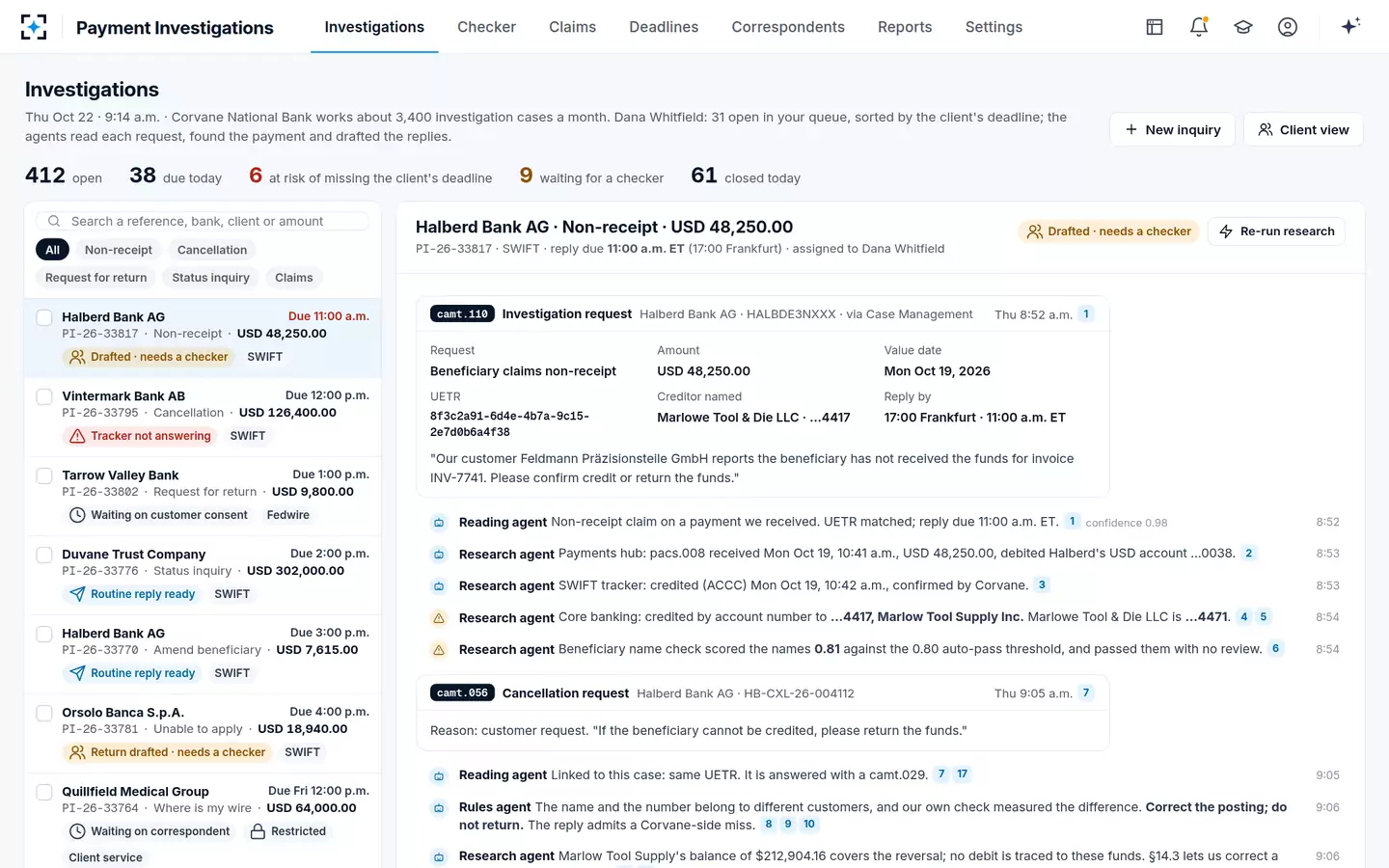
A camt.110 non-receipt claim as Payment Investigations reads it
Is camt.110 mandatory?
No U.S. rule requires a bank to use it, and the CPMI's requirements are recommendations, not law. The CPMI asks market participants to start aligning with its harmonised requirements now and to finish by the end of 2027 (CPMI, 2023), a target the guide to ISO 20022 readiness KPIs measures against, and payment system operators decide what their own networks accept and when. On Fedwire, the FAQ says camt.110 and camt.111 "can be used" for exceptions and investigations; how a bank's correspondents and its own operations adopt them is a matter of agreement and network rules.
The practical position for most banks in late 2026 is mixed traffic. Structured requests arrive from counterparties that have moved, free text from those that have not, and email from clients throughout. A desk that can only read one of them still has to read the others by hand.
What is the difference between camt.110 and camt.029?
camt.029 answers a cancellation request; camt.110 opens an investigation. In the CPMI's core set, camt.056 (payment cancellation request), camt.029 (the response) and pacs.004 (payment return) sit under payment returns, while pacs.028, camt.110 and camt.111 sit under payment investigations (CPMI, Table 1). The CPMI notes that camt.029 "currently covers more functionality than responding to a return request", and expects the ongoing exception and investigation message redevelopment to bring "the likely removal of functionalities not related to payment cancellations".
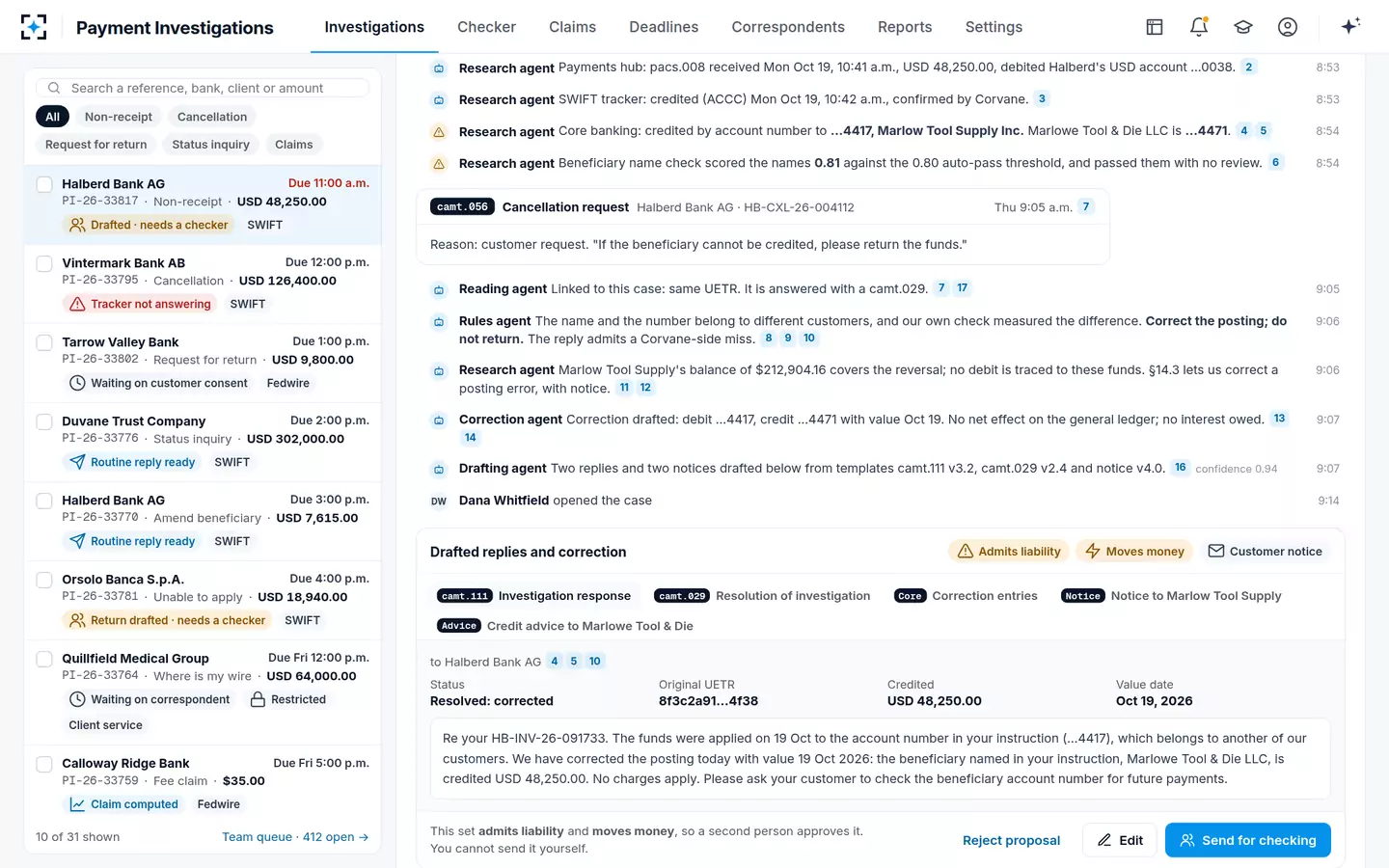
In practice the two pairs often meet in one case. A correspondent can send a camt.110 saying the beneficiary was not credited and, in the same breath, a camt.056 asking for the money back if it cannot be credited. The bank then owes two answers: a camt.111 to the investigation and a camt.029 to the cancellation request. When the cancellation is a fraud recall, speed and a different playbook apply; Botminds' Wire Recall Management is built for that.
Two answers to two requests, drafted in one case
How Payment Investigations reads and drafts camt.110 and camt.111
The reading agent reads each incoming request, structured or free text, classifies the case and extracts the references, amount, parties and the requester's deadline, with a confidence on every field; below 0.85 it asks the analyst rather than guessing. When a correspondent sends a camt.110 and a camt.056 about the same payment, it links both to one case by the UETR. The drafting agent writes the camt.111 and camt.029 from versioned templates, and the analyst sends routine answers; anything that admits liability, moves money or pays a claim goes to a team lead.
The structured fields make the agents' work checkable. A camt.110's investigation type and original UETR are facts in the message, not inferences from prose, so the case's classification and the payment it is about can be verified against the request itself. For the receiving side of the process, from intake to closed case, see the payment investigation process; for the systems the messages come through, see keeping the hub you have.
Questions people ask
What is the MT equivalent of camt.110?
There is no exact one. SWIFT's MT standard has free-format message types, the MT199 and MT299, which carry text rather than typed fields. camt.110 replaces the free text with an investigation type, the original payment's identifiers and reason codes.
What does CCNR mean in camt.110?
Creditor Claim Non-Receipt: the investigation type for a beneficiary saying it was not credited. The CPMI's model allows a camt.111 answer to a CCNR to carry a confirmation or a transaction status, with a status of closed, pending or rejected.
What are the camt.111 status codes?
CLSD (investigation closed), PDNG (investigation pending) and RJCT (investigation rejected). Under the CPMI's model a pending or rejected response must give a status reason, and a rejected response carries no investigation data.
When does Fedwire support camt.110?
Fedwire has run on ISO 20022 since July 14, 2025, and its message portfolio lists camt.110 and camt.111 for exceptions and investigations. The structured investigation data models from the CPMI's 2026 update are planned for the Fedwire release rescheduled to November 2027.
Can a camt.110 ask for compensation?
The CPMI's model for camt.110 includes additional request data with a requested compensation element, alongside a requested debit authorisation, a requested valuation and a request narrative; whether it may be used depends on the investigation type. How compensation is computed under U.S. law is a separate question, governed by UCC 4A-506 unless an agreement says otherwise.
Who sends a camt.110?
Any financial institution in the chain that needs to open or follow up an investigation: in a non-receipt case, for example, the originator's side asking the bank that should have credited the beneficiary. The message names a requestor and a responder, and the response copies the original request's identifiers back so both sides can match it.