UCC 4A-305 sets what a bank owes when it executes a payment order late or wrongly. If the funds transfer is completed but the bank's breach of its execution duties delayed payment to the beneficiary, the bank must pay interest for the period of delay, and "additional damages are not recoverable" unless an express written agreement provides for them. If the breach means the transfer is not completed, or goes by the wrong route or in the wrong form, the bank owes the originator its expenses, incidental expenses and interest losses. Interest is calculated under 4A-506 unless an agreement or system rule sets it: the amount, times the average of the New York Fed's published federal funds rates for the days, divided by 360, times the number of days. Each day a wire is late therefore has a price that anyone can compute. Botminds' Payment Investigations computes it on every claim, cites the cause, and puts paying it to a second person.
One late wire, priced day by day under UCC 4A-506
Tue 15 Sep
3.63%
published
Wed 16 Sep
3.63%
published
Thu 17 Sep
3.88%
published
Fri 18 Sep
3.88%
published
Sat 19 Sep
3.88%
no rate published: Friday's rate
Sun 20 Sep
3.88%
no rate published: Friday's rate
Average rate
3.7967%
(3.63 × 2 + 3.88 × 4) ÷ 6
Per day
$210.93
$2,000,000 × 3.7967% ÷ 360
Interest for 6 days
$1,265.56
$2,000,000 × 3.7967% ÷ 360 × 6
What does UCC 4A-305 cover?
It covers a receiving bank's liability for executing a payment order late or improperly, or for failing to execute one it agreed to. The duties it enforces are in 4A-302: issue a conforming order on the execution date, follow the sender's instructions about intermediaries and the funds-transfer system, use the most expeditious means when told to, and time execution so the beneficiary is paid on the payment date if one is stated. 4A-305 then sorts the breaches into four kinds, each with its own remedy.
What UCC 4A-305 makes a bank pay, breach by breach
| The breach | Who can claim | What is owed |
|---|---|---|
| Transfer completed, but delayed by improper execution (a) | The originator or the beneficiary | Interest for the period of delay. Nothing more unless an express written agreement provides it. |
| Transfer not completed, wrong intermediary used, or the order issued does not conform (b) | The originator | Its expenses in the transfer, incidental expenses and interest losses, to the extent not covered by (a). |
| Any of the above, where an express written agreement of the bank provides more (c) | As the agreement says | Damages, including consequential damages, to the extent the agreement provides. |
| Failure to execute an order the bank was obliged by express agreement to execute (d) | The sender | Expenses, incidental expenses and interest losses; more only by express written agreement. |
| A demand for compensation under (a) or (b) is made and refused before suit (e) | The claimant | Reasonable attorney's fees, on top of the compensation. |
Two features shape how a bank should handle these claims. The first is the ceiling: unless the bank signed something saying otherwise, a late wire costs interest, not the beneficiary's lost contract or late-payment penalty. The second is the floor: subsection (f) says the liability under (a) and (b) "may not be varied by agreement" except as the section states, so a bank cannot contract out of paying the interest.
How is interest on a late wire calculated?
By the formula in 4A-506(b), unless an agreement between the sender and the receiving bank, or a funds-transfer system rule, sets the amount. The statute's words: "the amount is calculated by multiplying the applicable Federal Funds rate by the amount on which interest is payable, and then multiplying the product by the number of days for which interest is payable. The applicable Federal Funds rate is the average of the Federal Funds rates published by the Federal Reserve Bank of New York for each of the days for which interest is payable divided by 360." For a day with no published rate, the rate is the one published for the next preceding day.
The rate the New York Fed publishes each business day is the effective federal funds rate (EFFR), a volume-weighted median of overnight federal funds trades, released at about 9:00 a.m. for the previous business day (Federal Reserve Bank of New York). Three consequences follow for anyone checking a claim. Weekends and holidays count as days of delay but carry the previous business day's rate. A claim that spans a change in the policy rate must average the rates, not apply the latest one. And the divisor is 360, not 365, which makes a 360-day claim slightly larger than a simple annual rate would suggest.
A worked claim, at September 2026's published rates
Take a hypothetical $2,000,000 customer transfer that the sender's bank should have executed for payment on Tuesday, September 15, 2026. A repair queue holds it and the beneficiary is credited on Monday, September 21. The beneficiary lost the use of the money from the 15th to the 20th: six days. In the middle of that week the published rate moved: the New York Fed's EFFR was 3.63% through September 16 and 3.88% from September 17, when the target range rose from 3.50–3.75% to 3.75–4.00%.
The average over the six days is 3.7967%: two days at 3.63% and four at 3.88%, counting the Saturday and Sunday at Friday's rate. Interest is $2,000,000 × 3.7967% ÷ 360 × 6, which is $1,265.56. Applying the latest rate to all six days would give $1,293.33, and a 365-day year at the average would give $1,248.22. Neither is the statutory figure. The differences are small on one claim, and they are the kind of error that tells a correspondent the bank did not check its own arithmetic.
The same six days, three ways of getting it wrong
$1,265.56
UCC 4A-506: the average of the published rates, ÷ 360
$1,293.33
the latest rate (3.88%) applied to all six days
$1,248.22
the average rate on a 365-day year
What one day of delay costs, by the size of the wire
At the 3.88% EFFR the New York Fed published on every business day from September 17 to October 23, 2026, one day's interest under 4A-506 is the amount × 3.88% ÷ 360. On a $100,000 wire that is $10.78. On the average Fedwire transfer of 2025, $5.28 million, it is $569.07. The interest on any single case is modest. That is the point: a bank that pays it promptly, with the arithmetic shown, spends little; a bank that disputes it invites the larger costs below.
One day's interest under 4A-506 at a 3.88% federal funds rate
What rate applies to wire compensation claims?
The rate in the agreement or system rule if there is one, and the 4A-506 formula if not. Subsection 4A-506(a) lets the amount be set "by agreement of the sender and receiving bank" or "by a funds-transfer system rule if the payment order is transmitted through a funds-transfer system". Correspondent and client agreements are where a bank should look first, because a negotiated term replaces the statutory default between those parties.
Fedwire adds its own wrinkle. Regulation J says it "is not a funds-transfer system rule" for Article 4A purposes (12 CFR 210.25), and when a Reserve Bank itself owes compensation in the form of interest, it pays an amount "calculated in accordance with section 4A-506" (12 CFR 210.32(b)). If the bank that receives that compensation is not the party entitled to it, the regulation requires it to pass the benefit through, by an interest payment of no less value. An investigator who receives compensation from a Reserve Bank on a client's behalf has an obligation, not a windfall.
The other sections of Article 4A that owe interest
4A-305 is the best known, but at least five other sections make a bank pay interest, each with its own start and end date. An investigator should know which one a claim rests on before computing it, because the period differs.
Where Article 4A owes interest, and for which days
| Section | When interest is owed | For the period |
|---|---|---|
| 4A-204(a) | The bank refunds an unauthorized order it was not entitled to charge. | From the date the bank received payment to the date of refund; lost if the customer fails to report within a reasonable time not exceeding 90 days. |
| 4A-209(b)(3) | A beneficiary's bank rejects an order after the payment date, and the sender's account does not bear interest. | From the payment date to the day the sender learns the order was not accepted. |
| 4A-210(b) | A receiving bank fails to execute despite funds in the sender's account, gives no notice of rejection, and the account does not bear interest. | From the execution date to cancellation or the day the sender learns. |
| 4A-402(d) | A sender paid an order it was not obliged to pay. | From the date of payment, except as 4A-204 and 4A-304 provide. |
| 4A-404(b) | A beneficiary's bank fails to notify an account beneficiary by midnight of the next funds-transfer business day. | From the day notice should have been given to the day the beneficiary learned of the payment. |
Of these, 4A-404(b) is the easiest for a beneficiary's bank to overlook, because it can apply even when nothing went wrong with the payment itself. A bank that received and accepted a wire on time but told its customer days later owes interest for the gap, and "No other damages are recoverable." How that duty plays out on a real non-receipt claim is followed day by day in wire transfer completed but not received.
What is a back value adjustment?
A back value adjustment is an entry booked today with an earlier value date, so that the account is treated as if the credit or debit had happened on the right day. It is the operational answer to a late or misapplied wire: instead of crediting the beneficiary today and paying interest separately, the bank posts the correction with value as of the original payment date, and the account's interest and overdraft position are recomputed from that date.
Back-valuing settles the effect on the account; it does not always settle the claim. On an interest-bearing account it restores the interest the customer would have earned. On a non-interest-bearing operating account it may not compensate for the use of the money that the beneficiary lost, and 4A-305 measures the claim by "the period of delay", not by what the account would have earned. Whether a value-dated correction fully answers a claim is a judgement on the facts and the agreement, and it should be recorded as one.
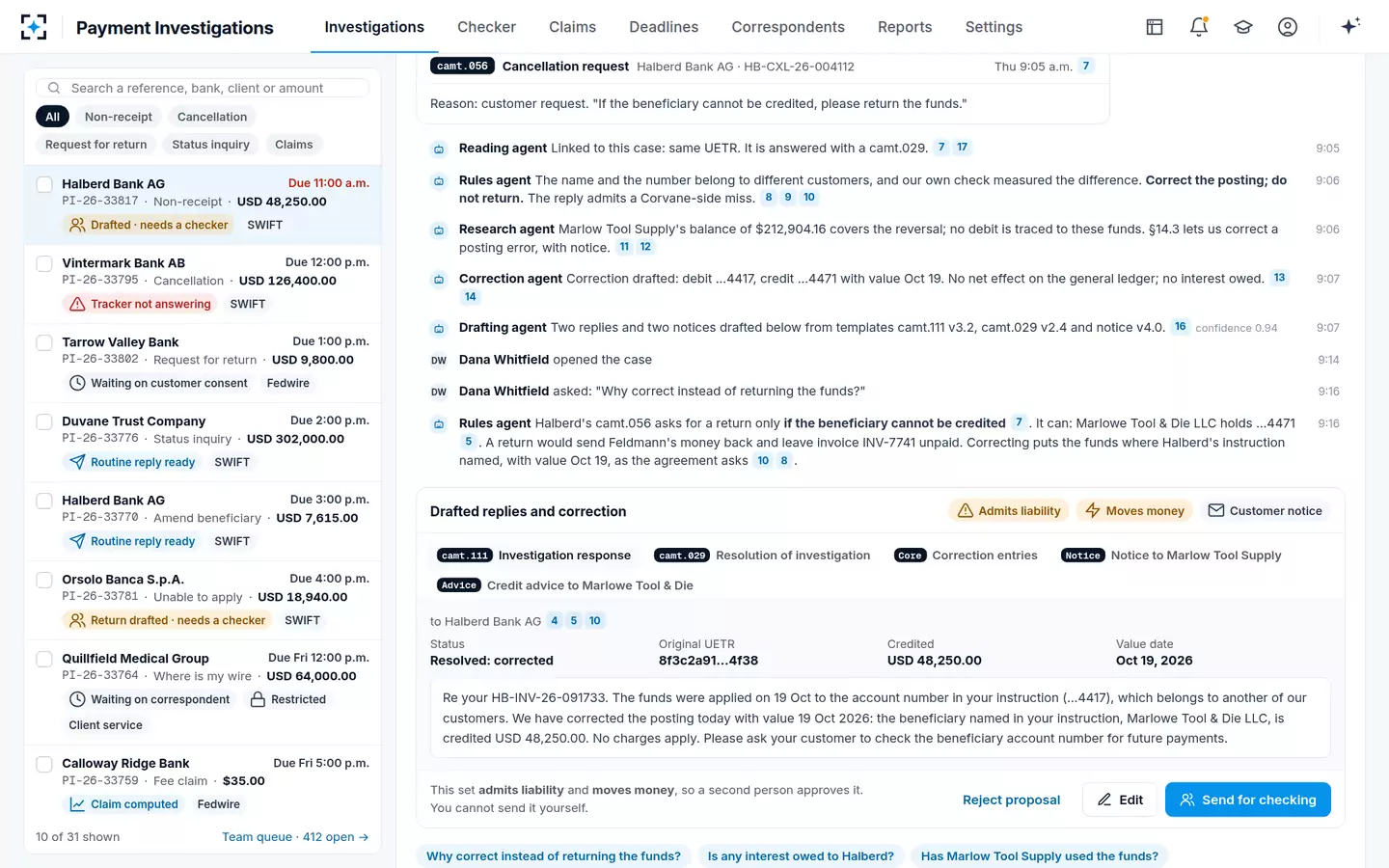
In Payment Investigations, the question of interest is asked in the case, before anyone decides
Can a bank be liable for consequential damages on a wire?
Only if it agreed to be, in an express written agreement. Subsection 4A-305(c) allows damages, "including consequential damages", to the extent "provided in an express written agreement of the receiving bank", and nowhere else in the section. The Reserve Banks have closed that door for themselves: Regulation J says a Reserve Bank "shall not agree to be liable" for consequential damages under 4A-305(d) (12 CFR 210.32(a)).
One exception sits outside 4A-305. Under 4A-404(a), if a beneficiary's bank refuses to pay after the beneficiary demands payment and gives notice of particular circumstances that will cause consequential damages, the beneficiary may recover those damages to the extent the bank had notice, unless the bank proves it refused because of a reasonable doubt about the beneficiary's right to payment. An investigator who receives such a demand is holding a different kind of claim, and should route it accordingly.
When are attorney's fees recoverable under UCC 4A?
When a demand for compensation is made and refused before suit. Under 4A-305(e), "Reasonable attorney's fees are recoverable if demand for compensation under subsection (a) or (b) is made and refused before an action is brought on the claim." 4A-404(b) has the same rule for a demand for interest on a late notice. This is the arithmetic that should govern how a bank handles small claims. A refused $1,265.56 claim can become a lawsuit in which the bank pays the interest and the other side's lawyers. The calculation is cheap to check and cheap to pay; the decision to refuse it should be deliberate and documented.
What a late wire can cost the bank, term by term
Interest for the delay
amount × average published rate ÷ 360 × days
Owed under 4A-305(a) when the transfer completed late; cannot be contracted away under 4A-305(f).
Payments operations computes; a second person approves paying it
Expenses and interest losses
originator's expenses + incidental expenses + interest losses
Owed under 4A-305(b) when the transfer did not complete, went the wrong way or did not conform.
Payments operations, with the originator's evidence
Attorney's fees
reasonable fees, if a demand was refused before suit
The cost of refusing a valid claim (4A-305(e)); avoidable by paying what is owed.
Legal
Consequential damages
only as an express written agreement provides
Zero unless the bank agreed in writing (4A-305(c)); check the client and correspondent agreements.
Legal and the relationship owner
What to ask of software that computes compensation claims
Ask it to show its work, day by day, and to treat paying a claim as a decision. A tool that prints a single figure cannot be checked; one that lists each day, the rate it used, whether that rate was published or carried from the preceding day, the 360-day divisor and the cause it relied on can be checked by anyone, including the claimant. The cause matters as much as the number: a claim is owed only if the bank's breach caused the delay, and a correspondent's own late instruction is not the bank's breach.
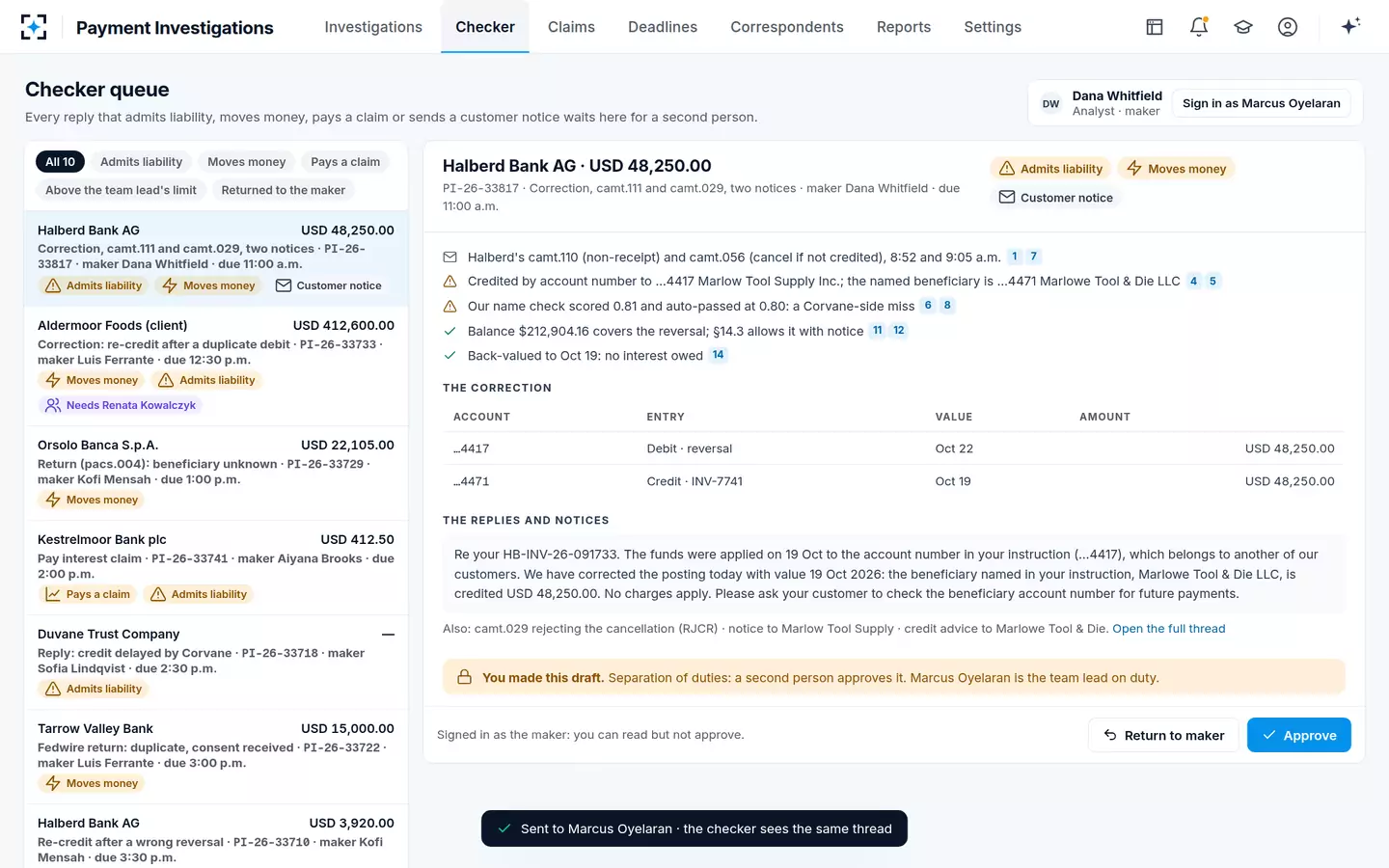
In Payment Investigations, the rules agent computes interest at the federal funds rate on a 360-day year, cites the cause, and marks any draft that pays a claim. Paying a claim always needs a checker, and claims above $10,000 in the sample settings go to the Head of E&I. The rate source and the basis are a versioned setting the administrator controls. The settings are the bank's; the arithmetic should be verifiable against the New York Fed's published rates every time. What to test any such tool on, including a claim that spans a rate change like the one above, is covered in five test cases for a payment investigation tool.
In Payment Investigations, a claim that pays money waits for a second person
Two numbers are worth tracking across a desk once claims are computed this way: how many claims the bank pays without dispute, and how many it refuses and why. Both are visible only if the reason for each decision is kept with the case. The file that makes that possible is described in the wire investigation case file, and the name-and-number cases that produce many such claims in UCC 4A-207.
Questions people ask
Does 4A-506 use 360 or 365 days?
360. The applicable rate is the average of the New York Fed's published federal funds rates for the days of delay, "divided by 360", then multiplied by the amount and the number of days. An agreement or a funds-transfer system rule can set a different basis between its parties.
Is UCC 4A-305 interest owed to the originator or the beneficiary?
Under 4A-305(a), when a completed transfer was delayed by improper execution, the bank pays interest "to either the originator or the beneficiary" for the period of delay. Under 4A-305(b), when the transfer did not complete or did not conform, the expenses and interest losses are owed to the originator.
Does the Federal Reserve pay interest on a late Fedwire?
When a Reserve Bank owes compensation in the form of interest under Regulation J, it pays an amount calculated under 4A-506, and a bank that receives it on behalf of the party entitled must pass the benefit through. A Reserve Bank will not agree to be liable for consequential damages.
What is a back value dated transaction?
It is an entry posted today with an earlier value date, so the account's balance history, interest and overdraft are computed as if the entry had been made on that date. Banks use it to correct misapplied or late credits; whether it fully answers a compensation claim depends on the account and the agreement.
How long does a sender have to report a wrongly executed wire?
A reasonable time not exceeding 90 days after the bank's notification, under UCC 4A-304. A sender that misses it does not lose the refund, but loses interest on the refundable amount for the period before the bank learns of the error.
Can a bank refuse an interest claim on a late wire?
It can refuse a claim that is not owed, for example where the delay was not caused by its own breach. Refusing a valid claim is costly: under 4A-305(e), reasonable attorney's fees become recoverable once a demand is made and refused before suit.