When a wire transfer shows completed but the beneficiary says it has not been received, the sending side's part is normally done: the payment has left the sender's bank and reached the beneficiary's bank, and the gap is on the receiving side: the beneficiary's bank has not credited the account, has credited a different account, or has not told its customer. On Fedwire, a completed status means the transfer settled, and a beneficiary's bank that received the funds for an open account it may lawfully credit has accepted the payment order. From that moment the law obliges it to pay its customer on the payment date and to notify an account holder by midnight of the next funds-transfer business day, or pay interest for the gap. The fix is an investigation: proving the payment settled, asking the beneficiary's bank what it did, and pressing it to credit. Botminds' Payment Investigations is software built to work those claims; the fictional case below shows where the days go when they are worked by hand.
One completed wire, seven days to a credit: where the week went
- Held for a name review, customer not toldTue 6 → Tue 13 · 7 days
- CreditedTue 13
- Portal: completedTue 6 → Thu 8
- Request sent; waiting on the beneficiary's bankThu 8 → Tue 13 · incl. a weekend and a Fed holiday
- AnsweredTue 13
Why does my wire transfer say completed but not received?
Because "completed" describes the sending side, and the receiving side has its own steps. Your bank's portal marks a wire completed when the payment has been sent and, on Fedwire, settled. The beneficiary sees it only when its bank posts the credit to the account and makes it available, and a bank can hold, misroute or simply not notify for several reasons: a name on the payment that does not match the account title exactly and sends it to a manual review, an account number that belongs to someone else, a compliance review the bank may not explain, an account that is closed, or a credit posted without a notice the customer noticed. A cross-border payment adds intermediary banks, each a place to pause.
The useful question is not whether the money left, which the status already answers, but what the beneficiary's bank did with it. That question has a legal answer, and once the beneficiary's bank has accepted the payment, it puts the next move on that bank.
What "completed" proves, and what it does not
On Fedwire, completed means settled, and settled usually means accepted. Fedwire reports each value message's outcome with a pacs.002: PDNG while it is in process or intercepted, then ACSC (accepted, settlement completed) or RJCT by the close of business (FRFS Format FAQs). A Reserve Bank's payment to the receiving bank occurs at the earlier of crediting that bank's account or sending it the payment order (12 CFR 210.31(a)), and a bank sender's payment occurs when the receiving bank "receives final settlement of the obligation through a Federal Reserve Bank" (UCC 4A-403(a)(1)).
Under UCC 4A-209(b)(2), a beneficiary's bank accepts a payment order when it receives payment of the entire amount, unless the beneficiary has no account there, the account has been closed, or the bank is not permitted by law to receive credits for it (4A-209(c)). Acceptance is the hinge. The funds transfer is completed at that moment, and the originator has paid the beneficiary: under 4A-406(a) the originator pays "at the time a payment order for the benefit of the beneficiary is accepted by the beneficiary's bank". From then on, the beneficiary's claim is against its own bank.
A completed Fedwire transfer: what it proves, and what it leaves open
What completed proves: It was sent, and Fedwire reported it accepted and settled (ACSC).
What it leaves open: Which account the beneficiary's bank posted it to, if any.
What completed proves: It received final settlement, so it has usually accepted the order.
What it leaves open: Whether it has paid its customer, or held the credit for review.
What completed proves: It has paid the beneficiary from the moment of acceptance (4A-406).
What it leaves open: Whether the underlying debt is discharged, if the beneficiary refuses a payment its contract prohibited.
What completed proves: It is owed the money by its own bank on the payment date (4A-404(a)).
What it leaves open: When it will be told, and whether interest for late notice is owed.
The claim, day by day
Take a fictional case. Corriveau Instruments Inc., a manufacturer, banks at Linden Harbor Bank. On Tuesday, October 6, 2026, it wires $73,915.00 to its supplier, Holloway Ceramics LLC, at Oakvale Federal Savings, to settle an invoice due that week. The wire goes out over Fedwire at 10:40 a.m. ET and Linden Harbor receives an ACSC status: accepted, settlement completed. Corriveau's portal shows the transfer as completed.
Tuesday, October 6: the wire leaves and settles
At Oakvale, the payment arrives naming the beneficiary as "Holloway Ceramic Works", a trade name, with Holloway Ceramics LLC's correct account number. Oakvale's system sends it to a manual review queue because the name does not match the account title exactly. The funds have settled to Oakvale, and the account exists and is open, so under 4A-209(b)(2) Oakvale has accepted the order. Holloway is not credited and not told.
Thursday, October 8: "completed but not received"
Holloway's accounts receivable team emails Corriveau that the payment has not arrived. Corriveau's controller calls Linden Harbor at 9:20 a.m. The call reaches Nadia Ferrault, a payment investigator. Within the hour she has confirmed, from Linden Harbor's own records, the settled Fedwire message, its UETR and Fedwire's input and output references, and she sends Oakvale an investigation request: a camt.110 of type CCNR, Creditor Claim Non-Receipt. She gives Corriveau the references to pass to Holloway, so Holloway can ask its own bank directly.
Friday, October 9, to Monday, October 12: waiting
Oakvale does not answer on Friday. Nothing obliges it to answer quickly: the Reserve Banks' Operating Circular 6 carries requests for information but imposes no obligation on participants to respond to them (§8.1.3). Nadia calls Oakvale's wire room and leaves a message. Saturday and Sunday are not funds-transfer business days, and Monday, October 12 is Columbus Day, a Federal Reserve holiday. Five calendar days pass with two business days in them.
Tuesday, October 13: the answer
Oakvale replies with a camt.111: the payment was received on October 6 and held for a name review that was not completed before the long weekend; it has now been credited to Holloway's account and Holloway has been notified. Nadia closes the case with Corriveau the same morning, recording the cause and the references, and noting that any claim for the delay lies between Holloway and Oakvale.
How long does the beneficiary bank have to credit a wire?
It must pay on the payment date, and tell an account holder by midnight of the next funds-transfer business day. Under UCC 4A-404(a), a beneficiary's bank that accepts a payment order "is obliged to pay the amount of the order to the beneficiary of the order", and payment "is due on the payment date of the order", or on the next funds-transfer business day if acceptance comes after the close of the bank's day. Under 4A-404(b), it must notify an account beneficiary of receipt "before midnight of the next funds-transfer business day following the payment date", or pay interest from the day notice should have been given until the day the beneficiary learned of the payment.
When payment to the beneficiary actually happens is set by 4A-405(a): for a credit to an account, when the beneficiary is notified of the right to withdraw it, when the bank lawfully applies it to a debt of the beneficiary, or when the funds are otherwise made available. A credit posted but blocked from withdrawal is not yet payment. In the fictional case, Oakvale's duty to pay fell on October 6 and its notice was due by midnight on October 7; it met both a week late.
The fictional claim, in the numbers the law cares about
0days
between settlement and acceptance at the beneficiary's bank on Fedwire
UCC 4A-209(b)(2), 4A-403(a)(1)
1day
for the beneficiary's bank to notify its customer: midnight of the next funds-transfer business day
UCC 4A-404(b)
6days
of late notice, October 7 to October 13, on our count
$47.80
interest the beneficiary's bank owes its customer at the 3.88% published rate
$73,915 × 3.88% ÷ 360 × 6
What proof shows a wire was paid?
The network's own record, identified by references both banks can look up. For a Fedwire transfer, that means the settled message and its status, with the UETR, which is mandatory on Fedwire value messages in the ISO 20022 format (FRFS Format FAQs), and Fedwire's input and output message accountability data, the IMAD and OMAD, which identify the transfer on each side of the Reserve Bank. A beneficiary's bank can find the payment in minutes from those references; without them, it is searching by amount and date.
Give the beneficiary those references and ask it to take them to its own bank. That puts the question where the answer is, and it puts the beneficiary's bank on notice from its own customer, which matters if the delay is costing the beneficiary money. Under 4A-404(a), a beneficiary that demands payment and gives notice of particular circumstances that will cause consequential damages may recover them if the bank still refuses to pay, unless the bank proves a reasonable doubt about the beneficiary's right to payment.
If your wire shows completed but has not been received
- Ask your bank for the settlement record and references
The UETR, and for Fedwire the IMAD and OMAD, plus the date and time it settled.
- Send them to the beneficiary
So it can ask its own bank to find the payment by reference, not by amount.
- Check the beneficiary details you sent
Name and account number: a bank may rely on the number, so a wrong digit can credit someone else.
- Ask your bank to open an investigation
It can send the beneficiary's bank a structured request and chase it.
- Note the dates
The payment date, and when the beneficiary was told, decide whether interest for late notice is owed.
- If fraud is possible, say so at once
A misdirected payment after a change of bank details is a recall, where hours matter.
What happens if the beneficiary bank credited the wrong account?
Then "completed" is true and the money is in the wrong place, and the rules shift. Under UCC 4A-207, if the payment named the beneficiary by name and number and they identify different people, a beneficiary's bank that did not know may rely on the number, and the loss falls on the originator's side, with the money recoverable from the person who received it under the law of mistake and restitution. Speed decides how much of it can be recovered.
That is why the first answer an investigator wants from the beneficiary's bank is not "was it credited?" but "to whom?". How the rule works, what "knew" means after the Fourth Circuit's 2025 decision in Studco, and why a reply conceding error is a decision for a person, is set out in UCC 4A-207: when the name and the account number don't match. Where the wrong account came from a fraudster's change of bank details, the question becomes whether a fraud wire transfer can be reversed, and Botminds' Wire Recall Management is built for that recovery.
Can I claim interest for a late wire?
Yes, from the bank that caused the delay, and the amount is arithmetic. In the fictional case the delay was Oakvale's, so Holloway's claim is against Oakvale under 4A-404(b): interest from October 7, when notice was due, to October 13, when Holloway learned of the payment. Under 4A-506(b), unless an agreement sets it, that is the amount times the average of the New York Fed's published federal funds rates for those days, divided by 360, times the days: $73,915 × 3.88% ÷ 360 × 6, or $47.80. "No other damages are recoverable" for late notice, though attorney's fees are, if a demand for the interest is refused before suit.
The sum is small; the principle is not. On a large wire, or a delay that runs for weeks, the same formula produces real money, and the bank that pays promptly with its arithmetic shown avoids a dispute it would lose. How interest is computed across a rate change, and the other sections of Article 4A that owe it, is in UCC 4A-305 interest.
Who owes whom once the wire is accepted
Once the beneficiary's bank accepts, the originator has paid, and the beneficiary's claim is against its own bank. Under 4A-406(b), a payment made to satisfy an obligation discharges it as if the beneficiary had been paid in money, with a narrow exception where the payment used a means the contract prohibited and the beneficiary refused it, did not use the funds, and would suffer an avoidable loss. In the fictional case, on Article 4A's terms, Corriveau paid its invoice on October 6, not October 13; the week's delay was Oakvale's.
That changes how an originator's bank should talk to its client. The honest answer to "completed but not received" can be: your payment has been made, here is the proof, the beneficiary's bank has it, and we are asking it to credit its customer. The investigator's job is to make that answer quick and well evidenced, and to keep chasing until the other bank confirms.
Where the days went, and how Payment Investigations works the same claim
In the fictional case the investigator's own work took about an hour: confirming settlement, finding the references and sending the request. The other six days were the beneficiary's bank's review queue, a weekend, a federal holiday and an unanswered request. The shape is worth recognizing: the investigator's work was short, and the week went to waiting on someone else.
A non-receipt claim as Payment Investigations shows it, with every record cited
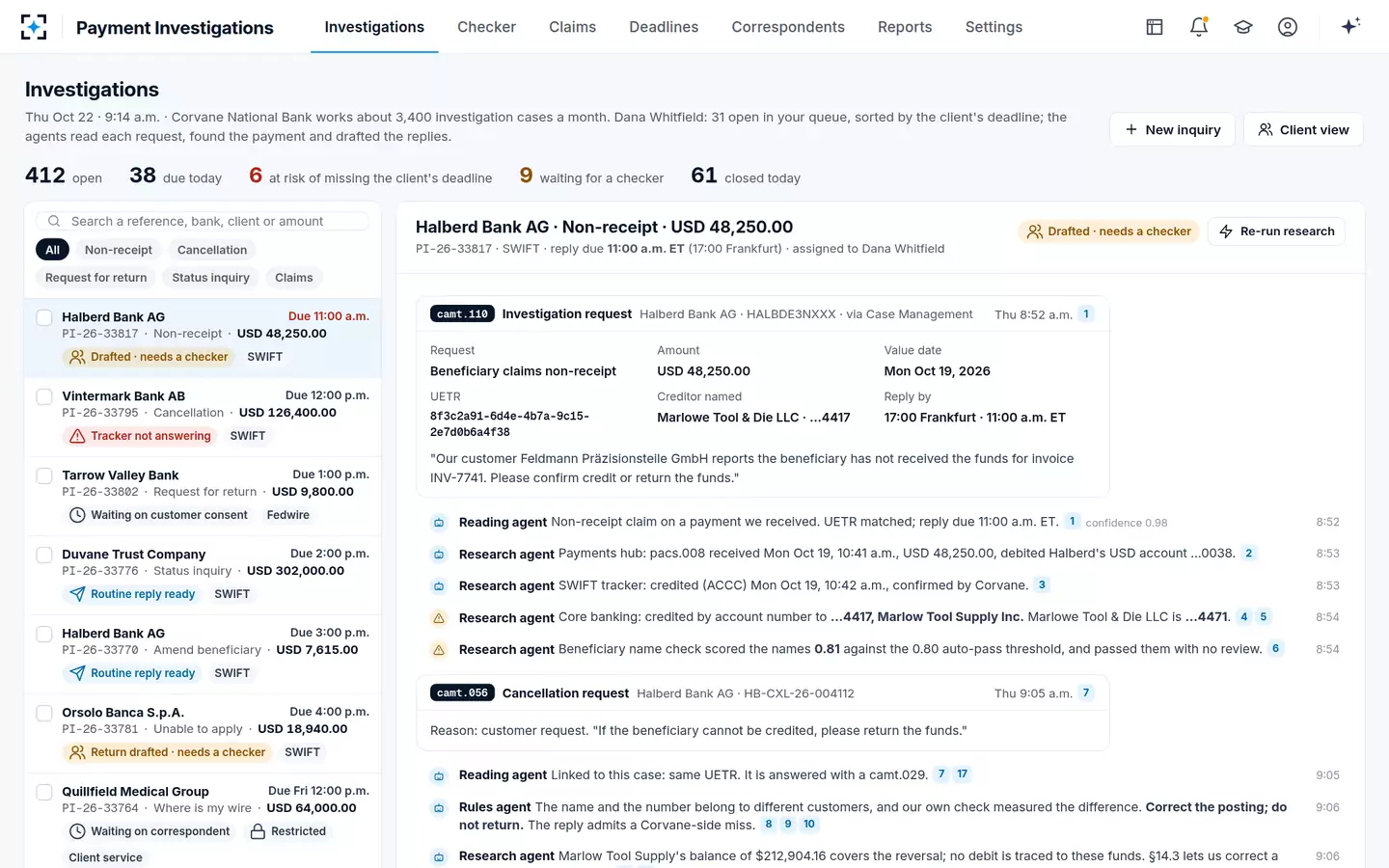
Payment Investigations works the claim from either side. At the originator's bank, the reading agent takes the client's email or a client service officer's note, the research agent finds the settled message and its references and cites them, and the drafting agent writes the investigation request and the client update for the analyst to send. At the beneficiary's bank, the same agents read the incoming request, find the posting or the held credit, and draft the answer, with any correction routed to a second person. A deadline agent watches the requester's deadline and raises cases that will miss it and why, so a request that no one has answered does not wait silently through a long weekend.
What client service can tell the client while the claim is open
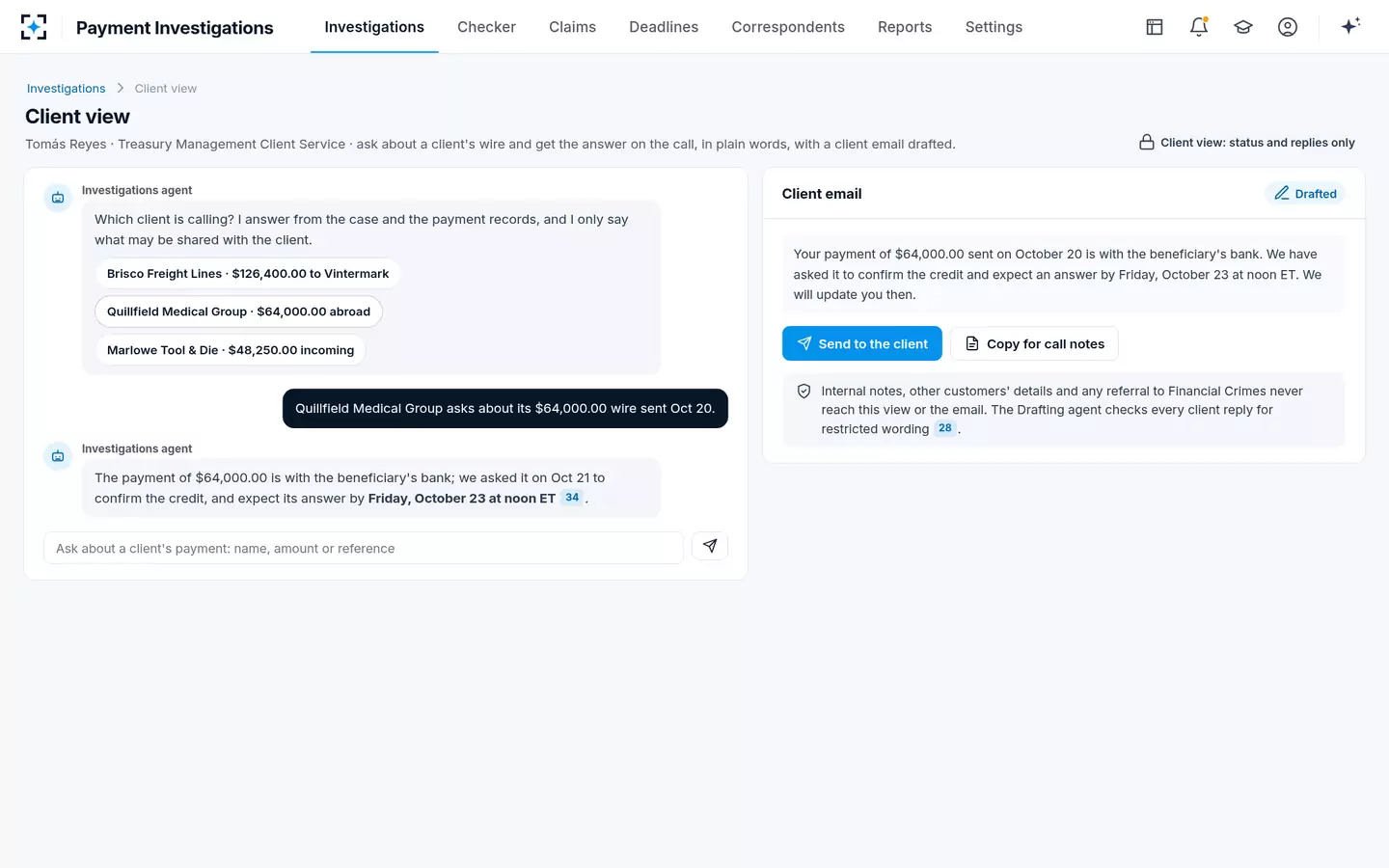
None of that makes another bank answer faster. It does make the evidence complete on the first day, keep the clocks visible and keep the client informed in plain words. For the steps of an investigation from intake to close, see the payment investigation process; to see the solution on a sample case, start from Payment Investigations.
Questions people ask
How long does it take for someone to receive a wire transfer?
On Fedwire the transfer settles between the banks when it is processed, and the beneficiary's bank must pay its customer on the payment date and notify an account holder by midnight of the next funds-transfer business day. Customer transfers must reach Fedwire by its 6:45 p.m. ET cutoff to settle that day; cross-border payments can take longer because they pass through more banks.
Can a completed wire transfer be returned?
Only with the beneficiary's bank's agreement once it has accepted the order, and under UCC 4A-211(c) a cancellation at that point is effective only for an unauthorized order, a duplicate, a wrong beneficiary or an overpayment. If the bank agrees, the funds come back as a payment return (a pacs.004 on Fedwire). Fraud cases follow a separate, faster recall process.
Who is responsible when a completed wire is not credited?
Usually the beneficiary's bank, once it has accepted the payment order: it owes the beneficiary the amount on the payment date and must give timely notice. The originator has paid when the beneficiary's bank accepts, under UCC 4A-406. The exceptions are a wrong account number, governed by 4A-207, and a payment the beneficiary's bank never accepted.
What is a UETR on a wire?
The unique end-to-end transaction reference: an identifier that stays with a payment through every bank. It is mandatory on Fedwire value messages in the ISO 20022 format, and the CPMI's harmonised requirements call for it on all cross-border payments. It is the fastest reference for a beneficiary's bank to find a payment.
Does Regulation E cover a business wire that was not received?
No. Business wires are governed by UCC Article 4A and, on Fedwire, Regulation J. A consumer sending money abroad through a remittance transfer has separate error-resolution rights under Regulation E's remittance rules, including where funds are not made available to the recipient by the disclosed date (12 CFR 1005.33).