ISO 20022 readiness, for the address part of the migration, comes down to one question: if the unstructured address option were withdrawn today, how many of your payments would fail, and why? A bank that can answer that every morning is measuring readiness; a bank that counts how many master entries were converted is measuring activity. The BIS has published the indicators that make the difference, starting with structured-field conformance and validation failure rates, and only a minority of payment systems were aligned with the harmonised data requirements in 2025. This guide turns those indicators into six numbers an address programme can report, shows how Botminds' ISO 20022 Structured Address Remediation produces them on a sample master, and prices the remaining work in hours.
If unstructured addresses were refused today: one sample month of payments
48,960 payments carrying a party address, after one approved batch
- Would pass: 43,858 · 90%
- Would fail: 5,102 · 10%
The 5,102 that would fail, by reason
- Payee address fully unstructured: 2,762 · 54%
- Client’s own address fully unstructured: 1,526 · 30%
- Town only inside an address line: 512 · 10%
- Placeholder instead of an address: 302 · 6%
How do we know we are ready for ISO 20022?
When the payments you actually send would pass the address rules of every rail you use, and you can show it. That test is stricter than "the master has been converted", because a converted master can still hold placeholders, districts in the town field and payees nobody pays, and it is looser in one useful way: a payee you never pay does not need to be ready at all.
The standard-setters set the bar by a date. The CPMI asked market participants "to begin preparations to align with the harmonised ISO 20022 data requirements in earnest and by end-2027 at the latest" (CPMI, October 2023). The networks set it by release: after Swift's August 2026 delay, cross-border messages have no confirmed new date, the Bank of England expects CHAPS to drop unstructured addresses in November 2027, subject to confirmation, and Fedwire's address release is November 2027. The deadline guide has the detail.
What KPIs track ISO 20022 migration?
The BIS offers a list in Annex 1 of its April 2026 paper on ISO 20022 migrations, as "a flexible, non-prescriptive tool": structured-field conformance (with hybrid postal address as its example), validation failure rate for schema and usage rules, reject or exception rate by reason, end-to-end reference continuity, latency, queue depth, incident detection and repair times, and screening quality, measured by false positive rates and alert disposition timeliness (CPMI Brief No 11). The BIS adds that the indicators "allow each jurisdiction to define their own measures, data sources and targets, tailored to their specific needs and operational context."
Four of those indicators bear directly on addresses, and each needs a translation before a bank can report it. The BIS writes them for payment system operators, measuring messages already sent. A bank remediating its master needs the same indicators measured before the messages are sent.
The BIS's migration KPIs, translated for an address programme
| KPI the BIS proposes | What it measures for an operator | The address programme’s version |
|---|---|---|
| Structured-field conformance | Adherence to structured data requirements for key fields, such as the hybrid postal address | Share of live payees whose every address field is structured and proven by a source |
| Validation failure rate | Messages rejected for schema or usage-rule breaches | Share of recent payments that would fail the address rules if replayed today |
| Reject or exception rate by reason | Rejections grouped to find systemic or participant issues | Forecast failures by reason, client, country and rail |
| Screening quality | False positive rate and alert disposition timeliness | Screening results changed by structuring, and how fast the sanctions team decides them |
Six numbers an address programme should report
The table becomes six numbers on one page. Each has an owner, a direction and a source a steering committee can ask to see.
1. Proven share of live payees. Structured, every field cited, approved by a maker and a checker. At the fictional bank, 38,412 of the 52,030 beneficiaries left after proposed retirements, about 74%. 2. Forecast failure rate. Recent payments that would fail the address rules today: 10.4% in the sample, against a target of under 1%. 3. Failures by reason. The split above: unstructured payee addresses, unstructured client addresses, towns left in a line, placeholders. Each reason points to a different fix. 4. The human queue and its age. 1,239 addresses need a person in the sample; 14 are overdue against a three-business-day setting. 5. Clients outstanding. 714 addresses wait on clients; 41 answers came back on the sample morning. 6. Screening changes. 18 results changed overnight out of 3,120 proposals: 6 new potential matches with the sanctions team, 12 false alerts gone.
Six readiness numbers from one sample morning in ISO 20022 Structured Address Remediation
74%
of live beneficiaries proven and approved
38,412 of 52,030
10.4%
of recent payments would fail today
target: under 1%
1,239
addresses waiting on a person
14 overdue
714
addresses waiting on clients
41 answered that morning
How do you forecast rejected payments?
By replaying real payments against the rules before the rules apply. Take every payment of the last 30 days that carried a party address, rebuild each party's address from the current master, and test it against the structured address rules of the rail it used: town and country present, no Address Line in a fully structured address, at most two lines of 70 in a hybrid one, nothing repeated, the payment character set. Count what fails, and why.
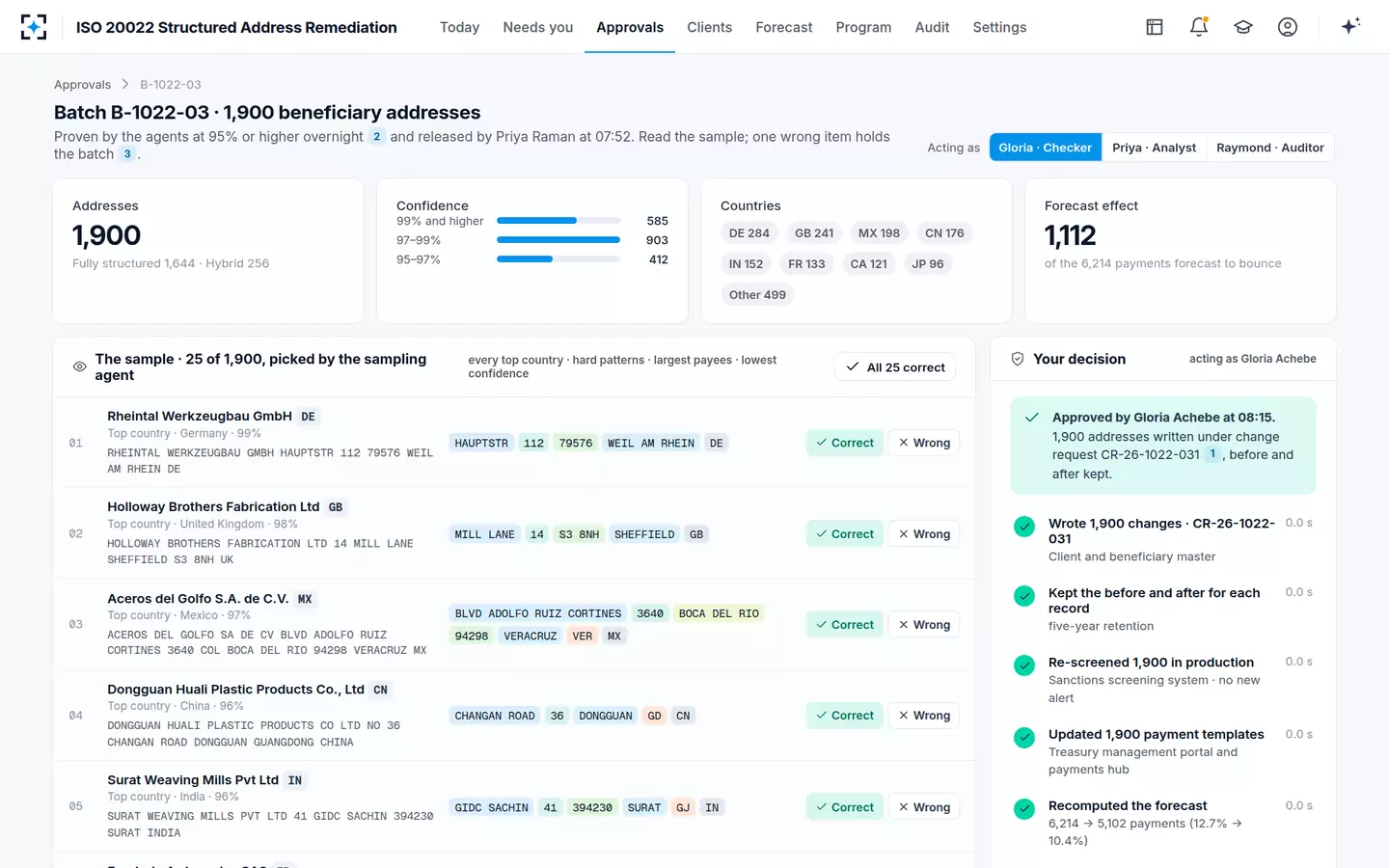
Three choices make the forecast honest. Replay the payments, not the master, so dormant payees do not inflate the work and high-volume payees count for what they carry. Test each rail by its own rules: a hybrid address that passes cross-border fails Fedwire's main-party rules until its 2027 release. And recompute every morning, so the number falls as batches are approved and the committee sees the effect of each one: in the sample, approving one batch of 1,900 addresses took the forecast from 6,214 failing payments to 5,102.
The human queue, ordered by money at risk
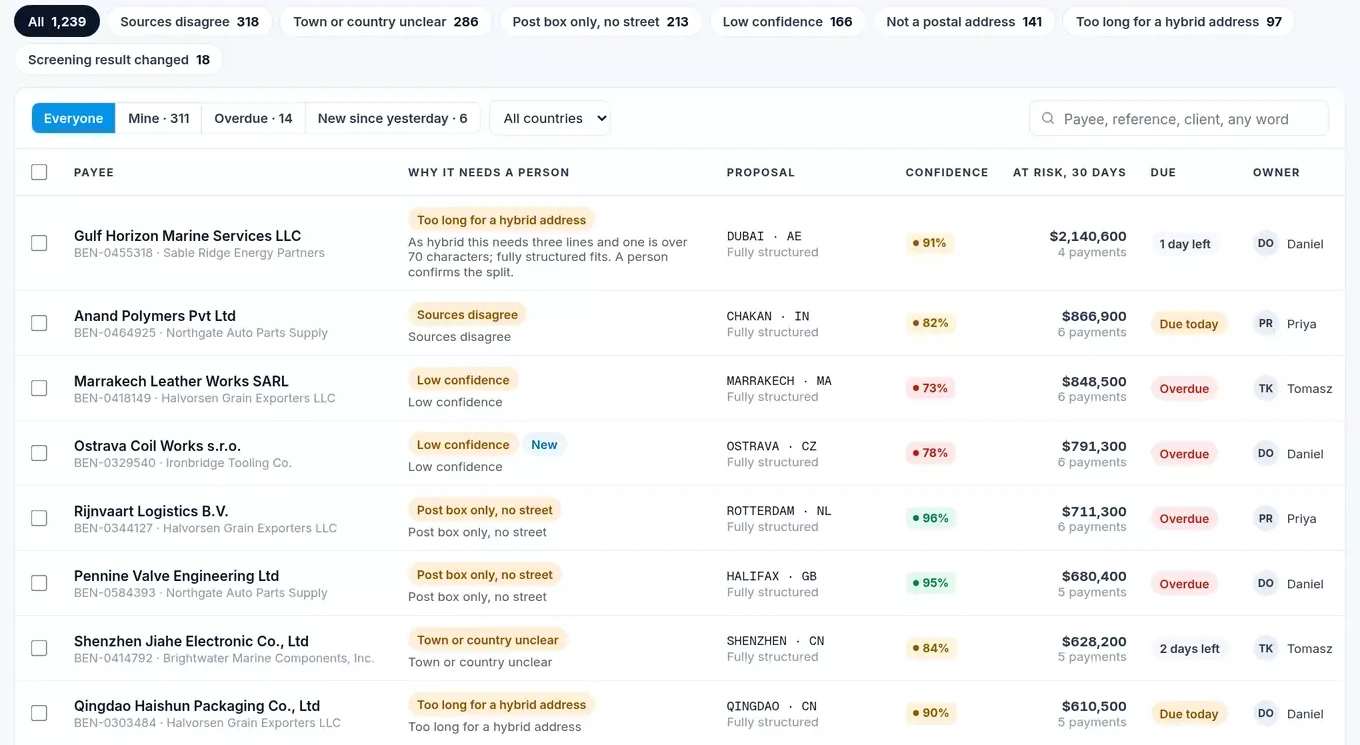
What share of addresses must be structured?
All the live ones, on the rails that enforce the rules, and none of the dead ones. That answer usually shrinks the task. At the fictional bank, 9,870 of 61,900 beneficiaries, about 16%, had not been paid in 24 months and were proposed for retirement instead of repair, with a second approval. The remainder must be fully structured or hybrid wherever an address is given, with Town Name and Country at a minimum.
A programme that reports "percentage of master converted" will look worse than it is early on, because it counts dormant payees, and better than it is late on, because it counts unproven conversions. Report the proven share of live payees instead.
What does unreadiness cost? Pricing the remaining work
Price it in hours, with your own rates, because no public source gives a credible industry cost per failed payment. The hours that matter sit in the remainder an approach cannot prove on its own. Our estimate of where the minutes go on one doubtful address is 43 by hand: finding and reading it, splitting it, proving each field against the wire archive and postal data, checking the rules, asking the client and retyping the reply, and a second person's check. With agents finding and proving, the same address takes about 5.2 minutes of human time.
For an hourly rate with a regulator's name on it, FinCEN prices Bank Secrecy Act recordkeeping time at $106.30 an hour, fully loaded (FinCEN, Federal Register, August 2024; BSA recordkeeping requirements by bank size shows how FinCEN built it). It is a proxy for payments operations time, not a measurement of it, and your own loaded rate is better.
The remaining work, priced: one sample master
Doubtful addresses, by hand
1,239 × 43 min = 888 h
About $94,400 at FinCEN’s $106.30 composite rate
Payments operations
The same addresses, agents proving
1,239 × 5.2 min = 107 h
About $11,400 at the same rate
Payments operations
Failing payments, if nothing changed
forecast failures × your measured repair minutes
Use your own repair-queue timings; no allowed industry figure exists
Payments operations
Tooling
licence + integration hours
Extract, payment archive, imaging, screening test mode, portal
Technology and procurement
How ready are payment systems for the harmonised data requirements?
Mostly not yet, which is why the networks' dates keep moving. The BIS's 2025 monitoring survey found that "In 2025, 13% of RTGS systems and 19% of FPS reported being aligned with the harmonised ISO 20022 data requirements, with payment systems in the Middle East and Africa taking the lead" (CPMI Brief No 13). These are payment systems, the infrastructures, not banks; the survey covered 80 RTGS systems and 57 fast payment systems.
Alignment with the CPMI's harmonised ISO 20022 data requirements, 2025
13%
of RTGS systems aligned
about 25% more plan to align
19%
of fast payment systems aligned
12% more plan to align
43%
of both still only considering alignment
22%
of payment systems not planning to align
For a bank, the low alignment cuts both ways. It explains why Swift and the central banks gave the industry another year. It also means the counterparties at the other end of a payment will reach the new rules at different times, so a bank that sends structured addresses early is not waiting on anyone. The Bank of England makes that point to its own participants: structured and hybrid formats are available now, and continuing to the original timelines will help find remaining gaps during the delay (Bank of England).
A steering report on one page
The six numbers are only useful if the committee sees them the same way every week. The steering report drafted in the solution's sample data has five short parts, each with its figures cited to where they came from. Where we are: how many beneficiary and client addresses are structured and checked, and how many wait for a checker. What would fail today: the forecast count and rate against the target. Pace: approvals per business day since sampled batches began, and the projected finish for each master. Decisions asked of the committee: retirements that need its approval, and clients whose relationship managers should call. Screening: potential matches created by structuring and false alerts removed, with the sanctions team.
Two rules keep the report honest. Every figure links to its source, so a committee member can open the batch, the queue or the replay behind it. And the programme manager signs it; the agent that drafts it never sends it. In the sample, the beneficiary master was approving about 2,310 addresses a business day and the client master about 540, with clients' answers on 714 addresses as the named risk to the finish.
What to look for in ISO 20022 readiness tooling
The useful test of any readiness tool is whether it produces the six numbers without a spreadsheet in between. The Federal Reserve lists a Readiness Portal Guide among its Fedwire format specifications, beside the Implementation Guide and usage guidelines (Federal Reserve Financial Services, April 2026). Material of that kind is about message formats. No network can tell a bank which of its own payees are ready; that gap is what an address tool has to fill.
Seven checks on any tool that claims to measure ISO 20022 address readiness
- It replays your recent payments, not just your master
Readiness is about what you send, weighted by what it carries.
- It tests each rail by its own rules and date
Fedwire, cross-border and CHAPS differ until 2027.
- It reports failures by reason, client and country
Each reason has a different owner and a different fix.
- It separates proven from merely converted
A structured address without a cited source is a proposal.
- It recomputes after every approved batch
So the committee sees the effect of each decision.
- It shows the human queue and the client backlog with ages
Those set the finish date, not the parser.
- It counts screening changes before go-live
The BIS lists screening quality as a migration KPI; structuring changes results.
Botminds' ISO 20022 Structured Address Remediation produces all six numbers from the bank's own systems: the payment archive for the replay, the master for the queue, the treasury portal for client replies and the screening system's test mode for screening changes. It does not test message formats in the payment hub; a bank still needs its network's own test environments for that. How the remainder is proven, and why the proven share is the number to trust, is in valid is not the same as right.
In ISO 20022 Structured Address Remediation, every approval moves the forecast the same morning
Questions people ask
What is structured-field conformance?
It is a KPI the BIS proposes for ISO 20022 migrations: how closely key fields, such as party names and the hybrid postal address, follow the structured data requirements. For an address programme it is best reported as the share of live payees whose every address field is structured and proven.
What is the ISO 20022 readiness portal?
The Federal Reserve lists a Readiness Portal Guide among its Fedwire format specifications on Swift's MyStandards platform, alongside the Implementation Guide and usage guidelines. Format specifications describe messages; address readiness also needs the payee-level view described here.
What is a good target for forecast failures?
The sample programme's target is under 1% of recent payments, a design goal rather than a regulatory figure. The right target is the one at which the remaining failures can be handled by people before each rail's date.
Should readiness be measured on payments or on the master?
On payments, weighted by what they carry, with the master behind it. The master tells you how much work is left; the payments tell you which of it matters first.
How often should readiness be reported?
Daily to the programme, weekly to the steering committee. A daily replay costs little once it is automated, and it shows the effect of each batch and each client reply while there is still time to act.