The ISO 20022 structured address deadline is no longer November 2026. That was the date on which cross-border payment messages were to stop carrying fully unstructured postal addresses, but on 27 August 2026 Swift announced a delay, and the Bank of England's current expectation is that the removal of unstructured address fields moves to November 2027, subject to confirmation. The Federal Reserve moved its own Fedwire release, which brings the hybrid format, to November 2027 on the same day. The work behind the deadline has not changed: a bank's client and beneficiary master still holds its addresses as free text, and each one has to be split into fields and proven before any network refuses it. Botminds' ISO 20022 Structured Address Remediation is built for that work. This guide sets out the dates as each operator published them and a plan that does not depend on which one holds.
The ISO 20022 structured address deadline, network by network
| Network or standard | Date first set | Where it stands on 26 October 2026 |
|---|---|---|
| Cross-border messages (Swift network) | November 2026: structured or hybrid only, where an address is given | Delay announced 27 August 2026; no new date confirmed |
| CHAPS, Bank of England | November 2026: unstructured addresses rejected | Expected to move to the November 2027 release, subject to confirmation |
| Fedwire Funds Service | November 2026 release: hybrid format in, unstructured format out | Rescheduled to November 2027; exact date to be announced |
| T2, the euro RTGS | November 2026: unstructured addresses removed | Release shifted to 28 November 2026; fully unstructured addresses allowed for a limited period |
| CHIPS | No published date found | No published date found |
| CPMI harmonised requirements | Align by end-2027 | Unchanged |
| FATF Recommendation 16 (revised) | Countries ready by the end of 2030 | Unchanged; not yet US law |
When is the ISO 20022 structured address deadline now?
For a US bank there are two dates to plan around, and both currently point to November 2027. For cross-border messages the original milestone was set out plainly by the BIS in May 2026: "From November 2026, where a postal address is provided, the data must be in either a fully structured or hybrid (ie partly structured) format (Swift (2026), PMPG (2026))" (CPMI Brief No 13). That release has been delayed and no replacement date has been confirmed; the Bank of England, which moved its own CHAPS release with it, expects a 12-month deferral.
For Fedwire the date is firmer. The Federal Reserve's ISO 20022 implementation centre says: "As announced on Aug. 27, 2026, the November 2026 release has been rescheduled and will now occur in November 2027" (Federal Reserve Financial Services). It intends to publish the final usage guidelines for that release in November 2026 and to open registration for peer-to-peer testing in June 2027. What Fedwire accepts in the meantime is covered in the Fedwire implementation delay guide.
Was the Swift unstructured address removal delayed?
Yes. The Bank of England's account is the most complete published by a central bank: "On 27 August 2026, Swift announced its decision to delay the November 2026 Swift Standards Release based on industry’s request for additional time to prepare for the removal of the unstructured postal address format following concerns about global readiness" (Bank of England). The Bank deferred its entire November 2026 release for CHAPS to stay aligned, and set out its expectation in so many words: "Our current expectation is that implementation will be deferred by 12 months, with the November 2026 changes (including the removal of unstructured address fields) incorporated into the scope of the November 2027 RTGS standards release. This approach, however, remains subject to confirmation and validation within the Bank, across the wider community, including Swift and other market infrastructures."
The Eurosystem took a different route. It kept its November 2026 releases for T2, T2S, TIPS and its collateral system, shifted from 14 to 28 November, and added a temporary measure letting fully unstructured addresses through T2 for a limited period, while asking participants to keep implementing structured and hybrid addresses (ECB, 4 September 2026). The change request behind it names the reason: "growing concerns regarding the readiness of parts of the global payments ecosystem to implement the hybrid postal address" (T2 change request T2-0188).
Hybrid and structured address formats are already available and there is no need to wait for the removal of unstructured fields before adopting them.
Bank of England, ISO 20022 programme page, August 2026
What happens to unstructured addresses after November 2026?
On Fedwire, and on the Swift network as the Eurosystem expects, they keep flowing for now, but not everywhere and not without cost. Europe's T2 will carry them for a limited period through its messaging channel, while its own screens accept only hybrid or structured addresses from November 2026 (T2-0188). Structured addresses are accepted on every one of these rails today, so a bank that sends them loses nothing by being early.
The cost of waiting is the one the delay does not remove. Receiving banks and intermediaries set their own requirements on top of the network's, and an unstructured address still gives screening less to work with. The CPMI's own target date for aligning with its harmonised requirements, end-2027, has not moved (BIS CPMI). For most banks the realistic reading is that November 2027 is now the date on which unstructured addresses stop being accepted on the big networks, and that it will arrive with a year less warning than the last one.
Does Fedwire require structured addresses?
Not yet, and not hybrid ones at all for the main parties until its next release. Until the November 2027 release, Fedwire supports a fully structured or a fully unstructured address for the debtor, creditor and their agents, and "strongly" encourages the structured format now (November 2027 release FAQ). The planning consequence is that a bank cannot simply store one hybrid address per payee and use it everywhere before 2027: where the street cannot be proven, the address that suits a cross-border message is not yet one Fedwire accepts for those parties.
Is there a grace period for unstructured addresses?
Not in the usual sense. What happened in August 2026 is a postponement of the whole release, not a tolerance window inside it. The closest thing to a grace period is the Eurosystem's temporary measure, which the ECB describes as allowing fully unstructured addresses in T2 "for a limited period" without saying how long. The industry's earlier grace-period rules for unstructured addresses in high-value market practice had already been deleted from T2's November 2026 message set, and the change request says they will not be reintroduced (T2-0188).
A bank that plans for a second postponement is betting against three central banks that have each told participants to keep going. The Federal Reserve's own advice in its rescheduling FAQ is to "continue preparing for the removal of the unstructured postal address format" (Federal Reserve Financial Services).
How long does address remediation take?
Longer than the parsing and shorter than most plans assume, because the time is spent on a small remainder. A parser handles the easy majority in days. The calendar is set by the addresses that need a person and by the clients who must confirm what the bank cannot prove.
Where the calendar goes in one ISO 20022 Structured Address Remediation sample
2,310
beneficiary addresses approved per business day once sampled batches start
fictional sample data
1,239
addresses that need a person, of 61,900
disagreeing sources, unclear towns, post boxes
714
addresses waiting on clients
412 payees, 302 clients
43 → 5.2min
per doubtful address, by hand and with the agents
our estimate
The arithmetic is worth doing on your own master. At our estimate of 43 minutes by hand, the 1,239 doubtful addresses in the sample are about 890 hours of analyst time; at 5.2 minutes with the agents doing the finding and proving, about 107. Client replies do not compress the same way: a request sent today is answered when the client's treasury team gets to it, which is why the plan below starts outreach in the first month.
A remediation plan in five stages
The plan works backwards from the earliest date any of your rails could enforce, and keeps the stages that wait on other people at the front.
Plan to the original date: clients are on the critical path, parsing is not
- Scope and retire2 wk
- Parse and prove3 wk
- People and clients6 wk
- Sign and load3 wk
- Scope1 wk
- Parse and prove3 wk
- People and clients5 wk
- Sign and load3 wk
1. Scope and retire. Replay recent payments to find which payees are live, and retire the ones nobody has paid in your policy's window before anyone cleans them. 2. Parse and prove. Split every live address into elements and prove each from a source the bank can show an examiner: postal reference data, the party's own structured payments, documents in imaging. 3. People and clients. Route the remainder by why it failed, and send each client one pre-filled request for the payees only it can confirm. 4. Sign and load. Maker and checker on every change, sampled batches for the proven majority, a test-mode screening run before anything goes live. 5. Keep it clean. Capture new payees structured at the front door, in the portal and the branch, so the master does not refill with free text.
The remainder that sets the calendar, one decision at a time

What should be done first?
Start with the payees that cross borders and carry money: they meet the earliest possible enforcement, and the payment archive tells you which they are. The fictional bank orders its work by the value of the last 30 days of payments each address touches, which puts a payee paid more than $2 million in a month ahead of a thousand dormant ones. Send the client requests in the same week, because they take longest to come back.
Then the client master, which supplies the debtor's address on every outgoing payment and is easy to forget because it does not sit in a payee list. Then domestic templates, where Fedwire's rules until 2027 argue for storing the fully structured form wherever it can be proven. The Federal Reserve's own first step for its address change is the same inventory: "Conduct impact analysis of all internal and external systems related to postal address format change (e.g., collect town name and country information)" (Federal Reserve Financial Services, January 2026).
Before any network refuses an unstructured address: eight checks
- Every live payee has a town and a country in their own fields
Measured on the payments of the last 30 days, not on the master as a whole.
- Each field names the source that proved it
So a checker, an auditor or an examiner can re-perform the decision.
- Dormant payees are retired, with a second approval
Cleaning an address nobody pays is cost without benefit.
- The client master is in scope
The debtor’s address is the bank’s own customer, and it fails the same rules.
- The format chosen fits the rail
Hybrid is not yet supported for the main Fedwire parties before the 2027 release.
- New addresses are screened before they go live
A newly structured town can create a match the free text hid.
- Every change has a maker and a checker
With the value before and after kept beside the evidence.
- New payees arrive structured
Portal, file upload and branch forms capture fields, not lines.
How to explain the moved date to a steering committee
Expect the question "so we have another year?" and answer it with three points. First, only one of the two dates a US bank depends on is confirmed: Fedwire's November 2027 release. The cross-border date is the Bank of England's expectation, not yet an announcement, and Europe's T2 is going ahead in November 2026 with a temporary allowance. Second, the critical path runs through clients, not systems, and clients answer at their own pace; a delay that is spent waiting is a delay lost. Third, the benefits do not wait for the deadline: structured addresses are accepted today on Fedwire and cross-border, and every proven address can take payments out of the forecast of failures now.
A programme that keeps its original plan and uses the extra time for the hard remainder, the disputed towns, the post boxes, the entries that are not addresses at all, arrives at November 2027 with nothing left but monitoring. One that pauses arrives with the same backlog and a year less patience from its clients.
What to look for in software for the deadline
Ask any tool four questions. Can it tell you, every morning, how many recent payments would fail if unstructured addresses were refused today, by rail, client and reason? Does it prove each field from a source you can show, or only produce a well-formed address? Does it know that the same address may be acceptable on one rail and not yet on another? And does it route the remainder to people, with clients asked once, rather than leave it in a spreadsheet? The readiness guide turns those questions into numbers.
Botminds' ISO 20022 Structured Address Remediation answers them on the master: a daily replay of recent payments, fields cited to their sources, a rules check, test-mode screening, client requests through the treasury portal and maker-checker on every change. It does not build or send payment messages; that remains the payment hub's job.
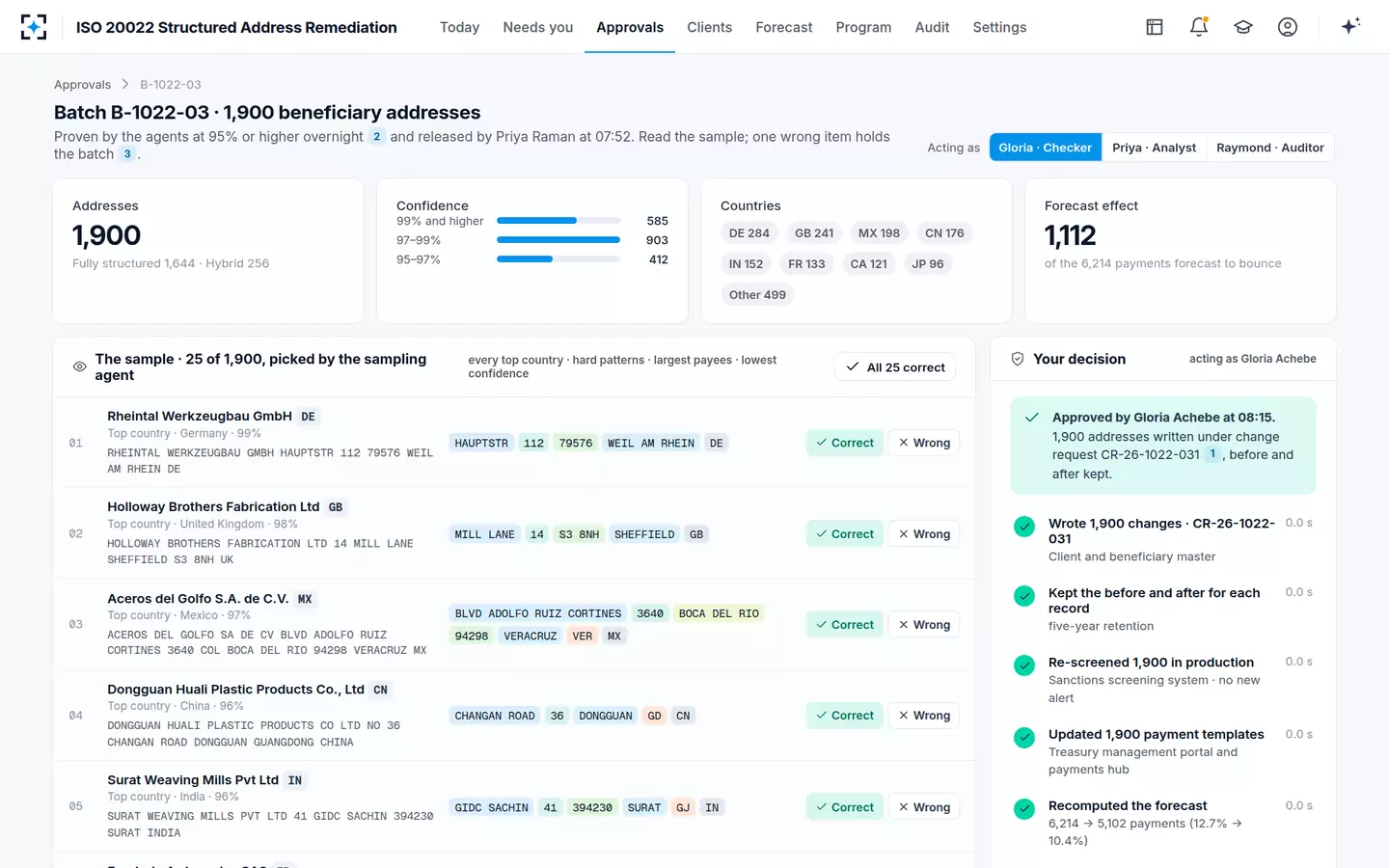
ISO 20022 Structured Address Remediation: a batch signed, re-screened and loaded in one morning
Questions people ask
Is the November 2026 ISO 20022 address deadline still on?
Not for cross-border messages on the Swift network, CHAPS or Fedwire: Swift announced a delay on 27 August 2026, the Bank of England expects a 12-month deferral, and Fedwire's release is now November 2027. Europe's T2 goes ahead with its November 2026 release but will accept fully unstructured addresses for a limited period.
What is the new date for the Swift structured address change?
No replacement date had been confirmed by 26 October 2026. The Bank of England's published expectation is November 2027, which it says remains subject to confirmation with Swift and other market infrastructures.
Does CHIPS follow the same date?
The Federal Reserve says it is coordinating its rescheduled release with peer market infrastructures, naming Swift and CHIPS, but CHIPS's own date for structured addresses does not appear in any regulator or central-bank publication we found. Check it with The Clearing House directly.
Should we pause our address programme until 2027?
The central banks say no. The Bank of England asks firms to keep to the original timelines to find remaining gaps during the delay, and the Federal Reserve tells Fedwire participants to keep preparing for the removal of the unstructured format. Client confirmations, the slowest part of the work, do not get faster by starting later.
What happens if a payment still carries an unstructured address after the deadline?
Once a network removes the unstructured option, a message using it fails that network's validation and is rejected rather than delivered. Before then, it may still be held or queried by a receiving bank whose own requirements go beyond the network's minimum.