Swift structured address AI means using machine learning, or agents built on language models, to turn the free-text party addresses in a bank's master into the structured ISO 20022 fields that cross-border payments on the Swift network, and Fedwire, increasingly require: Town Name and Country at a minimum, street, building number and post code where possible. AI does that split well. The hard part is knowing whether the result is right, and that is where tools differ. A good design proves each field from a source it can cite, asks the client or relationship manager when no source exists, and holds the address for a person when sources disagree. Botminds' ISO 20022 Structured Address Remediation is built that way: seven agents parse, prove and rule-check every address, and people approve every change. This guide sets out what to look for, and where the solution fits and does not.
Prove, ask or hold: what an agent may do in ISO 20022 Structured Address Remediation
Agent
ParseSplits the free text into ISO 20022 elements by the country’s address format, and records why each empty element is empty.
Never: invents a value that is in no source
Agent
ProveMatches each element against postal reference data, the structured payments the party’s own bank has sent, and the party’s invoices and forms.
Never: raises confidence without a source
Agent
AskWhere nothing proves a field, drafts one pre-filled request per client for the treasury implementation manager to approve and send.
Never: sends a request on its own, or mentions screening
A person decides
Hold for a personSources that disagree, post boxes with no street, low confidence: an analyst decides with every source in view.
A person decides
Checker signsA second person approves each change, singly or by sampled batch, before the master changes.
Can AI structure addresses for ISO 20022?
Yes. Splitting "PLOT 22 GIDC ESTATE ANKLESHWAR 393002 GUJARAT INDIA" into a building name, a street-like estate name, a post code, a town, a state and a country is pattern recognition, and modern models do it across scripts and country formats that defeat rule-based parsers. The BIS describes the job in its guide to ISO 20022 migration: "Mapping involves interpreting legacy content, decomposing unstructured fields and enriching data where necessary" (CPMI Brief No 11). AI handles the interpreting and decomposing.
"Enriching data where necessary" is where the risk lives. A model asked to produce a structured address will produce one. If the town is missing, a generative model can supply a plausible town; if the street is ambiguous, it can pick the likelier reading. Each output passes validation. None is evidence. For a field that screening will match against sanctions lists, and that will be copied into every future payment to that party, a plausible guess is worse than an empty field with a reason.
Why parsing is the easy part
Because the parse is checkable only against the text it came from. A parser that turns "80331 MUENCHEN" into Post Code 80331 and Town Name MUENCHEN has done its job even if the payee moved to Hamburg in 2021. The questions a bank has to answer are different: is this still the party's address, is MUENCHEN the town or a district, does the party's own bank use the same form, and who signed the change?
Two kinds of structured address AI, on the same doubtful address
AI that only parses: Infers a likely town from the post code or the region.
AI that proves, asks or holds: Leaves Town Name empty with the reason, and drafts a request to the client.
AI that only parses: Picks the one with the higher model score.
AI that proves, asks or holds: Shows both, with citations, to an analyst who chooses.
AI that only parses: Fills Street Name with POSTFACH or PO BOX.
AI that proves, asks or holds: Fills Post Box; Street Name stays empty and says why.
AI that only parses: A model score for the whole address.
AI that proves, asks or holds: A score per field, raised only by a cited source.
AI that only parses: Whatever passes validation, in bulk.
AI that proves, asks or holds: Only what a maker approved and a checker signed.
AI that only parses: The model version.
AI that proves, asks or holds: Each field’s source, the before and after, and who approved it.
How accurate is AI address parsing?
Nobody can tell you for your master without testing it on your master. We found no regulator, central bank or academic benchmark of AI address parsing for payment data, and vendor accuracy claims measure the split against a labelled test set, not whether the result is the party's real address. Two numbers matter instead: the share of addresses an approach can prove from independent sources, and the error rate a checker finds when sampling what it proved.
The solution's sample data shows what the first number looks like on a large master. Of 61,900 beneficiary addresses, the agents could not prove 1,239 on their own; those went to people, grouped by why. In one approved batch of 1,900, the checker's risk-weighted sample of 25 found no errors. Those are results on fictional sample data, and a bank should expect its own numbers to differ: the honest test is a back-test on a slice of its own master, with the answers held back.
Where ISO 20022 Structured Address Remediation sends the addresses it cannot prove
1,239
of 61,900 addresses needed a person
about 2% of the master
318
because sources disagreed
a person chose
141
because the entry was not a postal address
the client was asked
714
addresses sent to clients to confirm
one pre-filled request per client
Prove: which sources can an AI agent cite?
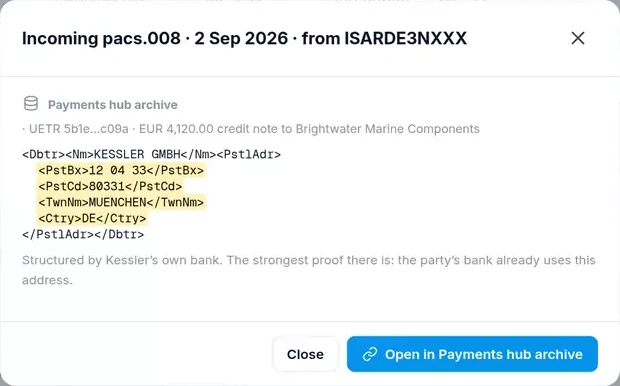
Three kinds, in rising order of strength. Postal reference data proves that a town, post code and subdivision exist together in a country; it says nothing about whether the payee is there. The party's own documents, invoices, letterhead and forms in the bank's imaging system, prove where the party says it is, as of the document's date. Structured payments sent by the party's own bank are the strongest: a bank that knows the party has already put its address into ISO 20022 elements, and the agent can show the exact message.
The master itself is not a source. It is the thing under test. An agent that "verifies" an address against the same master entry it parsed has proven nothing, and an evaluation should check for that loop.
A citation an auditor can open
Can AI ask clients for missing address data?
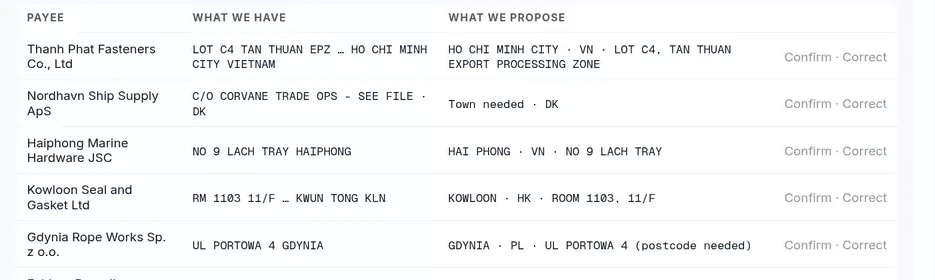
It can draft the question; a person should send it. When no source proves a field, the only party who knows is the client, or for a payee, the client who pays it. The useful request is pre-filled: here is what we hold, here is what we propose, confirm or correct. A blank form gets retyped; a pre-filled one gets checked.
When an address cannot be proven: who to ask, and for what
| What is missing | Who knows | What to ask for |
|---|---|---|
| A payee’s town or street | The corporate client that pays the payee | Confirm or correct the proposed address, payee by payee |
| The client’s own address | The client, through its relationship manager | Confirm the registered or operating address on file |
| A town the payee’s bank spells differently | Nobody outside: a person decides | Choose between the cited forms |
| An entry that is not an address (“SEE FILE”) | The department that wrote the note | Find the file, then ask the client |
| A dormant payee | Nobody: retire it | A second approval to retire |
A request a client can answer in minutes
Hold: what an address agent must never do
Some limits matter more than any capability. The sample solution's agents work under written ones. The parsing agent never invents a value that is not in a source and never fills a placeholder. The verification agent never raises confidence without a source and never treats one source as proof of a disputed field. The screening check agent never clears or decides a match. The outreach agent never sends without the implementation manager and never mentions screening. The batch agent never approves.
That shape matches what supervisors have said about AI in general. Federal Reserve Vice Chair Bowman has noted that "the joining of AI outputs with a human acting as a ‘filter’ or ‘reality check’ can capture efficiency gains and control for some AI risks", and that using AI changes neither the rules that apply nor the scrutiny that follows (speech, November 2024). The banking agencies' revised model risk guidance of April 2026 leaves generative and agentic AI out of its scope for now, and the agencies plan a request for information on AI (OCC Bulletin 2026-13; how to use AI for regulatory compliance on wires quotes both). We found no regulator statement on AI for address remediation itself; the controls a bank can show are the people, the sources and the trail.
Do beneficiaries need a full address?
Under the revised international standard, no: the town and country are enough. The FATF explains why it dropped a full-address requirement for beneficiaries: "requiring unverified beneficiary’s full address information would cause frictions and raise data protection and privacy concerns, without a sufficient material benefit. Accordingly, the FATF has decided to require only the country and town name for beneficiary, not the full address" (FATF, explanatory note on revised R.16). The standard is to be implemented by the end of 2030 and is not yet US law.
That changes what an agent should ask for. Chasing a client for a street it cannot supply wastes the client's time when a proven town and country meet the cross-border minimum, and where the rail accepts it, a hybrid address can carry the rest as text. The CPMI still recommends street, building number and post code "to the extent possible", and the law along the chain may require them (CPMI, 2026), so the right request is targeted: the town where the town is missing, the street only where the bank's policy needs it.
What to look for when you evaluate AI for structured addresses
Ask to see each of the following on a sample of your own addresses, not on the vendor's. Address standardization software built for mailing lists answers some of them; payment remediation needs all of them.
Ten questions for any structured address AI, in the demonstration
- Does every field name its source?
Click a value and the passage that proves it should open.
- Is the master ever used as proof of itself?
It should not be. Ask what happens when it is the only source.
- What does it do with a missing town?
The right answer is an empty field with a reason and a question, never a guess.
- What happens when two sources disagree?
Both should reach a person, cited, with neither pre-selected.
- Is confidence per field and tied to sources?
A single model score per address cannot be audited.
- Does it know the rules of each rail?
Hybrid is accepted cross-border but not yet for Fedwire’s main parties.
- Can it ask clients, and who approves the request?
Pre-filled, one per client, sent by a person.
- Does every change have a maker and a checker?
With the before and after kept beside the evidence.
- Is every new address screened before it goes live?
In test mode, with changed results sent to the sanctions team.
- Can you back-test it on addresses you have already fixed?
With your answers held back, counting what it gets right, wrong and holds.
Where Botminds' structured address agents fit, and where they do not
Botminds' ISO 20022 Structured Address Remediation fits a bank that has a client and beneficiary master to clean, a payment archive and document imaging to prove addresses against, and treasury clients it can reach through a portal. It works on the master, overnight, and leaves people with the remainder. The Bank of England's advice holds for any tool: hybrid and structured formats are available now, and there is no need to wait for the removal of unstructured fields to start (Bank of England).
It is not a payment hub and does not format or send messages. It is not a screening system and never decides a match. It does not replace the bank's address policy; it enforces the one the bank sets. And it is not the right first tool for a bank whose problem is a few hundred payees, where an analyst with good postal data may be enough. For how the work lands on people, see who has to meet the requirements; for what a proven address changes downstream, see what moves downstream.
Questions people ask
What is the minimum structured address?
Town Name and Country, each in its own element. That is the CPMI's minimum for cross-border payments and the minimum Fedwire's end-state format requires; street, building number and post code are recommended where the bank has them.
What happens when an address cannot be proven?
It should not be loaded as if it were. In the sample solution it goes to an analyst, grouped by the reason, or to the client in a pre-filled request; a dormant payee is proposed for retirement instead. Nothing changes in the master without a maker and a checker.
Is generative AI safe for payment address data?
It is safe for the split and unsafe as a source. Use it to decompose free text and to draft client requests; never let it supply a value no document holds. Supervisors have said existing law applies to AI and that a human check can control some of its risks.
Does structured address AI work for addresses in other scripts?
It can read them, but the payment needs the restricted Latin character set the CPMI specifies for cross-border messages. The transliteration should be consistent and, where possible, match how the party's own bank already sends it.
Is address standardization software enough?
For mailing addresses in one country, often. For payments it misses three things: the network's rules per rail, proof from the party's own payments and documents, and the maker-checker trail an examiner will ask for.