The ISO 20022 address fields are fourteen structured elements, from Department and Street Name to Town Name and Country, plus a free-text Address Line and an Address Type that cross-border practice does not use. Only two are required in every cross-border payment: Town Name and Country, with Post Code recommended. The rest are optional, and which of them a bank fills depends on what it can prove. That is the real work of remediation: a parser can put "80331" in Post Code, but only a source can say it is right for this payee. Botminds' ISO 20022 Structured Address Remediation splits each address into these fields and cites, for every field, the source that proved it. This guide lists the fields, their US equivalents, what each network requires, and the best proof for each.
The ISO 20022 address fields, with US equivalents and the best proof for each
| Field (element) | US equivalent, per the Fed | Cross-border status | Best proof |
|---|---|---|---|
| Department (Dept) | Department | Optional | The party’s own documents |
| Sub Department (SubDept) | Sub-Department | Optional | The party’s own documents |
| Street Name (StrtNm) | Street Name | Optional; may be required by law along the chain | Party’s bank’s structured payment; then postal data |
| Building Number (BldgNb) | Street Number | Optional | Party’s bank’s structured payment; letterhead or invoice |
| Building Name (BldgNm) | Name given to a particular building | Optional | The party’s own documents |
| Floor (Flr) | Floor | Optional | The party’s own documents |
| Post Box (PstBx) | P.O. Box | Optional | Postal reference data; party’s documents |
| Room (Room) | Suite number or apartment number | Optional | The party’s own documents |
| Post Code (PstCd) | Zip Code | Recommended | Postal reference data, checked against the town |
| Town Name (TwnNm) | City | Required | Postal reference data plus the party’s bank |
| Town Location Name (TwnLctnNm) | Could identify a county | Optional | Postal reference data |
| District Name (DstrctNm) | Administrative division, where a country has one | Optional | Postal reference data |
| Country Sub Division (CtrySubDvsn) | State | Optional; ISO 3166-2 codes | Postal reference data |
| Country (Ctry) | Country | Required | Any two agreeing sources |
What are the ISO 20022 postal address fields?
Fourteen structured elements, which is why market practice documents speak of "mapping local postal address formats to the fourteen ISO 20022 Structured Address elements" (Bank of England, 2024). The Federal Reserve's Fedwire FAQ lists them with US equivalents: Department, Sub-Department, Street Name, Building Number (a street number), Building Name, Floor, Room (a suite or apartment number), Post Box (a P.O. box), Post Code (a ZIP Code), Town Name (a city), Town Location Name, District Name, Country Sub Division (a state) and Country (Fedwire ISO 20022 format FAQ).
Two more elements sit beside them. Address Line is free text, allowed up to seven times by the base standard and up to twice under the CPMI's data model. Address Type, which classifies the kind of address, is marked "N" in the CPMI's data model, meaning "Not to be included" in cross-border payments (CPMI, 2023). How the Address Line combines with the fields is the subject of the hybrid postal address guide.
Which address fields are mandatory?
Town Name and Country, wherever an address is given in a cross-border payment. The CPMI's legend defines its strongest label precisely: "Required (“R”): the information must be provided across an end-to-end cross-border payment" (CPMI, 2023). Town Name and Country carry it; Post Code is "RC", recommended. Everything else is optional, but the CPMI recommends adding Street Name, Building Number and Post Code where possible because the law along the payment chain may require them.
Networks add their own conditions. Fedwire's end-state format requires the country code and town name; its interim format, still in use for the main parties until November 2027, does not let structured and unstructured parts be mixed. A party identified by its BIC needs no address on Fedwire at all: "Our format specifications do not require you to provide a name and address if you identify a party/agent in an ISO 20022 message with the international standard … BIC" (Fedwire ISO 20022 format FAQ). That exemption helps with banks; it does nothing for the companies and people who make up most of a beneficiary master.
Field by field: the best proof for each
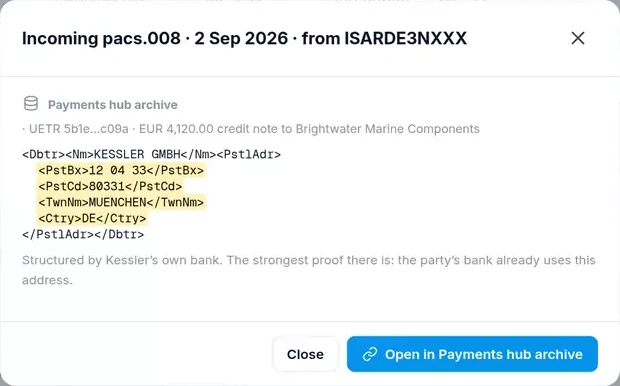
Every field can be proven, but not from the same place, and the cheapest proof is rarely the strongest. Postal reference data proves that a town and post code exist together; it cannot prove that this payee is there. The party's own documents prove where it says it is; they can be old. A structured payment that the party's own bank sent, with the same post box, post code, town and country in their own elements, is the strongest proof a bank can hold: another bank, which knows the party, has already structured the address the same way.
How ISO 20022 Structured Address Remediation proves one field, source by source
Agent
Read the masterTakes the free text as it was keyed and notes where it came from and when.
Never: treats the master as proof of itself
Agent
Postal reference dataConfirms the town, post code and subdivision exist together in that country.
Never: treats a valid post code as proof of the payee
Agent
The bank’s own paymentsFinds structured messages sent by the party’s bank, and the bank’s own past payments to it.
Agent
Documents in imagingReads the address on invoices, letterhead and forms the party sent.
A person decides
Analyst decides disputesWhere two sources disagree, or only one supports a field, a person chooses with both sources in view.
The master itself is the weakest source, because it is the thing being tested. An address loaded by a template bulk load in 2019 and never touched by a person proves only that someone once typed it. That is why the sample workbench shows, under each free-text address, when and how it entered the master.
The strongest proof: the party's own bank has already structured it
What is BuildingNumber, and must it be split from the street?
Building Number is the number on the street, what US forms call the street number, and the trend is to require it in its own element. The Bank of England set the clearest rule: "From 2025, the Bank will require the Building Number and Street Name fields to be split within Structured Addresses", having allowed them together in Street Name only where they were hard to separate (Bank of England, additional guidance).
Splitting is harder than it looks outside the US pattern of number-then-street. The solution's sample batch shows the range in five lines: a German payee at HAUPTSTR 112, a Mexican one at BLVD ADOLFO RUIZ CORTINES 3640, a Chinese one at NO 36 CHANGAN ROAD, an Indian one at PLOT 22 GIDC ESTATE, a Vietnamese one at LOT C4 in an export processing zone. The number comes after the street, before it, or is not a building number at all. The CPMI names the underlying difficulty: "The challenge of agreeing to a common minimum required level of postal address information is heightened for cross-border transactions because address formats and conventions vary greatly across jurisdictions" (CPMI, 2026). A rule that splits on the first number fails on every one of those.
A parser can put a number in Building Number. Only a source can say it is the payee's building and not its plot, its suite or its post box.
What is TownLocationName, and where should a district go?
Town Location Name names a place within a town; the Fed's FAQ says that "For U.S., this could be used to identify a county". District Name is a "Type of administrative division that in some countries is managed by the local government" (Fedwire ISO 20022 format FAQ). Neither replaces Town Name, which stays required.
The trap is putting a district in the town's place. For one sample payee, a textile company, the master and the postal reference data give the town as Ankleshwar, while a structured payment from the payee's bank puts Bharuch, which is the district. Bharuch belongs in District Name; whether the town is Ankleshwar is a question for a person with both sources in front of them. The town name guide catalogues the other ways that field goes wrong without an error.
Can a P.O. box be used in a payment address?
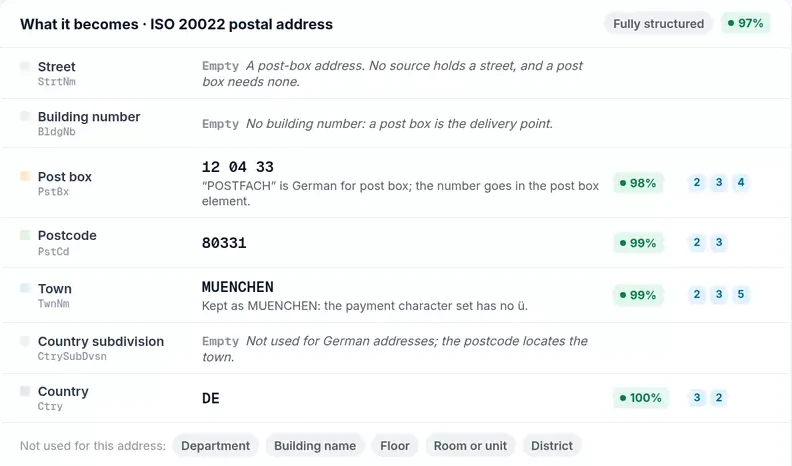
In the message, yes: Post Box is one of the fourteen elements, and a post-box address can be fully structured without a street. Under US rules, the question has an answer too. The FFIEC's BSA/AML manual records that "FinCEN issued a regulatory interpretation that states the Travel Rule should allow the use of mailing addresses, including post office boxes, in the transmittor address field of transmittal orders in certain circumstances", provided the bank keeps the transmittor's address on file and can retrieve it for law enforcement (FFIEC BSA/AML Examination Manual).
What a post box cannot do is prove a location. A bank's own policy may therefore ask for a person whenever an address is a post box with no street, as the policy of the fictional bank in the solution's sample data does. The solution does not fill the street for such an address; it leaves the element empty and says why.
Every field filled, or empty with a reason
How a US address maps to the fields
A US address maps cleanly, which is why US teams underestimate the rest of the master. Take an illustrative address, "125 MAIN STREET SUITE 400, SPRINGFIELD IL 62701". Following the Federal Reserve's equivalents, MAIN STREET goes in Street Name, 125 in Building Number (the street number), SUITE 400 in Room (a suite or apartment number), SPRINGFIELD in Town Name (the city), IL in Country Sub Division (the state, as an ISO 3166-2 code), 62701 in Post Code (the ZIP Code) and US in Country. Town Location Name could carry the county, but nothing requires it.
Two US habits need care. The city a postal directory gives for a ZIP Code can differ from the place name a company prints on its invoices, so Town Name should be checked against what the party's own documents and its bank use, not only against the directory. And a master built for domestic wires may never have stored a country, because every payee was assumed to be in the United States. Country is required under the cross-border rules and in Fedwire's end-state format, so that gap has to be closed even for purely domestic payees, and the bank's own customer data usually closes it.
Which source wins when they disagree?
None, automatically. A ranking of sources tells an analyst where to look first; it does not settle a dispute. When the postal reference data and the payee's own bank disagree about a town, both could be right in their own terms, and the choice depends on what the payee uses and what screening will match. The fictional bank's rule is that a single source never proves a disputed field and that the person who chooses sees both, with a button beside each.
Proof behind one sample address in ISO 20022 Structured Address Remediation
3
kinds of source behind each field
postal data, the party’s payments, its documents
99%
confidence on post code and town for one post-box payee
two or three sources agree on each
318
addresses in the queue because sources disagree
of 1,239 that need a person
Six checks on any structured address before it is loaded
- Town Name holds a town
Not a district, a county, a region or a post code.
- Country agrees with the post code and the town
A German post code with a French country code is a keying error, not an address.
- Building Number and Street Name are split
Unless the source genuinely has no number: then the number field is empty, with a reason.
- Country Sub Division uses its code
ISO 3166-2, for example NY for New York, per the CPMI.
- Nothing is a placeholder
“SAME”, “NA” and “SEE FILE” are not addresses and must not be structured as if they were.
- Each field names its source
An auditor should be able to open the passage that proved it.
Questions people ask
How many fields does an ISO 20022 postal address have?
Fourteen structured elements, plus Address Line for free text and Address Type, which cross-border practice excludes. The CPMI requires two of them, Town Name and Country, and recommends Post Code.
Which field holds a US state?
Country Sub Division. The Federal Reserve gives "State" as its US equivalent, and the CPMI asks for codes in line with ISO 3166-2, giving "NY" for the state of New York as its example.
What is the difference between Town Name and District Name?
Town Name is the city or town and is required. District Name is an administrative division that some countries use within or around towns; it is optional and never a substitute for the town. Confusing the two is one of the most common silent errors in remediation.
Should Building Name or Floor be filled if the source has them?
They are optional, and filling them helps only if they are right. The CPMI asks for further structure "to the extent possible" because the law along the chain may need it; a bank should fill what it can prove and leave the rest empty rather than guess.
Can the Address Line be used with a fully structured address?
No. Once an Address Line is present the address is hybrid by definition, and a hybrid address must keep Town Name and Country structured and never repeat structured data in the line.