An ISO 20022 structured address example looks like this: a postal address block in which each part of the address sits in its own element, such as StrtNm for the street, BldgNb for the building number, PstCd for the post code, TwnNm for the town and Ctry for the country, with at least the town and country always present. Three correct examples follow, fully structured, post box and hybrid, all taken from fictional payees in the sample data of Botminds' ISO 20022 Structured Address Remediation. The harder lesson comes after them. A structured address can satisfy the schema and every network rule and still be wrong, because those checks were built to test whether data is present and well formed, not whether it is true. Remediation that stops at "valid" moves errors from the repair queue into the master.
Three ISO 20022 structured address examples that are both valid and right
Fully structured
A UK manufacturer
<PstlAdr>
  <StrtNm>MILL LANE</StrtNm>
  <BldgNb>14</BldgNb>
  <PstCd>S3 8NH</PstCd>
  <TwnNm>SHEFFIELD</TwnNm>
  <Ctry>GB</Ctry>
</PstlAdr>
Every part in its own element; no Address Line.
Post box, fully structured
A German supplier
<PstlAdr>
  <PstBx>12 04 33</PstBx>
  <PstCd>80331</PstCd>
  <TwnNm>MUENCHEN</TwnNm>
  <Ctry>DE</Ctry>
</PstlAdr>
No street, and none needed; the umlaut is spelled out for the character set.
Hybrid
A Vietnamese fastener maker
<PstlAdr>
  <TwnNm>HO CHI MINH CITY</TwnNm>
  <Ctry>VN</Ctry>
  <AdrLine>LOT C4, TAN THUAN EXPORT
    PROCESSING ZONE</AdrLine>
</PstlAdr>
Town and country structured; the lot description stays as one line of free text.
What does a structured address look like in ISO 20022?
It is a set of named elements inside a postal address block, one element per part. The Federal Reserve's Fedwire FAQ lists the fourteen available, from Department to Country, with their US equivalents: Street Name, Building Number (the street number), Post Box (a P.O. box), Post Code (a ZIP Code), Town Name (a city), Country Sub Division (a state) and so on (Fedwire ISO 20022 format FAQ). A fully structured address uses only those elements. A hybrid address keeps Town Name and Country in elements and adds up to two free-text Address Lines; the hybrid postal address guide covers when that is the right choice.
What is the difference between a structured and an unstructured address?
Who can read it. An unstructured address is free text in up to three lines of 35 characters, and only a person can reliably tell which words are the town. A structured address states it: the town is whatever is in TwnNm. The difference is easiest to see on one payee. Unstructured, the German supplier above sat in the bank's master as four lines: KESSLER GMBH, POSTFACH 12 04 33, 80331 MUENCHEN, DE. A reader knows which is the town. A screening filter, a receiving bank's system or a validation rule only knows if the town is in its element.
That is also the risk. Once an address is structured, every system downstream trusts the labels. A free-text address with a district where the town should be is ambiguous, and a careful reader may catch it. The same mistake in TwnNm is a confident statement, carried into every payment, every screening run and every receiving bank's records. Structure makes a right address more useful and a wrong one more harmful, which is why the proof has to come before the structure, not after.
Which structured address fields are mandatory, and what does valid mean?
Town Name and Country are required; Post Code is recommended; everything else is optional (CPMI, 2023, Table A2.1). "Valid" means the message passes the schema and the network's usage rules: the required elements are there, no element is repeated beyond its limit, the characters are in the allowed set, a fully structured address carries no Address Line and a hybrid one no more than two of 70 characters.
The standard-setters are explicit that this is a test of completeness, not quality. Explaining what minimum data requirements achieve, the CPMI writes: "Establishing minimum data requirements facilitates validation of whether the necessary information is provided (although not necessarily the quality of these data)" (CPMI, February 2026). The parenthesis is the whole subject of this guide.
Six valid addresses that are wrong
Each of the addresses below would pass validation. Each is wrong in a way only a second source reveals. The patterns are drawn from the kinds of address that needed a person in the solution's sample master of 61,900.
Six ISO 20022 structured address examples that are valid and wrong
Passes every format check: TwnNm BHARUCH · Ctry IN
What the sources show: The master and postal data give ANKLESHWAR; Bharuch is the district. A person chooses.
Passes every format check: TwnNm MEXICO DF · Ctry MX
What the sources show: An old designation, flagged for a person to confirm against the payee’s documents.
Passes every format check: StrtNm GIDC ESTATE · BldgNb 22
What the sources show: PLOT 22 is a plot, not a building number; the estate is not a street.
Passes every format check: StrtNm POSTFACH · BldgNb 12
What the sources show: POSTFACH is German for post box: PstBx 12 04 33 and no street.
Passes every format check: TwnNm SAME · Ctry US
What the sources show: No address was ever captured. Ask the client.
Passes every format check: TwnNm COPENHAGEN · Ctry DK
What the sources show: Parsed from “C/O CORVANE TRADE OPS – SEE FILE”: the bank’s own desk, not the payee.
The last row is the most instructive. "C/O CORVANE TRADE OPS – SEE FILE" is a note one department left for another, stored where an address should be. A parser that finds a Danish country code and a likely town will produce a perfectly valid address for a place the payee has never been. The sample solution's answer is "Town needed · DK", and a request to the client.
Can a structured address be wrong and still pass validation?
Yes, and that is the normal way remediation errors reach production. Validation checks shape. Whether the town is the town, the number is a building number, or the address belongs to this payee at all, are questions the message cannot answer about itself. The BIS draws the same line in its May 2026 survey, describing pre-validation services: "Unlike traditional controls, which primarily verify the syntax and format of the data, PPV services are designed to verify the actual accuracy and completeness of payment information" (CPMI Brief No 13).
A valid but wrong address does damage that a rejection does not. A rejected payment is visible the same day. A wrong address is sent, screened against the wrong place, and copied into every later payment from the template, and it can turn into a screening alert, a query from the receiving bank or a payment that cannot be applied, long after anyone remembers the remediation that produced it.
Why remediation scripts produce valid but wrong addresses
Because the rules reward filling fields, and a script can always fill one. When Town Name becomes mandatory, a parser that cannot find a town has two options: fail the address, or put its best guess in TwnNm and pass. A script judged by its pass rate takes the second, because a failure lands on someone's desk and a guess does not, until later.
Three habits make the guesses worse. Parsers learn one country's pattern, number before street, and apply it to addresses where the number follows the street or is not a building number at all. Postal libraries normalise to the directory's form, which may not be the form the payee or its bank uses. And bulk scripts work on the master alone, so the only source they consult is the one being cleaned. The agents in the sample solution work under the opposite rules: never invent a value that is not in a source, never fill a placeholder, never raise confidence without a source, and explain every element left empty.
How do you test address accuracy?
Against a source the address did not come from. The revised FATF Recommendation 16 has a one-line definition worth adopting as a programme rule: "Accurate" "is used to describe information that has been verified for accuracy" (FATF, revised R.16 glossary). A structured address copied from the master is not verified by being well formed; it is verified when postal reference data, the party's own bank or the party's own documents agree with it.
Five tests that separate a right address from a valid one
- Postal reference: do the town, post code and subdivision exist together?
Catches districts in the town field, glued post codes and keying errors.
- Party’s bank: has the party’s own bank sent the same address, structured?
The strongest proof there is: another bank already uses it.
- Party’s documents: does the invoice or letterhead agree?
Catches invented streets and post boxes treated as buildings.
- Placeholder and note check: is it an address at all?
“SAME”, “SEE FILE” and “C/O” notes are not addresses.
- Second person: does someone other than the maker agree?
Singly for disputed cases; by sample for proven batches.
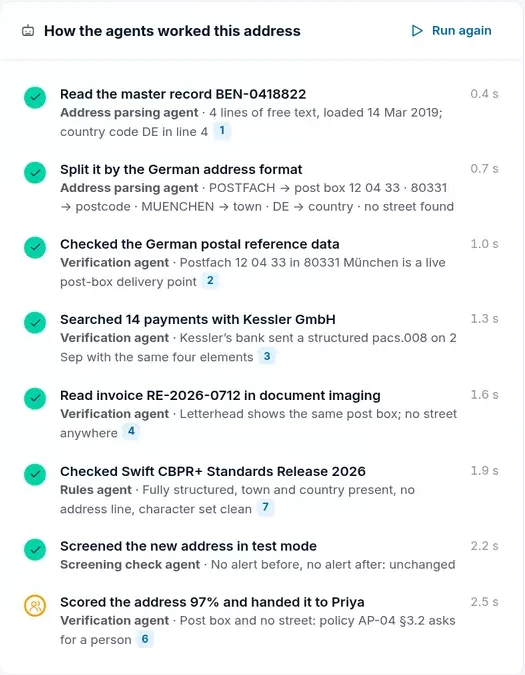
In ISO 20022 Structured Address Remediation, validity is one step of eight; the rest are about truth
A sampling plan a checker can defend
Testing every address by hand defeats the purpose; testing none is how wrong addresses get loaded. The workable middle is a risk-weighted sample per batch, read by a checker who did not make the batch, with a rule for what happens when the sample finds an error.
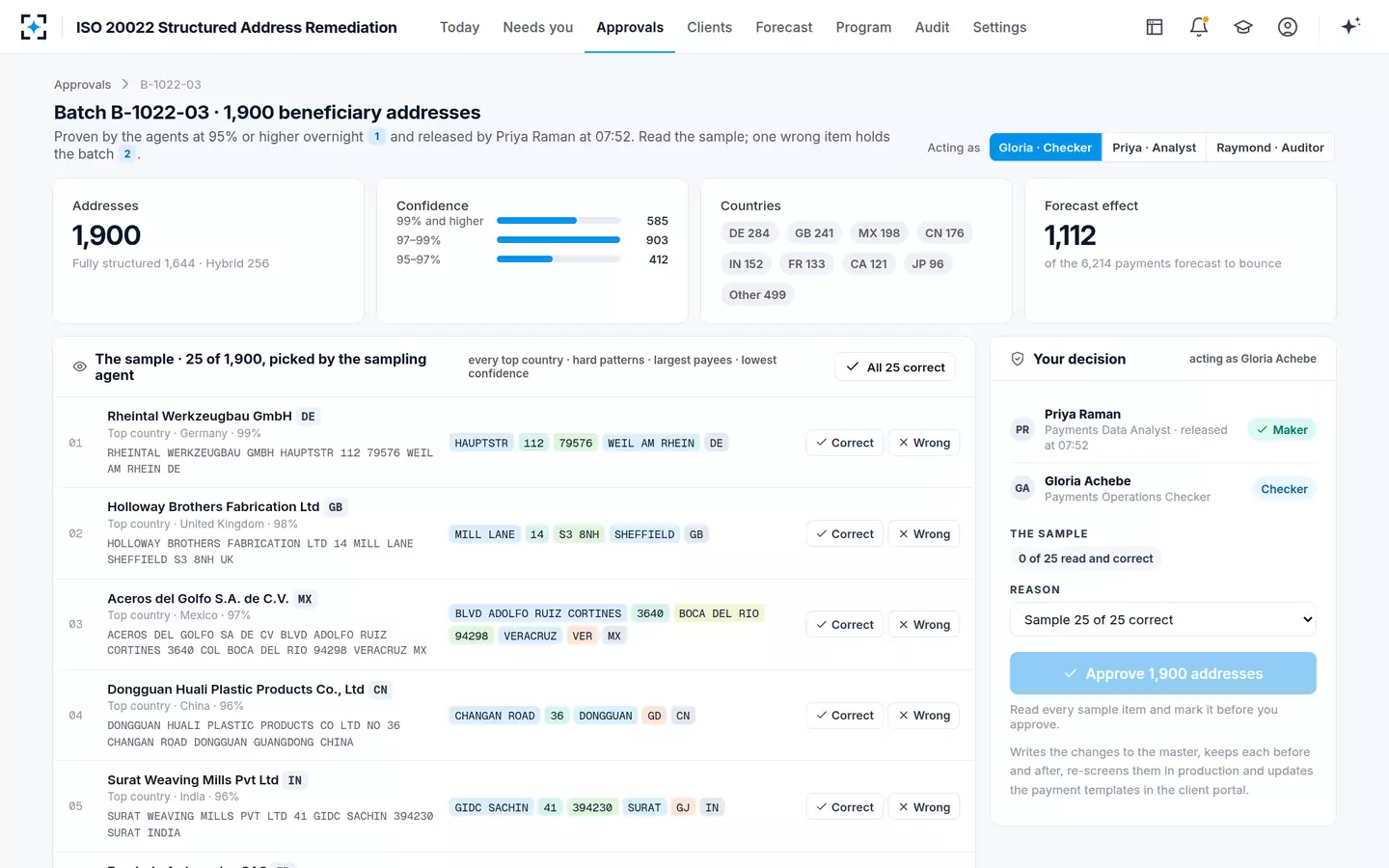
The settings of the fictional bank in the solution's sample data give one defensible shape. Only proposals at 95% confidence or higher are batched at all; below 80% a person always decides. A batch of up to 2,000 gets a sample of 25, chosen to cover every top country, the hard patterns, the largest payees and the lowest confidences. One wrong item holds the entire batch and widens the next sample to 80. In batch B-1022-03, 1,900 addresses, the checker read 25, found all 25 correct and approved.
How confident the agents were about one approved batch
A sample the checker reads before Approve switches on
What should accuracy look like over a whole programme?
Three numbers say more than a validation pass rate. The share of live addresses with every field proven by a source other than the master; the rate at which checkers find errors in samples, which should fall as the policy matures; and the count of disputed fields decided by a person, which shows the programme is not quietly picking winners. The readiness guide sets these beside the KPIs the BIS proposes for migrations.
Accuracy, not validity, in one ISO 20022 Structured Address Remediation sample morning
25 of 25
sample items correct in a batch of 1,900
one wrong item would hold the batch
318
addresses where sources disagree, decided by a person
of 1,239 that needed one
141
entries found not to be postal addresses at all
sent to clients, not parsed
Questions people ask
What is an example of a hybrid address?
A Vietnamese payee in an export processing zone: Town Name HO CHI MINH CITY and Country VN in their own elements, and "LOT C4, TAN THUAN EXPORT PROCESSING ZONE" in one Address Line. The lot description is not a street and building number, so structuring it would invent precision.
Does a structured address need a street?
No. Only Town Name and Country are required. A post-box address is complete with Post Box, Post Code, Town Name and Country, and an address whose street cannot be proven can be sent as hybrid where the rail accepts it.
Is the country written as a name or a code?
As a code. Fedwire's end-state rules call for a country code alongside the town name, and the examples here use GB, DE and VN. Country subdivisions use ISO 3166-2 codes, such as NY for the state of New York.
Can the same address be both structured and in an Address Line?
No. Data in a structured element must not be repeated in an Address Line, and a fully structured address carries no Address Line at all. An address that does both fails the hybrid rules.
How many addresses should a checker sample?
Enough to defend, and a rule for what an error triggers. The fictional bank reads 25 per batch of up to 2,000 and 40 up to 5,000, and one wrong item holds the batch and raises the next sample to 80. Those are the bank's own settings, which its auditors can test.