An ISO 20022 structured address change looks like a data-format task: free text in the client and beneficiary master becomes Street Name, Post Code, Town Name and Country. Downstream it is more than that. The new town is what sanctions screening will match from now on; the new fields are what every payment template will send; and the change decides which payments land in the repair queue and which pass. A structured address can remove a false alert that has fired for years, and it can create a genuine potential match the free text hid. Botminds' ISO 20022 Structured Address Remediation screens every proposed address in test mode before it goes live, sends any changed result to the sanctions team, and keeps the before and after of every change. This guide follows one change downstream.
One address change in ISO 20022 Structured Address Remediation, from proposal to payment
Agent
ProposeStructures the address and proves each field from postal data, the party’s payments and its documents.
Never: changes the master on its own
Agent
Screen in test modeRuns the new address against the same lists as production and compares the result with today’s.
Never: clears, closes or decides a match
A person decides
Sanctions analyst decidesAny changed result, a new potential match or an alert that would disappear, goes to the sanctions team first.
A person decides
Maker and checker approveThe change is approved by one person and checked by another; the old value is kept beside the new.
Agent
Write and re-screenWrites the change through a change request, re-screens it in production and updates the payment templates that use it.
What changes when an address is structured?
Four things a bank relies on. Screening now matches a town, a post code and a country as separate values instead of words in a line. Payment templates copy the new fields into every future payment to that party. Message validation on each rail tests the fields against its rules. And the repair queue sees a different set of exceptions: fewer addresses with no town, possibly new ones where a rail does not yet accept the layout chosen.
The CPMI expects the net effect to be faster payments: "The use of structured addresses will speed up overall processing of cross-border payments, especially where it will facilitate screening processes and prevent the need for manual interventions", sanctions checks being its example (CPMI, February 2026). Whether a given bank gets that benefit depends on whether its downstream systems use the new fields, and whether the fields are right.
Where a changed address travels in a bank
| System | What it does with the address | What to check after a change |
|---|---|---|
| Client and beneficiary master | Holds the address of record for each party | The change was approved by two people; the old value is kept |
| Sanctions screening | Matches names, towns, regions and countries against lists | A test-mode run before go-live; a production re-screen after |
| Payment templates and the payments hub | Copy the address into each new payment | Templates refreshed; the format fits each rail |
| Treasury management portal | Shows corporate clients their own payees | Clients see the confirmed address, never a screening reason |
| Past payment records | Keep the address as it was sent | Unchanged: history is not rewritten |
Does structuring addresses change sanctions screening?
Yes, in both directions, and that is the main reason an address change is not a clerical task. A structured town can match a place-based programme that the same town inside a free-text line never triggered, because the filter now knows it is a town. And a street name that has fired false alerts for years can stop firing once the filter knows it is only a street.
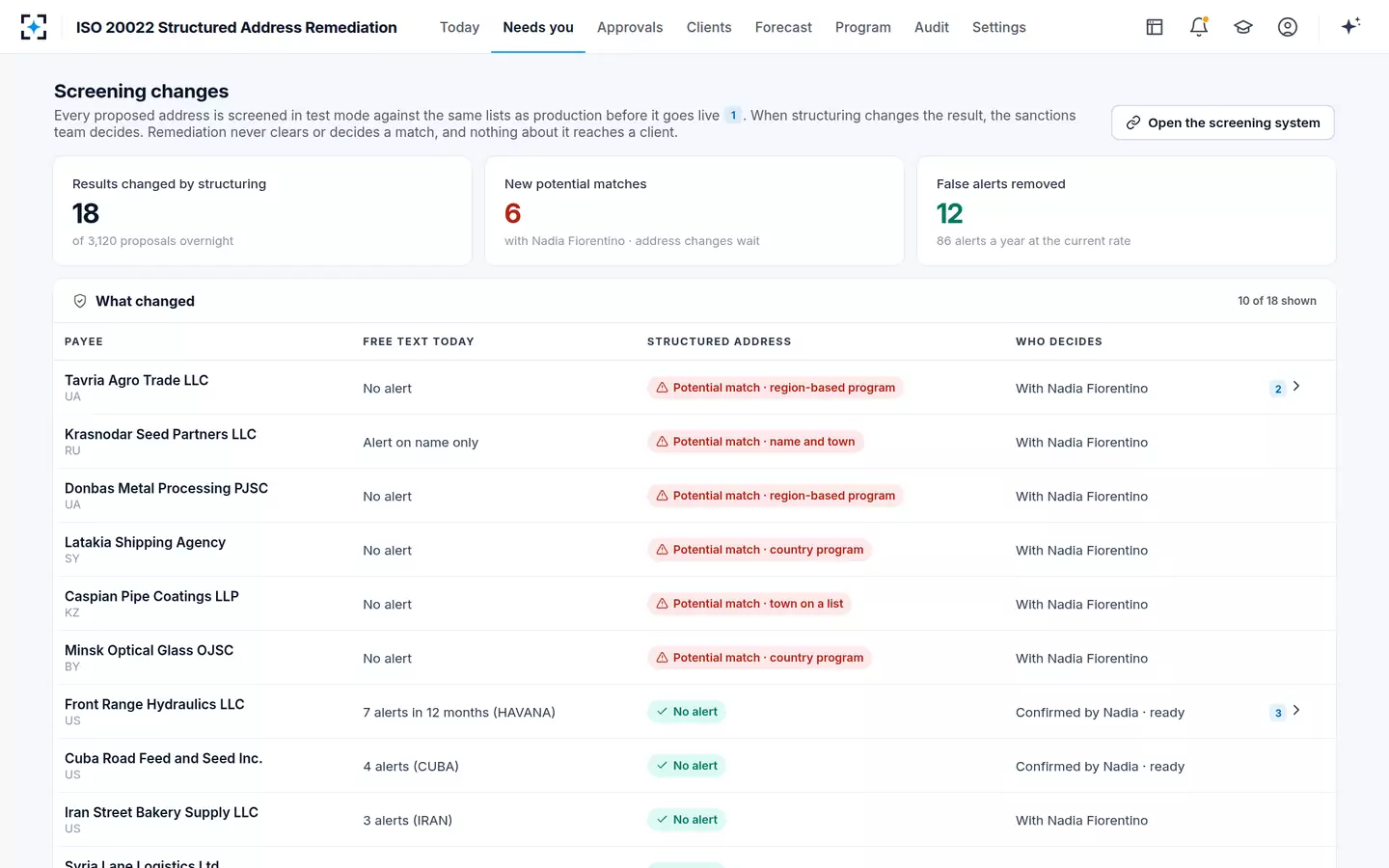
The solution's sample data shows both on one night. Of 3,120 proposed addresses screened in test mode, 18 results changed. Six became new potential matches, among them a Ukrainian trading company now matching a region-based programme and a Kazakh company whose structured town is on a list. Twelve false alerts disappeared: a Denver company on Havana Street that had triggered seven alerts in 12 months, a feed store on Cuba Road, a bakery supplier on Iran Street. All six potential matches went to the sanctions analyst; the address changes waited for her.
Screening changes ISO 20022 Structured Address Remediation found in one sample night
18
screening results changed
of 3,120 proposed addresses
6
new potential matches, sent to the sanctions team
address changes wait
12
false alerts removed
about 86 alerts a year at the current rate
Every result a new address would change, before it goes live
Will false positives go down after structuring?
They should, but only if screening uses the structure. The CPMI's rationale for Requirement 11 is explicit: "Unstructured addresses can lead to false positives due to the absence of contextual information that a more structured address could provide" (CPMI, 2026). The BIS is equally explicit that the benefit is not automatic. Many institutions "continue to rely on traditional screening methods developed for MT messages", which limits their "ability to implement targeted screening approaches, which could reduce false positives and enhance compliance efficiency" (CPMI Brief No 11, April 2026).
The same paper reports a case. A footnote on Japan says "false positive rates for AML/CFT screening had barely changed before and after the implementation of ISO 20022 as of summer 2025 in Japan, mainly due to maintenance of the existing screening method and the data quality issue." Structured addresses are a precondition for fewer false alerts, not a guarantee of them. A bank that structures its master but keeps screening the concatenated text will see the sample's 12 removed alerts only if the filter is told which value is a street.
How a false alert disappears: one sample payee on Havana Street
The clearest removed alert in the sample is a fictional Denver hydraulics company whose address sits on Havana Street. Held as free text, "HAVANA" is a word in a line, and a filter that scans lines for sanctioned places finds the name of Cuba's capital. The payee triggered seven alerts in twelve months, each one opened, read and closed by an analyst.
Structured, the same address says what each word is: HAVANA STREET in Street Name, DENVER in Town Name, CO in Country Sub Division, US in Country. A screening configuration that matches places against the town and country elements has nothing to match. The test-mode run shows the alert would disappear, and that is itself a screening result: the sample solution sends it to the sanctions analyst, who confirms it before the address goes live. The same pattern removed alerts for a feed store on Cuba Road and a bakery supplier on Iran Street.
The saving is real only if the screening system is configured to use the elements. A bank should test that configuration on a sample of known false-alert payees before it counts on the twelve, and should treat a removed alert with the same discipline as a new one, because a configuration that stops matching street names could, set wrongly, stop matching towns as well.
Structure makes screening more precise in both directions: fewer alerts on street names, and new ones on towns the free text used to hide.
Do we need to re-screen after address remediation?
Yes, twice: once in test mode before the change, and once in production after it. The test-mode run tells the sanctions team which results the change will alter, while the old address is still the address of record. The production re-screen confirms what the screening system now holds. At the fictional bank's approved batch of 1,900 addresses, the production re-screen raised no new alert, while the six addresses with potential matches waited for the sanctions analyst.
Region-based programmes are why the test run matters. OFAC's Crimea advisory warned that payment messages had carried a street address with no town, city, region or country, and that filters needed search terms for major cities and ports, not only the region's name (OFAC, 2015). Structuring is how those towns become visible to a filter. A bank should know which payees that will surface before it surfaces them in production.
What happens to payment templates and the repair queue?
Templates inherit the change; the repair queue reflects it. Every saved payment template for a party copies its address into the next payment, so an approved change has to reach the templates in the payments hub and the treasury portal, or the old free text goes on being sent. In the sample, approving one batch updated 1,900 templates in the same step.
The repair queue changes shape. Payments that would have been repaired for a missing or unstructured address stop arriving there; the sample forecast fell from 6,214 to 5,102 failing payments after that one batch. But a queue can also gain items if the layout chosen does not fit a rail: a hybrid address is accepted on cross-border messages and not yet for Fedwire's main parties before its November 2027 release. The hybrid postal address guide sets out which layout each rail takes.
Should we keep the old address?
Yes, beside the new one, with the reason for the change. The old value explains past payments, past screening results and past investigations; deleting it leaves the bank unable to say why a payment in 2025 carried a different town. It also makes the change reversible if a client later says the old address was right.
Records of payments already made keep their own copy regardless. For transfers of $3,000 or more, the US recordkeeping rule has the originator's bank retain, among other items, the originator's name and address (FFIEC BSA/AML Examination Manual), and records the BSA rules require are kept for five years (31 CFR 1010.430). The master's change history is a different thing: no rule names it, so how long it is kept is the bank's decision. The fictional bank keeps every change and its evidence for five years, a setting it can lengthen.
Who approves an address change, and who never should?
Two people, neither of them an agent: a maker, and a checker who did not make the change. In the sample design, an analyst approves a single address or releases a batch as maker; a different person checks it, singly or by reading a risk-weighted sample; and the sanctions analyst decides any screening change. The agents propose, prove, screen in test mode and write approved changes. They never approve, never decide a match and never retire a payee; retiring a dormant payee needs the checker and the programme manager.
The client never sees why a change was held. The sample solution's requests to treasury clients ask only about the address, and screening never appears on a client view. That separation matters most when a structured town is the reason for a hold. How the seats around the master fit together is set out in who has to meet the requirements.
What audit trail is needed for an address change?
Enough for someone outside the programme to re-perform each decision. The FFIEC's examination handbook treats data governance as a matter of formal authority over an entity's data (FFIEC IT Examination Handbook, 2021); for an address master, authority shows up as a trail of who decided what, on which evidence.
What each address change should carry on its trail
- Who proposed it, who approved it, who checked it
Person or agent, with the agent’s version.
- When each step happened
Proposal, test-mode screen, approvals, write, production re-screen.
- The value before and after
Field by field, not as a block of text.
- The evidence for each field
The postal entry, the payment from the party’s bank, the document page.
- Why it needed a person, if it did
Sources disagreed, post box, low confidence, client asked.
- The screening comparison
Result before and after, and who decided any change.
- The change request it was written under
So the master’s own change log and the trail agree.
Who, what, when, why, and the evidence
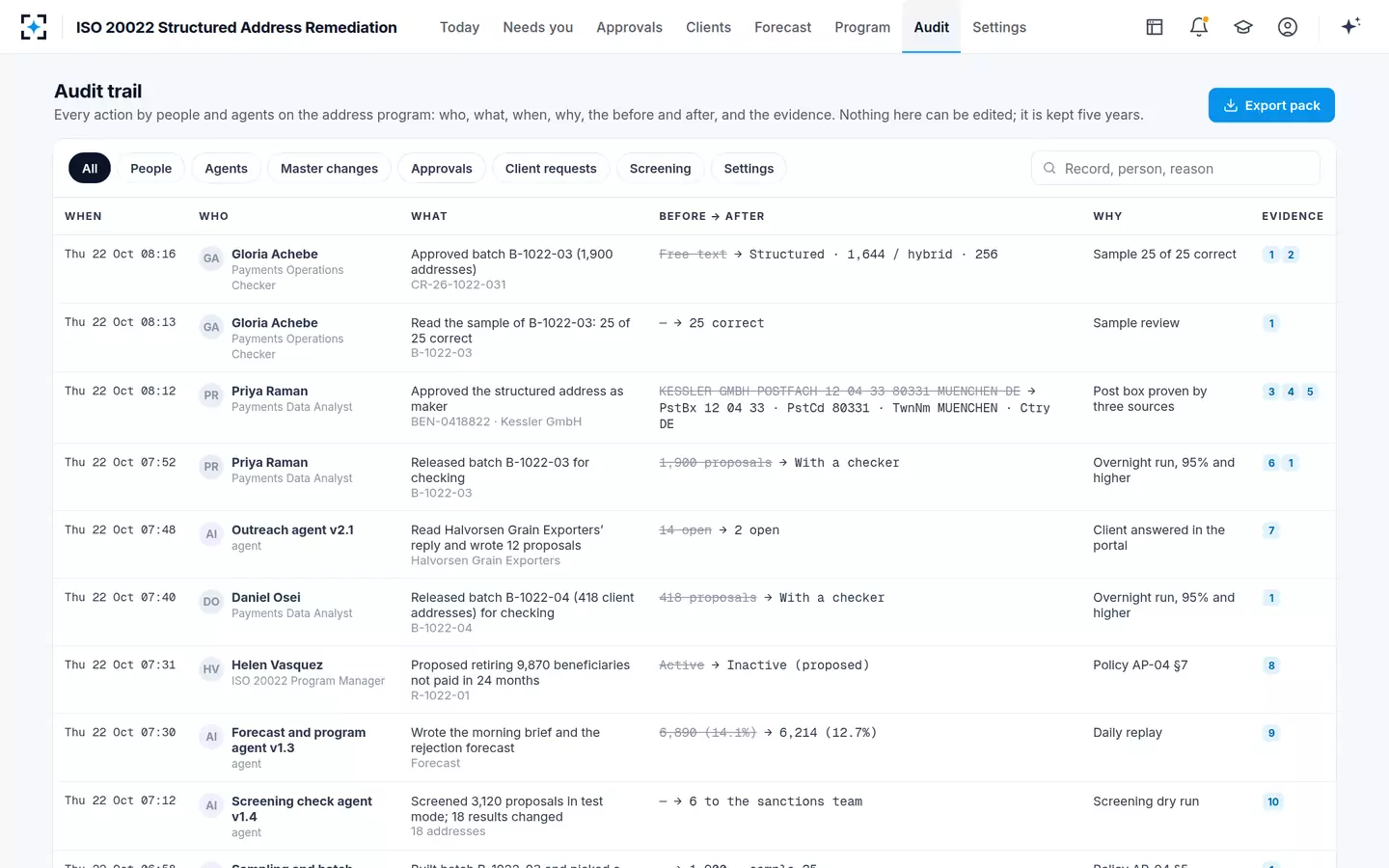
For a programme manager, the trail is also the progress report: what changed, by whom and on what proof. The readiness guide turns it into the numbers a steering committee needs.
Questions people ask
Can a better address create a new sanctions alert?
Yes. A town or region in its own field can match a place-based programme that the same words in a free-text line did not. In the solution's sample, 6 of 18 changed screening results were new potential matches, each sent to the sanctions team before the address went live.
Should the sanctions team approve address changes?
Only the ones that change a screening result. Asking the sanctions team to review every address would bury the few that matter; a test-mode comparison sends them exactly those.
Do past payments need to be corrected after remediation?
No. A payment's records reflect what was sent at the time and should not be rewritten. The master changes for future payments, and its history explains the difference.
What if a client says the new address is wrong?
Because the old value and the evidence are kept, the change can be reversed with a reason, through the same maker and checker steps. The client's correction becomes a new source for that payee.
Will structured addresses reduce payment repairs?
For address-related repairs, they should: in the sample, one batch of 1,900 approved addresses cut the payments forecast to fail by 1,112. Repairs for other reasons, such as account numbers or codes, are untouched.