The Fedwire ISO 20022 implementation delay is about addresses. Fedwire itself moved to ISO 20022 on 14 July 2025 and that migration is done; what has moved is the follow-on release that would have replaced Fedwire's unstructured address option with a hybrid format, requiring a town and a country in their own elements. The Federal Reserve announced on 27 August 2026 that this release would move to November 2027, with the exact date to come. For US banks the delay buys time, not relief: the client and beneficiary master still has to be turned into structured fields, and Fedwire asks for structured addresses now. Botminds' ISO 20022 Structured Address Remediation does that work on the master. This guide reconciles the dates from the Federal Reserve's own words.
Fedwire's address rules and the cross-border rules, side by side
Fedwire Funds Service: 14 July 2025, in one cutover.
Cross-border messages (Swift network): MT coexistence ended on 22 November 2025.
Fedwire Funds Service: Fully structured or fully unstructured for the debtor, creditor and their agents; never a mix of the two.
Cross-border messages (Swift network): Fully structured or hybrid preferred; the fully unstructured option has not yet been removed.
Fedwire Funds Service: Already required for ultimate debtor and ultimate creditor; for the main parties only from the November 2027 release.
Cross-border messages (Swift network): Available since November 2025.
Fedwire Funds Service: November 2027 release; exact date to be announced.
Cross-border messages (Swift network): Planned for November 2026; delay announced 27 August 2026, new date not confirmed.
Fedwire Funds Service: Not required by Fedwire’s own format; the sender is told to ask compliance and the receiving bank.
Cross-border messages (Swift network): Once the unstructured option goes, town and country at least wherever an address is given.
Was the Fedwire ISO 20022 address change delayed?
Yes, by a year. The Federal Reserve's rescheduling FAQ opens with it: "FRFS has rescheduled its Fedwire Funds release to November 2027. We will maintain ongoing collaboration with key peer market infrastructures, such as Swift and CHIPS, to support a seamless industry-wide implementation. The exact implementation date will be announced in the fall" (Federal Reserve Financial Services, November 2027 release FAQ). The implementation centre dates the announcement to 27 August 2026 (Fedwire ISO 20022 implementation centre), the same day the Bank of England reports Swift announced its own delay.
The rest of the timetable moved with it. The Fed intends to publish the final usage guidelines, including the Fedwire Funds Service ISO 20022 Implementation Guide, on MyStandards in November 2026; to announce when its DIT2 test environment opens for the release "in the fall"; to keep its peer-to-peer testing requirement; and to open registration for that testing in June 2027.
We strongly encourage customers to start sending in the structured postal address format.
Federal Reserve Financial Services, November 2027 release FAQ
What changed on July 14, 2025?
Fedwire's message format did. On that day the Fedwire Funds Service replaced its legacy format with ISO 20022 in a single cutover, and the Federal Reserve says participants "were immediately able to utilize the CPMI payments data models for high-value USD wire payments as part of the transition to ISO 20022" (Fed360, June 2026). Structured address elements have been available on Fedwire since then. What was left for a later release was the hybrid format for the main parties and the removal of the unstructured one.
What runs on the rail whose address rules just moved
217.3M
Fedwire funds transfers in 2025
up 3.5% on 2024
$1.148quadrillion
value transferred in 2025
869,187
transfers on an average day
$5.28M
average value of a transfer
What address formats does Fedwire accept today?
Two, and they cannot be mixed for the main parties. The Fedwire format FAQ defines them. The interim format "allows for the use of structured postal address information or unstructured but does not allow the combination of both structured and unstructured". The hybrid, or end-state, format requires at least the country code and town name and permits up to two free-text lines of 70 characters (Fedwire ISO 20022 format FAQ). Until the November 2027 release, the debtor, creditor, debtor agent and creditor agent use the interim format; a few parties already use the end-state one. In the FAQ's own example for a pacs.008, "you must use the hybrid/end-state format for the ultimate debtor and ultimate creditor."
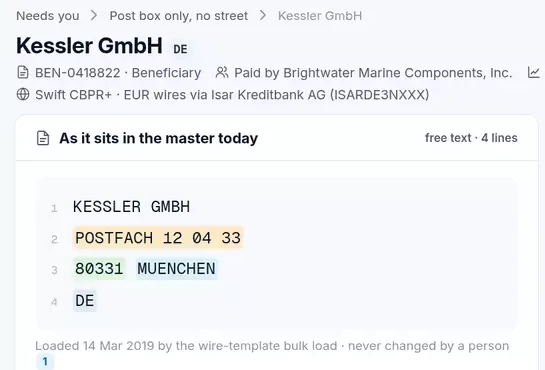
The unstructured option it will replace is the one most US masters were built for: three free-text lines of 35 characters, as the Fed described it when it first announced the change (On the Wire, October 2025). The detail of what hybrid permits, and when it is the right choice, is in the hybrid postal address guide.
Before ISO 20022 Structured Address Remediation: the shape Fedwire's unstructured option was built for
Why the Federal Reserve's own pages show three dates
Because the plan moved twice, and not every page was updated. A reader searching the Fed's site in October 2026 can still find three different answers to "when", and it is worth knowing which is current before a vendor or a correspondent quotes one back.
Three dates for one Fedwire release, all on the Federal Reserve's own site
| Where it appears | What it says | Status |
|---|---|---|
| On the Wire newsletter, October 2025 | “On November 23, 2026, the Fedwire Funds Service intends to implement the following changes to ensure interoperability with modifications that Swift® and CHIPS® (peer operator) will make” | Superseded |
| Fedwire ISO 20022 format FAQ, postal address answers | “As of Nov. 16, 2026, the Fedwire Funds Service will require the hybrid/end-state postal address requirements for all parties and agents” | Superseded, still online |
| Implementation centre and rescheduling FAQ, from 27 August 2026 | November 2027; “The exact implementation date will be announced in the fall.” | Current |
The October 2025 announcement is still the clearest statement of what the release does: remove "three free-text lines of 35 characters each, require town name and country, and allow the option to include other structured address elements such as two free-text lines of up to 70 characters each". Nothing published since says the scope has changed, only the date; the Fed says more details about the scope will be shared this fall.
The Fedwire leg of a cross-border payment does not get the extra year
Many US wires that start on Fedwire do not end in the United States. A community bank sends a customer's payment to a Mexican supplier as a pacs.008 over Fedwire to its correspondent, and the correspondent sends it on across the border. The Fedwire leg is judged by Fedwire's rules; the onward leg by the cross-border rules and by whatever the correspondent and the beneficiary's bank require. When those requirements move ahead of Fedwire's, the address the community bank sent is still the address the correspondent has to forward. Under the US travel rule an intermediary passes on what it received and has no duty to obtain what was not sent (FFIEC BSA/AML Examination Manual); a correspondent cannot invent a town either.
The Federal Reserve anticipates exactly this. Its format FAQ tells a Fedwire sender to check with the receiver "and any other bank that may process the transfer" about requirements beyond Fedwire's own, citing the creditor's postal address as the example (Fedwire ISO 20022 format FAQ). A requirement nobody asked about tends to surface the expensive way, as a query or a returned payment.
That is why the safe reading of the delay is narrow. It moves the date on which Fedwire's validation will reject an unstructured address. It does not move the date on which a correspondent, an intermediary or a foreign beneficiary's bank starts to need one, and for cross-border flows those dates follow the cross-border calendar, which the Bank of England expects to settle on November 2027 but which nobody has yet confirmed. A bank whose Fedwire traffic includes correspondent-routed international payments should treat those payees as cross-border payees in its remediation plan, not as domestic ones, and the work order of the fictional bank in the solution's sample data does the same: it ranks every payee by the money its recent payments carried, whatever rail they used.
Is ISO 20022 mandatory for Fedwire?
Yes, since 14 July 2025: there is no legacy Fedwire format to fall back on. What is not yet mandatory is a structured or hybrid address for every party; until the November 2027 release a fully unstructured address remains acceptable for the main parties. Fedwire also does not require a creditor postal address at all in a customer transfer, and does not require a name and address for an agent identified by its BIC. It sends the content question back to the sender: consult compliance and legal, and check with the receiving bank, which may have requirements of its own.
Does CHIPS follow the same date as Fedwire?
We found no published statement that it does. The Federal Reserve names CHIPS twice: in October 2025, as a "peer operator" whose modifications Fedwire's November 2026 changes were meant to match, and in its rescheduling FAQ, as one of the "key peer market infrastructures" it is working with for a seamless implementation. Neither statement gives CHIPS's own date for structured addresses. CHIPS is run by The Clearing House, a bank-owned company that sets its own rules and dates. Treat the CHIPS date as a question for The Clearing House, not an assumption borrowed from Fedwire.
How the Fedwire delay lines up with cross-border, CHAPS and T2
Closely, except in Europe. The BIS had reported that from November 2026 cross-border messages would carry only fully structured or hybrid addresses (CPMI Brief No 13); Swift delayed that release on 27 August 2026, and the Bank of England expects to move CHAPS's removal of unstructured addresses to its November 2027 release, subject to confirmation (Bank of England). The Eurosystem kept its November 2026 releases but softened the address rule in T2 for now: "This will be achieved by introducing a temporary measure in T2 allowing fully unstructured postal addresses in T2 RTGS messages to continue to be used for a limited period" (ECB, 4 September 2026).
For a US bank the practical consequence is that its two main rails now point to the same month, November 2027, but only one of those dates is confirmed. The structured address deadline guide sets out a plan that holds whichever way the cross-border date settles.
What should US banks do now?
Send structured addresses on Fedwire wherever the bank can prove them, and build the master so that the hybrid form is ready for November 2027 without a second clean-up. That means storing each address in elements, with the source that proved each one, and generating the right format per rail at send time: fully structured on Fedwire today, structured or hybrid cross-border.
Six things a Fedwire participant can do before the November 2027 release
- Read the final usage guidelines when they appear
The Fed intends to publish them on MyStandards in November 2026.
- Send structured addresses for the main parties now
The Fed “strongly” encourages it, and it is the format that survives the release.
- Store addresses in fields, not lines
A master that holds elements can produce structured, hybrid or legacy lines; one that holds lines cannot.
- Ask your receivers what they need
Fedwire does not require a creditor address; a receiving bank or intermediary may.
- Book testing early
Peer-to-peer test registration opens in June 2027; DIT2 dates follow this fall.
- Do not wait on CHIPS
We found no published date for it; confirm it directly.
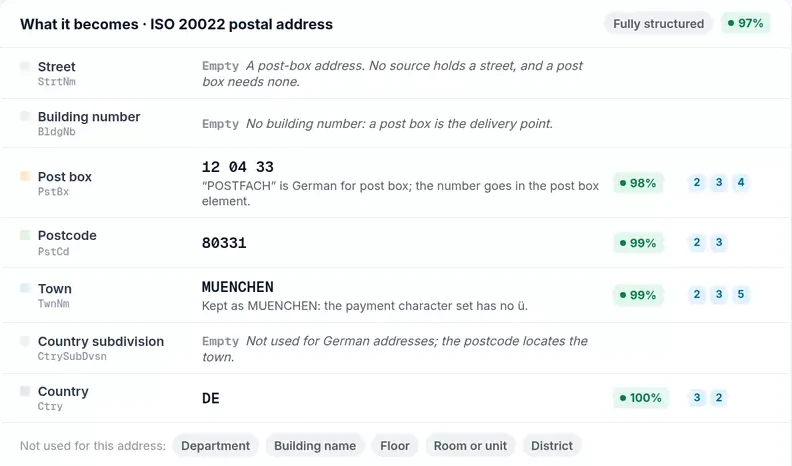
The same address as fields: acceptable on Fedwire today and after 2027
What the Fedwire delay changes for ISO 20022 Structured Address Remediation
It works on the master, so the Fedwire date changes the order of the work, not the work. Its agents split each address into elements, prove each from postal reference data, the bank's own payments with the party and its documents, and check the result against the network rules before a person approves it. Where Fedwire's interim rules and the cross-border rules differ, the address is stored once in fields and the format is the payment hub's choice at send time. A maker and a checker sign every change to the master; the solution does not build or send Fedwire messages.
Questions people ask
When is the Fedwire November 2027 release?
The Federal Reserve has said November 2027 and that "the exact implementation date will be announced in the fall". It plans to publish the final usage guidelines in November 2026 and to open peer-to-peer test registration in June 2027.
Can we send hybrid addresses on Fedwire before November 2027?
Not for the debtor, creditor and their agents: until the release, Fedwire supports only the unstructured and structured formats for those parties. Hybrid is already required for the ultimate debtor and ultimate creditor, and will be supported for the main parties once the release is in.
Will Fedwire reject unstructured addresses?
Not before the November 2027 release. The release is planned to remove the unstructured format, the three free-text lines of 35 characters, and the Fed tells participants to keep preparing for that removal.
What is the Fedwire ISO 20022 timeline so far?
Migration to ISO 20022 on 14 July 2025; an address release first announced for 23 November 2026, also shown as 16 November 2026 in the format FAQ; rescheduled on 27 August 2026 to November 2027, with final usage guidelines due in November 2026 and peer-to-peer test registration in June 2027.
Do the investigation messages move too?
The same release was to bring enhancements to the camt.110 and camt.111 investigation messages, so they move with it. The Fed has said the scope of the November 2027 release will be confirmed this fall.