The BSA recordkeeping requirements are the Bank Secrecy Act rules that make a bank create and keep records of certain transactions, most visibly funds transfers of $3,000 or more, extensions of credit and transfers abroad over $10,000, and a long list of account records, and keep each one for five years in a form it can retrieve. FinCEN prices the whole set of recordkeeping rules renewed in 2024 at 5,022,039 hours and $533.8 million a year, and its estimate for a bank's funds transfer and account records is a flat 100 hours, whatever the bank's size (FinCEN, 89 FR 65971). The flat average is honest about its limits, and it hides where the effort goes: storing records is cheap, but finding and fixing the wires whose required fields are missing or meaningless grows with every wire a bank sends and receives. Botminds' Funds Transfer Recordkeeping & Travel Rule automates that part, the field-by-field check, the request, the fix and the five-year file, which is why its value depends on volume.
FinCEN's own price for BSA recordkeeping
5.0Mhours
a year across the recordkeeping rules FinCEN renewed in 2024: 5,022,039
$533.8M
a year, the hours priced at one composite wage
$106.30
FinCEN's fully loaded composite hourly wage for BSA work
100hours
per bank per year for 31 CFR 1020.410, across 10,062 banks
What are the BSA recordkeeping requirements for banks?
For a bank, three sets of rules carry most of the recordkeeping. The general rules in 31 CFR 1010.410(a)–(c) apply to every financial institution: a record of each extension of credit over $10,000 not secured by real property, and of each instruction to transfer more than $10,000 to or from a place outside the United States. The bank-specific rules in 1020.410 add the funds transfer records, for every payment order of $3,000 or more, and in paragraph (c) a list of account records that runs from signature cards to a record of each debit over $100 (31 CFR 1020.410). The travel rule, 1010.410(f), adds a transmission duty on top: the required data must go out with each qualifying wire.
The bank's share of BSA recordkeeping, and FinCEN's hours for each
| Rule | What the bank keeps or sends | Threshold | FinCEN's estimate per bank |
|---|---|---|---|
| 31 CFR 1010.410(a)–(c) | Records of credit extensions and of transfers to or from places outside the United States | Over $10,000 | 50 hours a year |
| 31 CFR 1020.410(a) | Funds transfer records by role: originator's, intermediary and beneficiary's bank, retrievable by name and account | $3,000 or more | 100 hours a year, with 1020.410(c) |
| 31 CFR 1020.410(c) | Account records: signature authority, transaction records, checks, debits and deposits over $100, items to and from abroad over $10,000 | Varies, mostly $100 or $10,000 | Included in the 100 hours |
| 31 CFR 1010.410(f) | Travel rule: required data sent with each transmittal order | $3,000 or more | 12 hours a year |
| 31 CFR 1010.430(d) | Retention of every record the chapter requires | All of the above | Five years |
Add the three bank rows and FinCEN's model has a bank spending 162 hours a year on these requirements, $17,220.60 at FinCEN's wage. That is our arithmetic on FinCEN's averages, and it is the same for a $200 million community bank and a global correspondent bank.
What is the BSA recordkeeping threshold?
There is no single threshold; each requirement has its own. Funds transfer records and the travel rule start at $3,000. Credit extensions and transfers to or from abroad are recorded when they exceed $10,000 (31 CFR 1010.410(a)–(c)). Several account records in 1020.410(c) start at $100, such as a record of each item over $100 debited to a deposit account.
In practice the $3,000 line matters less than it looks, because most banks keep everything. When the Federal Reserve and FinCEN proposed lowering the threshold in 2020, they reported that, based on comments from 2006, "it appears that almost all banks, regardless of size, maintain records of all funds transfers and transmittals of funds regardless of the dollar amount, including those transfers/transmittals below the $3,000 regulatory threshold" (85 FR 68005, 2020). The proposal to cut the cross-border threshold to $250 was not adopted, and the rulemaking was listed as withdrawn in April 2025; the threshold in the eCFR is still $3,000.
How long must BSA records be kept?
Five years. "All records that are required to be retained by this chapter shall be retained for a period of five years," and they must be "filed or stored in such a way as to be accessible within a reasonable period of time, taking into consideration the nature of the record, and the amount of time expired since the record was made" (31 CFR 1010.430(d)). Records kept under a Treasury order can carry a different period, up to five years.
The search engines show people asking whether BSA retention is seven years. The BSA's own period is five; a bank that keeps wire records for seven does so for some other reason, such as a state law, a contract or its own policy, and should be able to say which. What the five-year rule does not spell out is the start date, so a retention setting should state it, for instance five years from each wire's execution date.
How much does BSA recordkeeping cost? FinCEN's estimate, line by line
FinCEN's answer is 5,022,039 hours a year for the whole renewed set, priced at "the same fully loaded composite hourly wage rate of $106.30" it used in other BSA notices, for a total of $533,842,745.70 (FinCEN, 89 FR 65971, Table 3). Two-thirds of the hours sit in the general rules for credit and transfers abroad, because FinCEN applies them to every non-agent financial institution and to more than 229,000 agents of money services businesses. Banks' funds transfer and account records are a fifth.
Where FinCEN's 5.0 million hours go
Hours by requirement
- 1010.410(a)–(c), credit and transfers abroad · 67.3%
- 1020.410, banks · 20%
- 1010.410(f), travel rule · 6.4%
- 1010.410(e), non-banks · 5.4%
- 1022.420, prepaid · 0.8%
The travel rule line is the smallest that touches banks: 12 hours per institution, across 10,062 banks and 16,897 money transmitters, 323,508 hours and $34.4 million. That number is worth a second look by anyone budgeting a wire compliance team, because it describes the burden of sending the data, not the burden of finding out what is wrong with the data other banks send.
Does the burden differ for small banks?
In FinCEN's model, no; in reality, yes, and FinCEN says so. The 100 hours per bank exist because of "the challenges of obtaining the total number of funds transfers of $3,000 or more conducted by each bank" and "the uncertain significance for burden calculation of different financial institutions conducting different numbers of such transactions". FinCEN continues the figure, in its own words, "In the absence of information suggesting a more accurate way of estimating total burden," and asks for data that would improve it (FinCEN, 89 FR 65971). On the general rules it goes further, expecting that the different nature and volume of institutions' business "means that these requirements are likely, in practice, to impose a greater recordkeeping burden on some types of financial institutions than on others."
Size cuts both ways. Small banks are many: the 2020 proposal counted "at least 3,817 small Federally-regulated banks and 4,681 small credit unions", using the Small Business Administration's line of $600 million in assets (85 FR 68005). Their wire volumes are small, so the hours of exception handling are few. But the fixed cost of a procedure, a trained reviewer, an exam-ready file and a way to retrieve five years of records falls on fewer wires, and the same proposal noted "an increase in the ability of small institutions to rely on third-party vendors to reduce their costs of handling compliance".
Storage, the part of recordkeeping most people picture, is the part that has become cheap. The agencies wrote in 2020 that "data storage costs have gone down", and that it is "likely that financial institutions generally use less expensive or more efficient means of electronic storage and retrieval." What has not become cheaper is a person reading a wire, deciding whether a field identifies anyone, and chasing the bank that sent it.
Where the hours actually go: exception handling scales with volume
The cost that grows with a bank's size is the handling of wires with a required field missing, meaningless or incomplete. It is a product of three numbers: how many qualifying wires the bank handles, what share have a gap, and how long a gap takes to work. The model below prices it with FinCEN's wage, so it can sit beside FinCEN's estimate on the same basis.
A bank's yearly cost of travel rule exceptions: wires × gap rate × minutes × wage
| Term | What it is | Value used below | Who should measure it |
|---|---|---|---|
| Qualifying wires | Wires of $3,000 or more a day, inbound and outbound, × 250 business days | 20, 200, 2,000 or 9,800 a day | Wire operations, from the payments hub |
| Gap rate | Share with a required field missing, meaningless or incomplete | About 0.7%: some 70 gaps a day in about 9,800 wires at the fictional sample bank | Compliance, on a sample |
| Minutes per gap | Reading, deciding, requesting, chasing and filing one gap | About 18 by hand; 2.7 with the solution, by our estimate | Measured in a pilot |
| Wage | Hourly cost of the person doing it | $106.30, FinCEN's fully loaded composite rate | Finance, with your own loaded cost |
Hours a year spent working travel rule gaps by hand, by daily wire volume
Three readings follow. A bank with twenty qualifying wires a day spends about ten hours a year on gaps by hand; no software is worth buying for that, and a written list of meaningless values and a second reviewer will do. Somewhere around a couple of hundred wires a day, exception handling alone matches FinCEN's average for all of a bank's funds transfer and account records. And at the volume of a regional bank with a correspondent business, the hours run into thousands, which is the point at which an agent that reads every wire, drafts the request and keeps the file changes the size of the team rather than its workload.
Per gap, the same estimate puts the hand-worked cost at about $31.89 and the assisted cost at about $4.78 at FinCEN's wage. The time saved is not the only return. The 2026 enforcement case covered in the guide on what the travel rule cases show involved some 33,300 outbound wires with inaccurate originator information, the kind of error that is cheap to stop at the channel and expensive to explain afterwards.
What records must be retrievable, and how fast?
Funds transfer records must be retrievable by the originator's name at the originator's bank, by the beneficiary's name at the beneficiary's bank, and by account number for established customers with accounts used for funds transfers. The rule leaves the method to the bank as long as it can retrieve them (31 CFR 1020.410(a)(4); funds transfer recordkeeping requirements quotes it). The general standard is retrieval "within a reasonable period of time".
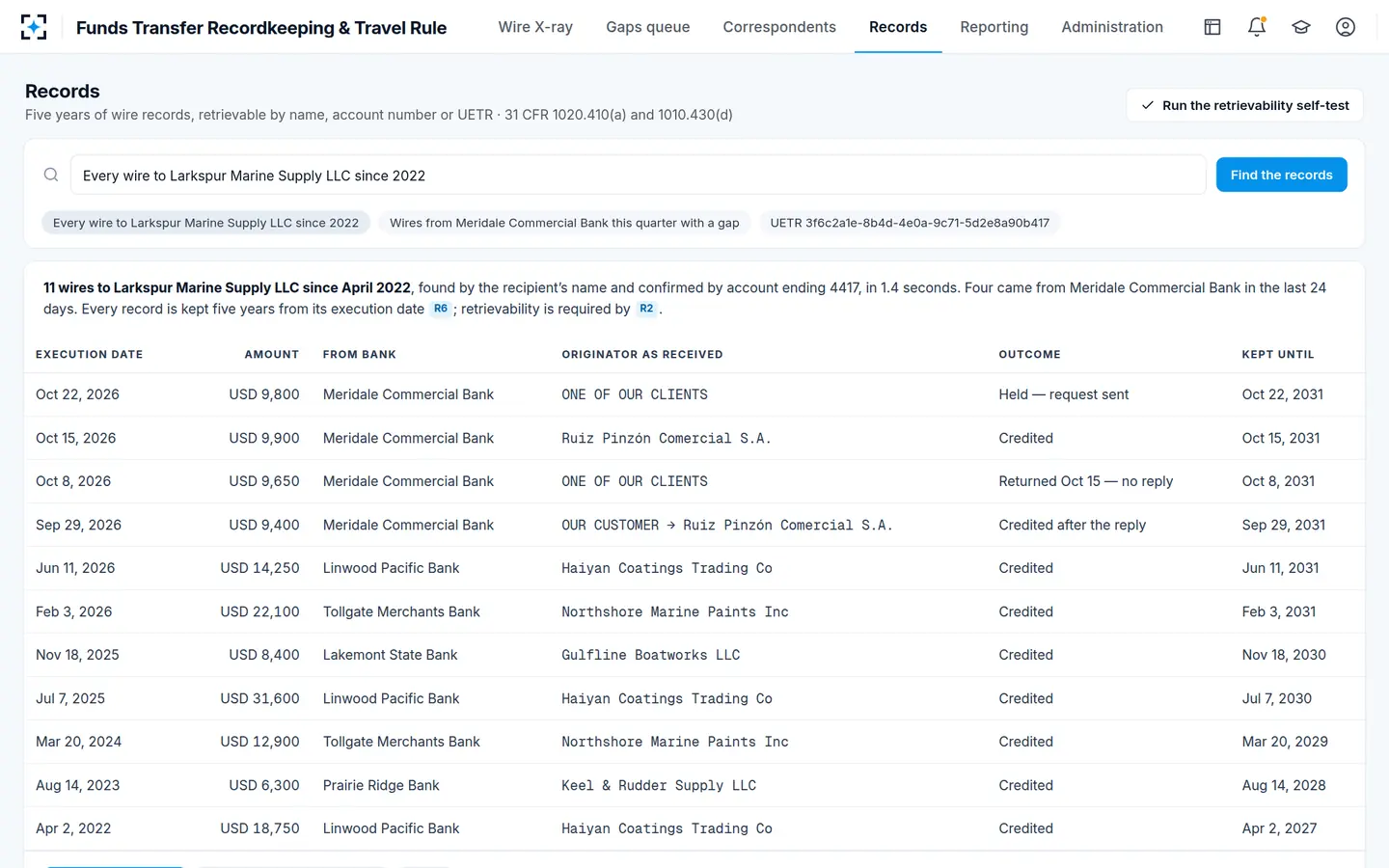
Retrieval is where the hidden cost of cheap storage shows up. Records that sit in a payments hub, an email archive and a spreadsheet are stored, but finding every wire to one customer over five years can take an analyst a day. The solution indexes each wire's file by originator, beneficiary, account and UETR, answers a plain-words search, and runs a self-test that samples old files and retrieves them by name and by account, so the bank finds a retrieval problem before an examiner or a law enforcement request does.
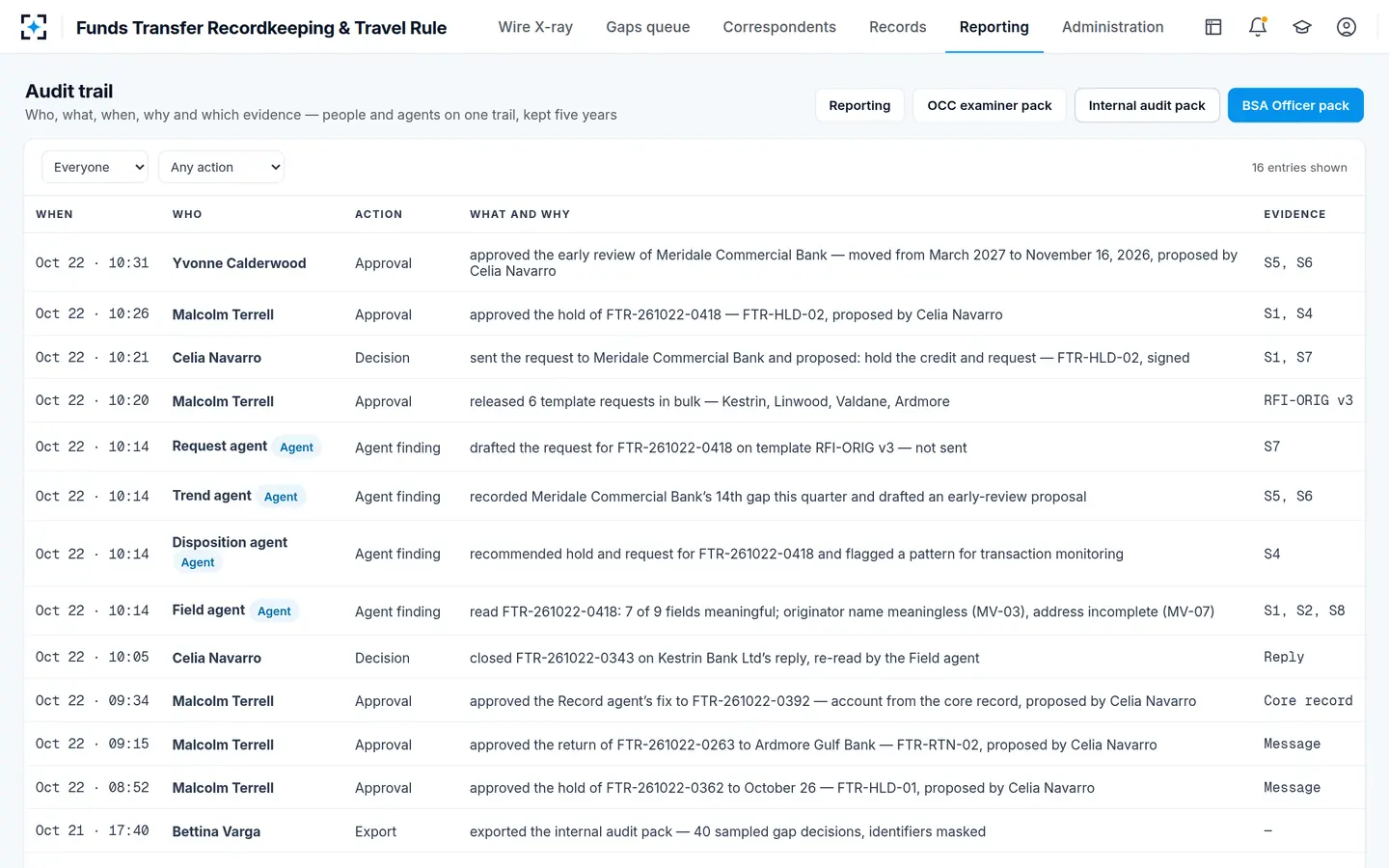
Every action on a wire, by people and agents, kept on one trail for five years
When does travel rule automation pay for itself?
When the hours of exception handling, retrieval and evidence-gathering are larger than the cost of the software and its oversight, and the volume above suggests where that line falls. Below a few hundred qualifying wires a day, a written standard, a second reviewer and a good retrieval index usually cost less than any platform. Above it, three things change at once: the hours run into the hundreds or thousands, the number of correspondents makes repeat offenders hard to count by hand, and the bank's own outbound channels start producing the same gap at scale.
The honest comparison also counts what automation adds. Agents need a library of meaningless values that someone owns, a confidence floor someone sets, and a supervisor who approves every hold, return and fix; the solution builds those in rather than removing them. A bank should measure its own gap rate and minutes per gap on a month of past wires before believing anyone's estimate, ours included, which is the subject of a one-month test on your own wires. For what each bank in a wire must keep, see who owes which field, or start from Funds Transfer Recordkeeping & Travel Rule.
A five-year search an examiner would ask for, answered by name and confirmed by account
Questions people ask
Is BSA record retention five years or seven?
Five. 31 CFR 1010.430(d) says every record the BSA regulations require "shall be retained for a period of five years". A seven-year period, where a bank uses one, comes from another law, a contract or internal policy, not from the BSA.
What does FinCEN's $106.30 an hour represent?
It is FinCEN's "fully loaded composite hourly wage rate", used across its 2024 notices to price the hours that BSA requirements take. It is a single blended rate, not a measured wage for wire compliance staff, so a bank should substitute its own loaded cost when building a business case.
Does FinCEN's estimate include software and systems?
No. The estimate is hours multiplied by the wage. FinCEN's notice separately invites comment on "estimates of capital or start-up costs and costs of operation, maintenance, and purchase of services", which shows those costs are outside the hour figures.
Do small banks keep records of wires under $3,000?
Most banks do. The 2020 joint proposal reported that, based on 2006 comments, almost all banks, regardless of size, kept records of all funds transfers regardless of amount, and noted that some institutions do so because it is cost-effective to maintain a single set of processes for all transactions.
Which BSA records must be retrievable by account number?
Funds transfer records for an established customer who has an account used for funds transfers, at both the originator's bank and the beneficiary's bank. For everyone else, records must be retrievable by the originator's or beneficiary's name.
What is the BSA recordkeeping threshold for wire transfers?
$3,000 or more, for both the recordkeeping rule in 31 CFR 1020.410(a) and the travel rule in 1010.410(f). Transfers to or from places outside the United States of more than $10,000 also fall under the general records rule in 1010.410(b)–(c).