Beneficiary information on a wire transfer is the recipient's name and address, account number or other identifier, together with the identity of the beneficiary's bank. The US travel rule requires the sending bank to include the beneficiary's bank in every transmittal order of $3,000 or more, but the beneficiary's own details only as far as they arrived with the customer's order (31 CFR 1010.410(f)(1)(vi); the travel rule paragraph by paragraph quotes it). That one condition makes beneficiary fields the hardest to test: a missing address may be a gap or may be exactly what the customer supplied, and two experienced reviewers looking at the same message will sometimes disagree. Botminds' Funds Transfer Recordkeeping & Travel Rule judges every required field on every wire and cites its reasons, and the way to know whether to trust it, or any reviewer, is to measure agreement on a sample of your own wires first.
A high agreement rate can hide a weak standard
96%
agreement between two reviewers on beneficiary addresses in the worked example below
0.48
Cohen's kappa for the same 400 fields, once agreement by chance is taken out
0.60
the kappa below which a published methods paper calls agreement inadequate, for health research
What beneficiary information must a wire include?
Under US rules, one beneficiary item is mandatory and three are conditional. The sending bank must include "the identity of the recipient's financial institution"; it must also include the beneficiary's name and address, account number and "any other specific identifier of the recipient", but only as many of those as it received with the order (31 CFR 1010.410(f)(1)(v)–(vi)). The recordkeeping rule uses the same words for what the originator's bank keeps (31 CFR 1020.410(a)(1)(i)(F)).
The softer duty reflects who knows what. The originator is the bank's customer, so the bank must obtain and verify the originator's data; the beneficiary is usually someone else's customer, so the bank passes on what its customer told it. FATF's 2025 explanatory note on the revised Recommendation 16 says the same of its standard: ordering institutions "are not required to verify the accuracy of the beneficiary information, but merely include the information that was provided by the originator" (FATF, explanatory note for revised R.16).
For cover payments the Basel Committee set a floor for the interbank leg: "The information on the beneficiary should at least include its name or an identifier code (such as a Business Entity Identifier)" (BCBS, May 2009, paragraph 21). And for old-format Fedwire orders, footnotes in both rules allow "only one of the items" to be included until the sending bank converts to the expanded format, a 1990s clause still in the text.
Is the beneficiary address required on a wire transfer?
Not by the US travel rule, unless the sending bank received it. Fedwire's format does not demand it either: its guidance says senders should consult their compliance and legal departments on "what information (e.g., creditor's postal address) you may need to include in messages to satisfy your compliance obligations", and should check with the receiving bank and any other bank in the chain for what they need "to ensure straight-through processing (e.g., creditor's postal address in addition to the creditor's name)" (Fedwire November 2027 release FAQ).
The international standard is moving toward a minimum. FATF's revised Recommendation 16 asks for the beneficiary's country and town on cross-border payments above its threshold, not a full address, with the changes due to take effect by the end of 2030; the guide on what the FATF Recommendation 16 changes ask sets out the detail. Until US rules change, a missing beneficiary address on a domestic wire is a policy question for the bank, and that is exactly the kind of field on which reviewers diverge.
Wire transfer recipient vs beneficiary: the same person, two rulebooks
A beneficiary is "The person to be paid by the beneficiary's bank"; a recipient is "The person to be paid by the recipient's financial institution", and the regulation adds that "The term recipient includes a beneficiary" except where the paying institution is not a bank (31 CFR 1010.100(f), (pp)). The recordkeeping rule for banks speaks of beneficiaries and payment orders; the travel rule, written for banks and non-banks alike, speaks of recipients and transmittal orders. In ISO 20022 the same party is the creditor, which is the word in a pacs.008.
The distinction matters only when someone mixes the vocabularies in a procedure or a test script. A reviewer told to check the "recipient" field in an ISO 20022 message will not find it by that name; a checklist that maps each regulatory term to the message element removes one source of disagreement before any judgment is made.
What happens if the beneficiary name and account do not match?
Under Article 4A, the beneficiary's bank may usually pay the account number without checking the name. Unless it knows the name and number belong to different people, it may treat the number as identifying the beneficiary, and it has no duty to check that they match (UCC 4A-207(b)(1); UCC 4A-207, when the name and the account number don't match, quotes the section and works the cases). Once it knows they differ, the rules change.
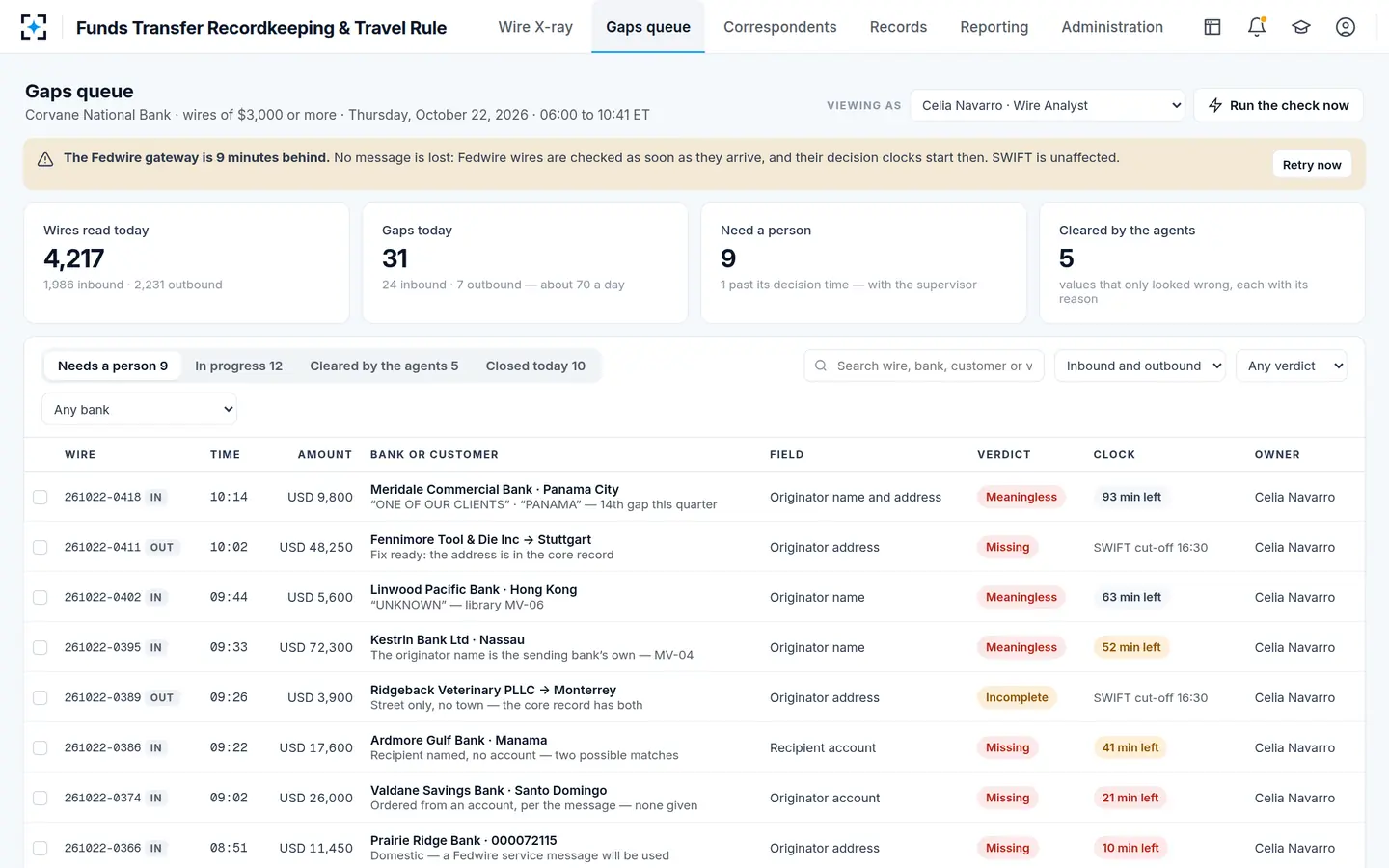
The revised FATF standard pushes the other way for cross-border payments: where countries adopt it, beneficiary banks will be expected to check whether the name and account align, by at least one of three methods, to catch misdirected payments. For a compliance reviewer, the practical effect is a new kind of disagreement. One reviewer treats a beneficiary named with no account, or an account whose name differs slightly, as a payment instruction; another treats it as a gap to resolve before credit. On the sample bank's queue below, the agents flag "Recipient named, no account — two possible matches" and leave the decision to the analyst.
Beneficiary gaps sit in the same queue as originator gaps, each with its clock
Why two reviewers disagree on the same field
Because most of the judgment is in the word "obvious". The supervisory test for a field that needs a response is that it is manifestly meaningless or incomplete, which the federal agencies defined in 2009 as obvious without further research; the guide on telling an originator's name from a placeholder works through it. Obviousness is not a property of the value alone. It depends on what the reviewer knows about the correspondent, the customer, the language and the format.
Disagreements cluster in predictable places. Beneficiary addresses split reviewers on whether a town and country is enough, whether a missing address is a gap when it was never received, and whether a P.O. box is acceptable. Names split them on abbreviations, transliterations and trade names. Accounts split them on whether an IBAN-shaped string that fails nothing visible is "present". And intermediaries that reformat messages can truncate a field, so the same beneficiary arrives complete on one wire and clipped on the next.
Where reviewers diverge, and the written rule that settles it
What splits two reviewers: One accepts town and country; one wants a street. One treats an address never received as a gap; one does not.
A rule that makes the call repeatable: State the minimum per wire type (domestic, cross-border) and say that an address not received is recorded as such, not as a gap.
What splits two reviewers: Abbreviations, trade names, transliterations and words like "client" or "trust" in a registered name.
A rule that makes the call repeatable: List what is acceptable (abbreviations, trade names, account labels) and what is not (coded names, generic phrases), with examples.
What splits two reviewers: A beneficiary named with no account; an account with a name that differs slightly.
A rule that makes the call repeatable: Decide when a missing account is a gap and when it is a repair or investigation question for operations.
What splits two reviewers: The same placeholder from the same correspondent, judged afresh each time.
A rule that makes the call repeatable: One versioned example per value, owned by the BSA Officer, cited on every verdict.
How consistent are reviewers? Measure it before you trust anyone
The simplest measure is percent agreement: "the number of agreement scores divided by the total number of scores." The problem is that it rewards agreement that would happen by chance. In 1960, Jacob Cohen "critiqued use of percent agreement due to its inability to account for chance agreement" and introduced kappa, which subtracts the agreement two reviewers would reach by guessing in proportion to how often each says "gap" (McHugh 2012). The formula is κ = (Pr(a) − Pr(e)) ÷ (1 − Pr(e)), where Pr(a) is observed agreement and Pr(e) is chance agreement.
Travel rule data is a case where the difference is large, because gaps are rare. If nineteen fields in twenty are clean, two reviewers who both say "clean" most of the time agree on most fields without agreeing on what a gap is. The table works two illustrative fields of 400 each through the arithmetic.
The same arithmetic on two fields: high agreement, very different kappa
| Step | Originator name, 400 fields | Beneficiary address, 400 fields |
|---|---|---|
| Reviewer A says gap | 40 | 12 |
| Reviewer B says gap | 44 | 20 |
| Both say gap | 30 | 8 |
| Both say no gap | 346 | 376 |
| Observed agreement, Pr(a) | (30 + 346) ÷ 400 = 94.0% | (8 + 376) ÷ 400 = 96.0% |
| Chance agreement, Pr(e) | 0.10 × 0.11 + 0.90 × 0.89 = 0.812 | 0.03 × 0.05 + 0.97 × 0.95 = 0.923 |
| Cohen's kappa | (0.940 − 0.812) ÷ 0.188 = 0.68 | (0.960 − 0.923) ÷ 0.077 = 0.48 |
The field with the higher agreement is the one reviewers understand less
Ninety-six percent agreement on a field where gaps are rare can mean two reviewers who mostly agree that nothing is wrong, and rarely agree on what is.
What is an acceptable error rate for a travel rule check?
No regulation or supervisory guidance we found sets one. The 2009 interagency guidance asks for "a risk-based method" to identify incomplete or meaningless fields, and the Basel Committee expected a risk-based approach to be audited for effectiveness; neither gives a number. The defensible bar is internal: a check, human or automated, should agree with your adjudicated answer at least as well as your best reviewers agree with each other, field type by field type.
McHugh's paper suggests that in health research "any kappa below 0.60 indicates inadequate agreement among the raters and little confidence should be placed in the study results." Banking is not health research, and a bank may choose a different line, but the reasoning carries over. A field type where your own reviewers sit below that line does not need a better tool first; it needs a written rule. Measure misses and false flags separately as well, because a check that never misses and flags a tenth of all wires will be switched off within a month.
How do you test travel rule compliance on beneficiary fields?
Start where the examiners start. The FFIEC procedures tell them to sample transfers the bank handled in each of its three roles, as originator's, intermediary and beneficiary's bank (funds transfer recordkeeping requirements quotes the step), and check that the bank "collects, maintains, or transmits the required information, depending on the institution's role in the transfer" (FFIEC examination procedures). An internal test that samples the same way, and adds a second reviewer, answers both the examiner's question and the tool-selection question.
A reviewer-agreement test for travel rule fields
- Sample by role, channel and correspondent
Originator, intermediary and beneficiary wires; online banking, branch and file channels; the correspondents that send the most.
- Give two reviewers the same wires, blind
Neither sees the other's answer or any tool output.
- Record a verdict per field, not per wire
Present, missing, meaningless or incomplete, so disagreement can be traced to a field type.
- Compute agreement and kappa per field type
Report both; the gap between them tells you where chance is doing the agreeing.
- Adjudicate every disagreement with a written reason
The BSA Officer, or a named delegate, settles it and the reason becomes a rule or an example.
- Re-test the weak field types after the rule is written
Agreement should rise; if it does not, the rule is not clear enough yet.
- Only then run the tool against the adjudicated answers
Count misses and false flags separately, by field type, and compare with your reviewers.
Who decides a field is meaningless?
A person, against a standard the BSA Officer owns. The analyst decides the individual wire; the standard behind the decision, the list of values that count as meaningless and the examples that do not, should be written, versioned and approved, because it is the thing an examiner will test for consistency.
That is how the solution is built. Each verdict cites a library entry approved by the BSA Officer, and each entry counts its hits and how often people overturn it; on the sample bank, entry MV-03 had 38 hits in twelve months and no overturns. An overturn rate is a running agreement measure between the agent and your reviewers, kept per entry, and an entry that people keep overturning is a field type where the standard needs work. Every hold, return or fix is then signed by the analyst and approved by a supervisor who sees the same evidence.
The checker sees the same verdicts, the same evidence and who proposed what
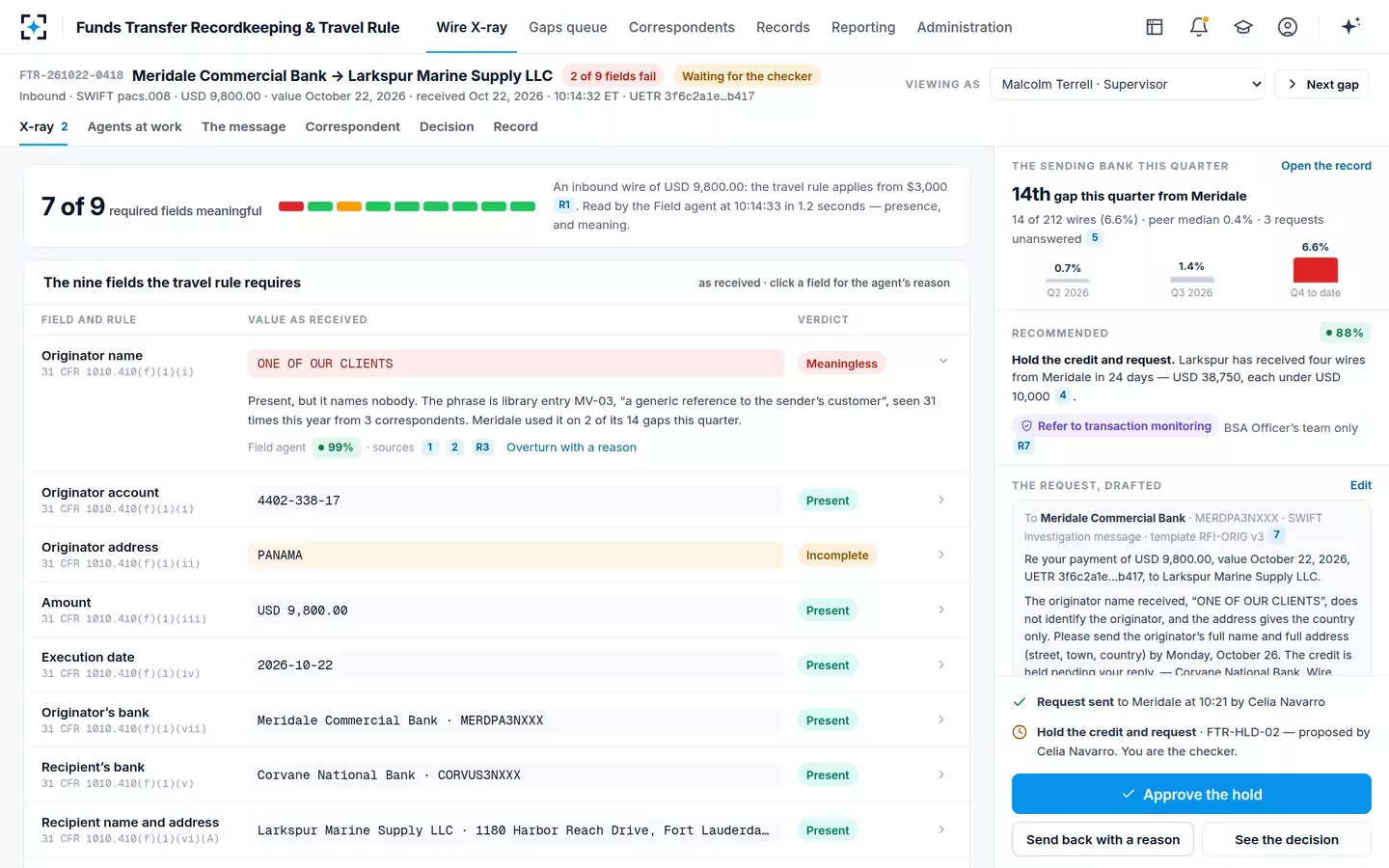
The solution does not settle your standard for you, and it should not. What it gives a testing team is a consistent first reader whose every call cites its example, a count of where people disagree with it, and a file an examiner can sample by role. To plan the test itself, see a one-month test of AI on your own wires, or start from Funds Transfer Recordkeeping & Travel Rule.
Questions people ask
Who is the beneficiary on a wire transfer?
The person to be paid by the beneficiary's bank, in the words of 31 CFR 1010.100(f). In ISO 20022 messages the same party is called the creditor, and in the travel rule, which also covers non-banks, the recipient.
Must the sending bank verify the beneficiary's details?
No. US rules ask the originator's bank to keep and send the beneficiary items it received, not to obtain or verify them. FATF's explanatory note for the revised Recommendation 16 takes the same line: ordering institutions include the beneficiary information provided by the originator without verifying its accuracy.
Can a wire be sent without the beneficiary's address?
Under the US travel rule, yes, if the address was not received with the order. Fedwire's format does not require the creditor's postal address in a pacs.008, but Fedwire tells senders to check their own compliance obligations and the receiving bank's requirements, and many banks require an address by policy.
What is the difference between percent agreement and kappa?
Percent agreement counts how often two reviewers give the same answer. Kappa removes the agreement they would reach by chance given how often each answers "gap"; on rare-gap fields, 96% agreement can correspond to a kappa below 0.5, as the worked example shows.
Who should settle a disagreement between two reviewers?
The person who owns the standard, usually the BSA Officer or a named delegate, with the reason written down. The point of the reason is reuse: it becomes a rule or an example that the next reviewer, and any tool, applies the same way.
Does the beneficiary's bank have to verify who it pays?
For a beneficiary who is not an established customer, yes, when proceeds are delivered in person: the bank verifies identity and records the name, address, identification document and taxpayer number under 31 CFR 1020.410(a)(3). For established customers it relies on its existing customer identification.