The FATF Recommendation 16 changes, agreed in June 2025, rewrite the international standard for the information that travels with payments: the payment chain now starts at the institution that receives the customer's instruction, cross-border payments above USD/EUR 1,000 carry standardized originator and beneficiary data including a date of birth for individual originators and the beneficiary's town and country, beneficiary banks must check that the name and account align, and the recommendation is renamed Payment transparency. In FATF's own words, "The changes will come into effect by the end of 2030" (FATF, June 2025). It is an international standard that binds only as countries write it into law; the US travel rule, 31 CFR 1010.410(f), still applies at $3,000 and has not been amended to match. Botminds' Funds Transfer Recordkeeping & Travel Rule checks wires against the US rule today, with a cross-border policy line that a bank can set lower, and it is built to read the structured data the revised standard expects.
The revised Recommendation 16 in four numbers
1,000USD/EUR
the most a country may set as its de minimis threshold for cross-border payments
3options
for beneficiary banks to check that name and account align, at least one required
300+
responses to two public consultations, in 2024 and 2025, before the text was agreed
2030
the end of the year by which the changes are to take effect
What changed in FATF Recommendation 16?
Four things, by FATF's own list: who in the payment chain is responsible for the information, what information must accompany a cross-border payment, tools against fraud and error, and the scope of the card exemption. The revision was agreed at the June 2025 plenary after "two public consultations which gathered more than 300 responses", and on October 28, 2025, FATF published an Annex IV to its assessment methodology "setting out how compliance with the revised Recommendation 16 will be assessed in FATF mutual evaluations" (FATF, June 2025).
The reasons are stated plainly in the explanatory note: payment chains "have grown more fragmented with the arrival of new players, and new technologies", and the nature of illicit finance has changed, "with fraud now constituting a major predicate crime for money laundering" (FATF explanatory note). The old recommendation was written for wire transfers between banks. The new one is written for payments and value transfers by whoever performs them, on the principle of "same activity, same risk, same rules".
The revision point by point, and what it means for a US wire team
What the revised standard says: Recommendation 16 is renamed Payment transparency and covers payments or value transfers, with requirements set by activity rather than by type of institution.
What it means at a US bank: Where their countries adopt it, correspondents that are fintechs or money transmitters abroad are held to the same data standard as banks.
What the revised standard says: "The payment chain is considered to start with the financial institution which receives an instruction from the customer."
What it means at a US bank: The bank that takes the customer's instruction owns the data, even if another institution funds or routes the payment.
What the revised standard says: Name, account or unique reference, address, and for an individual a date of birth (year of birth if the full date is not available).
What it means at a US bank: More fields to receive on inbound cross-border wires, and fields foreign banks may ask for on outbound ones.
What the revised standard says: Name, account or unique reference, and only the country and town name for the address.
What it means at a US bank: Town and country become a defined minimum where the US rule asks only for what was received.
What the revised standard says: Beneficiary banks check that the beneficiary's name and account align, by one of three methods, to detect misdirected payments.
What it means at a US bank: A different stance from Article 4A, under which a US beneficiary's bank may rely on the account number.
What the revised standard says: R.16 "does not itself require real-time sanctions screening"; national rules still decide how screening is done.
What it means at a US bank: No change to OFAC obligations, which remain a separate duty.
What the revised standard says: In effect by the end of 2030; guidance on implementation consulted on in 2026.
What it means at a US bank: Nothing changes in US law until US rules are amended; the eCFR still reads $3,000.
The revised Recommendation 16 beside the US travel rule, field by field
The cleanest statement of the new information requirements is the restatement in the CPMI's February 2026 report on harmonised ISO 20022 data: above the applicable threshold, every cross-border payment "should always contain" the names of originator and beneficiary, their account numbers or a unique transaction reference, "the address of the originator and the country and town name (or the nearest alternative) of the beneficiary", for an individual originator "the date of birth of the originator", and for legal persons a connected BIC, an LEI or a unique official identifier where one exists (BIS CPMI, updated report, February 2026, footnote 17). Set beside the US rule, the gaps are specific.
What a cross-border payment must carry: revised R.16 and the US travel rule
| Item | Revised Recommendation 16 (above the threshold) | US travel rule today, 31 CFR 1010.410(f) |
|---|---|---|
| Threshold | A country may set a de minimis threshold no higher than USD/EUR 1,000 | $3,000 or more, domestic and cross-border |
| Originator name | Always | Always |
| Originator account | Where an account is used; otherwise a unique transaction reference | If the payment is ordered from an account |
| Originator address | Full address by default; country and town if no standardized postal address exists | Required, with an old Fedwire clause |
| Originator date of birth | Required for an individual; year of birth if the full date is not available | Not required |
| Legal-person identifier | Connected BIC, LEI or unique official identifier, where it exists | Not required; the sending bank identifies itself by name and address or number |
| Beneficiary name | Always | As received |
| Beneficiary account | Where an account is used; otherwise a unique transaction reference | As received |
| Beneficiary address | Country and town name only | As received |
| Name and account alignment | Checked by the beneficiary bank, by one of three methods | Not required; Article 4A lets the beneficiary's bank rely on the number |
When do the Recommendation 16 changes take effect?
By the end of 2030. FATF's announcement says "The changes will come into effect by the end of 2030", and its June 2026 consultation repeats that "All countries around the world are expected to be ready to implement the changes by the end of 2030" (FATF, June 24, 2026). The explanatory note explains why the usual rule, that amendments take effect immediately, was set aside: a majority of respondents agreed the end of 2030 was realistic, and "The FATF will expect that most, or all of the new requirements are in effect by that date."
The changes will come into effect by the end of 2030, and the FATF will produce guidance and continue to engage with the private sector to help industry prepare for the changes.
FATF, June 2025
The note also warns that some changes may need longer, naming cash withdrawals and the domestic payment infrastructures that must carry the data, and it gives the work to a public-private Payment Advisory Group. Guidance is on its way: FATF consulted on a draft from June 24 to August 21, 2026, and the explanatory note expected a guidance paper "for publication in late 2026".
From consultation to 2030, beside the message changes US banks already face
- Consultations
- Adopted; guidance
- Countries implement, by end-2030
- Current formats
- Nov 2026
- Nov 2027 Fedwire hybrid address
Does FATF Recommendation 16 apply in the US?
Not directly. FATF standards are commitments that countries carry out through their own laws, and FATF assesses them through mutual evaluations; a bank's obligations come from national rules. In the United States the operative rule is still 31 CFR 1010.410(f), at $3,000, with no date-of-birth or alignment requirement (eCFR, current as of October 22, 2026). The last attempt to change the US threshold, a 2020 proposal to go to $250 for cross-border transfers, was withdrawn in April 2025.
US banks will still meet the revision through their counterparties and their messages. A foreign beneficiary bank whose country adopts the standard will check that the beneficiary's name and account align on payments US banks send, and may query those that do not; foreign correspondents will expect structured data. The message infrastructure is moving first, if more slowly than planned. The BIS recorded November 2026 as the date from which a postal address in a cross-border message would have to be fully structured or hybrid (BIS CPMI Brief 13); that removal was delayed in August 2026 and is now expected in November 2027, subject to confirmation, as the structured address deadline that moved sets out. Federal Reserve Financial Services has moved the release that brings the hybrid address to Fedwire to November 2027 as well (FRFS).
What is an alignment check?
An alignment check is the beneficiary bank's test that the name and account number in the payment message fit the account it holds, to catch payments sent to the wrong person by fraud or error. The revised standard lets the bank choose: check each payment after receipt, run "holistic ongoing monitoring" to find anomalous accounts and activity including misaligned beneficiary information, or rely on a pre-validation scheme such as confirmation or verification of payee when both banks take part (FATF explanatory note, paragraph 35 and the revised interpretive note).
It is not a name-matching rule. The interpretive note says "Alignment does not imply that there must be an exact match. The expected degree of alignment may vary based on the risk and context." For US banks the contrast is with Article 4A, under which a beneficiary's bank that does not know the name and number differ may pay on the number; the guide on beneficiary information on a wire transfer covers that rule and the disagreements it produces.
Is date of birth required on cross-border payments?
Under the revised standard, yes, for an originator who is an individual, on cross-border payments above the threshold; not for legal entities and not for beneficiaries. FATF softened it after consultation: "when a full DoB is not available, the year of birth only will suffice", and future guidance will deal with cases where no date of birth exists or can be verified, such as unregistered births (FATF explanatory note). Under the US travel rule there is no date-of-birth requirement today.
Date of birth is personal data that most banks do not put in payment messages now, and the note acknowledges data protection and privacy as a policy objective it balanced. A US bank should not start sending it on its own initiative; the sensible preparation is to know where it is held for individual customers who send cross-border wires, and how it would be mapped into a structured field if US rules or a correspondent require it.
What is payment transparency?
It is the new name of Recommendation 16 and a statement of its purpose: that "basic information on the originator and beneficiary" of a payment is immediately available to law enforcement, financial intelligence units and the institutions in the chain. FATF's announcement describes the aim as building "a clearer picture of who is sending and receiving money", and helping "to eliminate fraud and error impacting customers" (FATF, June 2025). The older name, Wire transfers, described a channel; the new one describes a duty that follows the payment whatever the channel.
The phrase also explains why a field that is merely filled is not enough. Transparency means the information identifies the parties, which is the same test US supervisors apply when they ask banks to find fields that are manifestly meaningless or incomplete. The guide on originator information, name or placeholder covers that test.
What is the Recommendation 16 threshold?
A country may set a de minimis threshold for cross-border payments of no more than USD/EUR 1,000; the revision keeps that ceiling. Below it, lighter requirements apply, and FATF says "Countries will continue to be able to impose lower, risk-based requirements for domestic payments and cross-border payments no higher than USD/EUR 1,000" (FATF explanatory note, paragraph 33). FATF has also said it will support the implementation of de minimis thresholds in its guidance, with financial inclusion in mind.
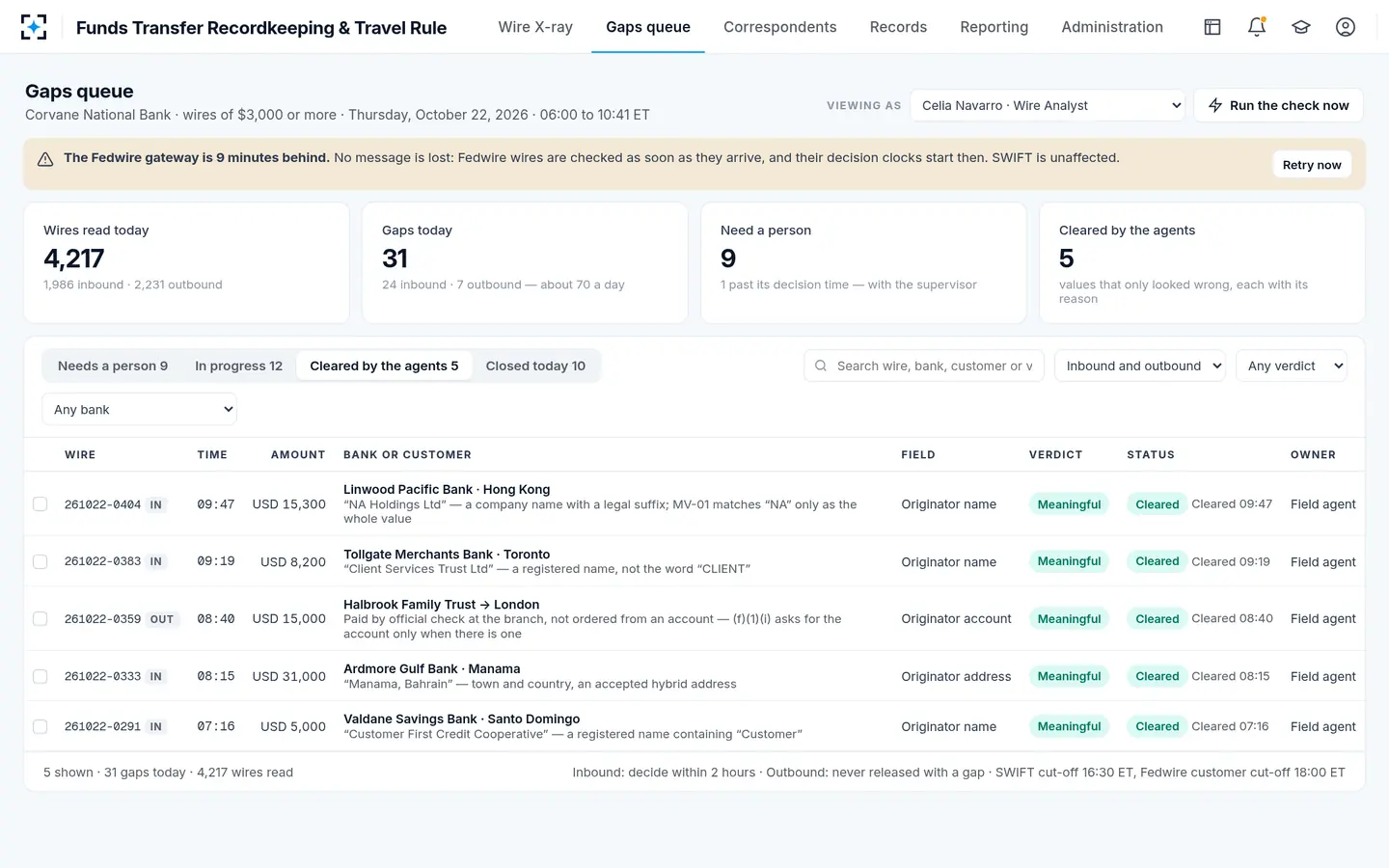
The US line sits three times higher, at $3,000, for every funds transfer. A US bank that wants its cross-border controls to be ready for correspondents in countries that adopt the revision can apply a lower line as policy. That is what the sample bank in the solution does: it checks all wires of $3,000 or more and cross-border wires from $1,000, a setting its BSA Officer approved, and the check reads town and country in structured or hybrid form.
Town and country accepted, a lookalike name cleared, each with its reason
For what the US rule requires line by line, see the 31 CFR 1010.410 travel rule in plain words; to see the cross-border line applied to your own wires, start from Funds Transfer Recordkeeping & Travel Rule.
Questions people ask
Is Recommendation 16 the same as the crypto travel rule?
It is the same recommendation. FATF notes that R.16 is "also referred to as the 'Travel Rule' in the context of virtual assets", and applies it to virtual asset service providers indirectly through Recommendation 15 rather than bringing them directly into R.16's scope.
Does the revised Recommendation 16 require real-time sanctions screening?
No. A new footnote clarifies that R.16 does not itself require real-time sanctions screening and does not change targeted financial sanctions duties; how screening is done is left to national regulation and industry practice. US banks' OFAC obligations are unchanged.
Do card payments fall under the revised standard?
Card purchases of goods and services stay exempt from the full requirements, with the scope of "purchase of goods or services" clarified. A card used to fund a person-to-person transfer is covered, and cross-border cash withdrawals get a new targeted rule: the cardholder's name is sent to the acquiring institution on request within three business days.
Where does the payment chain start under the revised standard?
At "the financial institution which receives an instruction from the customer", and it ends at the institution that services the beneficiary's account or pays out cash. FATF chose this instruction route over a funding route after consultation responses said the funding route was ill-suited to complex payment chains.
Will US banks have to collect originators' dates of birth?
Not under current US rules: 31 CFR 1010.410(f) has no date-of-birth item, and the US has not amended the rule to match the revision. Foreign correspondents subject to their own countries' implementations may ask for it on cross-border payments as those take effect by the end of 2030.
When will FATF publish implementation guidance?
FATF consulted on draft guidance from June 24 to August 21, 2026, asking in particular about detecting misdirected payments using the three alignment-check options. The explanatory note expected the guidance paper to be published in late 2026.