The travel rule in 31 CFR 1010.410 is paragraph (f) of that section: any transmittor's financial institution or intermediary financial institution located in the United States must include specified information in every transmittal order for $3,000 or more, so that the originator's identity travels with the money to the next bank in the chain. The sending bank includes the originator's name, address and account number (if the payment came from an account), the amount, the execution date, the beneficiary's bank, whatever beneficiary details it received, and its own identity; an intermediary passes the same items on if it received them (eCFR, 31 CFR 1010.410(f)). The rule has stood at $3,000 since 1995, and a 2020 proposal to lower it to $250 for cross-border transfers was withdrawn. Botminds' Funds Transfer Recordkeeping & Travel Rule reads every wire against these lines, cites the paragraph on every field verdict, and leaves decisions on the money to people.
The travel rule in four numbers
1paragraph
31 CFR 1010.410(f): the whole travel rule, for banks and non-banks alike
$3,000
the threshold since 1995; the 2020 proposal of $250 for cross-border transfers was withdrawn
7items
the sending institution includes, (i) to (vii); an intermediary passes them on if received
12hours
a year per institution, FinCEN's own estimate of the rule's burden
What is the travel rule in 31 CFR 1010.410?
It is the single paragraph of 31 CFR 1010.410 that governs what travels with a transmittal order; the rest of the section is about records. FinCEN describes it that way itself: "The Travel Rule consists of a single provision, codified at 31 CFR 1010.410(f), that applies to all transmittals of funds, including those processed by banks" (FinCEN, 89 FR 65971). Paragraphs (a) to (d) of the same section require records of credit over $10,000 and of transfers abroad over $10,000; paragraph (e) is the funds transfer recordkeeping rule for non-banks. Banks' recordkeeping rule lives elsewhere, at 1020.410(a).
The Travel Rule consists of a single provision, codified at 31 CFR 1010.410(f), that applies to all transmittals of funds, including those processed by banks.
FinCEN, 89 FR 65971 (2024)
FinCEN issued it on January 3, 1995, alongside the joint recordkeeping rule, and amended it in 1996. Until 2010 it was numbered 31 CFR 103.33(g), the number the agencies' 2009 cover payment guidance cites; the current text carries the source note "75 FR 65812, Oct. 26, 2010, as amended at 81 FR 76864, Nov. 4, 2016." The words "transmittor" and "transmittal order" are deliberate: the rule covers non-banks such as money transmitters, so it uses broader terms than the bank-only "originator" and "payment order".
The travel rule, paragraph by paragraph
Read slowly, paragraph (f) answers five questions: who must comply, on which orders, what goes in, what an intermediary owes, and what is excluded. The annotated text below takes each line in order. The rule text is quoted as it stands in the eCFR; the right-hand column is our plain-words reading.
31 CFR 1010.410(f), annotated
(f)
The ruleAny transmittor's financial institution or intermediary financial institution located within the United States shall include in any transmittal order for a transmittal of funds in the amount of $3,000 or more, information as required in this paragraph (f)
In plain wordsWho and when: a US sending or intermediary institution, bank or non-bank, on every order of $3,000 or more. Not the beneficiary's bank.
(f)(1)(i)
The ruleThe name and, if the payment is ordered from an account, the account number of the transmittor
In plain wordsThe originator's name always; the account number only if the money came from an account.
(f)(1)(ii)
The ruleThe address of the transmittor, except for a transmittal order through Fedwire until such time as the bank that sends the order to the Federal Reserve Bank completes its conversion to the expanded Fedwire format
In plain wordsThe originator's address. The Fedwire exception dates from the 1990s format change.
(f)(1)(iii)–(iv)
The ruleThe amount of the transmittal order; The execution date of the transmittal order
In plain wordsHow much, and the day the sending bank may properly execute it.
(f)(1)(v)
The ruleThe identity of the recipient's financial institution
In plain wordsAlways the beneficiary's bank.
(f)(1)(vi)
The ruleAs many of the following items as are received with the transmittal order: (A) The name and address of the recipient; (B) The account number of the recipient; (C) Any other specific identifier of the recipient
In plain wordsBeneficiary details only as received: the sending bank need not obtain what its customer did not give.
(f)(1)(vii)
The ruleEither the name and address or numerical identifier of the transmittor's financial institution
In plain wordsThe sending bank identifies itself.
(f)(2)
The ruleA receiving financial institution that acts as an intermediary financial institution, if it accepts a transmittal order, shall include in a corresponding transmittal order at the time it is sent to the next receiving financial institution, the following information, if received from the sender
In plain wordsAn intermediary passes the same items on, if it got them. It has no duty to go and get them.
(f)(3)
The ruleSafe harbor for transmittals of funds prior to conversion to the expanded Fedwire message format
In plain wordsA 1996 relief clause for banks still on the old Fedwire format: send less, supply the rest on request.
(f)(4)
The ruleThe requirements of this paragraph (f) shall not apply to transmittals of funds that are listed in paragraph (e)(6) of this section or § 1020.410(a)(6) of this chapter
In plain wordsOut of scope: transfers between listed institutions and governments, and same-person transfers within one institution.
Three words carry most of the weight. "Include" means the information goes in the order itself, at the time it is sent; supplying it later on request is only allowed under the old Fedwire safe harbor. "Received" limits both the beneficiary items and the intermediary's duty to what actually arrived. And "located within the United States" means a foreign bank's US branch is covered for orders it sends, while the foreign head office is not.
What is the travel rule threshold?
$3,000 or more, per transmittal: the rule applies to "a transmittal of funds in the amount of $3,000 or more". The threshold was a deliberate trade-off in 1995. In the 2020 proposal, the Federal Reserve and FinCEN explained that "In deciding on a threshold of $3,000 in 1995, the Agencies balanced the value of data on funds transfers and transmittals of funds with the burden that the Recordkeeping Rule and Travel Rule imposed on both bank and nonbank financial institutions" (85 FR 68005).
The same threshold applies to domestic and cross-border wires, and to the recordkeeping rule. Banks may go lower as policy, and FinCEN has noted that some already collect originator and beneficiary information below $3,000 because "it is cost-effective to maintain a single set of processes for all transactions". The sample bank in the solution checks all wires of $3,000 or more and cross-border wires from $1,000, both as settings its BSA Officer approves.
Was the travel rule threshold lowered to $250?
No. On October 27, 2020, the Federal Reserve and FinCEN proposed to "reduce this threshold from $3,000 to $250 for funds transfers and transmittals of funds that begin or end outside the United States", and to clarify that the rules cover convertible virtual currencies and digital assets with legal tender status (85 FR 68005). The proposal was never finalized. The government's regulatory agenda for spring 2025 lists rulemaking RIN 1506-AB41, by then titled only for the virtual currency clarification, as "Withdrawn" on April 16, 2025 (reginfo.gov, RIN 1506-AB41), and the eCFR text, current as of October 22, 2026, still reads $3,000.
The proposal's evidence is still worth knowing, because it explains why the question keeps coming back. FinCEN analysed about 2,000 suspicious activity reports filed by money transmitters between 2016 and 2019 on potential terrorist financing, referring to about 1.29 million underlying transmittals with a median of $255, and found that "Approximately 71 percent of those 1.29 million transmittals (more than 916,000) were at or below $500." Small cross-border transfers are where the threshold leaves data on the table.
Thirty years at $3,000: the travel rule's history
| Date | What changed | Where it is recorded |
|---|---|---|
| January 3, 1995 | Travel rule issued as 31 CFR 103.33(g), with the joint recordkeeping rule; the expanded Fedwire format announced the same day | 60 FR 234; FinCEN Issuance 98-1 |
| April 1, 1996 | Amended, adding the Fedwire safe harbor; effective May 28, 1996 | 61 FR 14383 |
| January 26, 1998 | Conditional exceptions: customer-file names and addresses, and safe-harbor relief to April 1, 1998 | FinCEN Issuance 98-1 |
| October 26, 2010 | Current numbering, 31 CFR 1010.410(f) | 75 FR 65812, in the eCFR source note |
| November 4, 2016 | Section amended | 81 FR 76864, in the eCFR source note |
| October 27, 2020 | $250 proposed for transfers that begin or end outside the United States | 85 FR 68005 |
| April 16, 2025 | Rulemaking listed as withdrawn; threshold stays $3,000 | reginfo.gov, RIN 1506-AB41 |
Does the travel rule apply to domestic wires?
Yes. Paragraph (f) applies to "any transmittal order for a transmittal of funds in the amount of $3,000 or more" by a US sending or intermediary institution, with no distinction between domestic and cross-border; FinCEN calls it a rule that "applies to all transmittals of funds". The withdrawn 2020 proposal would have changed only the cross-border threshold, which is itself a sign that the domestic rule was not in question.
Two limits catch people out. The definitions exclude transfers governed by the Electronic Fund Transfer Act and those made "through an automated clearinghouse, an automated teller machine, or a point-of-sale system" (31 CFR 1010.100(w), (ddd)), so a domestic ACH credit of $50,000 is not a travel rule transfer. And domestic Fedwire orders are where the old safe harbor clause still sits in the text, a subject for the guide on the BSA travel rule for wires and its 1990s Fedwire clause.
What is the difference between 1010.410 and 1020.410?
Section 1010.410(f) says what must be sent with an order; section 1020.410(a) says what a bank must keep. The two were issued together and FinCEN describes them as complementary, but they bind different banks in the chain and are tested separately: examiners first check that the bank keeps the records 1020.410(a) requires (funds transfer recordkeeping requirements covers that step) and, as a separate step, "Verify that the bank transmits payment information as required by 31 CFR 1010.410(f)."
Keep or send: the two funds transfer rules side by side
31 CFR 1020.410(a), recordkeeping (banks): Obtain and retain records of each payment order of $3,000 or more.
31 CFR 1010.410(f), travel rule: Include required information in each transmittal order of $3,000 or more when it is sent.
31 CFR 1020.410(a), recordkeeping (banks): Originator's, intermediary and beneficiary's banks, each with its own list.
31 CFR 1010.410(f), travel rule: Transmittor's and intermediary institutions; nothing for the beneficiary's bank.
31 CFR 1020.410(a), recordkeeping (banks): Name and address, amount, date, payment instructions, beneficiary's bank; identity checks for non-established customers.
31 CFR 1010.410(f), travel rule: Name, account (if ordered from an account), address, amount, date, beneficiary's bank, and the sender's own identity.
31 CFR 1020.410(a), recordkeeping (banks): As many items as are received.
31 CFR 1010.410(f), travel rule: As many items as are received.
31 CFR 1020.410(a), recordkeeping (banks): By name; by account number for established customers with accounts used for funds transfers.
31 CFR 1010.410(f), travel rule: No retrieval duty in the rule itself.
31 CFR 1020.410(a), recordkeeping (banks): Five years, under 31 CFR 1010.430(d).
31 CFR 1010.410(f), travel rule: None of its own; the sent order is kept under the recordkeeping rule.
What are the travel rule exceptions?
Paragraph (f)(4) excludes the same transfers the recordkeeping rules exclude. Under 1020.410(a)(6), the funds transfer rules do not apply where both the originator and the beneficiary are a bank, a wholly owned domestic subsidiary of a US-chartered bank, a broker or dealer in securities or its wholly owned domestic subsidiary, a futures commission merchant or introducing broker or its subsidiary, the United States, a state or local government, a federal, state or local agency or instrumentality, or a mutual fund. Nor do they apply where the originator and beneficiary are the same person at the same bank (31 CFR 1020.410(a)(6)).
Beyond the formal exceptions, three conditions shrink what a given order must carry. The originator's account number is needed only "if the payment is ordered from an account". Beneficiary items are needed only as received. And the Fedwire clauses in (f)(1)(ii), (f)(2)(ii), the footnotes and (f)(3) relieve banks that had not converted to the expanded Fedwire format, a conversion FinCEN expected to be complete by the end of 1997. A check that treats every empty field as a breach will flag compliant wires on the first two counts.
How long must travel rule records be kept?
The travel rule has no retention period of its own because it creates no records; it governs what goes into an order. The order a bank sends or receives is a record under the recordkeeping rule, and every BSA record is kept five years (31 CFR 1010.430(d); BSA recordkeeping requirements by bank size quotes the rule and prices the work).
One provision of the travel rule does reach into records. Under the Fedwire safe harbor, information a bank later requests to fill an old-format order "shall be treated by the requesting institution, once received, as if it had been included in the transmittal order to which such information relates" (31 CFR 1010.410(f)(3)(iii)). The same logic is good practice today: when a sending bank answers a request for a missing originator name, the answer belongs in that wire's file, matched to the original message.
How Funds Transfer Recordkeeping & Travel Rule applies the paragraph
The solution lays each wire out as the items paragraph (f)(1) names, split into nine fields so that the originator's name and account, and the beneficiary's name and account, are judged separately. Each field shows its paragraph, the value as received and a verdict, so an analyst, a supervisor or an examiner can check the reading line by line against the rule text above.
Each field with the paragraph it comes from, the value as received and a verdict
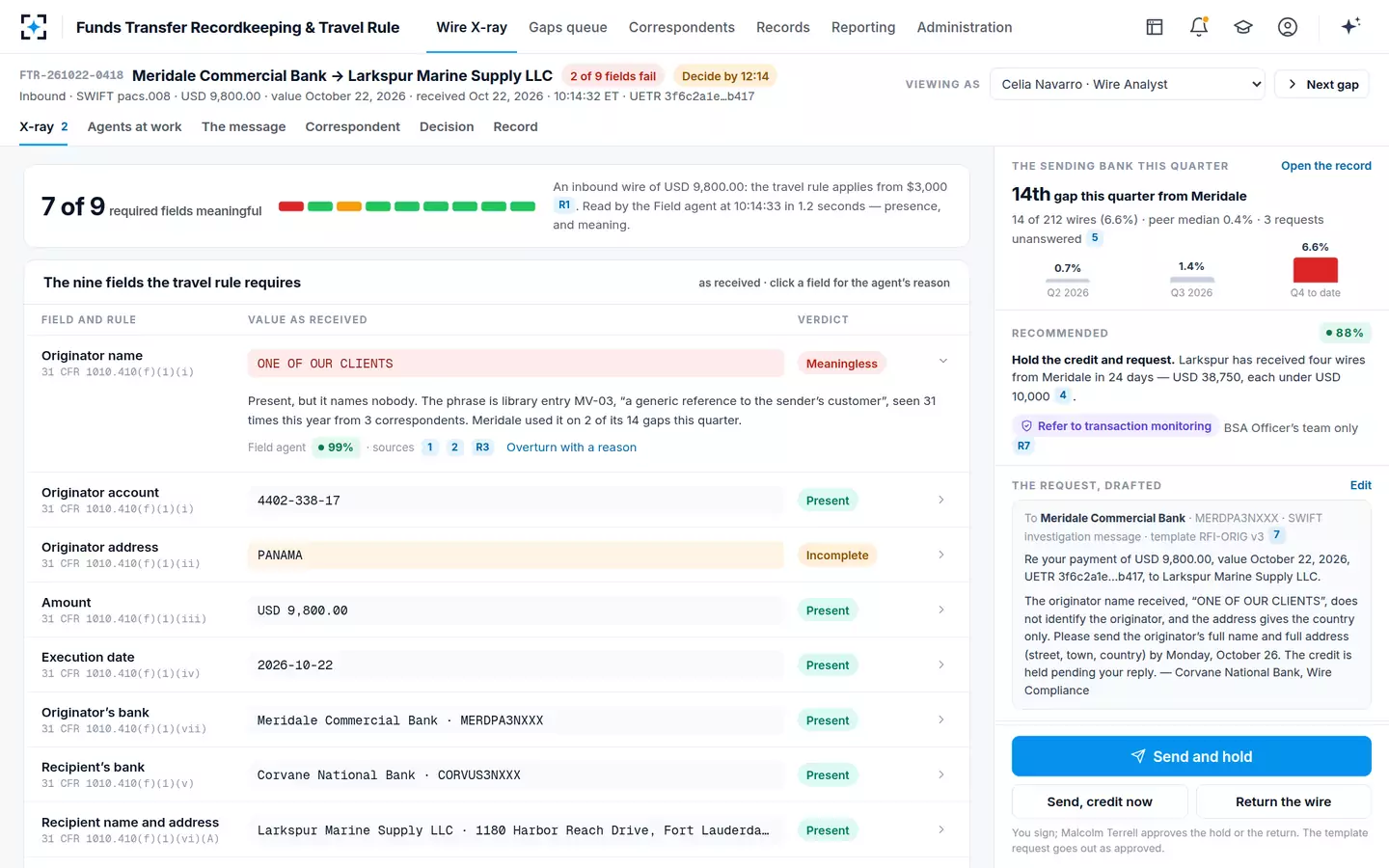
The citations are the point. A verdict that names its paragraph can be wrong, but it cannot be vague, and a team that disagrees with one can say exactly which line it reads differently. For what each bank in the chain owes beyond this paragraph, see funds transfer recordkeeping requirements, bank by bank; to see the paragraph applied to your own wires, start from Funds Transfer Recordkeeping & Travel Rule.
Questions people ask
Does the travel rule apply to non-banks?
Yes. It covers any transmittor's or intermediary financial institution in the United States, which includes money transmitters and other non-bank financial institutions. FinCEN's burden estimate counts 10,062 banks and 16,897 money transmitters as subject to it.
What is a transmittal order?
An instruction from a sender to a receiving financial institution, given orally, electronically or in writing, to pay or cause another institution to pay a fixed or determinable amount of money to a recipient, under 31 CFR 1010.100(eee). The term includes a bank's payment order and is used in the travel rule because the rule covers non-banks too.
Does the travel rule apply to a foreign bank's US branch?
Yes, for orders the branch sends or passes on, because the rule applies to institutions "located within the United States", and the bank recordkeeping rule applies to each agency, branch or office of a bank located in the United States. A foreign head office sending to the branch is outside the US rule, though its own country's rules apply.
Is the US travel rule the same as FATF Recommendation 16?
No. Recommendation 16 is the international standard that countries implement through their own laws, and its 2025 revision sets a threshold of no more than USD/EUR 1,000 and new requirements such as alignment checks. The US rule is 31 CFR 1010.410(f), still at $3,000, and has not been amended to match the revision.
Does the travel rule apply to cryptocurrency transfers?
FinCEN's 2019 guidance said transfers of convertible virtual currency by non-bank financial institutions may fall within the recordkeeping and travel rules, and the 2020 proposal sought to put that into the regulation. That rulemaking was listed as withdrawn on April 16, 2025, so the clarification was not adopted as a rule change.
Does the travel rule require the beneficiary's address?
Only if the sending bank received it. Paragraph (f)(1)(vi) asks for "As many of the following items as are received with the transmittal order", including the recipient's name and address, so a bank whose customer gave a name and account but no address may send the order without one.