The funds transfer recordkeeping requirements are two federal rules that work as a pair: for every funds transfer of $3,000 or more, a bank must keep a defined set of records about the payment order under 31 CFR 1020.410(a), and the sending and intermediary banks must pass named information along with the order under the travel rule, 31 CFR 1010.410(f). Every record is kept five years. What makes the work hard is that the duties change with the bank's role in each wire, so the same missing address is a violation at one bank, a pass-through at another and only a monitoring question at a third. Botminds' Funds Transfer Recordkeeping & Travel Rule is agentic software for a bank's wire compliance team: agents read every wire of $3,000 or more, judge each required field, place the gap with the bank that owes it, and keep each wire's file retrievable for five years, while people decide every hold, return and fix.
The four numbers the funds transfer rules turn on
$3,000
the amount from which a funds transfer is covered, under both the recordkeeping rule and the travel rule
5years
how long every record the Bank Secrecy Act regulations require must be retained
3roles
originator's bank, intermediary bank, beneficiary's bank: each owes something different
1995
the year both rules were issued, on the same day, January 3
What are the funds transfer recordkeeping requirements?
They are a recordkeeping rule and a transmission rule, issued together and meant to be read together. On January 3, 1995, Treasury and the Federal Reserve Board issued the recordkeeping rule and FinCEN issued the travel rule. FinCEN's own summary of the pair is plain: "The Recordkeeping Rule and the Travel Rule complement each other," and the recordkeeping rule exists to preserve "an information trail about persons sending and receiving funds through the funds transfer system" (FinCEN, 89 FR 65971).
For banks, the recordkeeping half lives at 31 CFR 1020.410(a); the version for non-bank institutions such as money transmitters is 1010.410(e). The travel rule is one paragraph, 1010.410(f), and applies to banks and non-banks alike. The FFIEC BSA/AML Examination Manual draws the line between them in one sentence that saves a lot of confusion: "There are no recordkeeping requirements in the Travel Rule" (FFIEC manual, Funds Transfers Recordkeeping). Keeping is one duty, sending is another, and a bank can meet one while failing the other.
Both apply only to a funds transfer of $3,000 or more (the travel rule's threshold, and its history), and the trigger is the role. The rule speaks of the originator's bank (the bank that receives the customer's payment order), an intermediary bank (any receiving bank in between) and the beneficiary's bank (the bank that pays the beneficiary). The FFIEC manual says the information a bank must collect and retain "depends on the bank's role in the particular funds transfer". One bank can play all three roles in one day, and many do.
One wire, three banks: what each owes under the funds transfer rules
Today
Obtains and keeps the originator's name and address, the amount, the execution date, any payment instructions, the beneficiary's bank, and whatever beneficiary details it receives. Verifies identity when a non-established customer places an order in person.
With agents
Sends the originator's name, address and account (if the order came from an account), the amount, the date, the beneficiary's bank, the beneficiary details received, and its own identity, with the order.
Still theirs: The only bank in the chain that must obtain the originator data.
Today
Keeps a copy or electronic record of the payment order it accepts.
With agents
Passes on, in its own order, the same items "if received from the sender".
Still theirs: No duty to obtain what the bank before it did not send.
Today
Keeps the payment order; for a beneficiary who is not an established customer, verifies and records identity when paying in person.
With agents
No travel rule duty: it sends nothing onward.
Still theirs: Supervisors still expect it to spot wires that arrive without complete originator information.
What must the originator's bank keep, and what must it send?
The originator's bank carries the heaviest load, and the two rules ask it for slightly different lists. The recordkeeping rule tells it to "obtain and retain" six items for each payment order it accepts; the travel rule tells it what to put in the order "at the time it is sent to a receiving financial institution". Read side by side, the lists differ in three places that matter to anyone building a check.
Keep versus send: the originator's bank, item by item
| Item | Keep, 31 CFR 1020.410(a)(1)(i) | Send, 31 CFR 1010.410(f)(1) |
|---|---|---|
| Originator's name | (A) name and address | (i) name |
| Originator's account number | Not on the list, but records must be retrievable by account number for an established customer with an account used for funds transfers | (i) only if the payment is ordered from an account |
| Originator's address | (A) | (ii), with a clause for Fedwire orders before the sending bank's 1990s format conversion |
| Amount | (B) | (iii) |
| Execution date | (C) | (iv) |
| Payment instructions received from the originator | (D) | Not required |
| Beneficiary's bank | (E) its identity | (v) its identity |
| Beneficiary name and address, account number, other identifier | (F) as many as are received | (vi) as many as are received |
| Originator's bank itself | Not required | (vii) name and address, or a numerical identifier |
The first difference is the account number. The travel rule wants it in the message only when the payment was ordered from an account, so a wire funded by a check at the counter carries none, legitimately. The second is that payment instructions must be kept but never travel. The third is that the bank must identify itself in what it sends, by name and address or by a numerical identifier, such as a routing number.
The beneficiary's details are where the two rules agree on a softer duty. Both ask only for the beneficiary items received with the order, which means the originator's bank must keep and send what its customer gave it, but is not obliged to obtain a beneficiary address the customer never supplied. The originator's data is different: the bank must obtain it, because the originator is its customer. The travel rule paragraph by paragraph covers the exceptions and the threshold history.
What does an intermediary bank have to pass on?
An intermediary bank must include in its own outgoing order the same items the originator's bank had to send, "if received from the sender", and keep a copy of every order it accepts. That is the whole duty, and the FFIEC manual states its limit as clearly as anything in the BSA: intermediaries "must pass on all of the information received from a transmittor's financial institution or the preceding financial institution, but they have no duty to obtain information not provided by the transmittor's financial institution or the preceding financial institution" (FFIEC manual).
That sentence is why an intermediary's travel rule test is a comparison, not a completeness check. The question an auditor asks is whether every field that arrived in the inbound message left in the outbound one, unchanged. A US correspondent that receives an order with the originator's address and drops it when it reformats the message has a travel rule problem; one that receives no address and sends none does not, under 1010.410(f).
Supervisory expectations go further than the rule. In 2009 the federal banking agencies told US banks acting as cover intermediaries that they should have a risk-based way to find blank fields and fields filled with meaningless data (interagency guidance, 2009; quoted in originator information on wire transfers). That expectation sits in correspondent risk management, not in the travel rule, and the guide on cover payments and where the originator data goes follows it leg by leg.
What records must a beneficiary bank keep?
The beneficiary's bank must retain the original or a copy of every payment order of $3,000 or more that it accepts, retrievable by the beneficiary's name, and by account number when the beneficiary is an established customer with an account used for funds transfers. If it pays a beneficiary who is not an established customer, it must verify that person's identity when proceeds are delivered in person and record the name, address, document type and number, and taxpayer identification number; if proceeds go out another way, it keeps the check or instrument and the name and address it was sent to (31 CFR 1020.410(a)(1)(iii), (a)(3)).
What it does not have is a travel rule duty. The FFIEC manual says so in one line: "There are no Travel Rule requirements for beneficiary banks." A US bank that receives an inbound wire with "ONE OF OUR CLIENTS" as the originator name has not broken 1010.410(f); the bank that sent it may have broken its own country's version of the rule.
That does not make the gap someone else's problem. The Basel Committee's 2009 paper, which the US agencies circulated with their own guidance, says beneficiary banks "should have effective risk-based procedures in place to identify wire transfers lacking complete originator information", that transparency problems may be a factor in deciding whether a transfer is suspicious, and that a beneficiary bank should in some cases "consider restricting or even terminating its business relationship" with institutions that fail transparency standards (BCBS, May 2009, paragraphs 32–33). The duty is monitoring and response, not transmission.
Who is responsible for missing originator information?
The originator's bank is responsible for originator information it was required to obtain and send; an intermediary is responsible only if it received the information and failed to pass it on; the beneficiary's bank is responsible for noticing and responding. The Basel Committee put it in a sentence: "it is the responsibility of the originator's bank to ensure that complete information is included for each wire transfer. However, the beneficiary and cover intermediary banks also have their roles to play in ensuring appropriate flows of information" (BCBS 2009, paragraph 18).
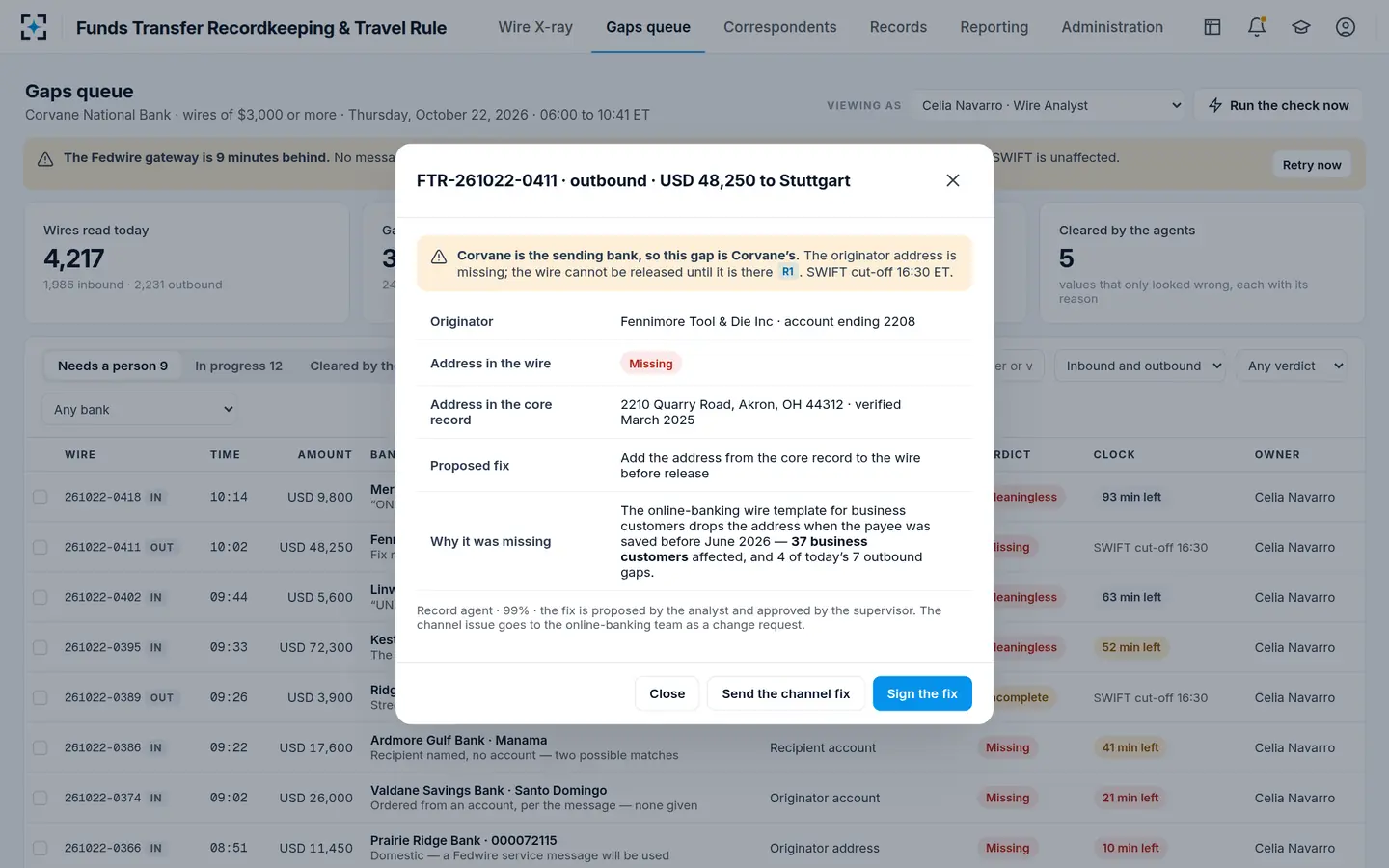
For a compliance team this splits gaps into two queues that need different handling. Inbound gaps are requests: ask the sending bank, decide whether to credit, hold or return, and count which correspondents repeat. Outbound gaps are the bank's own, and a request to anyone else will not fix them. When a bank's online-banking channel, a payment template or an import file drops the originator address, every wire through that channel leaves with the same gap, and the bank is the originator's bank on every one of them. The guide on what the travel rule enforcement cases show includes a 2026 case built on exactly that kind of outbound error.
The bank's own outbound gap, traced to the channel that caused it
What is an established customer, and why does it change the record?
An established customer is a person with an account at the bank, including a loan or deposit account, or a person for whom the bank keeps on file a name, address and taxpayer identification number (or a passport or alien identification number) and to whom it provides financial services relying on that information (31 CFR 1010.100(p)). The definition matters for two things in the funds transfer rules.
First, identity verification. When someone who is not an established customer places a payment order in person, the originator's bank must verify identity before accepting it and keep the name, address, type and number of the identification document, and the taxpayer identification number or its substitute. If the order is not placed in person, the bank keeps the person's name, address and taxpayer number and "a copy or record of the method of payment". The mirror-image duty applies at the beneficiary's bank when proceeds are paid out.
Second, retrievability. Records must always be retrievable by the originator's name; they must also be retrievable by account number only "if the originator is an established customer of the originator's bank and has an account used for funds transfers". A walk-in customer has no account to search by, so the name must carry the search. That is one reason a placeholder name on a walk-in wire is worse than a placeholder on an account wire: it can leave the record impossible to find.
Do ACH payments count? What the funds transfer rules leave out
No. The definition of a funds transfer leaves out electronic fund transfers under the Electronic Fund Transfer Act and any other transfer made through an automated clearinghouse, an ATM or a point-of-sale system (31 CFR 1010.100(w)). In practice that leaves wire transfers in scope, and takes ACH credits, card payments and ATM withdrawals out.
Two other exclusions remove large volumes from scope. The rules do not apply where both the originator and the beneficiary are on a list that includes a bank, a wholly owned domestic subsidiary of a US-chartered bank, a broker or dealer in securities, a futures commission merchant, the United States, a state or local government or agency, and a mutual fund. And they do not apply where originator and beneficiary are the same person and both banks are the same bank (31 CFR 1020.410(a)(6)). A treasury desk's interbank funding wires and a customer moving money between two of their own accounts at one bank are both outside.
These exclusions are where a check that reads every wire must know the rule, not just the format. A pacs.009 between two banks for their own account is out of scope; the same message type carrying a customer payment as cover is not, which is the subject of the cover payments guide.
Retrievable by name and account: what an examiner will test
The rule does not prescribe a system. Records "need not be retained in any particular manner, so long as the financial institution is able to retrieve the information", either from funds transfer records directly or "through reference to some other record maintained by the bank" (31 CFR 1020.410(a)(4)). The general retention rule adds that records must be retrievable in a reasonable time, judged by the kind of record and how old it is (31 CFR 1010.430(d); BSA recordkeeping requirements by bank size quotes it).
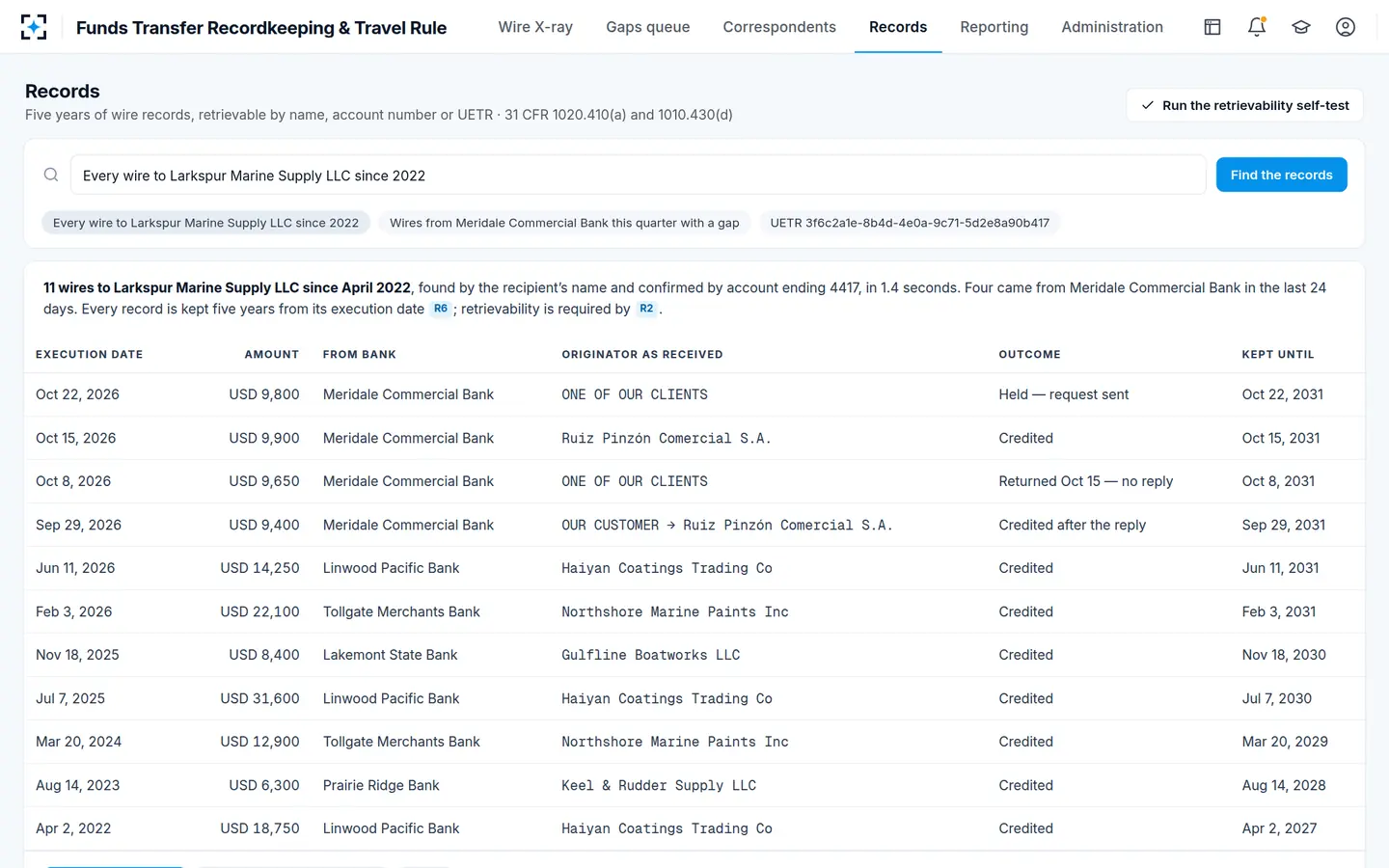
The FFIEC examination procedures turn that into a sample. Examiners verify that the bank "obtains and maintains appropriate records for compliance with 31 CFR 1020.410(a)" and that it sends the information the travel rule requires, then, on the basis of a risk assessment, prior reports and audit findings, "select a sample of funds transfers processed as an originator's bank, an intermediary bank, and a beneficiary's bank" (FFIEC examination procedures). A bank that can produce every wire to one customer over five years, by name and then by account, passes that test in minutes. One whose wire history sits in a payments hub, an email archive and a spreadsheet often cannot.
Five years of a customer's wires, found by name and confirmed by account
Where Funds Transfer Recordkeeping & Travel Rule fits the chain
The solution reads each wire in the role the bank plays in it, so a gap lands in the queue that can fix it. Inbound, it drafts the request to the sending bank and counts the correspondent's record; outbound, it looks for the missing value in the bank's own customer data before cut-off; for every wire, it keeps the file and makes it findable. People sign every decision that moves, holds or changes anything.
How the solution routes a gap to the bank that owes it
Agent
Field agentReads every wire of $3,000 or more, inbound and outbound, and judges each required field present, missing, meaningless or incomplete, citing the paragraph.
Never: Never edits a payment.
Agent
Record agentOutbound only: finds the missing value in the core banking system, proposes the fix before cut-off and names the channel that dropped it.
Never: Never changes a wire or a customer file without a checker.
Agent
Request agentInbound only: drafts the request to the sending bank on an approved template, sets the clock and matches the reply to the wire.
Never: Never mentions a referral or a case.
A person decides
Wire compliance analyst and supervisorThe analyst signs credit, hold, return or fix with a reason code; the Wire Room Supervisor approves it. Nobody approves their own step.
Agent
Retrieval agentIndexes the file by originator, beneficiary, account and UETR, and samples old files to prove they can still be found.
Never: Never deletes a file inside retention.
What the solution does not do matters as much. It does not make a US beneficiary's bank answerable for a foreign sending bank's data, and it does not treat a request as a finding against the correspondent; it records that the gap arrived and what was done about it. It does not replace the payments hub or the core system, and a bank with a handful of wires a week may reasonably keep doing this by hand. For the field judgments themselves, start with how the Field agent tells a name from a placeholder, or see the whole workflow on Funds Transfer Recordkeeping & Travel Rule.
Questions people ask
Does the travel rule require a bank to keep records?
No. The travel rule, 31 CFR 1010.410(f), only says what information must accompany a transmittal order when it is sent; the FFIEC manual states that "There are no recordkeeping requirements in the Travel Rule." Keeping is the job of the recordkeeping rule, 1020.410(a) for banks, and every record is retained five years under 1010.430(d).
Do the funds transfer rules apply to wires under $3,000?
The federal requirements start at $3,000; below that, neither the recordkeeping rule nor the travel rule applies, although a bank's own policy may go lower. A 2020 proposal to cut the threshold to $250 for cross-border transfers was not adopted, and its rulemaking was listed as withdrawn on April 16, 2025.
Are transfers between two banks covered?
Not when both the originator and the beneficiary are banks or other listed entities, such as a wholly owned domestic subsidiary of a US bank, a broker-dealer, a government or a mutual fund. A bank-to-bank message that carries a customer's payment as cover is a different case: the underlying transfer has a non-bank originator and beneficiary.
Can funds transfer records be kept electronically?
Yes. The rule asks for "the original or a copy, or electronic record" and says the information "need not be retained in any particular manner", provided the bank can retrieve it by name, and by account number for established customers. Records must be accessible within a reasonable time under 31 CFR 1010.430(d).
What is the difference between a payment order and a transmittal order?
A payment order is the bank-specific term; a transmittal order is the broader one used by the travel rule, which covers banks and non-banks alike. The FFIEC manual notes the travel rule uses "more expansive terms" such as transmittor's financial institution instead of originator's bank, and that the broader terms include the bank-specific ones.
Who verifies identity when a non-customer sends a wire in person?
The originator's bank, before it accepts the order. It records the person's name and address, the type and number of the identification document and the taxpayer identification number, or notes that there is none; if it knows the person placing the order is not the originator, it also records the originator's taxpayer number if the person knows it.