Originator information is the data that identifies who sent a wire: the originator's name, address and, when the payment is ordered from an account, the account number. Under the US travel rule the originator's bank must put it in every transmittal order of $3,000 or more, along with the amount, the date and the banks involved (31 CFR 1010.410(f)). The hard part is not whether the field is filled, which any payments hub can check, but whether what is in it names anybody: "ONE OF OUR CLIENTS" fills the field and identifies no one, while "NA Holdings Ltd" looks odd and is a real company. Botminds' Funds Transfer Recordkeeping & Travel Rule gives that judgment to one agent, the Field agent, which reads every inbound and outbound wire, marks each required field present, missing, meaningless or incomplete, cites the rule and the example it relied on, and leaves every decision about the money to people.
Most of the work is clearing values that only look wrong
4,217
wires of $3,000 or more read between 06:00 and 10:41 on one sample morning
31
had a field missing, meaningless or incomplete: 24 inbound, 7 outbound
5
values the agent cleared as real, each with its reason, such as a registered name containing "Customer"
9
waited for a person to decide, one of them past its decision time
What originator information is required on a wire?
For a US originator's bank sending $3,000 or more, three items describe the originator: its name, its address, and its account number when the payment is ordered from an account. The bank must also identify itself, by "the name and address or numerical identifier of the transmittor's financial institution", and include the amount, the execution date and the identity of the recipient's bank (31 CFR 1010.410(f)(1)). An intermediary bank passes the same items on, if it received them.
Two details trip up checks built on the message format. The account number is conditional, so a wire paid for by an official check at a branch can legitimately carry no originator account. And the address requirement still carries a clause for Fedwire orders sent before the sending bank's conversion to the "expanded Fedwire format", a 1990s change that the guide on the travel rule's old Fedwire clause examines. A rule engine that flags every wire without an account, or every Fedwire without an address, will be noisy in one case and wrong to excuse in the other.
Inbound wires from abroad were sent under the sending country's rules, not 1010.410(f). The receiving US bank has no travel rule duty for them; its duty is supervisory, to monitor for originator information that is missing or meaningless and respond. That is the test the rest of this guide is about.
What is manifestly meaningless information?
Manifestly meaningless information is a value that is present in the field but obviously does not identify the party. The phrase comes from the federal banking agencies' December 2009 guidance on cross-border funds transfers, which defines it in one clause: a field is "manifestly meaningless or incomplete" where "it is obvious, without further research or investigation, that the message does not identify parties to a transaction" (interagency guidance, FDIC FIL-72-2009; issued by the Federal Reserve as SR 09-9).
Each word in that definition limits the test. "Obvious" sets a high bar: a value that might be a real name is not meaningless. "Without further research or investigation" means the judgment is made from the message itself, not after a registry search. And "does not identify parties" is about identification, not accuracy. The same guidance says that neither the SWIFT format change nor the Basel Committee paper "suggests that intermediary banks must gather information relating to incomplete fields in all payment orders or must verify the accuracy of information contained in payment message fields."
What the agencies did expect is a method. "Banks should have, as part of their monitoring processes, a risk-based method to identify incomplete fields or fields with meaningless data," the guidance says, and banks processing cover payments "should within reasonable timeframes develop and implement plans for adapting automated monitoring systems." Seventeen years on, that is still the standard a checker is measured against: a method, risk-based and automated where volume demands it.
Meaningless, incomplete or acceptable: the examples a check must get right
| Value in the originator field | Verdict | Why |
|---|---|---|
| "ONE OF OUR CLIENTS" | Meaningless | A generic reference to the sending bank's customer. Present, and names nobody. |
| "UNKNOWN" | Meaningless | A filler word in the name field. |
| The sending bank's own name as originator, on a customer payment | Meaningless | Names the bank, not the customer whose money it is. |
| "PANAMA" as the address | Incomplete | A country, with no street and no town. |
| A street with no town, on an outbound wire | Incomplete | The bank holds the full address; the channel dropped part of it. |
| "NA Holdings Ltd" | Acceptable | A company name with a legal suffix; "NA" is a filler only when it is the whole value. |
| "Client Services Trust Ltd" or "Customer First Credit Cooperative" | Acceptable | Registered names that happen to contain "client" or "customer". |
| "XYZ Payroll Account", a trade name, or an abbreviation | Acceptable | Allowed by the travel rule, per the FFIEC manual. |
| A coded name or pseudonym | Not permitted | The travel rule does not allow coded names, per the FFIEC manual. |
| No originator account, on a wire paid by official check | Acceptable | The account is required only if the payment is ordered from an account. |
Can abbreviations be used for the originator name?
Yes. The FFIEC BSA/AML Examination Manual says that "Although the Travel Rule does not permit the use of coded names or pseudonyms, the rule does allow the use of abbreviated names, names reflecting different accounts of a corporation (e.g., XYZ Payroll Account), and trade and assumed names of a business", as well as the names of unincorporated divisions or departments (FFIEC manual, Funds Transfers Recordkeeping).
The prohibition on coded names is old and firm. In 1998 FinCEN quoted its own January 1997 guidance to banks: "[t]he use of a code name, or pseudonym is prohibited" under the travel rule, and it warned that a new customer request for a nominee or coded name "should be carefully evaluated by depository institutions as a potentially suspicious transaction" (FinCEN Issuance 98-1, 63 FR, January 26, 1998).
For a checker, the two lists pull in opposite directions. Abbreviations, trade names and account labels are exactly the values a keyword rule flags, because they are short, unusual or contain words like "client" and "account". Coded names are the values a keyword rule misses, because they look like names. That asymmetry is why a list of banned words, on its own, either floods the queue or lets the dangerous cases through.
Is a P.O. box acceptable as the originator address?
In certain circumstances, yes. The rule does not define "address", and the FFIEC manual records that FinCEN issued a regulatory interpretation in November 2003 (68 Fed. Reg. 66708) allowing mailing addresses, including post office boxes, in the transmittor address field. Under it, the address means "either the transmittor's street address or the transmittor's address maintained in the financial institution's automated CIF (such as a mailing address including a post office box)", as long as the bank keeps the transmittor's address on file and it is retrievable on request by law enforcement (FFIEC manual).
That makes the address the field where policy matters most. A country alone, like "PANAMA", is incomplete on any reading. A town and a country, like "Manama, Bahrain", is a judgment: the sample bank's policy accepts it on inbound wires, consistent with the hybrid address format, which requires a country code and a town at the least (Fedwire format FAQ; the ISO 20022 town name), while another bank might ask for more. Fedwire itself tells senders that its format is not their compliance standard: "We recommend that you consult with your compliance and legal departments" on what to include (Fedwire November 2027 release FAQ). The point for an evaluation is that the threshold should be a written, versioned setting the BSA Officer owns, not a rule buried in code.
Inside the Field agent: how one agent judges one field
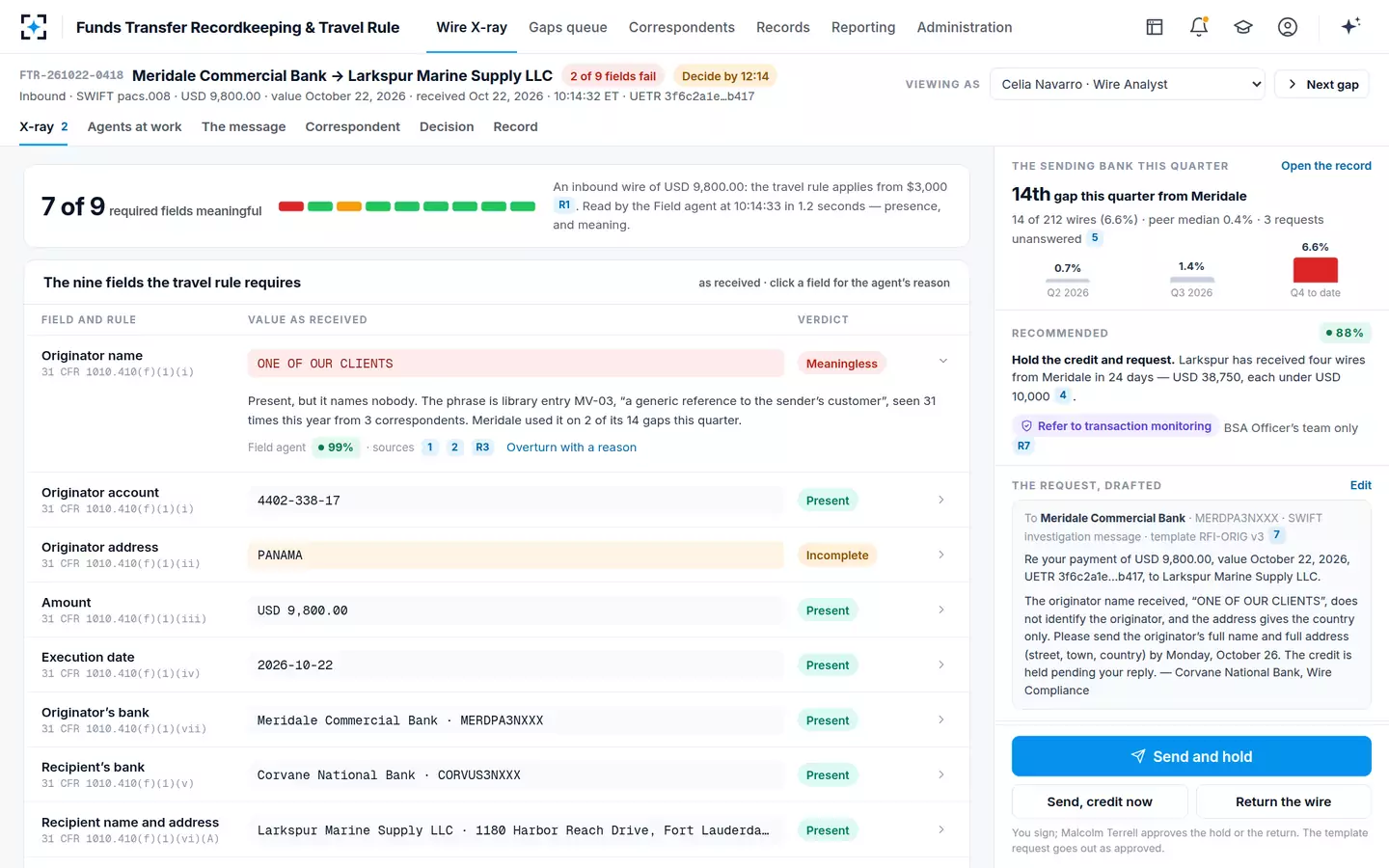
The Field agent does one job: it turns a message into the fields the travel rule names and gives each a verdict with its reasons. It does not decide what happens to the wire, does not write to the sending bank and does not change a payment. On the sample wire below, an inbound USD 9,800.00 pacs.008 from a bank in Panama City, it read the message in 1.2 seconds and found seven of nine fields meaningful.
The wire laid out as the fields the travel rule names, each with a verdict
What the Field agent does with each value, and where it stops
Agent
MapMaps each message element (pacs.008, pacs.009 cover, or Fedwire) to the travel rule field it carries, and reads the value exactly as received.
Agent
Test against the libraryCompares the value with a versioned library of meaningless values (placeholders, fillers, country-only addresses), each entry approved by the BSA Officer, with its hit count and how often people have overturned it.
Agent
Test against the contextChecks the value against the sending bank's own name, the bank's customer data and the rest of the message, so a registered name containing a library word is cleared, with its reason.
Agent
Give a verdict with its citationMarks the field present, missing, meaningless or incomplete, cites the rule paragraph and the library entry, and states its confidence.
Never: Never calls a value meaningless below the confidence floor; a person decides those.
A person decides
Wire compliance analystReads the verdicts, can overturn any one with a reason code, and decides credit, hold or return with the supervisor as checker.
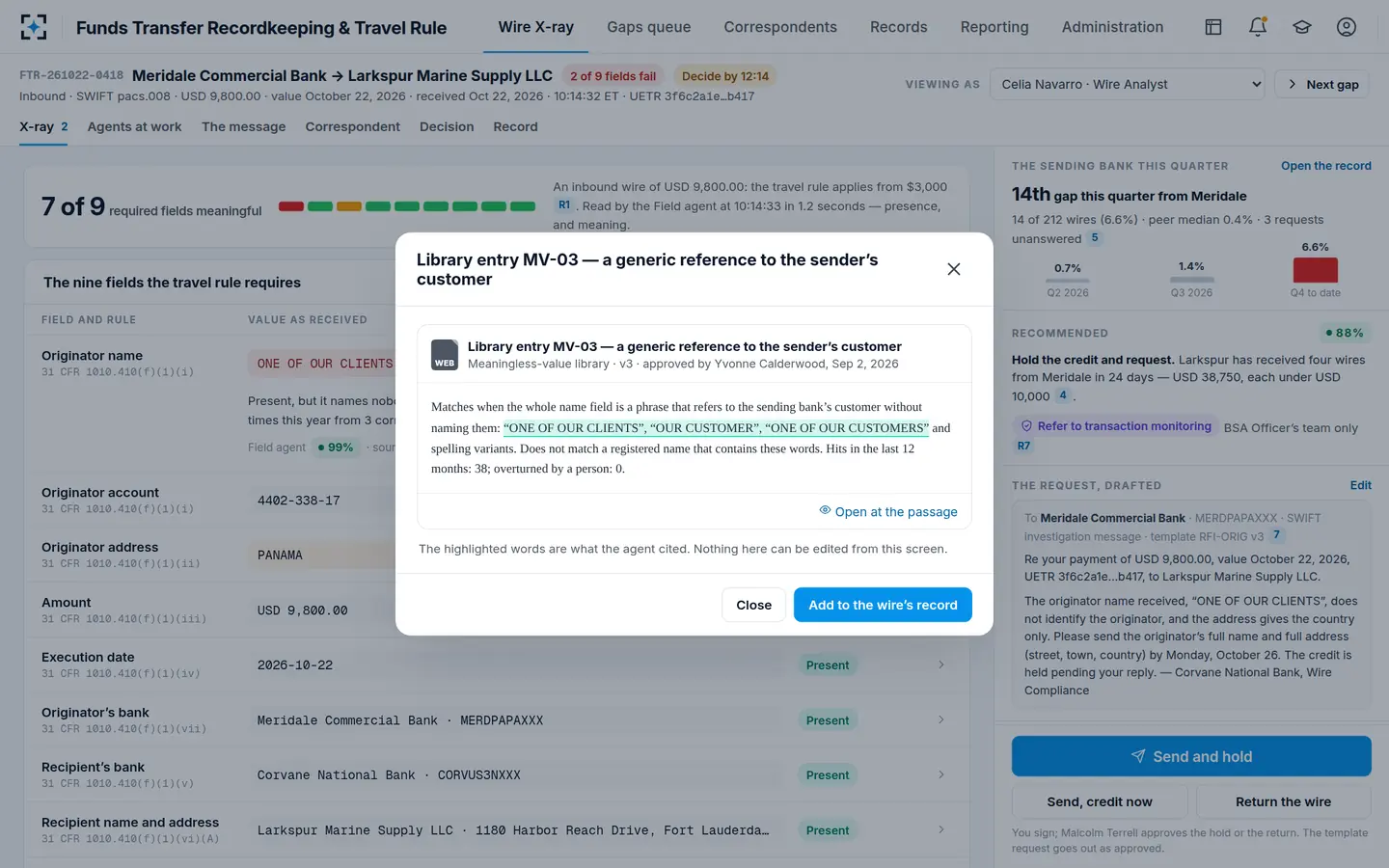
The library is where the judgment is made auditable. Every verdict on a meaningless value points to an entry, such as MV-03, "a generic reference to the sender's customer", which lists the phrases it matches, states what it does not match (a registered name that contains those words), shows its version and the BSA Officer who approved it, and counts how often a person has overturned it. An examiner who asks why a value was flagged gets a citation, not an explanation reconstructed after the fact.
The citation behind a verdict: a versioned library entry with its overturn count
What should a bank do with incomplete originator data?
Ask the bank that sent it, decide what to do with the funds while waiting, and keep count. For an inbound wire the usual sequence is a request to the originator's bank or the preceding intermediary, a decision to credit, hold or return, and a running record of which correspondents repeat; the Basel Committee's 2009 paper lists contacting the sending bank first among the possible responses, and expects the reasons for each decision to be documented. The guide on what the enforcement cases and supervisors expect covers repeat offenders and reporting.
For an outbound wire the answer is different: the bank is the originator's bank, the data is its own, and the wire should not leave without it. The solution's Record agent looks for the missing value in the bank's customer data before cut-off and proposes the fix for a supervisor to approve. The Field agent's role in both cases ends at the verdict, which is the design choice a buyer should test hardest: a checker that also decides cannot be checked.
What to look for in travel rule software
Judge a travel rule checker on the values it clears as much as on the values it flags. A tool that flags every short name will look thorough in a demonstration and bury the team in a week. The checklist below is what we would ask of any tool, ours included.
Ten questions to put to any tool that checks originator information
- Does it judge meaning, not just presence?
Ask it to read "ONE OF OUR CLIENTS", "UNKNOWN" and a country-only address, and to clear "NA Holdings Ltd" and "XYZ Payroll Account".
- Does every verdict cite the rule paragraph and the example it relied on?
An examiner will ask why a value was flagged; a score with no reason is not an answer.
- Is the list of meaningless values versioned and owned?
Each change approved by a named officer, with hit counts and how often people overturned it.
- Does it use context?
The sending bank's own name in the originator field, a registered customer name, the rest of the message.
- Does a person decide the borderline cases?
A stated confidence floor, below which a person makes the call, and reason codes for overrides.
- Does it treat inbound and outbound differently?
Inbound is a request to another bank; outbound is your own data and should be fixed before release.
- Does it know the conditional requirements?
No account is needed for a wire not ordered from an account; out-of-scope transfers are not gaps.
- Does it ever edit a payment?
It should not. Data is added from evidence by a person, and nothing is removed or obscured.
- Can it show its clearances to an examiner?
Values that only looked wrong should be listed with their reasons, not silently passed.
- Will the vendor run it on your own past wires before you sign?
Count misses and false flags against your reviewers on a sample you choose.
Where the solution fits less well is worth saying plainly. A bank that sends and receives a few dozen wires a week can review originator fields by hand with a written list, and should; the value of an agent rises with volume, with the number of foreign correspondents, and with how often the same channels produce the same gaps. And no tool knows your reviewers' standard until you measure it, which is why measuring how often two reviewers agree comes before choosing one. To see the Field agent's verdicts on a sample of your own wires, start from Funds Transfer Recordkeeping & Travel Rule, or read how to run a one-month test of AI on your wires.
Questions people ask
Is the originator's account number always required on a wire?
No. Under 31 CFR 1010.410(f)(1)(i) the originator's bank includes the account number only when the payment is ordered from an account (the travel rule paragraph by paragraph). A wire funded with cash or an official check at a branch can carry no originator account and still comply, provided the name and address are there.
What is the difference between missing and meaningless originator information?
Missing means the field is empty or absent. Meaningless means it holds a value that obviously identifies nobody, such as a placeholder phrase or the sending bank's own name on a customer payment. A field of blanks is missing in substance: Fedwire's format guidance warns senders not to fill free-text elements with spaces only, because it causes problems for receivers.
Can the receiving bank correct the originator name itself?
It should not invent or overwrite another bank's originator data. The right move on an inbound wire is a request to the sending bank, and a decision on the funds by a person. On an outbound wire the bank is the originator's bank and may add the value from its own verified customer data, with a checker approving the change.
How accurate is the Field agent?
No published figure would tell you how it performs on your correspondents' traffic, so the honest answer is to measure it. Run it over a past month of your wires, compare its verdicts with your reviewers', and count misses and false flags by field type; the confidence floor and the library are then tuned to your standard before anything goes live.
Does the travel rule apply to a beneficiary bank receiving incomplete originator data?
No. The FFIEC manual says the travel rule places no duty on beneficiary banks (funds transfer recordkeeping requirements sets out who owes what). The receiving bank's obligations are to keep the payment order and, under supervisory guidance, to have a risk-based way to spot transfers that lack complete originator information and respond to them.
Does checking originator information replace sanctions screening?
No. The 2009 interagency guidance says US banks "should screen transactor information on all automated funds transfers"; a transparency check and a sanctions screen use the same fields for different purposes. A meaningless originator name can defeat a screen, which is one reason the two teams should see each other's findings.