A Reg E notice of error is an oral or written notice from a consumer that the bank receives no later than 60 days after it sent the statement first showing the problem, that lets the bank identify the consumer's name and account, and that says why the consumer believes there is an error, with the type, date and amount where possible (12 CFR 1005.11(b)(1)). Once the bank receives one, it has 10 business days to decide whether an error occurred, or to credit the account provisionally and take longer. In a secure message the notice rarely announces itself: it sits in the second sentence of a fee question or behind a request to close an account, and whoever keys it decides, often without noticing, which day the clock started. Botminds' Secure Message Triage gives that decision to one agent, the Clock agent, which tests each element against the customer's own sentences and dates the clock to the day the message arrived, never later.
What a notice of error starts, counted from the day it is received
10business days
to determine whether an error occurred, or to credit provisionally
45days
to finish with provisional credit; 90 for point-of-sale debit, transfers not initiated within a state, and new accounts
60days
after the statement first showing the error: the window for the notice to arrive
What is a notice of error under Reg E? Three elements and a date
A notice of error is defined by what it does, not by what it is called. Any oral or written notice counts if it meets three elements: it identifies the consumer and the account, it says why the consumer believes there is an error, and it arrives within 60 days of the statement on which the error first appeared. The customer never has to write "dispute", "Regulation E" or "notice of error", and in a secure message they almost never do.
The error itself must be one of the seven the regulation lists: an unauthorized transfer; an incorrect transfer to or from the account; a transfer missing from a statement; the bank's own computational or bookkeeping error; a customer handed the wrong amount of cash by an ATM or other terminal (worked through in ATM overage); a transfer not properly identified on the statement; and a request for documentation, information or clarification about a transfer (1005.11(a)(1)). The same section lists what is not an error: a routine balance inquiry, a request for information for tax or record-keeping purposes, and a request for duplicate copies.
What information must a Reg E notice of error include?
Less than most dispute forms ask for. The notice must enable the bank "to identify the consumer's name and account number", and it must indicate "why the consumer believes an error exists and includes to the extent possible the type, date, and amount of the error" (1005.11(b)(1)(ii)–(iii)). "To the extent possible" matters: a customer who knows only that "something came out of my account last week that I didn't do" has given a notice, and the bank's job is to find the transfer, not to send the message back.
The account number is not required either. "The notice of error is effective even if it does not contain the consumer's account number, so long as the financial institution is able to identify the account in question. For example, the consumer could provide a Social Security number or other unique means of identification" (comment 11(b)(1)-1). A message sent from a signed-in session meets that test before anyone reads it, which is why the Clock agent takes identity from the session and does not ask the customer to repeat it.
Two things the notice cannot be made to wait for. The first is a signed statement: the bank may ask the customer for one, but it may not hold back the start or the finish of the investigation until it arrives (comment 11(b)(1)-2; what that means for frontline scripts is in Reg E training). And if the request is for documentation or clarification, the third element does not apply at all: the customer does not have to allege an error to ask what a transfer was.
Inquiry or notice of error? Where the line falls in a message
The line is drawn by what the customer asserts, and the commentary draws it more finely than most frontline scripts. A request for information is an error notice by default; a question about whether a payment went through is not, unless the customer says something is wrong. The table sorts sentences of the kind secure messages carry.
Sentences from secure messages, sorted by what Regulation E makes of them
| What the customer writes | Notice of error? | Why |
|---|---|---|
| "Can you tell me what this $71.44 charge is? I don't recognise it." | Yes | A request for information about a transfer is an error (1005.11(a)(1)(vii)); comment 11(a)-5 says it "must be treated as an error" unless plainly for tax or records. |
| "Did my rent payment go out on the 1st?" | No | Checking whether a transfer was made, "without asserting an error", is outside error resolution (comment 11(a)-2). |
| "Please send last year's statements for my taxes." | No | A request for information for tax or record-keeping, or for duplicate copies, is excluded (1005.11(a)(2)). |
| "I lost my debit card yesterday." | Not yet | A lost-card report triggers error resolution only "if the consumer also alleges possible unauthorized use" (comment 11(a)-3). It still starts the card team's work. |
| "I lost my card and there's a charge I didn't make." | Yes | The loss plus an alleged unauthorized use. |
| "The ATM gave me $40 less than I asked for." | Yes | An incorrect amount from an electronic terminal is listed error (v). |
| "This is the same charge I disputed in August." | Depends | If the bank fully complied the first time, it has no further duty on a reasserted error, with one exception (1005.11(e)). |
The first row is where most misses happen, because it reads as a question. A representative answering "that charge is from a fuel merchant in Columbus" has answered the question and missed the notice. The Clock agent reads it the way the commentary does, as an error request with its own 10-business-day clock, and the reply still answers the question.
When is a notice of error received? The date is the decision
A notice is received when it reaches the bank, not when someone opens, reads or keys it. For a secure message that moment is in the message's own timestamp. The regulation counts "business days" as days the bank's offices are open "for carrying on substantially all business functions" (1005.2(d)), and the official interpretation adds that a notice given outside normal business hours is still effective; the first-response guide quotes it and works through a weekend message.
The FDIC's examination manual reminds examiners of the other half of the arithmetic: "The term 'day' as used in Regulation E refers to calendar days unless specified as a 'business day'" (FDIC Consumer Compliance Examination Manual, VI-2). The 10 days are business days; the 45, 90 and 60 are calendar days. A calculator that mixes them is wrong in a way that only shows up near a holiday, and the Reg E Dispute Management guide to the Reg E error resolution calculator covers the counting in full.
The 60 days have their own start, and it is not the transaction date. The window runs from the date the bank "sends the periodic statement" first showing the error (1005.11(b)(1)(i)); for a customer who has statements held for collection, from the day the statement is first made available. The Clock agent reads the statement date from the core system, not from the customer's message.
What if the customer sends the dispute to the wrong place?
It still counts, unless the bank has a working way to send the customer to the right place. The commentary lets a bank hold customers to the phone number or address it disclosed only if it has reasonable procedures for redirecting a customer who tries to give notice some other way (comment 11(b)(1)-6; the same rule on a phone line is in Reg E written notification requirements). A secure message center that receives a dispute and answers only the customer's other question has no such procedure for that message.
Written confirmations get the same treatment. "If the consumer sends a written confirmation of error to the wrong address, the financial institution must process the confirmation through normal procedures" (comment 11(b)(2)-1). The one concession is on provisional credit: if a confirmation the bank required is delayed beyond 10 business days because it went to the wrong address, the bank need not credit provisionally. The investigation still runs.
Inside the Clock agent: five tests, one date
The Clock agent does one job: for each request the splitting step has cut out of a message, it decides which legal clock starts and on which day, and shows why. It tests the notice elements in a fixed order and cites the customer's sentence or the system that meets each one. It does not investigate, decide the claim, credit an account or close a clock; those belong to the card dispute specialist.
How the Clock agent tests and dates a notice of error in a secure message
Agent
Is it one of the seven errors?Matches the request to 1005.11(a)(1), including requests for information about a transfer, and screens out balance checks and tax-copy requests.
Agent
Can the bank identify the customer and account?Takes the customer and accounts from the signed-in session the intake step matched; no account number is needed.
Agent
Does it say why there is an error?Marks the deciding sentence, and the type, date and amount where the customer gave them.
Never: holds the clock for a missing amount; the reply asks for it
Agent
Did it arrive within 60 days of the statement?Reads the statement date from the core system and computes the window end, counted from the statement, not the transaction.
Agent
Which clock, from which day?Starts the Regulation E clock on the day the message arrived and counts business days on the bank's own calendar, with the 45- or 90-day outer limit.
Never: starts a clock later than the day the message arrived, or closes one
A person decides
Representative, then dispute specialistWhere the agent is below 0.85 confidence, the representative decides with a reason. The specialist owns the investigation, provisional credit and the decision.
The order matters. Testing the 60-day window last would let a message that is clearly a notice fall out of the count because the statement date had to be looked up; testing identity first, from the session, means the agent never has to ask a signed-in customer who they are. And each test cites its source, so the specialist who inherits the clock can see in one click why it started.
One sample message, sentence by sentence: where each element is met
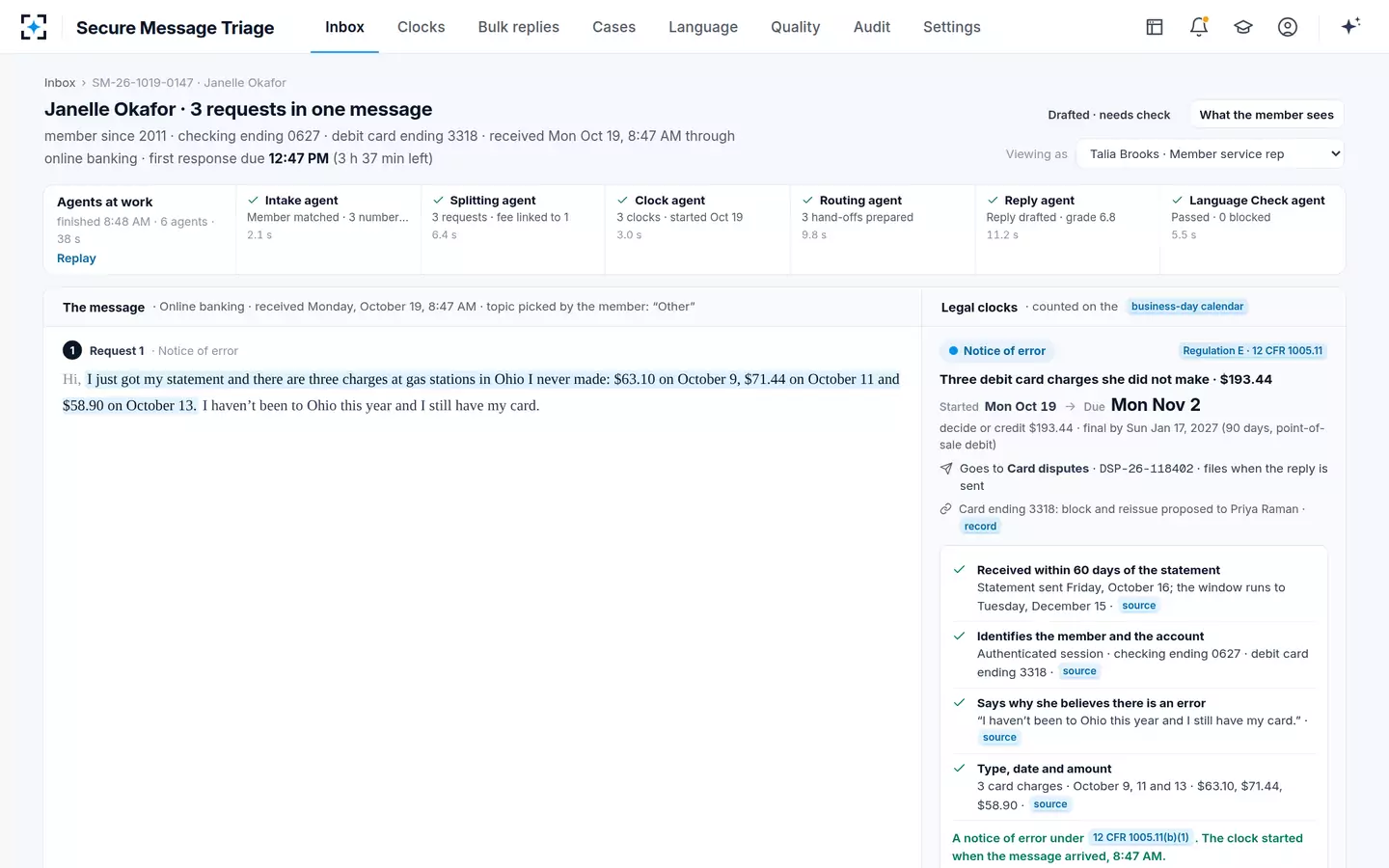
Hi, I just got my statement and there are three charges at gas stations in Ohio I never made:
Error type
Unauthorized transfers, the first kind of error in 1005.11(a)(1).
$63.10 on October 9, $71.44 on October 11 and $58.90 on October 13.
Type, date and amount
Given in full; the rule asks for them only "to the extent possible".
I haven’t been to Ohio this year and I still have my card.
Why she believes there is an error
The deciding sentence. It also tells the specialist the card was not lost.
(sent from her signed-in session, Monday 19 October, 8:47 AM)
Identity, account, receipt
The session names her and her debit card; the timestamp is the date of receipt.
Is it legally a notice of error? Every element, with its sentence
Why the agent dates the clock but never decides the claim
Because the enforcement record already holds a case in which a machine decided: in 2022 the CFPB penalised Bank of America for letting an automated fraud filter deny prepaid cardholders' notices of error (CFPB, 2022), the case the AI email triage test takes as its starting point.
Dating a clock is a different kind of decision. It is narrow, it has a right answer the specialist can check from two sources, and getting it wrong in the safe direction (starting a clock for a message that turns out to be a question) costs a little work, while getting it wrong the other way costs the customer days of their protection. So the agent is built to start early and to never stop a clock, and every judgement about the claim itself stays with a person.
When the agent is not sure: a message at 0.71
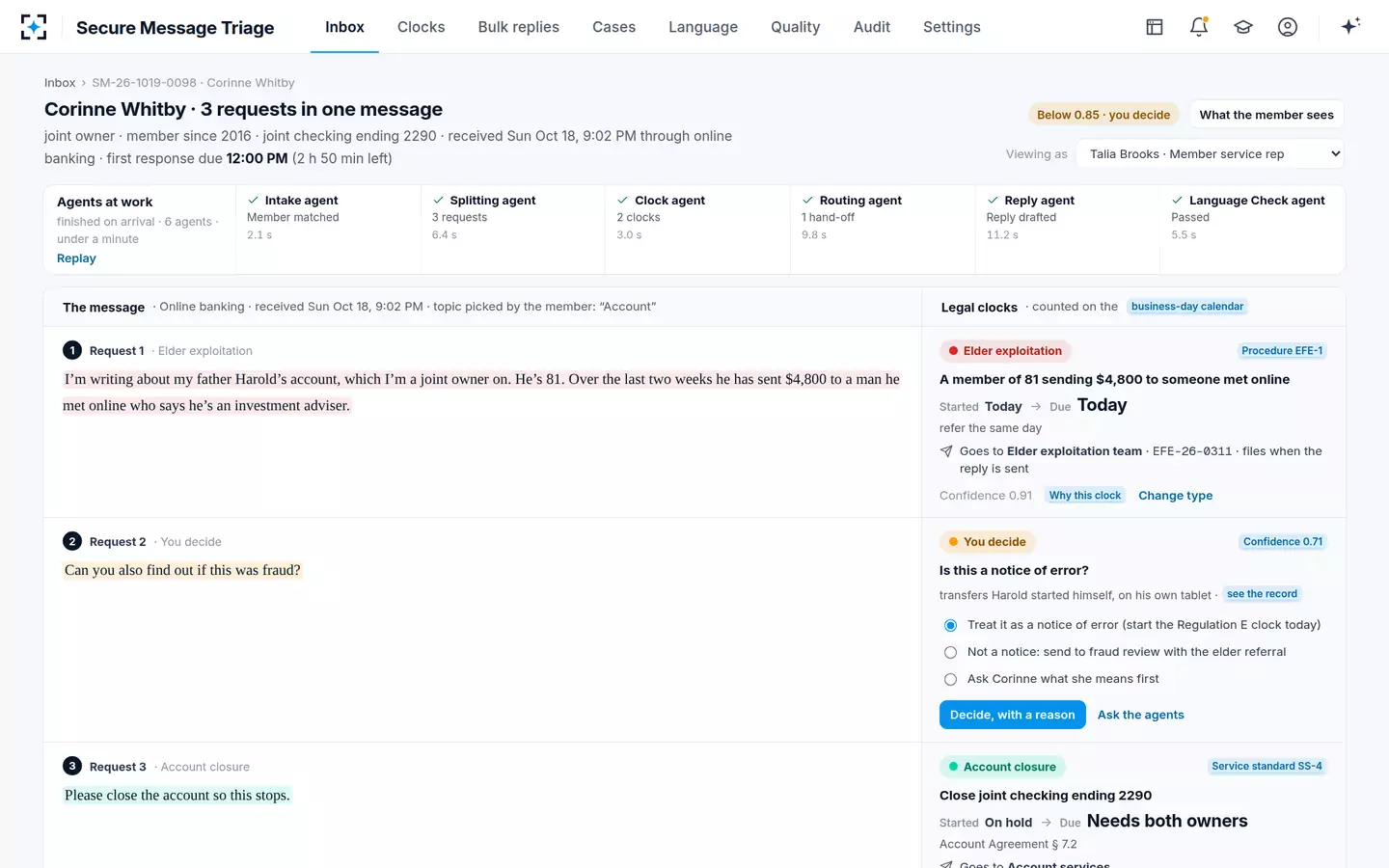
Some messages do not resolve on their face, and those go to the representative with the options laid out. In one sample message a joint owner writes that her 81-year-old father has sent $4,800 over two weeks to a man he met online, adds "Can you also find out if this was fraud?" and asks to close the account. The transfers were made by the father himself, on his own tablet.
Whether that question is a notice of error turns on facts the message does not give. CFPB staff guidance treats a transfer made with account access a fraudster tricked out of the consumer as unauthorized (CFPB Electronic Fund Transfers FAQs); a payment the customer chose to send to someone who then deceived him is a different question. The agent rated its answer 0.71, below the 0.85 threshold, and left three choices: treat it as a notice and start the clock today, send it to fraud review with the elder referral, or ask the customer what she means first. The referral itself went out the same day either way.
Below the confidence threshold, the representative decides, with a reason
How long does a customer have to give notice under Reg E?
Sixty days from the date the bank sent the statement that first showed the error, for the error-resolution duties in 1005.11 to apply. The commentary is explicit that a late notice does not end the matter where the error is an unauthorized transfer: the liability limits in 1005.6 still have to be applied before the customer can be charged anything (comment 11(b)(1)-7). The rule, its exceptions and what examiners found when banks counted from the transaction date are covered in the Reg E Dispute Management guide to the Reg E 60 day rule; for triage, the point is that the window is computed from the statement date and shown on the clock, not judged by a representative from the customer's wording.
Questions people ask
Does a secure message count as a notice of error?
Yes, when it meets the three elements: Regulation E covers "any oral or written notice of error", and names no channel. A message sent from inside online banking also answers the identity element by itself, because the bank knows which signed-in customer wrote it.
Does the bank have to investigate an error it found itself?
No. The commentary says the error-resolution procedures "apply when a notice of error is received from the consumer, and not when the financial institution itself discovers and corrects an error" (comment 11(b)(1)-5). If the customer then writes in about the same transfer, that message is a notice and starts its own clock.
Can a bank make the customer use a dispute form before it starts?
It can ask for one, but it cannot wait for it. The bank may request a written, signed statement, but may not delay starting or finishing the investigation until it arrives (comment 11(b)(1)-2). If it requires written confirmation of an oral notice, it must say so on the call and give the address, and confirmation can be required only within 10 business days.
Is a notice of error on a closed account still a notice?
Yes. The commentary requires the error-resolution procedures for a properly asserted error even after the account is closed (comment 11(a)-4). The account closure request that hid a dispute follows one such message day by day.
What if the customer reports the same error again?
A bank that fully complied with the error-resolution rules the first time has no further responsibilities when the consumer reasserts the same error (1005.11(e)). The exception is an error asserted after the customer received documentation or clarification they asked for, which restarts the process.
Who should own the notice date: the representative or the dispute team?
Neither should have to type it. The date is a fact of the channel: the timestamp of the call or the message. Where people key it, the date drifts toward the day it was keyed, which is the gap Secure Message Triage closes by passing the customer's own notice date with every dispute hand-off.