A secure message in banking is a written message a customer sends from inside the bank's online or mobile banking, after signing in, to the bank's service team, which answers in the same signed-in inbox rather than by ordinary email. It looks like customer service mail, but it is not one queue's business. A single message can report a card charge the customer did not make, ask to close an account and complain about a fee, and each of those starts a different clock owned by a different desk: the dispute team, account services, the complaint officer. The first person to read it is usually a member service or customer service representative who owns none of those clocks. Botminds' Secure Message Triage exists for that gap: agents read every message as it arrives, split it into its requests, date each legal clock to the day the message arrived and draft one reply from approved language, which a person checks and sends.
The examples below come from the solution running on fictional sample data: Norrell Federal Credit Union, its members and its staff are invented. The rules and research are real, and linked where they appear.
The secure message center sits inside the channel most households now use
48.3%
of banked US households used mobile banking as their main way into their account in 2023
28.9%
used an in-person channel, an ATM or a teller, as their main way in
104,200
checking or savings complaints reached the CFPB in 2025; most common issue: managing an account
What is a secure message in banking, exactly?
It is the bank's own written channel, reached only after the customer signs in. The customer opens a "Messages" or "Message center" screen in the app or on the website, picks a topic, types and sometimes attaches a file; the bank answers in the same place. Some banks also send an ordinary email or text saying "you have a new secure message", without the content, so the customer signs in to read it. That notification is the part scammers copy, and how to tell a real secure message from a fake is a guide of its own.
Two things make the channel different from a phone call or an email. Because the customer is signed in, the bank knows who wrote and which accounts that login can see before anyone reads a word. And because the message is typed, it is a written notice with a timestamp the moment it lands. Those two features decide most of what follows: the identity question that slows a phone dispute is already answered, and the date the bank received a request is not a matter of anyone's memory.
Its weight comes from where customers now are. In the FDIC's 2023 survey, "almost half of banked households (48.3 percent) used mobile banking as their primary method of account access" (FDIC). For those customers the message center is the branch counter: the place to report a charge, ask for a document, stop a payment or say they are unhappy, often all in one paragraph.
Is a secure message the same as email?
No. A secure message is written like an email but delivered like a transaction: inside the bank's signed-in session, tied to a known customer, kept in the bank's own systems. The differences matter most to the people who have to act on it.
Email and a secure message look alike and behave differently
Ordinary email to the bank: Whoever controls the sending address. The bank has to verify the sender before acting.
A secure message: The customer signed in to send it, so the login already ties it to a person and the accounts that login can see.
Ordinary email to the bank: A shared mailbox, often outside the service and case systems.
A secure message: The message center queue, with the customer and accounts attached.
Ordinary email to the bank: Whatever the mail server stamped, if anyone checks.
A secure message: A timestamp the bank controls, which is the date a legal clock should start from.
Ordinary email to the bank: Back across the open email system.
A secure message: Into the same signed-in inbox; any email the bank sends only says a message is waiting.
Ordinary email to the bank: A spoofed address and a link.
A secure message: An email or text claiming to be a "secure message" with a link to a look-alike sign-in page.
Who reads secure messages at a bank? Five desks behind one inbox
A representative reads the message first, but at least five desks may own what is inside it, and each is waiting on the representative to notice its part. That is the structural problem with the channel: the person who reads first owns the reply, while the clocks belong to people who never see the message unless someone hands it on.
Who waits on whom when one secure message arrives
Today
Reads each message when the queue reaches it, picks one topic, opens one case and types a reply from memory.
With agents
Opens a message already split into its requests, each with its clock and the sentence that started it, and edits a drafted reply.
Still theirs: what the reply says, and every decision the agents are unsure of
Today
Gets the dispute days later, keyed with the date it was typed rather than the date the customer wrote.
With agents
Gets it with the customer's own notice date and the business days left on the Regulation E or Regulation Z clock.
Still theirs: the investigation, provisional credit and card blocks
Today
Sees a complaint only if the representative recognises it as one and has time to log it.
With agents
Has every complaint inside a message logged the day it arrives and linked to the dispute behind it.
Still theirs: root causes and the complaint response
Today
Receives closures and stop payments as free text, sometimes after the debit has gone.
With agents
Receives each request prepared for the core system with its due date.
Still theirs: the change to the account
Today
Learns of a scam report or a restricted account when a reply has already gone out.
With agents
Gets fraud reports and restricted-account messages routed to it, with nothing drafted for the representative.
Still theirs: the decision, and what the customer may be told
The representative is not the bottleneck because of speed. By Botminds' own estimate, reading a message and deciding what it is takes about a minute and a half by hand. The problem is that the queue is ordered by arrival or by the topic the customer picked, and customers pick badly: Norrell's sample member chose "Other" for a message that held a card dispute, an account closure and a fee complaint. A queue sorted by topic sorts that message as nothing in particular.
Is a secure message a written notice? Under Reg E, usually yes
For a debit card, ACH or other electronic transfer, a secure message describing an error is a written notice of error once it identifies the customer and the account and says what is wrong. Regulation E's error rules apply to a notice the customer gives by phone or in writing, provided it reaches the bank within 60 days of the statement, lets the bank identify the customer and the account, and says why the customer thinks something is wrong (12 CFR 1005.11(b)(1)). The rule names no channel.
The regulator's own model notice expects electronic notice. The error-resolution notice in Appendix A tells customers to "Telephone us at [insert telephone number] Write us at [insert address] [or email us at [insert email address]]" (Regulation E, Model Form A-3). A bank may ask customers to use a particular number or address, but the commentary allows that only if the bank keeps "reasonable procedures to refer the consumer" who writes somewhere else (comment 11(b)(1)-6). A message center that receives disputes it was not designed for is exactly that somewhere else.
Credit cards are different. Regulation Z's billing error notice must be written and must reach the card issuer at the address its billing rights statement discloses (12 CFR 1026.13(b)), and an electronic notice counts only where the card issuer has said it accepts one and how. Whether a credit card dispute in a secure message is a billing error notice therefore depends on what the bank's own disclosure says, which the guide to Regulation Z billing error resolution in a secure message works through sentence by sentence.
One message, several clocks: what each request starts
Every request type in a message has its own start and its own first deadline, and only some of them are set by law. The table puts them side by side, with the desk that owns each.
The clocks a secure message can start, and who owns each
| Request in the message | Rule | When the clock starts | First deadline | Owner |
|---|---|---|---|---|
| A debit card or ACH charge the customer did not make | Regulation E, 12 CFR 1005.11 | The day the bank receives the notice | 10 business days to decide, or to credit provisionally and take up to 45 days (90 in some cases) | Card dispute specialist |
| A request for documents or details about a transfer | Regulation E, comment 11(a)-5 | Receipt; treated as an error unless it is plainly for tax or record-keeping | The same 10 business days | Card dispute specialist |
| A credit card charge the customer disputes | Regulation Z, 12 CFR 1026.13 | Receipt at the disclosed address or stated electronic means | Acknowledge in 30 days; resolve within two billing cycles, at most 90 days | Card dispute specialist |
| Stop next week's automatic debit | Regulation E, 12 CFR 1005.10(c) | Must arrive at least three business days before the debit | The scheduled debit date | Account services |
| A complaint about a fee or service | The bank's complaint policy | The day it is received | Set by policy (sample: acknowledge in 2 business days, resolve in 15) | Complaint management officer |
| Close an account, change an address | The bank's service standards and account agreement | The day it is received | Set by the bank (sample: closure in 2 business days) | Account services |
The second row is the one representatives miss most easily. A customer who writes "can you send me the details of this transfer, I don't recognise it" has not said "dispute", but under the commentary a request for documents or details about a transfer is an error notice unless the customer clearly wants a duplicate for tax or record-keeping (comment 11(a)-5). What makes a message a Reg E notice of error walks through the other near-misses.
Secure Message Triage: one message, three requests, three clocks
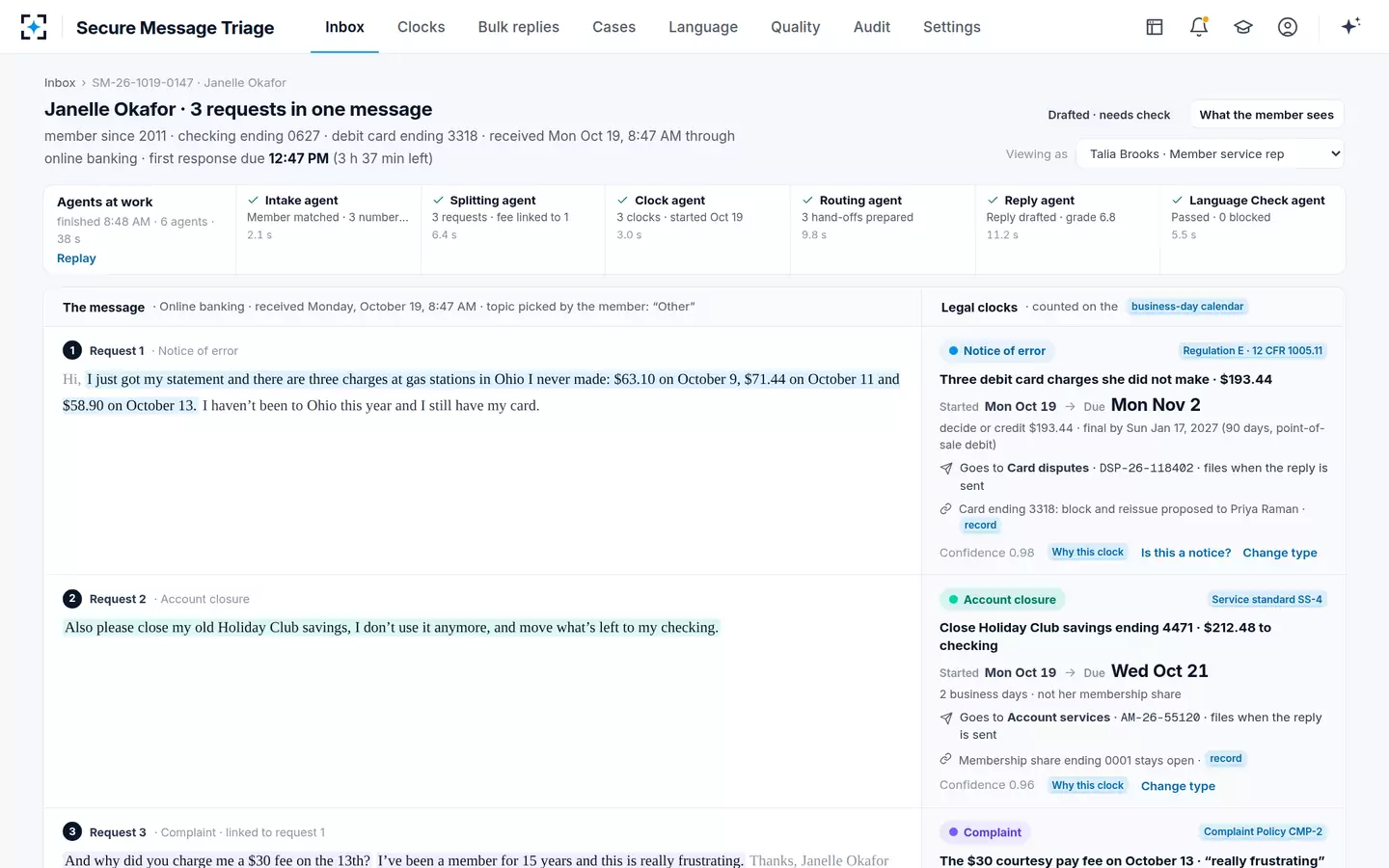
How long does a bank take to answer a secure message?
No federal rule sets a reply time for a secure message as such; each bank sets its own first-response standard, often in business hours or business days. The sample credit union promises a first response within four business hours. What the law does fix is the date on the requests inside the message: the Regulation E clock runs from the day the bank receives the notice, whether or not anyone has read it, and a notice that arrives outside business hours is still effective that day.
That gap between a service standard and a legal clock is where secure messages go wrong. A message sent on Friday evening and read on Monday afternoon has already spent part of its ten business days, and the queue's first-response report will show it as answered within standard. First response time and the Reg E clock prices that gap, and the Reg E Dispute Management series covers the full Reg E dispute timeline from day 0 to the final letter.
Can you dispute a charge by secure message?
For a debit card or other electronic transfer, yes: a secure message that identifies you and the account, says why you think a charge is wrong and gives the date and amount where you can is a notice of error, and it should be dated the day it arrived. You do not need to quote an account number if the bank can tell which account you mean, which the commentary confirms (comment 11(b)(1)-1; the full test is in what makes a Reg E notice of error). Inside a signed-in session, it almost always can.
The 60 days in the rule run from the statement on which the error first appeared, not from the transaction; the Reg E Dispute Management guide to the Reg E 60 day rule covers what happens after that. For a credit card, look at the billing rights statement on your statement or in your agreement: if it gives a web or email address for billing errors, a message there is a written notice; if it gives only a postal address, the issuer may treat a secure message as an inquiry.
What should you not send in a secure message?
A bank does not need a password, a one-time code, a PIN or a full card number to read or answer a secure message, because the customer is already signed in. Those are the details social engineers ask for, and the FFIEC's authentication guidance records how often they have talked call center and IT help desk staff into resetting passwords and other credentials (FFIEC, 2021, Section 8; the phone side of the same problem is in contact center fraud prevention). A secure inbox is a service desk in writing, and the same caution applies in both directions.
For the bank, the discipline is on the reply side. A reply that asks for a code teaches customers to give codes to anyone who writes like the bank. In Secure Message Triage the agents mask account and card numbers to their last four digits on every screen, attachment and export. The approved reply library is the place to write the other half of the rule down: a reply that never asks for a credential gives customers one consistent signal to hold on to.
How banks route secure messages, and where the wait comes from
A common set-up routes by the topic the customer picks and works the queue in arrival order. The wait comes from three places: the hours before anyone opens the message, the minutes a representative spends deciding what it is and keying it into each system, and the requests that never get keyed because the representative saw only the first one. A topic picker cannot fix any of the three, because it describes the message with one word.
Secure Message Triage changes the order of work rather than the people. Seven agents share the work: one matches the customer and accounts from the signed-in session and masks numbers, one splits the message into its requests, one decides which clock each request starts and on which day, one prepares each hand-off for the system that owns it, one drafts the reply, one checks every draft and every human edit for promises outside policy, and one draws the daily review sample. Over one sample weekend at Norrell, 2,186 messages arrived between Friday 6 PM and Monday morning; the agents found 241 notices of error and logged 131 complaints, each dated the day it arrived.
Every request goes to the system that owns it, with the customer's own date
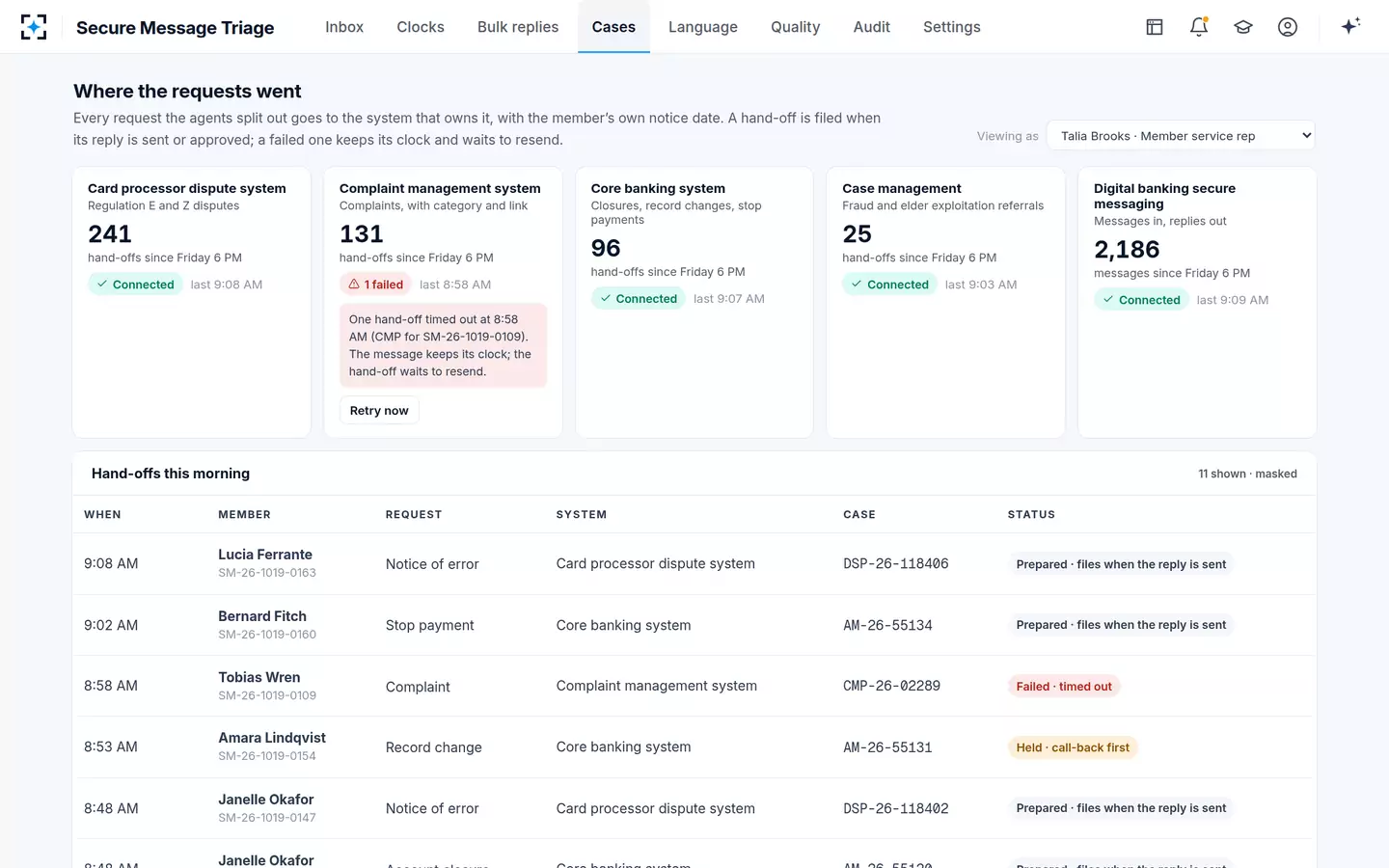
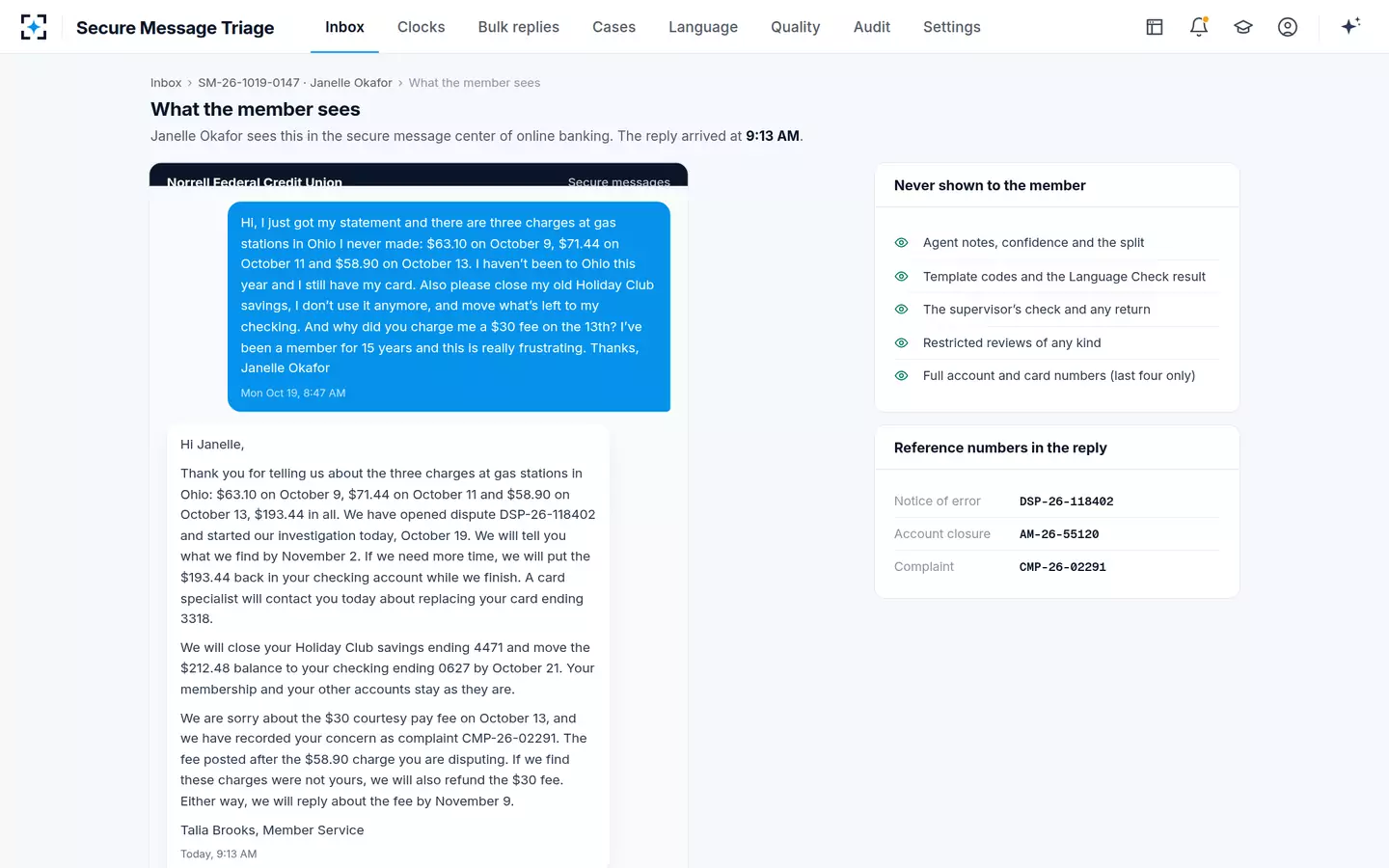
The people still decide. A representative edits and sends every reply; a supervisor who did not draft it checks every reply on a complaint and every reply that confirms a claim, closure or fee refund; and where an agent is less than 85% confident, the representative decides and gives a reason. The customer sees none of the machinery: one reply that answers each request in plain words, with a reference number for each.
What the customer sees: one answer to everything she asked
Questions people ask
Are secure messages read on weekends?
That depends on the bank's staffing; no rule requires a weekend reading. What the rules do say is that a Regulation E notice is effective when given, even outside business hours, and that a business day is any day the bank's offices are open for substantially all business functions. A message sent on Saturday is received on Saturday, and its clock is counted from there on the bank's own calendar.
Does a secure message count as written confirmation of a phone dispute?
It can. A bank that wants a phone dispute confirmed in writing may ask for it within 10 business days, provided it tells the caller so and gives the address during the call (12 CFR 1005.11(b)(2)). If the customer confirms by secure message instead of the address given, the commentary says a confirmation sent to the wrong address must still be processed through normal procedures.
Does Regulation E apply to credit unions' secure messages?
Yes. Regulation E's definition of a financial institution names credit unions alongside banks and savings associations, and reaches anyone else who holds a consumer's account, directly or indirectly, as the Federal Reserve's Consumer Compliance Outlook sets out (the same definition decides whether Zelle is covered by Reg E). A credit union member's message reporting a debit card charge is a notice of error on the same terms as a bank customer's.
What does a "you have a new secure message" email mean?
It is a notification that a message is waiting inside online banking; a real one does not need you to click its link. Sign in the way you always do, through the app or a bookmarked address, and read the message there. If the email asks you to sign in through its link, or the message asks for a code or password, treat it as suspect.
Can a bank refuse to act on a dispute sent by secure message?
A bank can name a phone number or address for error notices, but only if it has reasonable procedures to refer a customer who uses another channel (comment 11(b)(1)-6). In practice that means the message center has to recognise a dispute and pass it on, or tell the customer where to send it, rather than let it sit as an unanswered service question.
How many requests can one secure message hold?
As many as the customer writes. The sample credit union's agents found three in a single short message: a Regulation E dispute, a savings closure and a fee complaint. Each was given its own clock and owner, and the reply answered all three in numbered paragraphs.