Under Regulation E, a consumer can stop payment of a preauthorized electronic fund transfer from their account, such as a recurring ACH debit for a gym or a loan, by telling the bank, on the phone or in writing, three or more business days before the transfer is scheduled (12 CFR 1005.10(c)(1)). If the request was oral, the bank may require written confirmation within 14 days; it must say so during the call and give the address, and an oral order the customer never confirms stops binding after 14 days. A secure message asking the bank to stop next week's debit is a written stop-payment order, received the moment it arrives, and the three-business-day test is measured from that moment, not from when someone reads it. Botminds' Secure Message Triage dates every stop payment it finds in a message to the arrival time and shows the deadline beside it; this guide sets out the rule that deadline comes from.
The stop-payment rule in three numbers
3business days
before the scheduled debit: the latest a stop order must reach the bank
14days
to confirm an oral order in writing, if the bank requires it and says so on the call
0forms
the rule requires for a written order; a secure message is already in writing
What does Reg E say about stop payments?
Two short paragraphs. The first gives the right: a customer may stop a preauthorized transfer out of the account by telling the bank, by phone or in writing, no later than three business days before the transfer is due (12 CFR 1005.10(c)(1); how that right sits beside a bank's ACH fraud controls is in ACH fraud filter vs fraud monitoring). The second lets the bank ask for paper behind a phone call, and it ends with the sentence that catches most banks out:
"An oral stop-payment order ceases to be binding after 14 days if the consumer fails to provide the required written confirmation."
Regulation E, 12 CFR 1005.10(c)(2)
The right covers preauthorized transfers, which the regulation defines as transfers "authorized in advance to recur at substantially regular intervals" (1005.2(k)): the monthly insurance premium, the car loan, the streaming service on a debit card. It covers consumer accounts, the ones opened mainly for personal, family or household use (1005.2(b)(1)). A one-time debit the customer authorized last week is not a preauthorized transfer under that definition, and stopping it depends on the bank's own procedures rather than this paragraph.
The second paragraph, 1005.10(c)(2), lets the bank require written confirmation of an oral order "within 14 days of an oral notification". A bank that wants it has to say so during the call and give the customer the address to write to; only then does the 14-day lapse quoted above apply (12 CFR 1005.10(c)(2)). Error notices carry the same duty to name the address, as Reg E training sets out for the phone team.
How many days before a payment can you stop it?
At least three business days before the scheduled date. For a debit due on Friday 23 October 2026, a stop order the bank receives on Tuesday 20 October is in time; one that arrives on Wednesday 21 October is not, and the bank is no longer bound by the rule to stop that payment, though it may still try. Business days are the bank's own: days its offices are open for "substantially all business functions", which is why a bank with Saturday teller hours but no Saturday back office does not count Saturday.
The three-business-day line, and the 14 days behind an oral order
- Stop received in timeany day up to Tue 20
- Too lateWed, Thu
- Due
- 14 days to confirm in writingto Mon 2 Nov
- Lapsesafter
The bank's own cut-off can be later than the rule's but not earlier in effect. A message received at 9 PM on Tuesday is received on Tuesday: the official interpretation treats a notice given outside business hours as effective that day, as the first-response guide sets out. A bank that treats stop requests received after 3 PM as received the next day is applying a cut-off that the regulation's 24-hour business day does not provide for.
Does a stop payment have to be in writing?
No. The customer may give it "orally or in writing", and the bank must act on either. What the bank may do is require an oral order to be confirmed in writing within 14 days, provided it says so during the call and gives the address. If it does not require confirmation, the oral order stands on its own.
The bank may not add conditions the rule does not have. In 2020 the CFPB reported institutions that "required consumers to sign stop payment request forms and deposit agreements in which the consumers agreed to indemnify and hold the institutions harmless for various claims and expenses arising from the institutions honoring stop payment requests", including not holding them liable for failing to stop a payment "due to inadvertence, accident, or oversight"; examiners found those forms "impermissibly waived consumers' rights" under the EFTA and Regulation E (CFPB Supervisory Highlights, Summer 2020). A reply to a secure message that says "please sign and return the attached stop-payment form" can carry the same problem if the form does.
How long is an oral stop payment valid?
Under Regulation E, an oral order the bank required to be confirmed lapses after 14 days if the customer does not confirm it; if the bank did not require confirmation, the rule sets no lapse. A written order, including one sent by secure message, has no expiry in the rule's text. Checks follow a different rule entirely, and representatives who handle both mix them up.
A stop on a recurring electronic debit is not a stop on a check
Preauthorized electronic debit (Regulation E): Received at least three business days before the scheduled transfer.
Check (UCC § 4-403): Received in time to give the bank "a reasonable opportunity to act on it" before it pays the item.
Preauthorized electronic debit (Regulation E): Valid; the bank may require written confirmation within 14 days and must say so on the call.
Check (UCC § 4-403): Lapses after 14 calendar days unless confirmed in a record.
Preauthorized electronic debit (Regulation E): No expiry in the rule's text; if the debit is resubmitted, the bank must keep honoring the stop.
Check (UCC § 4-403): Effective for six months; renewable for further six-month periods by a record given to the bank.
Preauthorized electronic debit (Regulation E): Federal: 12 CFR 1005.10(c) and its official interpretation.
Check (UCC § 4-403): State law: the Uniform Commercial Code as each state enacted it.
Can a stop payment be requested by secure message?
Yes. A secure message is a written request from a customer the bank has already identified, which makes it as good a stop order as a letter and a better one than most calls. Its timing is its arrival time. That puts the burden on the message center: a stop request read on Monday morning that arrived on Thursday afternoon was in time for Monday's debit when it came in, and may not be by the time anyone acts on it.
The practical risk is the stop request that is not the main point of the message. "Please close my old account and stop the gym from taking money every month" contains two requests and the second has the earlier deadline. A queue that files the message as a closure, and closes the account days later, has let a debit through that the customer asked, in time and in writing, to stop. The decision tree from sentence to rule shows where stop requests sit beside disputes and complaints in the same message.
Stop payment or revoking authorization? Two different requests
A stop payment stops a payment; a revocation tells the bank the customer's authorization for that payee is no longer valid, and it reaches every future debit. The commentary is firm about the second: "Once a financial institution has been notified that the consumer's authorization is no longer valid, it must block all future payments for the particular debit transmitted by the designated payee-originator", and "the institution may not wait for the payee-originator to terminate the automatic debits" (comment 10(c)-2).
The bank may check that the customer has told the payee, "for example, by requiring a copy of the consumer's revocation as written confirmation to be provided within 14 days of an oral notification", and if that confirmation does not arrive in 14 days "it may honor subsequent debits to the account". A secure message that says "I cancelled my membership, please don't let them take any more payments" reads as a revocation, and the reply should say which of the two the bank is treating it as.
What if the payee resubmits the debit?
The stop holds. The commentary: "The financial institution must honor an oral stop-payment order made at least three business days before a scheduled debit. If the debit item is resubmitted, the institution must continue to honor the stop-payment order (for example, by suspending all subsequent payments to the payee-originator until the consumer notifies the institution that payments should resume)" (comment 10(c)-1).
Recurring debits on a debit card raise a practical problem the commentary also answers. If the bank cannot block a preauthorized debit from posting, "as in the case of a preauthorized debit made through a debit card network or other system", it "may instead comply with the stop-payment requirements by using a third party to block the transfer(s), as long as the consumer's account is not debited for the payment" (comment 10(c)-3).
Can a bank charge for a Reg E stop payment?
Yes; the rule does not forbid a fee, and the regulator's own model disclosure leaves a slot for one: "(We will charge you [insert amount] for each stop-payment order you give.)" (Regulation E, Model Clause A-2(h)(1)). The FDIC's examination manual adds that stop-payment fees "may, but need not, be disclosed under Regulation E (see Regulation DD, 12 CFR Part 1030)" (FDIC, Consumer Compliance Examination Manual VI-2), so the fee schedule the account opened under is where to look.
What a fee cannot do is become a condition. A reply that says the stop will be placed "once the fee is paid" has made the customer's right depend on something the rule does not mention. Charge the disclosed fee; place the stop.
What if the debit is taken after the stop payment?
Then the bank is responsible for the loss. The model disclosure states it plainly to customers: "If you order us to stop one of these payments 3 business days or more before the transfer is scheduled, and we do not do so, we will be liable for your losses or damages" (Model Clause A-2(h)(3)). Banks must disclose that liability when an account is opened (1005.7(b)(8)). For the customer, the right move is to tell the bank at once, in writing, with the date of the stop request; for the bank, the stop request's own timestamp is the evidence of when it was given.
Stop payment requests a secure inbox sees, and what each needs
| The customer writes | What it is | What the bank does |
|---|---|---|
| "Please stop the $89 gym payment on the 1st." | Stop payment of one preauthorized debit | Date it to arrival; if three business days or more before the 1st, place the stop. |
| "I cancelled with the gym, don't let them take any more." | Revocation of authorization | Block all future debits from that payee; it may ask for a copy of the revocation within 14 days of an oral notice. |
| "Stop the insurance debit tomorrow." | Stop request inside three business days | Not required by the rule; try, and tell the customer honestly whether it worked. |
| "They took the payment I stopped last week." | Failure to stop | Treat as urgent; the bank's liability is set out in its own disclosure. |
| "Stop check 1043." | Stop on a check | State law (UCC § 4-403): six months; an oral order lapses after 14 calendar days unless confirmed. |
A stop payment in Secure Message Triage
The stop-payment clock is a setting like the others: it starts on the day the message arrived and is due three business days before the debit; for a request that arrives later than that, the sample credit union's rule is "we try". The clocks view shows each open stop payment with its deadline and owner. On the sample Monday, one member's message asking to stop a debit due Wednesday 21 October arrived only two business days ahead; the agents marked it as inside the three days and set the stop to be in place by 5 PM on Tuesday, with account services as owner.
Every open stop payment on the clocks view, with its deadline
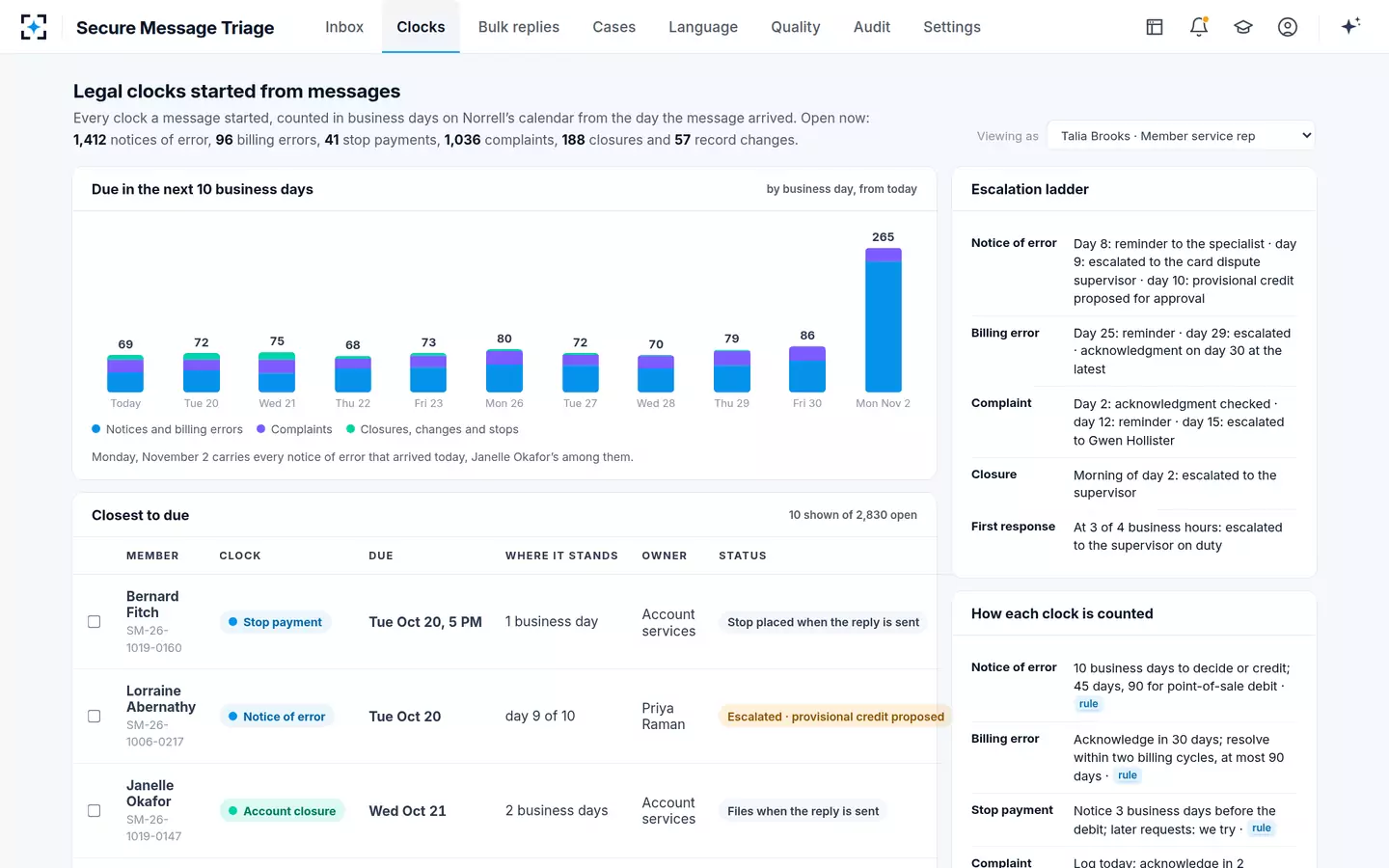
The reply matters as much as the stop. A stop request in a secure message is answered in its own numbered paragraph that says what the bank will do and by when, and whether a fee applies. Conditions the rule does not allow, such as a signed indemnity, belong nowhere in the approved template library the reply is drafted from. Where the same message also disputes a past debit from that payee, the dispute starts its own Regulation E clock, as the notice-of-error guide explains.
Questions people ask
Is Reg E 10 business days or calendar days?
The 10 days to investigate a notice of error are business days; other periods in Regulation E written in days, including the 14 days to confirm an oral stop-payment order, are calendar days, because the regulation reads "day" as a calendar day unless it says "business day". The Reg E Dispute Management guide to the Reg E error resolution calculator counts both.
Does the Reg E stop payment right apply to business accounts?
No. Regulation E covers only accounts held mainly for personal, family or household use (1005.2(b)(1)). Stopping debits on a business account depends on the account agreement and the payment network's rules.
Does stopping payment cancel what I owe the company?
No. A stop order tells the bank not to pay; it does not settle anything between the customer and the payee. Customers who want the payments to end for good should cancel with the company as well and, if they want all future debits blocked, tell the bank that the authorization is revoked.
Can a bank refuse a stop payment received on time?
Not for a preauthorized electronic transfer from a consumer account: the right belongs to the consumer, and the bank must honor an order received at least three business days before the debit. It may require written confirmation of an oral order within 14 days, and may charge the fee it disclosed.
Does a stop payment on a debit card subscription work the same way?
The right is the same if the debits are preauthorized transfers from a consumer account. Where the bank cannot block a card-network debit itself, the commentary lets it use a third party to block the transfer, so long as the account is not debited (comment 10(c)-3).