An account closure request is a customer's instruction to close a deposit or credit account, naming the account and saying where any remaining balance should go; it can arrive by letter, at a branch, on a call or, increasingly, as a secure message in online banking. The bank checks for pending debits, open disputes, automatic payments and joint owners, then closes the account and sends the balance. The difficulty is not the closure. It is what else the message says. A customer writing to close an old savings account mentions, a sentence earlier, card charges she did not make: that sentence is a Regulation E notice of error, due a decision or provisional credit in 10 business days from the day she wrote, and if the message is filed under "account closure" the closure gets done and the dispute starts late. Botminds' Secure Message Triage splits every message into its requests on arrival so that each starts its own clock. This page follows one such message, from the fictional Norrell Federal Credit Union's sample data, through a member service representative's morning.
The same message, Monday 19 October to Monday 9 November, two ways
- Closureto Wed 21
- Dispute: decide or credit provisionallydue Mon 2 Nov
- Fee complaintdue Mon 9 Nov
- Closureto Wed 21
- Dispute unseen; complaint never loggedWed 21 – Mon 2 Nov
- Member writes againkeyed Mon 2 Nov
What is an account closure request, and what does a bank check first?
It is an order to the bank, and for checking and savings accounts state law has long said what kind. The Uniform Commercial Code, adopted by the states, lets a customer, or any person authorized to draw on the account, "close the account by an order to the bank describing the item or account with reasonable certainty received at a time and in a manner that affords the bank a reasonable opportunity to act on it" (UCC § 4-403(a)). A secure message from a signed-in customer naming "my old Holiday Club savings" describes the account with reasonable certainty; the account agreement and the bank's own procedures fill in the rest.
What the bank checks first is everything that would be cut off or left hanging by closing: debits already scheduled, deposits still on their way, open disputes and provisional credits, recurring payments, linked services, other owners, and where the balance goes. The last item on that list is the one this case is about: other requests in the same message.
The message: three sentences, and the one that carries a deadline
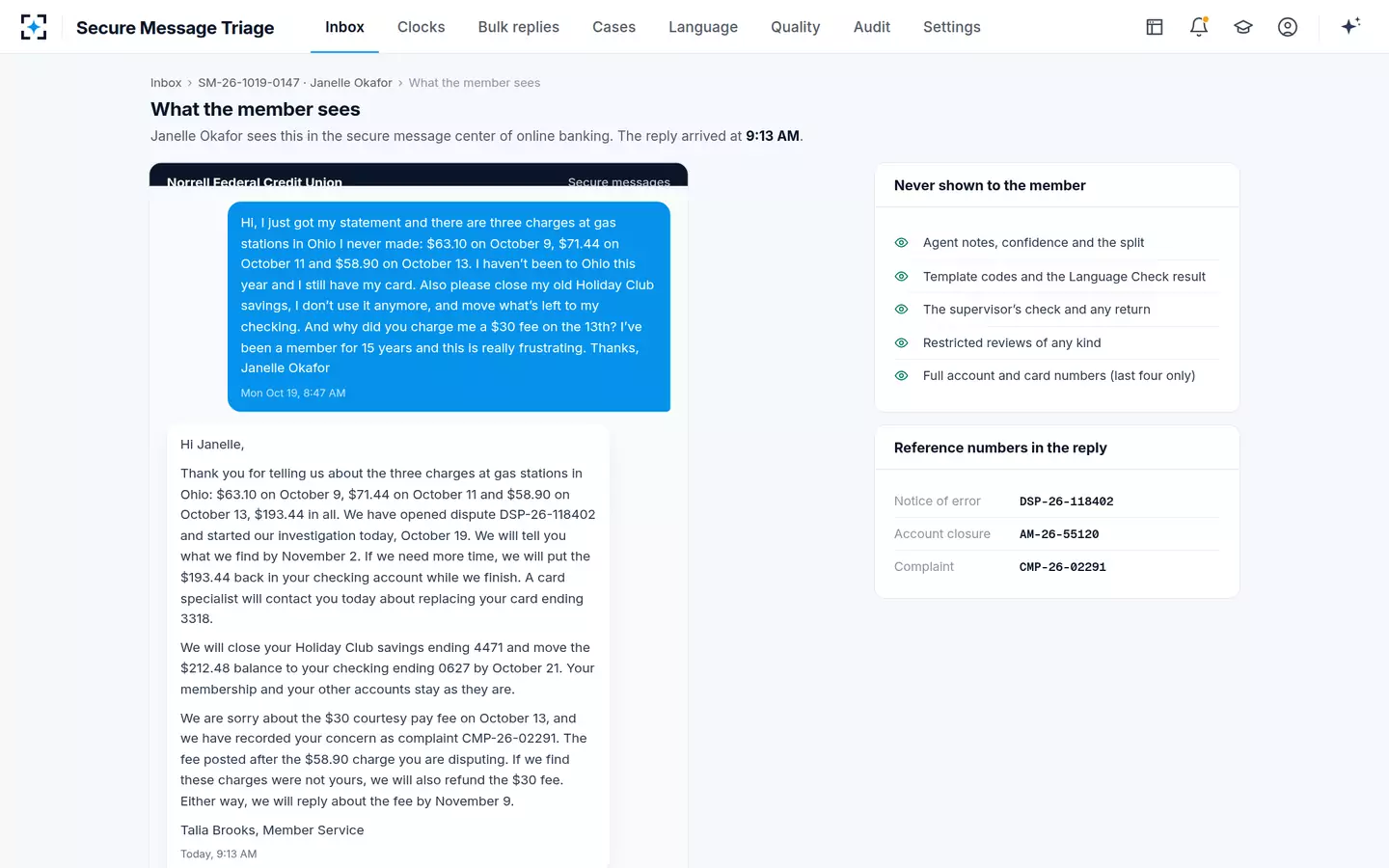
Janelle Okafor, a member since 2011, writes through online banking at 8:47 AM on Monday 19 October 2026. She picks "Other" from the topic list. Her message, in full: "Hi, I just got my statement and there are three charges at gas stations in Ohio I never made: $63.10 on October 9, $71.44 on October 11 and $58.90 on October 13. I haven't been to Ohio this year and I still have my card. Also please close my old Holiday Club savings, I don't use it anymore, and move what's left to my checking. And why did you charge me a $30 fee on the 13th? I've been a member for 15 years and this is really frustrating. Thanks, Janelle Okafor"
Read as one topic, the message is a closure; read as requests, it is three clocks
Filed under one topic: Context for the closure, or a question for later.
Split into its requests: A Regulation E notice of error for $193.44, dated Monday 19 October; due Monday 2 November.
Filed under one topic: The case: closure opened, balance moved.
Split into its requests: A closure of savings ending 4471, $212.48 to checking, due Wednesday 21 October; membership share stays open.
Filed under one topic: Answered with an apology, if at all.
Split into its requests: A complaint, logged the same day and linked to the dispute: the fee posted after a disputed charge took checking below zero.
The link in the third row is the detail a person in a hurry misses. The $30 courtesy pay fee posted at 11:58 PM on 13 October, after the disputed $58.90 charge took checking to minus $21.36; without that charge the balance would have stayed at $37.54. The fee complaint is not a separate grievance. If the charges are found to be errors, the correction Regulation E requires takes in the fees the bank charged because of them (comment 11(c)-6), so the fee belongs to the dispute and is refunded on the dispute's own Reg E timeline.
Day 0, from 8:47 to 9:13 AM: what the representative did
Talia Brooks, a member service representative who works about 120 secure messages a day, opens the message shortly after 9 AM with the agents' work already done. The table follows the 26 minutes.
The 26 minutes from the member's message to a checked reply
| Time | Who | What happened |
|---|---|---|
| 8:47 AM | Member | Message arrives through online banking; the receipt time is stamped. |
| 8:48 AM | Agents, 38 seconds | Member and accounts matched from the session; message split into three requests; three clocks started on 19 October; three hand-offs prepared; reply drafted at reading grade 6.8. |
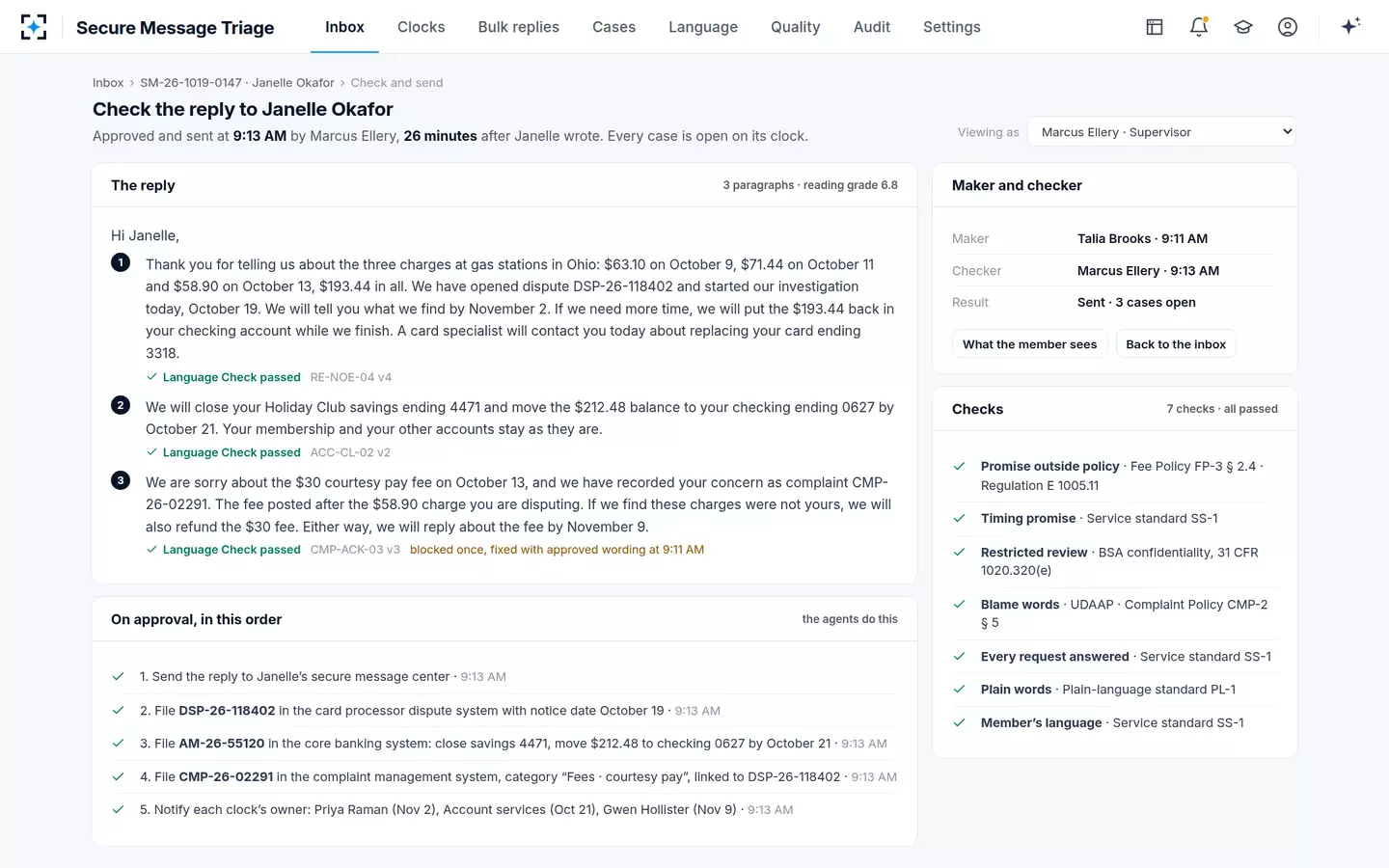
| 9:10 AM | Representative, then the language check | Talia adds "We've refunded your $30 fee today". The check blocks it under the fee policy and offers the approved sentence: "If we find these charges were not yours, we will also refund the $30 fee." |
| 9:11 AM | Representative | Takes the approved wording and sends the reply for a supervisor's check, because it carries a complaint and confirms a closure. |
| 9:13 AM | Supervisor | Marcus Ellery, who did not draft it, reviews seven checks and approves. The reply goes out; dispute, closure and complaint are filed with the member's notice date. |
The refund sentence is the second near-miss of the morning. Promising the fee back today, before anyone has investigated the charges, would have told the member the bank had already decided; the approved sentence ties the refund to the outcome, which is what the credit union's fee policy requires. Replies that cannot promise too much covers the other phrases a reply must avoid.
What the member sees: three answers, three reference numbers
Day by day: the closure, the dispute and the complaint
From Monday on, each request runs on its own calendar, and each owner sees it on the clocks view counted in business days. The closure of savings 4471 is due Wednesday 21 October under the credit union's two-business-day service standard. The notice of error is due a decision or provisional credit on Monday 2 November, ten business days after 19 October, with a reminder to the card dispute specialist on day 8 and an escalation on day 9. Because the charges were point-of-sale debit card transactions, the outer limit with provisional credit is 90 days, Sunday 17 January 2027. The fee complaint is to be resolved by Monday 9 November, fifteen business days out under the complaint policy.
The bottom lane of the timeline is what the same message does in a queue that files it under one topic. The closure is done on Tuesday. Nothing else is opened. The member waits, sees her next statement, and writes again; suppose that second message comes on Monday 2 November. The dispute team now receives a notice whose 10 business days ended that day, keyed with that day's date. Nobody did anything wrong that a closure checklist would catch, and the complaint about the fee, which might have prompted a second look, was never logged at all.
What happens to a dispute if the account is closed?
Nothing that ends it. The Regulation E commentary is direct: "The financial institution must comply with the error resolution procedures when a consumer properly asserts an error, even if the account has been closed" (comment 11(a)-4). The Federal Reserve's Consumer Compliance Outlook restates it for examiners and compliance staff: "A financial institution must follow the required error resolution procedures even if it receives notice of an error after the consumer has closed the account" (Consumer Compliance Outlook, 2025).
In this case the disputed charges were on the checking account and the closure was of a savings account, so the dispute's account stayed open. When the account being closed is the one with the disputed charge, the closure and the dispute still run separately, and the practical question becomes where a provisional credit or a final correction will be paid. That is a question to answer in the reply, not one to discover on day 10.
Can a customer dispute a charge after closing the account?
Yes. The right to assert an error survives the closure, and the timing rule does not change: a notice is timely if the bank receives it within 60 days after it sent the statement on which the error first appeared. A customer who closes an account in October and finds an unauthorized charge on the final statement in November can still give notice, and the bank's 10 business days run from that notice. The Reg E Dispute Management guide to the Reg E 60 day rule covers the window and its exceptions.
Can you close a bank account by secure message?
Usually, if the bank's account agreement and procedures allow it; the UCC's test is an order that describes the account "with reasonable certainty" and gives the bank "a reasonable opportunity to act on it". A secure message sent from a signed-in session identifies the customer and the account better than most letters do. An account agreement may still require a signed form or a call for some accounts, or another owner's agreement; in another sample message at the same credit union, a joint owner's request to close an account was held under the account agreement while an exploitation referral went to the elder exploitation team the same day.
For the representative, the order of operations matters more than the channel. Close the account after every other request in the message has its own case and its own date, not before.
What should a bank check before closing an account?
Everything the closure would cut off, and everything else the customer asked for. The list below is ours, written for a closure that arrives in a secure message.
Before closing an account that a secure message asked to close
- Every other request in the message
A dispute, a complaint or a stop payment in the same message gets its own case and its own date first.
- Open disputes and provisional credits on this account
Decide where a credit or correction will be paid once the account is closed.
- Scheduled and recurring debits
Closing the account does not cancel the payee's authorization; tell the customer, and offer to stop specific debits under 12 CFR 1005.10(c).
- Deposits on the way
Direct deposits and transfers in need a new destination before the account goes.
- Other owners and signers
Check who may close the account under the account agreement.
- The balance and how it moves
Confirm the amount and the destination account in the reply, with a date.
- Linked services
Overdraft links, bill pay, transfers and cards attached to the account.
- Fees and penalties
Any fee for early closure should be disclosed already; do not add one in the reply.
How long does an account closure take?
No federal rule sets a deadline for closing a deposit account at a customer's request; the bank sets its own standard, and the sample credit union's is two business days. Slow closures do show up in what customers report to the CFPB. The CFPB's summary of credit card complaints received in 2025 notes: "Others stated that companies did not close their accounts in a timely manner, or that companies charged them additional fees due to the company's own delays" (CFPB, Consumer Response Annual Report 2025). A closure standard is a promise in the reply; the triage step's job is to keep it from crowding out the requests with legal clocks.
A supervisor who did not draft the reply approves it, and the filings follow
What if a closure request also mentions fraud?
Then the closure is often the customer's reaction to the fraud, and it should wait for the fraud work to start, not the other way round. If the message alleges transfers the customer did not make, it is a notice of error with its own clock; if it reports a lost card or a scam, the card team and the fraud team need it today. Closing first can strand a provisional credit, break the trail an investigator needs, and leave the customer believing the problem is handled. Card blocks, account takeover and scam reports belong to the bank's fraud teams; the triage step's job is to get the message to them the same day with nothing lost.
And when the agents cannot tell whether a sentence is a notice of error, as with a daughter asking the bank to check whether transfers her father made himself were a scam, the representative decides with the options in front of them. How the Clock agent tests a notice of error shows that decision and its threshold.
Questions people ask
How do you write an account closure request letter or message?
Name the account clearly (type and last four digits), say you want it closed, and say where the remaining balance should go and how. List anything that should happen first, such as stopping a recurring debit, and if you are also disputing a charge, say so in its own sentence with the date and amount, so it is not read as part of the closure.
Does closing an account stop automatic payments?
Not by itself. The payee still has your authorization, and debits presented to a closed account may be returned unpaid, which can cause late fees with the payee. Tell each payee, and ask the bank to stop specific preauthorized debits; Regulation E lets you do that orally or in writing at least three business days before a scheduled debit.
Does Reg E apply after an account is closed?
Yes, for errors on it. The commentary requires the error-resolution procedures for a properly asserted error even if the account has been closed, so a notice about a charge on the final statement starts the same 10-business-day clock.
How long must a bank keep evidence about a dispute on a closed account?
Regulation E makes the bank keep evidence of compliance for at least two years from the day each disclosure was due or each action had to be taken (12 CFR 1005.13(b)), and longer once the bank knows it is under investigation; what that file has to hold is set out in Reg E documentation. Closing the account does not shorten that period.
Can a closure and a dispute be answered in one reply?
Yes, and they should be, in separate numbered paragraphs with a reference number each. The sample reply answered the dispute, the closure and the fee complaint in three paragraphs, so the member could see that each request had been recognised and dated.