AI customer service in banking means chatbots that answer customers directly, assistants that draft replies for staff, and software that reads and routes incoming messages. It is widespread: the CFPB found in 2023 that each of the ten largest commercial banks used chatbots, and estimated that 98 million people, about 37% of the US population, had engaged with a bank's chatbot in 2022. The rules did not change for it. A reply drafted by software and sent by the bank is the bank's statement, and in a secure inbox that statement can promise a refund before any investigation, set a condition Regulation E forbids, or hint at a confidential review. Botminds' Secure Message Triage drafts replies from approved language, and a language check reads every draft and every edit a person makes before anything can be sent; a representative sends, and a supervisor who did not draft it checks the replies that matter. This guide sets out what such a check must catch, and why.
AI is already in bank customer service; the evidence on what it does is early
10 of 10
largest US commercial banks used chatbots in customer service (CFPB review, 2023)
98M
people, about 37% of the US population, engaged with a bank's chatbot in 2022 (as reported by the CFPB)
14%
more issues resolved per hour with a generative AI assistant; 34% for novice agents (one software firm's support desk)
How is AI used in banking customer service today?
In three ways, with very different risks. Customer-facing chatbots answer in real time, without a person in the loop. Staff-facing assistants suggest answers or draft replies that an employee reviews and sends. And triage software reads written messages, works out what they ask for and routes them. Treasury's 2024 report counts customer service among the long-standing uses: "AI has long been deployed in the financial services sector in a variety of ways, including credit underwriting, insurance underwriting, trading, investment advice, customer service, compliance, forecasting, and process automation" (U.S. Treasury, December 2024).
The same report records the hesitation: respondents told Treasury that some banks keep large language models out of customer-facing work because a wrong, inconsistent or half-finished answer can become a legal claim and a reputational one (U.S. Treasury, December 2024; how that worry plays out for compliance questions is in ChatGPT for AML compliance). That concern is the design requirement for the second and third uses: keep the model away from the customer until a person has read what it wrote, and check the writing against the rules before the person does.
Are chatbots in banking regulated?
Not by a rule written for them; by every rule that already applies to what they say. The CFPB put it in one sentence in 2023, and the document remains in force: it was not on the list of 67 guidance documents the CFPB withdrew on 12 May 2025 (90 FR 20084). The spotlight says it is "not intended to impose any obligations"; the obligations it points to are the ones the laws already set.
"Like the processes they replace, chatbots must comply with all applicable federal consumer financial laws, and entities may be liable for violating those laws when they fail to do so."
CFPB, 'Chatbots in consumer finance', June 2023
The GAO's 2025 review of AI in financial services frames the trade the same way: "AI can improve customer service but could also lead to lending bias or cybersecurity risk" (GAO-25-107197). We found no federal banking regulator guidance specific to AI-drafted replies in a secure message center; the obligations come from Regulation E, Regulation Z, the unfair, deceptive or abusive practices statute, and the confidentiality rules that already govern what staff may say.
Why every reply is a statement the bank has made
Because the customer reads it as the bank's answer, and some of what it says the bank is required to say, or forbidden to say. A reply to a notice of error that says "we'll get back to you" when the bank has started its 10-business-day investigation has left out the one thing the customer needs; one that says "your money is back" before any decision has made a promise the bank may have to break. The CFPB's spotlight describes the stakes when an automated channel misreads a dispute: "Failing to recognize or resolve a dispute, therefore, can be disastrous for a person" (CFPB, 2023).
Some limits are outright prohibitions. Regulation E forbids delaying an investigation until the customer supplies information. Confidentiality rules forbid a bank or its staff to disclose a suspicious activity report, or anything that would let the reader infer one was filed (31 CFR 1020.320(e)), and a reply that explains why an account is restricted can do exactly that; how far that duty reaches is worked through in a grand jury subpoena for bank records. Others are the bank's own: a fee policy that allows a refund only after an investigation is a policy a hurried reply can break in one sentence.
What should a bank reply never promise?
A refund before an investigation, a deadline the rule does not give, or a condition the rule forbids; and it should never ask for credentials or hint at a confidential review. The comparison sets common phrasings beside wording that says the same thing safely. The right-hand column is the kind of sentence an approved template library should hold.
Phrases a reply should never send, and what to say instead
The phrase that breaks a rule or a policy: "We've refunded your $30 fee today."
Approved wording that answers the same need: "If we find these charges were not yours, we will also refund the $30 fee." (the sample credit union's approved sentence)
The phrase that breaks a rule or a policy: "Please file a police report so we can open your claim."
Approved wording that answers the same need: "We have started looking into these charges today. If you have a police report you can send it, but we do not need it to begin."
The phrase that breaks a rule or a policy: "Please contact the merchant before we can help."
Approved wording that answers the same need: "We have opened your dispute. You do not need to contact the merchant for us to investigate."
The phrase that breaks a rule or a policy: "This will be resolved within 10 days."
Approved wording that answers the same need: "We will tell you what we find by November 2. If we need more time, we will put the $193.44 back in your checking account while we finish."
The phrase that breaks a rule or a policy: "Please confirm your card number and the code we just texted you."
Approved wording that answers the same need: "You don't need to send card numbers or codes in a message; we can already see your accounts."
The phrase that breaks a rule or a policy: "Your account is under review by our BSA team."
Approved wording that answers the same need: "A specialist team will reply to you about this."
Can a bank ask for a police report before investigating?
It can ask; it cannot wait for one. The CFPB answers that exact question in its Electronic Fund Transfers FAQs with a plain no: the investigation starts when the notice arrives, by phone or in writing, and nothing the bank asks the customer to supply, a police report included, may hold it up (CFPB, EFT FAQs, error resolution, question 4). The commentary behind that answer, and how to train a frontline team on it, is in Reg E training.
Examiners have also found the condition written into account agreements. In 2020 the CFPB reported deposit agreements that made customers promise to "cooperate" with any error investigation, which in practice meant signing affidavits and going to the police; examiners treated those clauses as waivers of rights the EFTA gives the customer (Supervisory Highlights, Summer 2020). What a phone dispute requires of the bank, and what it cannot require of the caller, is in Reg E written notification requirements. For credit cards, the CFPB's case against Citizens Bank turned on billing error claims denied because a fraud affidavit was not returned, and ended in a $9 million penalty in 2023 (CFPB). A reply template that says "send us the signed form and we will start" puts the same condition in front of every customer who reads it.
Can AI write replies to bank customers?
It can draft them, and the bank should treat the draft as a draft. The cautionary case is not a reply at all but a decision, Bank of America's automated denial of notices of error in 2020 and 2021, told in how to test AI email triage before it goes live. The lesson for replies is the same: software prepares, a person decides what the bank says.
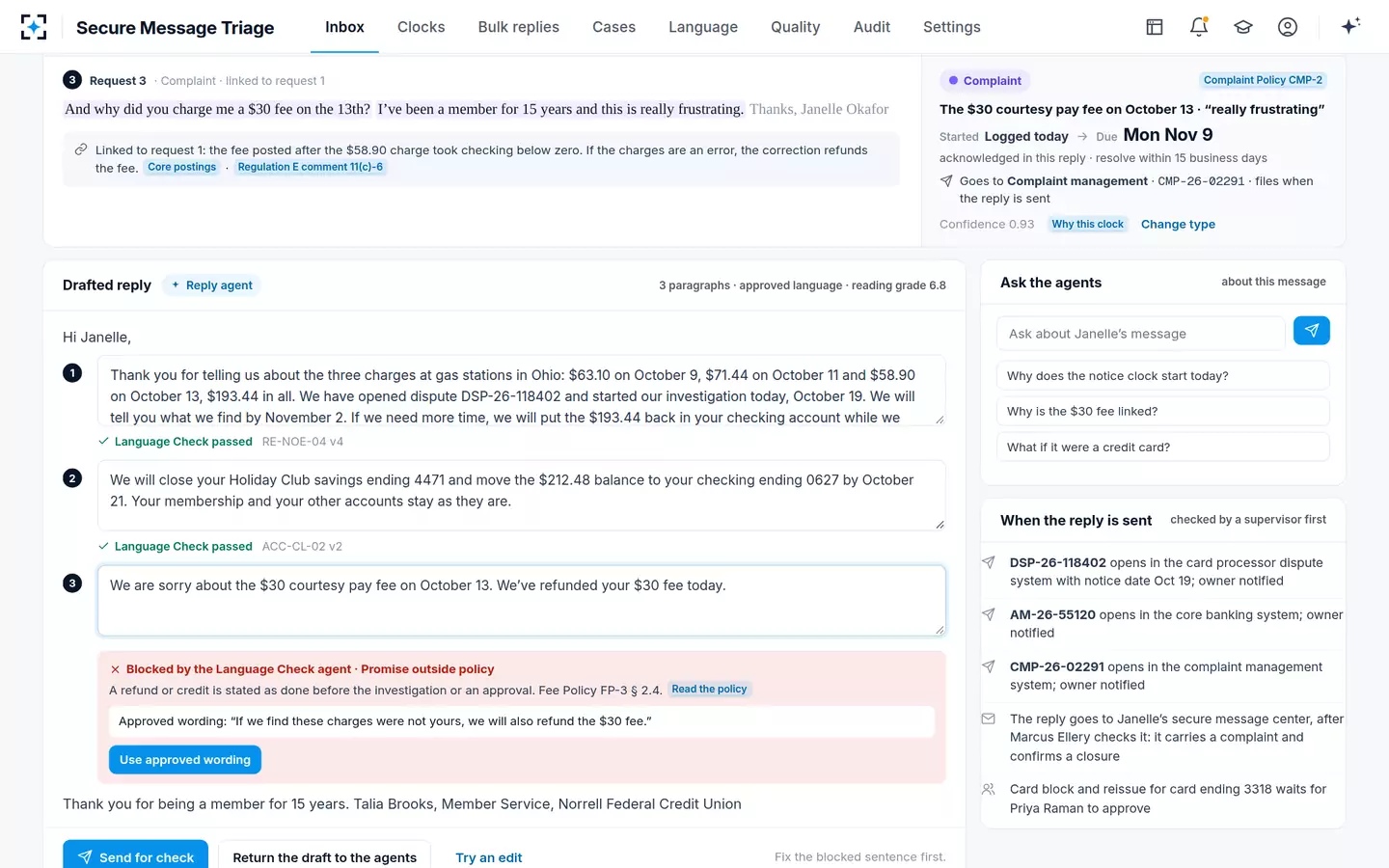
In Secure Message Triage the Reply agent drafts one reply from approved language, one numbered paragraph per request, in the customer's language, under a reading grade of 8; it never sends, and it never drafts for a restricted account. Each paragraph names the template and version it came from. Then the language check reads it, and reads again whenever a person changes a word.
A refund promise outside policy, blocked before it can be sent
The language check: what it reads, and what it blocks
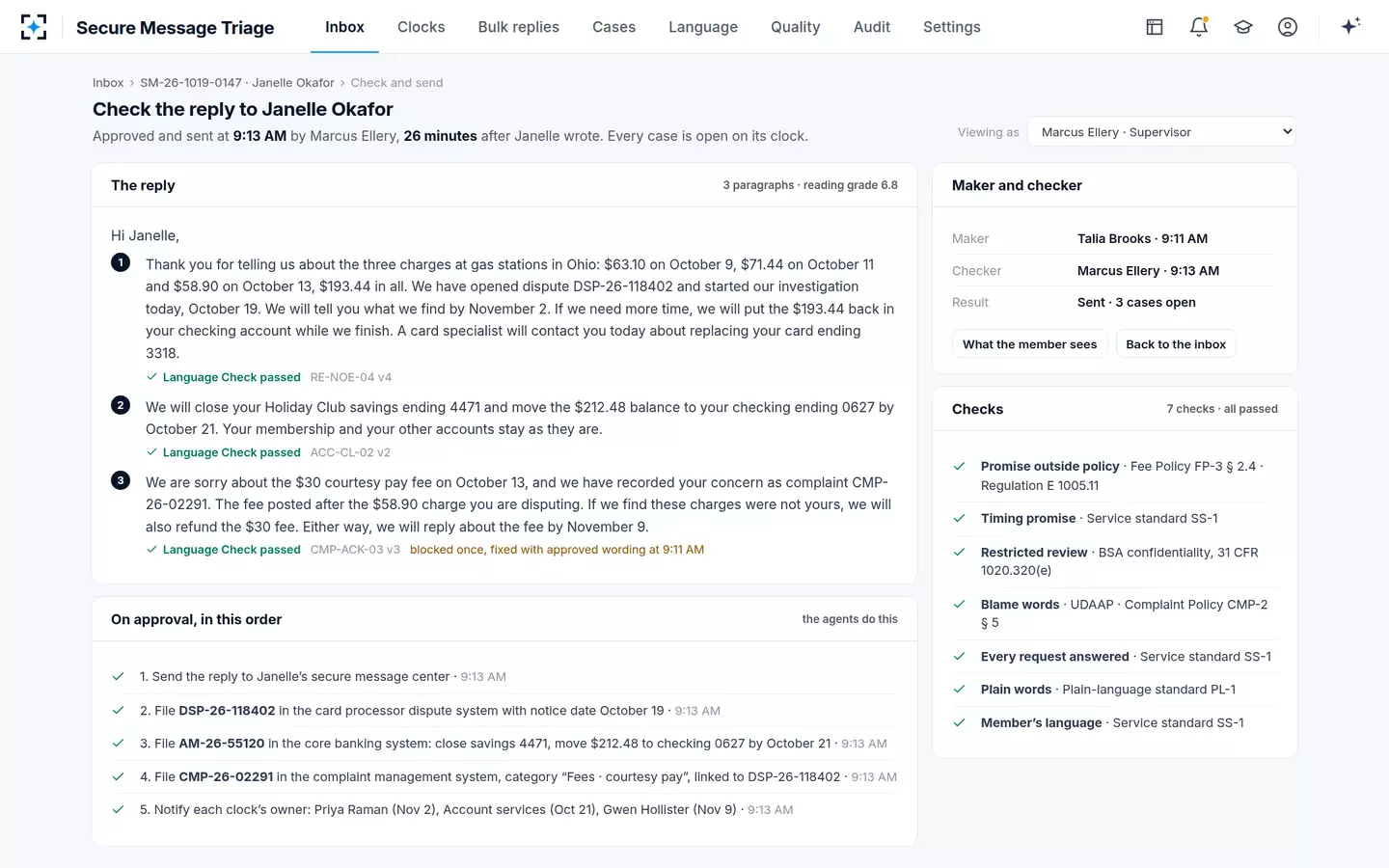
It reads every draft and every human edit, and it blocks rather than guesses: a sentence it cannot clear does not go out until a person fixes it with approved wording. It never rewrites a sentence without showing the change, and each block names the policy or rule and offers the approved sentence with its source. On the sample reply the supervisor saw seven checks: promises outside policy, timing promises, anything that could reveal a restricted review, blame words, whether every request was answered, plain words, and the member's language.
What a reply in a regulated inbox may never do
- State a refund or credit as done before a decision
Tie it to the outcome instead; a provisional credit is described as provisional.
- Promise a date the rule does not
Say when the bank will report, and what happens if it needs longer.
- Make a police report, affidavit or merchant contact a condition
The bank may ask for information, but may not delay the investigation for it.
- Ask for a password, code, PIN or full card number
A signed-in customer has already been identified; asking trains customers to answer impostors.
- Reveal or hint at a confidential review
Messages on restricted accounts go to a specialist team with nothing drafted.
- Blame the customer
Negligence does not change a consumer's liability under Regulation E; a reply should not suggest it does.
- Leave a request unanswered
One numbered paragraph per request, so the customer can see each was recognised.
- Use internal codes or jargon
Template codes, agent notes and check results stay inside the bank.
Who approves AI drafted replies?
A person always sends, and a second person checks the replies where a mistake would be expensive. In the sample configuration a representative edits and sends; a supervisor who did not draft it checks every reply on a complaint, every reply that confirms a claim, closure, fee refund or account change, and every bulk reply; and a sample agent draws 5% of the day's other sent replies for a supervisor the next morning. The supervisor's screen shows the reply, its seven checks, and exactly what will happen on approval, in order.
A supervisor who did not draft the reply checks it and sends it
Can AI replies be used for complaints?
Yes, with the complaint logged first and every complaint reply checked by a second person. A complaint reply is where blame words and defensive explanations creep in, and where the customer is most likely to take the matter further, to the regulator if not to the branch. In Secure Message Triage the complaint is logged the day the message arrives, linked to any dispute behind it, and the reply's complaint paragraph comes from language the complaint officer co-approves.
In the sample message the fee complaint was linked to the dispute because the fee posted after a disputed charge took the account below zero. That link is what made the refund promise wrong and the conditional sentence right. The full message, day by day, shows how the three requests were answered in one reply.
What are the risks of AI customer service in banking?
The CFPB's 2023 review lists them from the customer's side: wasted time, "receiving inaccurate information", "doom loops" with no way to reach a person, failure to recognise a dispute, and impersonation of chatbots by scammers. The last of those is why replies must never ask for credentials; how secure message scams work covers it from the customer's side. On the bank's side the risks are the ones above: a promise that becomes a liability, a condition that becomes a violation, a hint that becomes a disclosure.
The research on benefits is real but narrow. The NBER study of 5,179 customer support agents found a generative AI assistant raised issues resolved per hour by 14% on average and by 34% for novice and low-skilled workers, "with minimal impact on experienced and highly skilled workers" (NBER w31161). The firm studied was a software company, not a bank, and the tool was given to the agents, not to the customers; a regulated inbox should keep that arrangement.
Questions people ask
Do customers have to be told a reply was drafted with AI?
We found no federal consumer financial rule that requires a bank to label a reply that software drafted and an employee sent. Respondents to Treasury's 2024 request for information proposed disclosure when AI tools inform decisions about credit and other products; a bank's own policy can go further.
What happens when the language check blocks a sentence?
The reply cannot be sent until the sentence is fixed. The block names the policy or rule, and offers the approved sentence with its source; the representative can take it, edit again, or return the draft to the agents. Each block and fix stays on the audit trail.
Can AI decide whether to refund a fee?
Not in Secure Message Triage. The agents can link a fee to a disputed charge and draft the conditional sentence; whether a fee is refunded follows the investigation and the bank's fee policy, and any reply that confirms a refund goes to a supervisor first.
Should AI replies be in the customer's language?
Yes, if the bank serves customers in that language; the sample credit union's approved language exists in English and Spanish, and "member's language" is one of the seven checks. A notice of error written in Spanish starts the same clock as one in English.
Is a chatbot conversation a notice of error?
It can be. Regulation E covers any oral or written notice that meets its elements, and the CFPB's spotlight warns that chatbots may recognise a dispute only from specific words. The Reg E Dispute Management guide to Reg E training covers what frontline staff and channels must capture.