Email triage software reads incoming customer messages, works out what each one asks for, sends each request to the team that handles it and drafts a reply. For a bank's secure inbox the bar is higher than for a general service mailbox: a single message can hold a Regulation E notice of error, a complaint and an account closure, each with its own deadline from the day the message arrived, and a reply that promises too much is a statement the bank has made. Botminds' Secure Message Triage is email triage software built for that inbox. With its connections to digital banking, the core system and the dispute and complaint systems in place, it can be live on a bank's own messages in about eight weeks, if the rollout is staged: two weeks to load the bank's rules, calendar and approved language, two weeks in shadow mode on live messages with nothing sent, two weeks of supervised drafts, and then live, with a second person still checking every reply that matters. That is our suggested plan, not a promise for every bank, and the rest of this page is what each stage has to prove.
Eight weeks from connection to live, with nothing sent until week five
- Rules, calendar, language, connectionsWeeks 1–2
- Shadow mode on live messagesWeeks 3–4
- Supervised draftsWeeks 5–6
- Live, second person keptWeeks 7–8
- Today's process, unchangedWeeks 1–4
- Replies from checked draftsWeeks 5–8
What is email triage software, and what must it do in a bank's secure inbox?
In a bank's secure inbox, email triage software has five jobs, and only the first is what most products mean by triage. It must identify the customer and accounts from the signed-in session; split each message into its separate requests; date each request's legal clock to the day the message arrived; hand each request to the system that owns it with that date; and draft one reply from approved language that a person checks and sends. A tool that does the first job well and the other four not at all is a sorter.
The dating job is the one that separates bank-grade triage from the rest, because it is where a miss costs a customer a protection. Regulation E's 10 business days run from receipt, and a notice inside a fee complaint is still a notice. The planted test for AI email triage is how a bank checks that job before it buys; this plan is how it checks it again before it goes live.
How long does it take to implement email triage software?
About eight weeks for one secure inbox when the connections exist, and longer when they do not. The weeks are not spent building; they are spent proving. Two weeks load the bank's own rules and language. Four weeks run the software alongside the people, first silently and then with every reply checked, so that by the time it drafts for customers the bank has seen it handle a month of its own messages.
Treasury's 2024 report on AI in financial services sets the expectation plainly: check each AI use against the laws that already apply before it goes live, and check it again as it runs (U.S. Treasury, December 2024; the same recommendation applied to wire compliance is in how to use AI for regulatory compliance). The staging below is that review, done on live messages rather than on paper.
Weeks 1–2: your rules, your calendar, your approved language
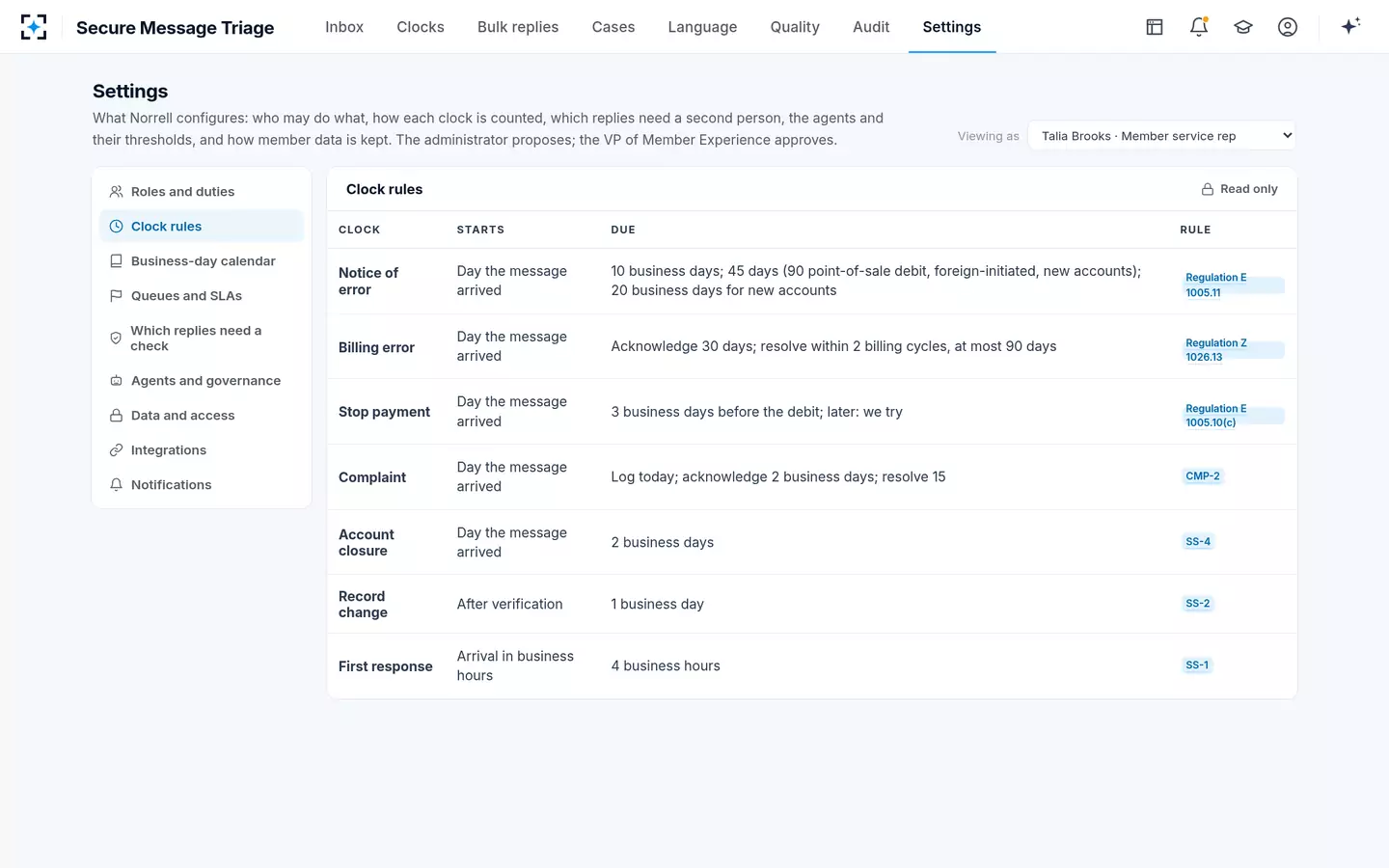
The software is configured with the bank's rules, not the vendor's. Each legal clock is a setting with its start, its deadline and the rule behind it: Regulation E notices of error, Regulation Z billing errors, stop payments under 1005.10(c), and the bank's own complaint, closure and first-response standards. Changes follow a maker-checker path: at the sample credit union an administrator proposes a setting and the VP of Member Experience approves it, and both go on the audit trail.
The calendar needs more care than it looks. Regulation E counts as business days only the days the bank's offices are open to the public for substantially all of their business (12 CFR 1005.2(d)), and the commentary gives the example that matters to anyone with Saturday branch hours: a bank whose branches take deposits and withdrawals on Saturday but whose back office does not work error investigations that day does not count Saturday as a business day (comment 2(d)-2; a day-by-day count is in the Reg E error resolution calculator). The bank's business days are also one of its required disclosures (1005.7(b)(3)), so the triage calendar should match what the bank has already told its customers.
The approved language is the last input and usually the longest. Take the bank's best recent replies by request type, have compliance and the complaint officer approve each as a versioned template in each language the bank serves, and write down what no reply may say. Finally, export a masked sample of last quarter's messages for the shadow comparison and the planted test.
Clock rules, set by the bank and approved by a second person
What is shadow mode for AI? Weeks 3–4 on live messages, nothing sent
Shadow mode means the software runs on every live message while the team works exactly as before, and nothing it produces reaches a customer or a downstream system. Each day, a compliance analyst compares what the agents found with what the representatives did: every request the agents split out that no case was opened for, every clock date that differs from the date keyed, every draft that a representative's actual reply contradicts. Most differences will be the people's misses, not the software's; the point is to know which.
"AI system performance or assurance criteria are measured qualitatively or quantitatively and demonstrated for conditions similar to deployment setting(s)."
NIST, AI Risk Management Framework 1.0 (AI 100-1), MEASURE 2.3
Shadow mode on live messages is the closest any test can get to the deployment setting, because it is the deployment setting minus the sending. Run the planted test in the same fortnight: the planted notices go through the same software as the real messages, and the scoring is blind. Two things should be zero at the end of week 4: notices the agents missed that a person found, and notices the agents dated later than the day the message arrived.
Weeks 5–6: supervised drafts, every reply checked
In supervised mode representatives work from the agents' drafts and every reply goes to a supervisor before it is sent. The hand-offs to the dispute, complaint and core systems are filed only when the reply is approved. Three numbers matter in these weeks: how often representatives change a draft and why, how often the language check blocks a sentence a person added, and whether any reply was approved with a request unanswered.
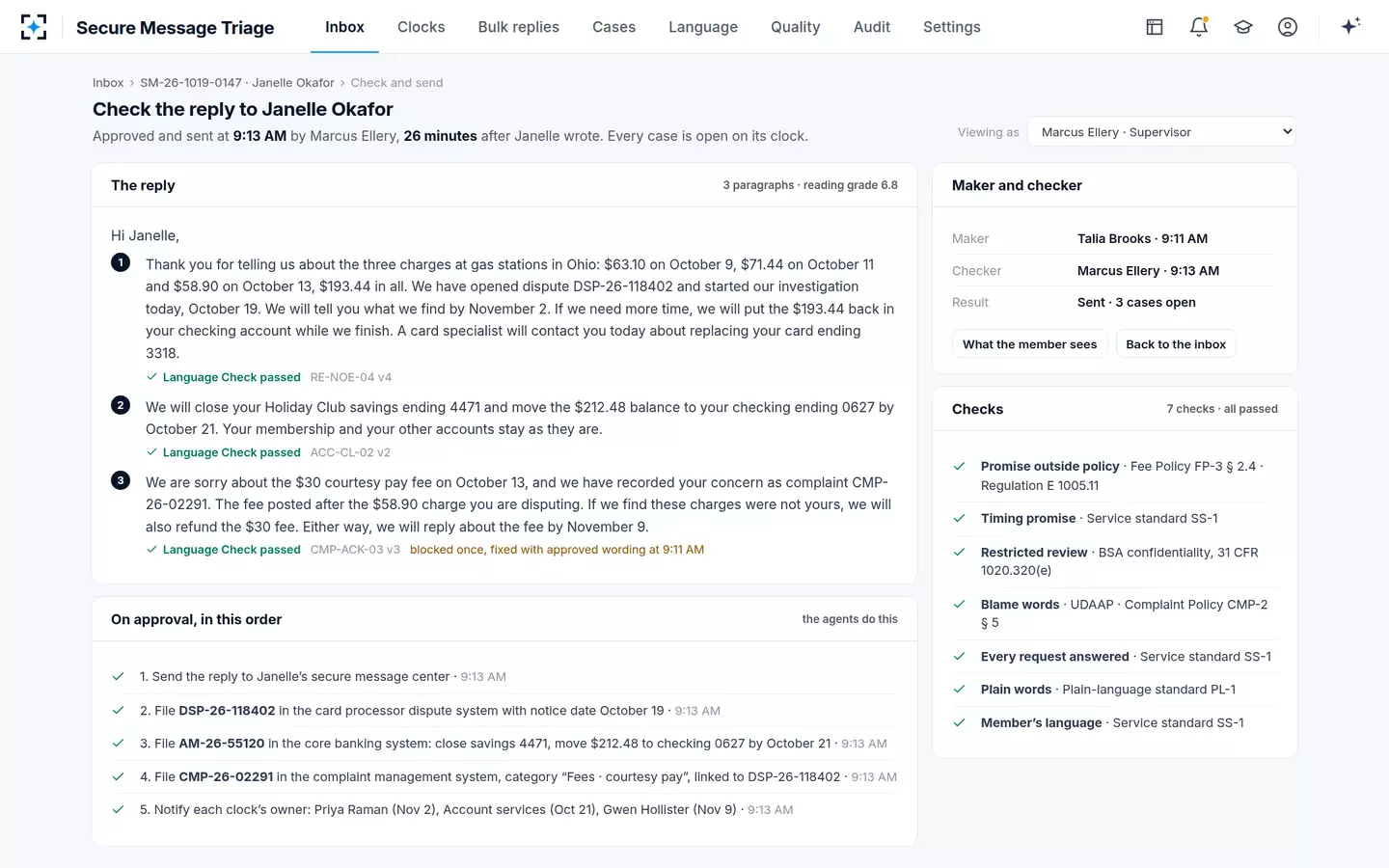
The language check is worth watching closely here, because people under queue pressure write the promises templates are designed to avoid. In one sample message a representative added "We've refunded your $30 fee today" to a reply about a fee caused by a disputed charge; the check blocked it under the credit union's fee policy and offered the approved conditional sentence. That is the behaviour to see dozens of times in week 5, not for the first time in week 9. Why a reply cannot promise too much sets out the rules behind it.
Weeks 7–8: live, with the second person kept where it matters
Going live means representatives send most replies themselves, and the second person stays on the replies where a mistake is a statement the bank cannot take back: every reply on a complaint, every reply that confirms a claim, closure, fee refund or account change, and every bulk reply. The rest are sampled: a sample agent draws 5% of the day's other sent replies for a supervisor the next morning, and never passes or fails one itself.
"The functionality and behavior of the AI system and its components – as identified in the MAP function – are monitored when in production."
NIST, AI Risk Management Framework 1.0 (AI 100-1), MEASURE 2.4
Monitoring in production is ordinary work once the trail exists. In Secure Message Triage every split, clock, draft, edit, block, check and send is logged with who did it, agent or person, and when; an export for examiners builds in one step, with account numbers masked and restricted reviews excluded.
A supervisor who did not draft the reply checks it before it goes
What are go-live criteria for AI triage?
Criteria that can fail, written before the rollout starts, and checked at the end of each stage by someone who does not run the software. The checklist below is the set we would hold Secure Message Triage, or any triage tool, to before it drafts for a bank's customers.
Criteria to pass before moving from one stage to the next
- No missed notices in the planted test
Every planted notice of error found, with the answer key held by compliance. Any miss is explained and fixed, then the test is rerun.
- Every clock dated to the arrival day
In shadow mode, no notice dated later than its message, including weekend and after-hours messages.
- Every request in a multi-request message answered
Supervisors find no approved reply that leaves a request unanswered.
- No blocked sentence sent
The language check blocks promises outside policy in drafts and in human edits, and nothing blocked reaches a customer.
- Hand-offs tested, including failure
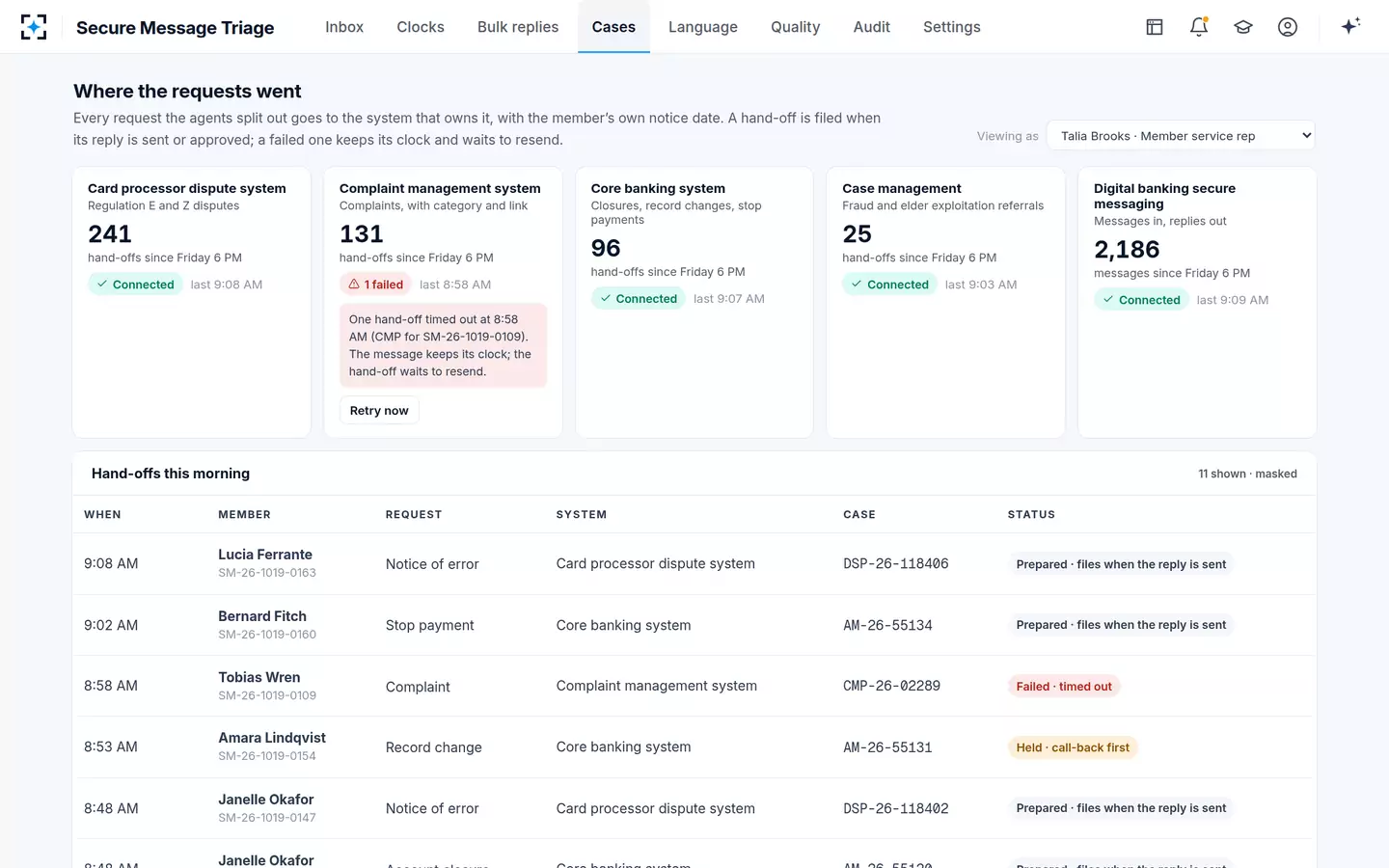
Each system receives its request with the customer's notice date; a failed hand-off waits to resend and the message keeps its clock.
- Restricted accounts handled
Messages on restricted accounts go to the specialist team with nothing drafted and nothing in the reply that hints at a review.
- Bulk replies hold out other requests
An outage flood gets one approved reply; every message that also carries a notice, complaint or closure is held out.
- Low-confidence decisions go to a person
Below the threshold the representative decides, with a reason code, and the decision is logged.
- An export for examiners can be produced
Masked, complete for the period, and reconciled to the message count.
- A way back
Turning off drafting returns the team to today's process the same day, with every clock already started kept.
Can email triage software integrate with online banking?
It has to, or it cannot do the dating job: the message, the customer's identity and the receipt time all live in the digital banking platform's secure messaging. Secure Message Triage works with five kinds of system, each carrying something the triage step needs or produces.
The systems a secure-inbox triage connects to, and what to test on each
| System | What comes in | What goes out | Test before live |
|---|---|---|---|
| Digital banking secure messaging | Messages, attachments, the signed-in customer, the receipt time | Replies into the customer's message center | Receipt time is the platform's, not the time the software read it |
| Core banking system | Accounts, postings, statements and statement dates | Closures, account changes, stop payments | Statement dates match what customers received |
| Card processor dispute system | Card authorizations | Disputes with the customer's notice date | The notice date is not overwritten by the filing date |
| Complaint management system | — | Every complaint, categorized and linked to any dispute behind it | A timed-out hand-off resends without losing its date |
| Case management | — | Fraud and elder-exploitation referrals | Referrals reach the team the same day |
Each request handed to the system that owns it, and a failed hand-off caught
Who approves replies during rollout?
The same people who approve them afterwards, with more of them checked. In supervised weeks every reply goes to a supervisor; after go-live the supervisor keeps complaint, claim, closure, refund, account-change and bulk replies, and the sample covers the rest. Around them, each role keeps its own decisions.
Who decides what, during the rollout and after it
| Role | Decides | Never |
|---|---|---|
| Member service representative | Edits and sends replies; decides below the confidence threshold, with a reason | Checks a reply they drafted |
| Member service supervisor | Checks, returns or approves replies; approves bulk sends | Approves a reply they drafted |
| Card dispute specialist | Owns each dispute; approves card blocks and provisional credit | Inherits a dispute without its notice date |
| Complaint management officer | Co-approves reply language; owns the complaint log | Learns of a complaint only if someone remembered to log it |
| BSA officer | Handles messages on restricted accounts | Has a review mentioned in any reply |
| Administrator and VP of Member Experience | Propose and approve settings: clock rules, thresholds, which replies need a check | Change a setting without the other |
| Internal auditor | Reads and exports the trail | Changes anything |
What is the best email triage software for banks? Where this one fits
The best one for a bank is the one that passes the planted test on the bank's own messages, dates every clock to arrival, and cannot send or decide anything a person has not approved. Ask any vendor for those three before price. Secure Message Triage was designed around them: seven agents read, split, date, hand off, draft, check and sample; a representative sends; a supervisor who did not draft it checks the replies that matter.
It fits a bank or credit union with a secure message center in online and mobile banking, a core system, a card processor and a complaint system to connect to, and a compliance team that will own the rules and the language. It does not fit as a general marketing or sales inbox tool, it does not investigate or decide disputes (the bank's dispute team does, with tools such as Reg E Dispute Management), and it does not replace authentication, which happens before a customer can write a secure message at all. And because first response time and the Reg E clock are separate clocks, a fast queue is not by itself the result to buy.
Questions people ask
Can a bank go live faster than eight weeks?
The configuration weeks can shrink if the bank's approved language already exists. The shadow and supervised weeks should not, because they are what produce the evidence: a fortnight of live messages, a blind planted test and a fortnight of checked drafts. Cutting them means going live on a vendor's numbers rather than your own.
Does shadow mode change anything customers see?
No. In shadow mode the software reads and drafts but sends nothing and files nothing; the team works as it does today. Customers see a change only in week 5, when replies start from drafts a supervisor checks.
What if we have no approved reply library?
Build one in weeks 1 and 2 from the bank's best recent replies, one template per request type and language, approved by compliance and the complaint officer and versioned. Each reply paragraph then names the template and version it came from, which is what an examiner or auditor will ask for.
What happens if a downstream system is down?
The hand-off waits and resends; the message keeps its clock. In the sample data the complaint system timed out at 8:58 AM on a Monday morning, and the hand-off sat in a visible retry state with the customer's original date rather than disappearing.
How do we roll back if something goes wrong?
Switch drafting off and the team returns to writing replies by hand the same day. Write the rollback so that every clock already started stays in front of its owner; a rollback that loses a notice date has traded one risk for a worse one.