Regulation Z billing error resolution is the procedure 12 CFR 1026.13 sets for credit card and other open-end credit disputes: the cardholder sends a written billing error notice that reaches the card issuer within 60 days of the first statement showing the error, the issuer acknowledges it in writing within 30 days, and resolves it within two complete billing cycles and no later than 90 days. Regulation E's error resolution, in 12 CFR 1005.11, covers debit cards, ACH and other electronic transfers from deposit accounts, accepts an oral or a written notice, and gives the bank 10 business days to decide or to credit provisionally. In a secure message the hard question is narrower than the rule: whether this message, sent through this channel, is a billing error notice at all, and if not, what the reply has to tell the cardholder today. Botminds' Secure Message Triage makes that call request by request, and this guide sets the decision out as a tree a person can follow too.
From a sentence in a secure message to the rule and the clock it starts
Does the sentence ask the bank for something, or report a problem? If not, no clock starts. If it does, ask what it concerns.
A debit card, ACH, transfer or ATM: money in or out of a deposit account
Regulation E
- A charge they did not make, a wrong amount, a missing transfer, or "what is this charge?"Notice of error. 10 business days from receipt to decide or credit provisionally (1005.11).
- Stop a future automatic debitStop payment. Honored if received at least three business days before the debit (1005.10(c)).
- A lost card, with no charge allegedA card block, not yet an error (comment 11(a)-3).
A credit card or other credit line
Regulation Z
- One of the seven billing errors, sent by a means the billing rights statement namesBilling error notice. Acknowledge within 30 days; resolve within two billing cycles, at most 90 days (1026.13).
- The same, by a channel the statement does not nameNot a 1026.13 notice yet: tell the customer today where to send it. A report of unauthorized use still counts as notification under 1026.12(b)(3).
Neither: a fee, the service, or the account itself
The bank's own policies
- Dissatisfaction about a fee or the serviceComplaint, logged the day it arrives, on the bank's complaint policy.
- Close the account, change an addressAccount services, on the bank's service standard and agreement.
What is a billing error under Regulation Z?
A billing error is one of seven things listed in 1026.13(a), all of them about what a periodic statement shows. They are a charge for credit not made to the cardholder or someone with authority to use the card; a charge not properly identified; a charge for goods or services not accepted or "not delivered to the consumer or the consumer's designee as agreed"; a failure to credit a payment or credit properly; a computational error by the creditor; a charge for which the consumer asks for clarification, including documentary evidence; and a failure to send a statement to the cardholder's last known address (12 CFR 1026.13(a)).
Two of those reach further than debit-card rules do. A merchandise dispute, the goods that never came, is a billing error under Regulation Z; Regulation E's list of errors has no item for goods that never arrived on a debit card purchase the customer authorized. And a request for clarification of a charge is a billing error, just as a request for information about a transfer is a Regulation E error. A credit card holder who writes "what is this charge?" has, if the notice is properly sent, started a 30-day acknowledgment clock.
Does a billing error notice have to be in writing?
Yes. The rule defines the billing error notice as "a written notice from a consumer" that is "received by a creditor at the address disclosed" in the billing rights statement, no later than 60 days after the creditor sent the first statement reflecting the error (1026.13(b)). The regulator's own model disclosure tells cardholders what a phone call does not do.
"You must notify us of any potential errors in writing [or electronically]. You may call us, but if you do we are not required to investigate any potential errors and you may have to pay the amount in question."
Regulation Z, Appendix G, Model Form G-3(A), 'Your Billing Rights'
That is the sharpest difference between the two regulations. Under Regulation E a phone call is a notice and the investigation must start on it; under Regulation Z a phone call is a conversation, and the cardholder's billing rights attach to the written notice. A secure message is written, so the question it raises under Regulation Z is not the form but the address.
Can a billing error notice be sent electronically?
Yes, where the card issuer has said so. The official interpretation provides that "if the creditor stipulates in the billing rights statement that it accepts billing error notices submitted electronically, and states the means by which a consumer may electronically submit a billing error notice, a notice sent in such manner will be deemed to satisfy the written notice requirement for purposes of § 1026.13(b)" (comment 13(b)-2). The model form leaves room for exactly that: "[You may also contact us on the Web: [Creditor Web or email address]]".
So the answer for any one bank is in its own billing rights statement. If the statement names the online-banking message center, or "our website", a secure message about a credit card charge is a billing error notice on the day it arrives. If the statement gives only a postal address, it is not one yet, and the reply has to say so plainly and tell the cardholder how to send it.
Debit card or credit card: what changes for the message
The same complaint, a customer says a charge is wrong, meets different rules at almost every step depending on the card it posted to. The comparison below is limited to what triage needs to get right in the inbox; the card issuer's full comparison of the two regimes is in the Card Dispute Management guide to Reg E vs Reg Z disputes.
What changes between a debit card dispute and a credit card dispute
Regulation E (debit card, ACH, transfers): Oral or written. The investigation starts on an oral notice.
Regulation Z (credit card, open-end credit): Written, or electronic where the billing rights statement says so.
Regulation E (debit card, ACH, transfers): Anywhere, unless the bank names a number or address and refers customers who use another channel.
Regulation Z (credit card, open-end credit): The address, or electronic means, disclosed in the billing rights statement.
Regulation E (debit card, ACH, transfers): 60 days after the statement first showing the error was sent.
Regulation Z (credit card, open-end credit): 60 days after the first statement reflecting the error was transmitted.
Regulation E (debit card, ACH, transfers): 10 business days to decide, or to credit provisionally.
Regulation Z (credit card, open-end credit): 30 days to acknowledge in writing, unless resolved within the 30.
Regulation E (debit card, ACH, transfers): 45 days with provisional credit; 90 for point-of-sale debit, transfers not initiated within a state, and new accounts.
Regulation Z (credit card, open-end credit): Two complete billing cycles, and no later than 90 days.
Regulation E (debit card, ACH, transfers): Provisional credit with full use of the funds, if the bank takes longer than 10 business days.
Regulation Z (credit card, open-end credit): No duty to pay the disputed amount; no collection, no adverse credit report on it.
Is a credit card dispute in a secure message a billing error notice?
It is when the billing rights statement names an electronic means that covers the message center; otherwise it is a written message that has not yet reached the place the rule requires. Even then it is not nothing. If the customer reports a charge they did not make, Regulation Z's separate liability rule applies, and it is generous about form: notification of loss, theft or possible unauthorized use "may be given, at the option of the person giving it, in person, by telephone, or in writing", and written notification "is considered given at the time of receipt" (12 CFR 1026.12(b)(3)). The cardholder's liability for unauthorized use is capped at $50 or less.
The reply is where banks get this wrong. In 2020 the CFPB sued Citizens Bank, alleging that it failed "to: (1) reasonably investigate and appropriately resolve billing error notices and claims of unauthorized use by automatically denying such claims for failure to return a fraud affidavit" and to "(3) provide consumers with required acknowledgment and denial notices regarding billing error notices"; the court entered a stipulated judgment in May 2023 with a $9 million civil money penalty (CFPB, Citizens Bank, N.A.). A secure message reply that asks for an affidavit before anything will happen, or that never acknowledges a notice that arrived by a disclosed electronic means, is the same failure in writing.
How long does a creditor have to acknowledge a billing error?
Thirty days from receiving the notice, unless it resolves the error within those 30 days: the creditor "shall mail or deliver written acknowledgment to the consumer within 30 days of receiving a billing error notice" (1026.13(c)(1)). Resolution then has to come within two complete billing cycles, and in no event later than 90 days.
One credit card billing error, sent by secure message on 19 October
- Up to 30 days to acknowledge in writing30 days
- Rest of the current cyclerest of Oct
- Two complete billing cyclesNov and Dec cycles
- 90 days from receipt90 days
What is the 2 billing cycle rule?
It is the outer limit for resolving a billing error, and it counts real cycles, not a length of time. The commentary: "The phrase two complete billing cycles means two actual billing cycles occurring after receipt of the billing error notice, not a measure of time equal to two billing cycles. For example, if a creditor on a monthly billing cycle receives a billing error notice mid-cycle, it has the remainder of that cycle plus the next two full billing cycles to resolve the error" (comment 13(c)(2)-1). The 90-day cap applies on top.
The rule also says what an issuer cannot do afterwards. Once the period has run, a creditor that credited an alleged error cannot reverse the credit even if it later finds evidence the error did not occur, and one that fails to send the required explanation "generally must credit the disputed amount" (comment 13(c)(2)-2). Missing the clock is not a delay; it decides the claim.
How long does a customer have to dispute a credit card charge?
Sixty days after the creditor transmitted the first periodic statement that reflects the charge, for the notice to be a billing error notice. If the creditor failed to send a statement, the 60 days run from when it should have been sent, and once the statement is provided the cardholder "has another 60 days to assert any billing errors reflected on it" (comment 13(b)(1)-1). The same 60-day shape appears in Regulation E for debit cards, counted from the statement, which the Reg E Dispute Management guide to the Reg E 60 day rule covers.
One message, two regulations: how the Clock agent picks
The agent picks by the account, not by the customer's words. Customers say "my card" for both; the session tells the agent which card is debit and which is credit, and the rule follows from the account the charge posted to. On the sample Monday at the fictional Norrell Federal Credit Union, Janelle Okafor's three gas-station charges hit her debit card, so the Clock agent started a Regulation E clock due in 10 business days; Owen Delacroix's message about a credit card charged twice was a Regulation Z billing error, with an acknowledgment due by 18 November.
Each request on its own clock, with the rule beside it
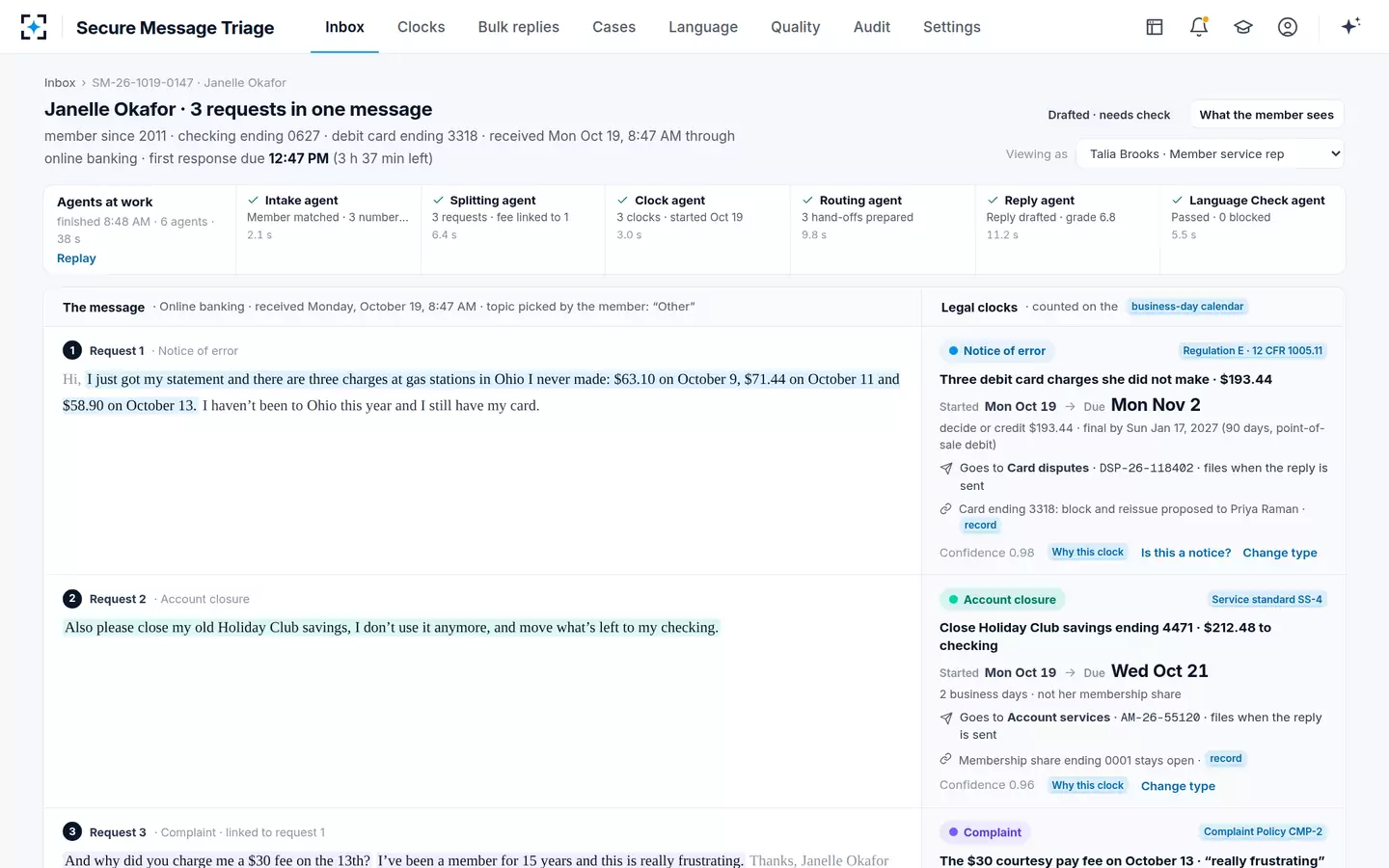
The bank's settings carry the rest. The billing error clock acknowledges within 30 days and resolves within two billing cycles at most 90 days; its escalation ladder reminds the specialist on day 25 and escalates on day 29, so the acknowledgment never depends on someone remembering. Where a stop payment sits in the same message, it goes down the Regulation E stop branch with its own deadline, set out in the guide to stop payment under Reg E.
One sentence about a hotel charge, three different clocks
| The customer writes | Account | Rule and clock |
|---|---|---|
| "There are two charges from the same hotel and I only stayed once." | Debit card | Regulation E notice of error: 10 business days from the day the message arrived. |
| "There are two charges from the same hotel and I only stayed once." | Credit card, statement names the message center | Regulation Z billing error: acknowledge within 30 days, resolve within two cycles, at most 90 days. |
| "There are two charges from the same hotel and I only stayed once." | Credit card, statement names only a postal address | Not yet a 1026.13 notice: reply the same day with where and how to send one. |
Questions people ask
What does a billing error notice have to include?
Enough for the issuer to identify the cardholder's name and account number, and, to the extent the cardholder can, why they believe there is an error and its type, date and amount (1026.13(b)(2)–(3)). A message from a signed-in session already identifies the cardholder; the triage question is whether the channel is one the billing rights statement names.
Can a cardholder stop paying the disputed amount?
Yes, while a billing error is unresolved. The consumer "need not pay (and the creditor may not try to collect)" the disputed portion and related charges, and the creditor may not report it as delinquent (1026.13(d)). The rest of the balance is still due.
What if the cardholder pays by automatic debit from a deposit account?
The card issuer must not deduct the disputed amount if the billing error notice is received "any time up to 3 business days before the scheduled payment date" (1026.13(d)(1)). A secure message that disputes a charge days before an autopay date needs that date checked the same day.
Can the issuer close the account because the cardholder disputed?
Not for that reason alone. A creditor shall not accelerate the debt "or restrict or close a consumer's account solely because the consumer has exercised in good faith rights provided by this section" (1026.13(d)(3)).
Does a phone call protect a credit card holder at all?
For unauthorized use, yes: notice by telephone counts under 1026.12(b)(3), and it caps the cardholder's liability for later use. For a billing error notice, no: the model disclosure tells cardholders the issuer is not required to investigate a call, which is why a written message, in the right channel, matters.