An ATM overage is the amount by which the cash actually found in an ATM, in its cassettes and its reject or purge bin, exceeds what the machine's journal, the network settlement and the general ledger say should be there. The money is not a windfall. It is the trace of something that went wrong: notes the machine presented and took back without the reversal reaching the card issuer, a withdrawal that dispensed less than it recorded, a deposit that was not credited, a replenishment keyed wrong or a miscount. When the cash belongs to a cardholder, Regulation E treats "the consumer's receipt of an incorrect amount of money from an electronic terminal" as an error with its own deadlines. Botminds' ATM & Teller Balancing ties every machine each morning and matches each overage to the retracted withdrawal or the customer's claim behind it, so the analyst returns the money instead of booking it.
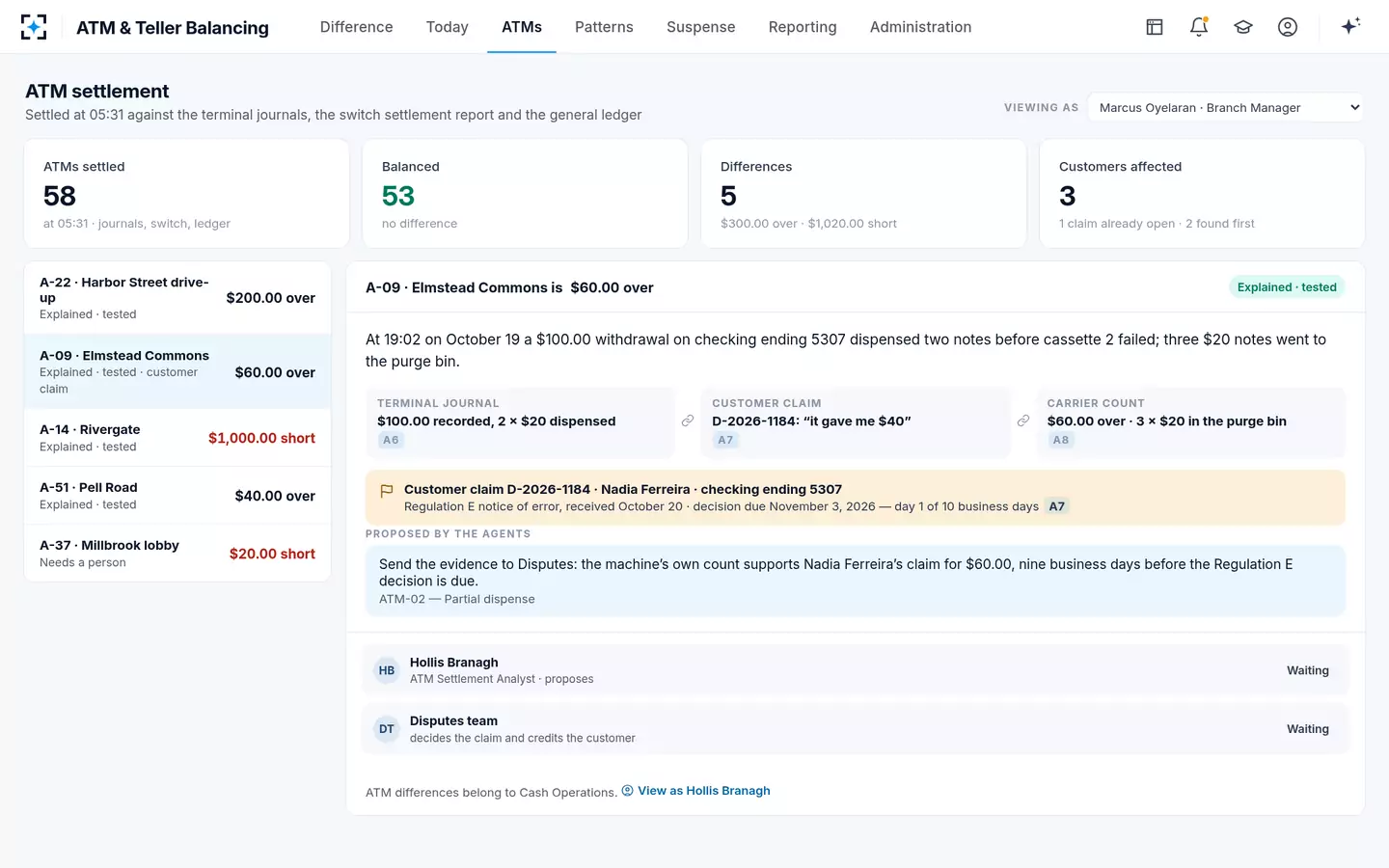
The timeline below follows one overage from the sample data of Tessaly Community Bank, a fictional bank with 58 ATMs. Machine A-09 at Elmstead Commons comes up $60.00 over at the morning settlement on Wednesday, October 21.
One ATM overage and one customer’s claim, side by side, in business days
- WithdrawalMon 19
- In the binTue 20
- MatchedWed 21
- BeforeMon 19
- NoticeTue 20
- EvidenceWed 21
- Disputes investigate and decide, with the machine’s own countBusiness days 2 to 10
What is an ATM overage?
It is a balancing difference in the machine's favor: more cash on hand than the records explain. ATM balancing compares four things that should agree. The terminal's electronic journal records every transaction and every note the machine counted out or took back; the switch or network settlement records what the networks settled; the general ledger records the bank's ATM cash; and a count, by the branch or the carrier, records what was physically in the cassettes and bins. An overage means the count is higher than the other three.
The opposite, an ATM shortage, means less cash than the records explain, and it has its own list of causes: a dispense the journal missed, notes of the wrong denomination loaded in a cassette, or theft. Both are differences to explain, but they point in different directions. A shortage is a loss the bank has to find. An overage can be someone else's money that the bank is holding.
What causes an ATM overage?
Five causes cover the explanations that fit an overage, and three of them leave a customer behind the money. Each leaves a different trail in the records, which is how the cause is told apart from the others.
Five causes of an ATM overage, whose money it is, and the record that proves it
| Cause | Whose money | Records that show it | What happens to it |
|---|---|---|---|
| Notes presented, not taken, retracted; reversal never sent | The cardholder, at this bank or another | Journal: presented, then retracted. Switch: settled as approved. Bin: the notes. | A reversal, or a network adjustment back to the card issuer |
| Partial dispense or pick failure: fewer notes paid than recorded | The cardholder | Journal: amount recorded and notes counted out. Cassette counters. Purge bin count. | Evidence to the team deciding the customer’s claim; the customer is credited |
| Deposit accepted but not credited, at a deposit-taking ATM | The depositor | Deposit journal, envelope or image, the count of the deposit bin | The deposit is credited |
| Replenishment keyed lower than the cash loaded | The bank | The load record against the general ledger entry and the count | A general ledger correction, with a maker and a checker |
| A count error at settlement | Nobody | A recount of the cassettes and bins | Corrected by recount |
The first two are the ones that matter most for a customer, and they are easy to miss because nothing looks wrong from the bank's side. In a retract, the machine did what it was built to do: it took back notes that sat in the presenter too long. Whether the customer's account was debited depends on whether the reversal reached the card issuer. In a partial dispense, the journal records the amount requested and the notes counted out; if a cassette fails part way, the rest of the notes go to the purge bin and the customer walks away with less than the receipt says.
Does Reg E apply to ATMs?
Yes, and an overage that is a customer's missing cash is exactly what one of its definitions describes. Among the errors Regulation E lists is "the consumer's receipt of an incorrect amount of money from an electronic terminal" (12 CFR 1005.11(a)(1)(v)). Once the consumer gives notice of the error, orally or in writing, the institution has to investigate promptly and decide within 10 business days whether an error occurred (the rule is quoted, and the days counted, in first response time and the Reg E clock). If it cannot finish in that time, it may take up to 45 days, provided it credits the account provisionally within the first 10 business days.
Two details matter for ATMs in particular. The longer deadlines for point-of-sale transactions do not stretch to machines in shops: the official interpretation keeps an ATM withdrawal on the ordinary deadlines even when the machine stands in a shop (Supplement I to Part 1005, comment 11(c)(3)-1). And the 10 days become 20 for a transfer made within 30 days after the first deposit to a new account. The Reg E dispute timeline covers every deadline in the family; the balancing question is narrower: how fast can the machine's own evidence reach the people deciding the claim?
An ATM that did not dispense cash, matched to the customer’s claim
What happens when an ATM retains your cash?
From the customer's side, the machine counts out the notes, the customer does not take them in time, and the machine pulls them back into a retract bin. If the network reversal reaches the card issuer, the debit is undone and nothing more is needed. If it does not, because the host link was down or the message was lost, the account stays debited for cash the customer never received, and the notes sit in the bin until the machine is next counted, when they appear as an overage.
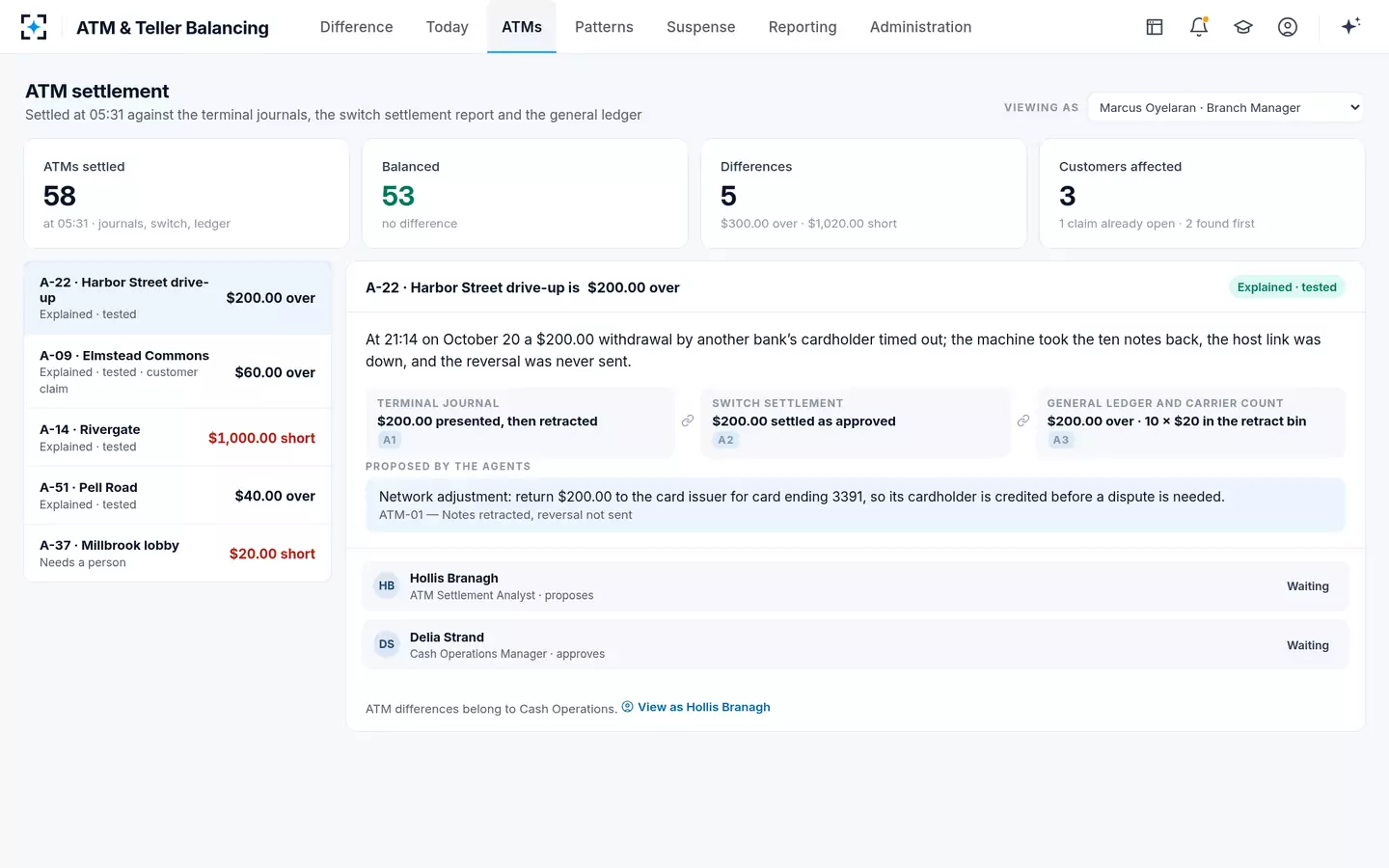
The customer may never call. That is why the overage is the more reliable signal: the bank can find the retract in the journal and the notes in the bin before anyone complains. At Tessaly, the morning settlement found machine A-22 at Harbor Street $200.00 over: another bank's cardholder's withdrawal had timed out at 21:14 the evening before, the machine took the ten notes back, and the reversal was never sent. The journal, the switch settlement and the count agreed, and the analyst proposed a network adjustment returning $200.00 to the card issuer, so that its cardholder is credited before a dispute is needed. The Cash Operations Manager approves it.
A retract with no reversal: an overage turned back into a cardholder’s money
How is an ATM overage reconciled?
By finding the transaction it belongs to, proving it from records the customer and the bank did not write, and sending the money back through the right channel. In practice the analyst works through four questions. Which session left notes in the machine? The journal's retract or partial-dispense entries answer that. Did the network settle that transaction as paid? The switch settlement answers it. Do the notes in the bin match? The count answers it. And is there already a claim? The dispute system answers it.
When all four point the same way, the fix depends on whose account it is. For the bank's own customer, the evidence goes to the team that owns the Regulation E claim, or the customer is credited before they need to claim. For another bank's cardholder, the bank that owns the machine cannot credit the account; it returns the funds to the card issuer through the network's adjustment process, and the issuer credits its customer. If a customer later asks how the bank decided, Regulation E requires the bank, where it finds no error or a different one, to explain its findings in writing and to tell the customer they may ask for the documents the decision rested on (12 CFR 1005.11(d)(1); what that file should hold is in Reg E documentation). For an ATM claim, the journal and the count are those documents.
Can a bank keep an ATM overage?
Not while the money can be traced to someone. An overage traced to a cardholder is that cardholder's money, and if the cardholder gives notice, it is a Regulation E error with a deadline. An overage that cannot be traced at once belongs in a suspense account, aging in the open with an owner, until it is explained. What a bank finally does with an overage nobody can ever trace is a matter of its accounting policy, and that decision should come last, after the journal, the settlement and the claims have been searched.
The risk is the opposite habit: booking overages to income one at a time while shortages on other machines are researched. Each overage taken to income is a customer whose claim, when it comes, will find no matching cash. The suspense account guide covers how unexplained items age and who should review them.
One morning's ATM differences, and why each machine gets the same treatment
Overages and shortages on the same morning are worked the same way, because the cause, not the sign, decides whose money it is. At Tessaly, the settlement at 05:31 tied 58 machines to their journals, the switch and the general ledger: 53 balanced and five were different, $300.00 over and $1,020.00 short in total, with three customers affected: one claim already open and two found by the bank first.
Five ATM differences on one morning, overages and shortages alike
Repeated differences on one machine are a different signal. In the same sample data, the Pattern agent found four pick failures on cassette 3 of machine A-41 in 21 days, each a short of one to three $20 notes later found in the purge bin, against 0.3 pick failures a month on other machines of the model, and proposed an ATM service ticket. The FDIC's examination module asks a related question about the machine itself: "whether the ATM automatically shuts down after it experiences recurring errors" (FDIC examination module, item 30).
Why ATM overages matter more as withdrawals grow larger
Fewer ATM withdrawals are made each year, but each one moves more cash, so a single failed dispense or lost reversal involves more of a customer's money. The Federal Reserve Payments Study counts the trend.
Fewer ATM withdrawals, each larger
3.4billion
ATM withdrawals in the United States in 2024, down from 5.2 billion in 2015
$210
average value of an ATM withdrawal in 2024
$134
average value in 2015
A $200.00 withdrawal is now close to the national average, and the cardholder behind a failed one may be a customer of any bank. That makes the morning settlement the bank's earliest chance to find a customer's money before the customer has to ask for it. How the agents and the analyst split that morning is set out in the guide to reconciliation software for banks, and what to ask a vendor about it in ATM reconciliation software. The solution as a whole is on the ATM & Teller Balancing page.
Questions people ask
What if an ATM did not dispense cash but charged me?
Tell your bank as soon as you can, by phone or in writing, with the date, the machine and the amount. Under Regulation E, receiving an incorrect amount of money from an ATM is an error, and your bank generally has 10 business days to decide, or up to 45 days if it credits your account provisionally in the meantime. If the cash is in the machine, the ATM owner's settlement will show it as an overage.
Who handles my claim if I used another bank's ATM?
Your own bank, the one that holds the account and sends your statement. The bank that owns the machine settles with your bank through the network, and when its settlement finds your cash in the machine it can return the money to your bank through a network adjustment.
What happens if an ATM gives out too much money?
The machine will come up short at its next settlement by the extra amount, and the journal will show the dispense. One cause is notes of the wrong denomination loaded in a cassette, which the count of the cassettes reveals. The bank traces the shortage like any other difference.
What is an ATM overage report?
It is the list, produced at each settlement, of machines whose counted cash exceeds the journal and the general ledger, with the amount and the date. A useful one also shows the explanation, whether a customer is behind it and who owns each item, so that an overage is not left in suspense as unclaimed money.
Does an ATM deposit count as a Regulation E error?
A deposit that was not credited, or credited for the wrong amount, can be an incorrect transfer under Regulation E. A customer who only asks whether an ATM deposit was credited, without asserting an error, has not given a notice of error, according to the rule's official interpretation; one who says it was wrong has.