A teller is out of balance when the cash counted in their drawer at the end of the shift does not match the expected cash the teller platform calculated from the day's transactions. What happens next is set by the bank's over and short policy: the teller recounts and reports it, a supervisor reviews it, larger differences are recounted by two people, and the difference is either explained and corrected, or posted to over and short or to suspense. The next part, the tracing, is the one that can feel like an accusation. Botminds' ATM & Teller Balancing is built to make tracing fair: agents explain each difference from the journal, the cash recycler log and the slips, never name a person as the cause, compare drawers by volume rather than by raw counts, and route any pattern to a named manager who decides what it means.
Whether tellers trust the tracing decides whether the rollout works. A teller who expects blame will force a drawer, pool cash or stay quiet, and every one of those destroys the evidence the bank needs. The rules below are the ones a head of branch operations can promise tellers before go-live, and keep.
Twelve rules for tracing teller differences that tellers can rely on
- One drawer, one teller
Sole access comes first; without it no difference can be attributed fairly to anyone.
- Say what is traced, before go-live
Every drawer close, against the teller platform, the recycler log and the slips. Nothing hidden from the teller about their own drawer.
- No explanation without a record
Each explanation names the journal line, recycler entry or slip that supports it.
- Causes, never culprits
Explanations describe transactions: a withdrawal keyed low, a reversal never posted. The agents never name a person as the cause.
- Overs are traced as hard as shorts
An overage can be a customer’s money, and tracing it shows the work is about accuracy, not suspicion.
- Two people recount, and the teller is not one of them
Above the threshold, two colleagues count separately with their own sign-ins.
- Compare by volume
A drawer with three times the transactions is likely to have more differences. Patterns are normalized before anyone looks.
- A pattern is a reason to look, not a finding
The agent drafts a referral; a named manager accepts or dismisses it with a reason.
- Referrals stay confidential
Never shown on the teller’s own view, a banker’s screen or anything a customer sees.
- Customers hear about corrections, not reviews
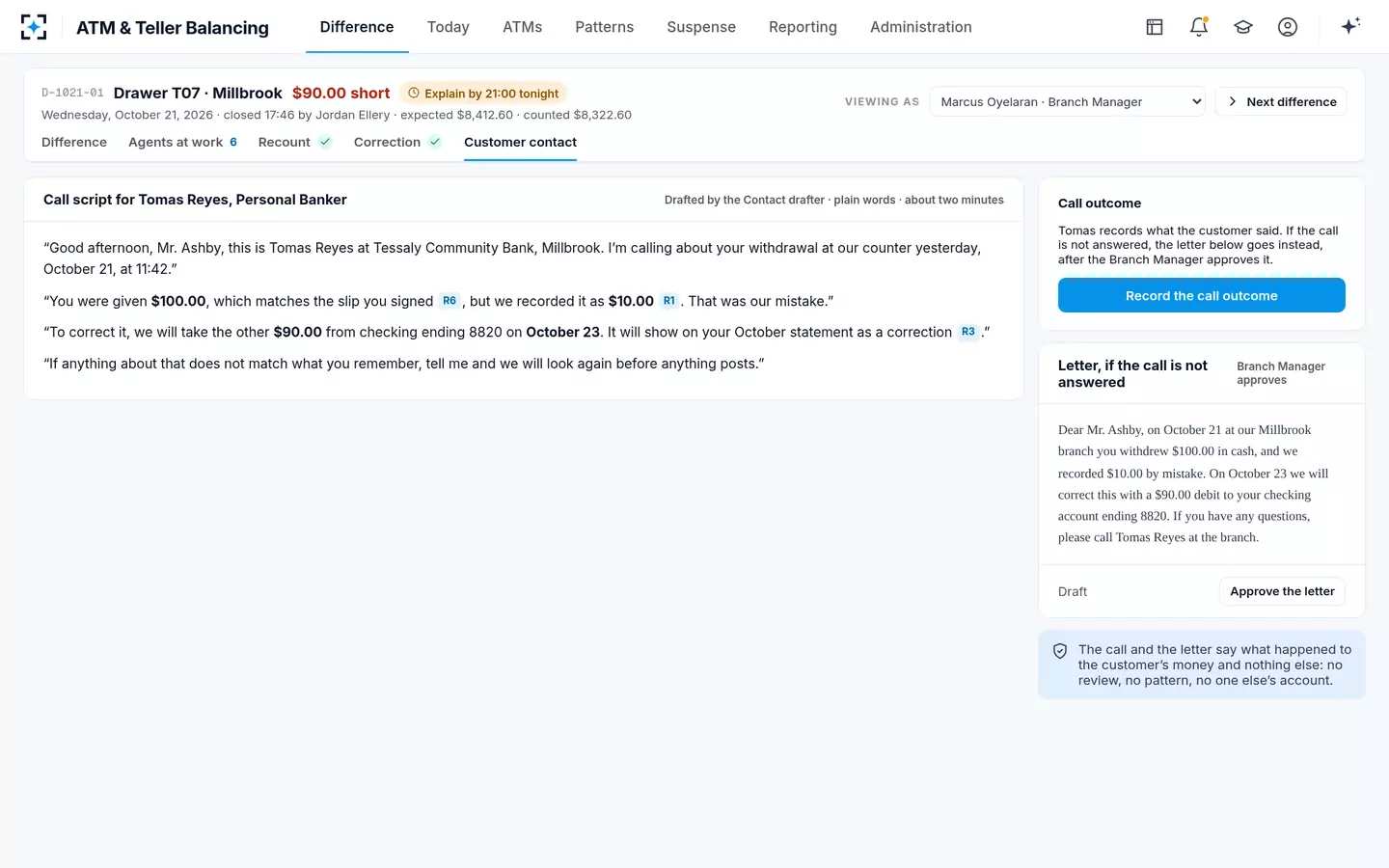
The call script says what happened to the customer’s money and nothing about any review.
- Run it on past closes first
A shadow period on closed drawers, compared with what supervisors found by hand, before anything is live.
- Policy changes are shown with their effect
A proposed threshold comes with what it would have changed over the last 90 days, and goes to the person who owns the policy.
What happens when a teller is out of balance?
The teller recounts and reports it, and the policy decides the rest by size. The FDIC's examination module expects two things at this point: that "teller transactions identify the responsible teller", so the difference has an owner, and that "tellers report large differences to a responsible official for clearance" (FDIC examination module, items 11 and 13). Between those, the bank writes its own tiers.
At Tessaly Community Bank, a fictional bank whose sample data the solution runs on, the tiers are: under $5.00, post with the teller's note; $5.00 to $49.99, a supervisor reviews the agents' explanation before posting; $50.00 or more, a recount by two people before any correction; $500.00 or more, the Branch Manager and the Security Officer are told at once. The target is every difference explained the same business day, before the 21:00 posting. Those are one bank's settings; a policy should be written for its own volumes and risk.
How much can a teller be out of balance?
There is no regulatory tolerance. Neither the FDIC's nor the Federal Reserve's examination procedures set a dollar amount a teller may be over or short; they ask whether differences are cleared, documented, reported and tracked. The tolerance is a line in the bank's own policy, and it decides only what happens next, not whether a difference counts. A $2.00 shortage under a $5.00 tolerance is still a shortage, and still belongs in the teller's cumulative over-and-short history.
Thresholds have side effects that are easy to miss. In the sample data, a proposal to raise Tessaly's recount threshold from $50 to $75 came back with its effect over the last 90 days: 41 fewer recounts, but 3 of the 11 shortages that stayed unexplained after a recount would not have been recounted at all, including two on the same drawer. The change went to the Head of Branch Operations with those three items attached, and was not applied.
Why tracing feels like blame, and why the FDIC says it protects tellers
A teller can hear "we traced your shortage" as "we suspect you". The regulator's own reasoning runs the other way. The FDIC's manual explains why each teller should have a drawer of their own: "Institutions should provide tellers with a separate cash drawer to which they have sole access. Common cash funds should not be used. An inability to fix responsibility in the event of a discrepancy could unnecessarily embarrass an employee or result in improper termination" (FDIC RMS Manual, section 4.2).
The point of attributing a difference is to protect the people who did nothing wrong. When cash is pooled, every shortage is everyone's, and suspicion falls on whoever is least liked. The FDIC's module asks whether the bank has “a policy that prohibits tellers from maintaining ‘kitties’ of pooled funds that are not reconcilable to one individual” (FDIC examination module, item 12). Tracing finishes the job that sole access starts: once the cause of a difference is found in a record, it stops being a question about a person.
The same shortage, handled two ways
Punitive tracing: Who was short.
Fair tracing: Which transaction explains the difference, to the cent.
Punitive tracing: The supervisor’s impression; the teller’s history of shortages.
Fair tracing: Records the teller did not create: recycler logs, slip images, the customer’s receipt.
Punitive tracing: Ignored, or quietly welcomed.
Fair tracing: Traced as hard as shortages; an over can be a customer under-credited.
Punitive tracing: Raw counts: the busiest teller looks worst.
Fair tracing: Normalized by volume, over 30 and 90 days.
Punitive tracing: Becomes a warning in the teller’s file.
Fair tracing: Becomes a confidential referral that a named manager accepts or dismisses with a reason.
Punitive tracing: Report less; balance the drawer however it takes.
Fair tracing: Report everything; the search is for a transaction, not a person.
The last row is the reason it matters. A teller who expects to be blamed has a reason to make a difference disappear, and the guide to force balancing shows what that costs: two errors in the books instead of one, and a customer who is never told.
How do you investigate a teller shortage?
Start from the transactions, not the teller. Pull every transaction on the drawer, line up each cash movement with the recycler's dispense and deposit log, read the slip images, and write down every explanation that fits the amount exactly. Then try to break each one against a record that could contradict it, and recount only when the policy or the evidence calls for it. This order matters for fairness: by the time anyone discusses the shortage with the teller, it may already have an explanation in a record, and the conversation is about a transaction rather than about trust.
In ATM & Teller Balancing, agents do that work at the close. On the fictional bank's drawer T07, $90.00 short at 17:46, the agents read 63 transactions and found the cause in 53 seconds: a $100.00 withdrawal keyed as $10.00 at 11:42, with the recycler log showing five $20 notes paid and the customer's slip for $100.00. A dual-control recount by two colleagues confirmed it. The teller, Jordan Ellery, appears on the screen as the person who closed the drawer, and nowhere as a cause.
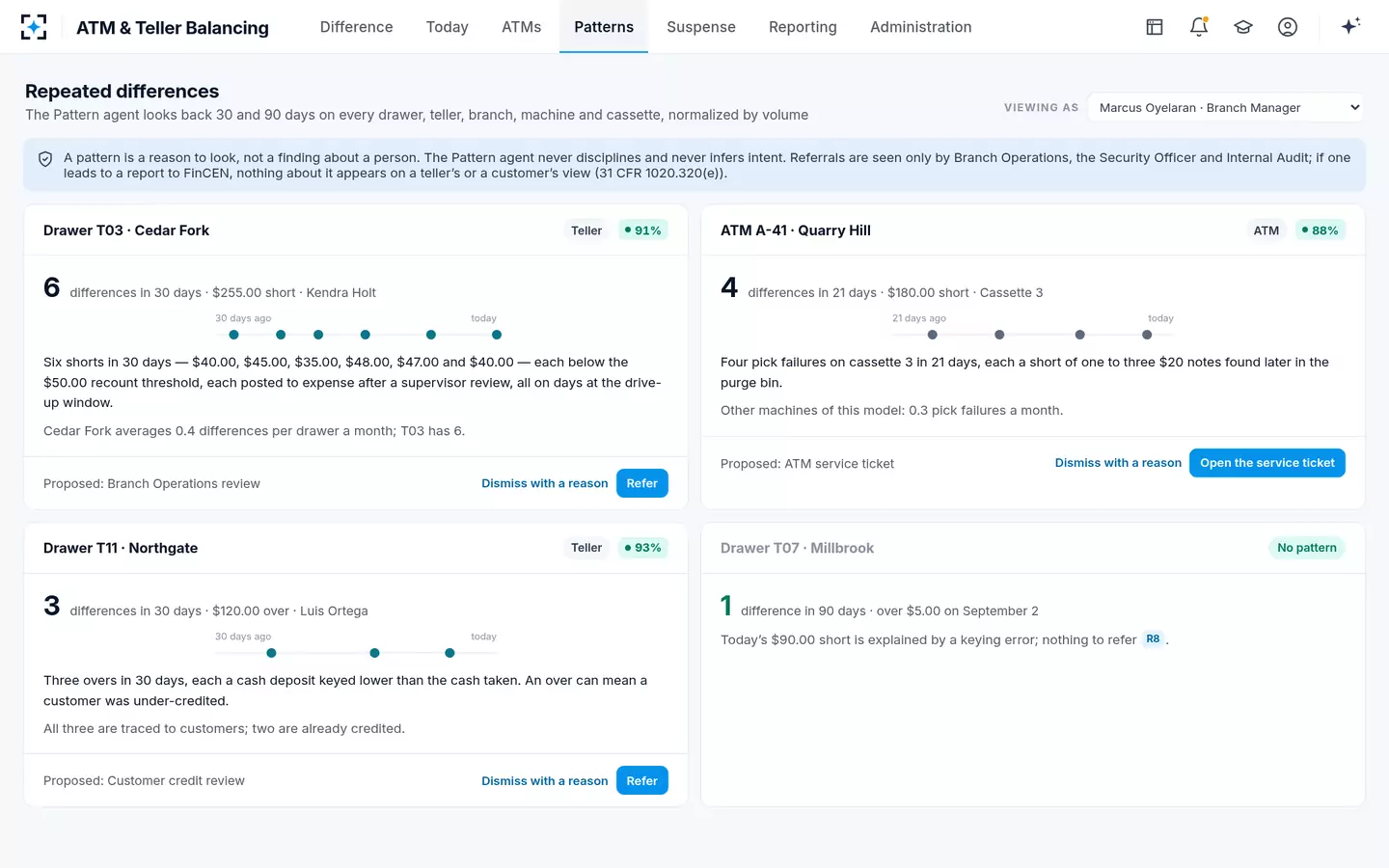
Repeated differences, normalized by volume and referred, never shown to the teller
How do you track teller differences fairly?
Keep a cumulative history for every person who handles cash, compare it with their volume and their peers, and look at it over weeks, not days. Raw counts punish the busiest tellers: a teller who handles three times the transactions will have more differences without being any less careful. Normalizing by volume, and comparing with drawers at the same branch, separates a teller with a problem from a teller with a queue.
The sample data shows why the window matters. Drawer T03 at Cedar Fork was short six times in 30 days, by $40.00, $45.00, $35.00, $48.00, $47.00 and $40.00: $255.00 in all, every one under the $50.00 recount threshold, every one posted to expense after a supervisor's review, and all on days at the drive-up window. The branch averages 0.4 differences per drawer a month. No single day looked like anything. The Pattern agent proposed a Branch Operations review, which a named manager may accept or dismiss with a reason. The drive-up detail is the kind of fact that can clear a teller as easily as implicate one: a different window can mean a different way of handling cash. The teller balancing guide follows the cumulative record in detail.
Four roles in a fair tracing process, and what each keeps
Today
Learned of a shortage the next morning, often with no reason, and wondered what was in their file.
With agents
Sees their own drawer, its difference and its explanation the same evening; never sees or is named in a referral.
Still theirs: Reporting the difference honestly, and their own count at close.
Today
Spent the evening reading printouts and had to judge people with little evidence.
With agents
Starts from the leading explanation with the records side by side; recounts with a colleague when the policy asks.
Still theirs: Confirming the cause and proposing the correction.
Today
Approved corrections on the supervisor’s word and heard about patterns as rumors.
With agents
Approves corrections with the evidence in front of him; sees referrals about his branch.
Still theirs: Approval, never of an entry he proposed; accepting or dismissing a referral with a reason.
Today
Owned the over and short policy and saw its effect once a quarter in write-offs.
With agents
Sees differences normalized by volume across branches and the effect of any proposed threshold change.
Still theirs: The policy itself: every threshold, clock and approval limit.
Can a teller be fired for being short, and should tellers pay for shortages?
Whether a shortage can lead to dismissal is a question of the bank's policy and employment law, not of banking regulation, and the regulator's warning points the other way: without sole access, the FDIC says, a discrepancy "could unnecessarily embarrass an employee or result in improper termination". A fair policy separates three things a shortage can be: an honest error, a pattern that needs coaching or a change at the window, and a suspected theft, which is a matter for the Security Officer and, where it applies, a suspicious activity report. None of the three is decided by software.
Charging shortages to tellers is limited by federal wage law. The U.S. Department of Labor's guide to the Fair Labor Standards Act says that "deductions made from wages for such items as cash or merchandise shortages, employer-required uniforms, and tools of the trade, are not legal to the extent that they reduce the wages of employees below the minimum rate required by the FLSA or reduce the amount of overtime pay due under the FLSA" (U.S. Department of Labor, Handy Reference Guide to the FLSA). State laws can add their own limits. Beyond the law, a teller who pays for shortages has the strongest possible reason to force a drawer, which is the outcome a bank least wants.
The customer hears about the correction, and nothing about any review
What is a normal teller error rate?
No government, academic or non-profit source publishes one. Teller over-and-short rates, typical recount thresholds and write-off levels are each bank's own data, and figures quoted without a source should not be used to judge a teller or a branch. The useful benchmark is internal: the same teller over time, and drawers of similar volume at the same branch.
The job itself is changing in ways that make internal comparison more important. The Bureau of Labor Statistics counts fewer tellers each year, and the remaining ones handle more of the complicated transactions.
Tellers in the United States, by the Bureau of Labor Statistics
339,200
teller jobs in 2025
−13%
projected change in teller employment, 2025 to 2035
$43,030
median annual pay in 2025, $20.69 an hour
At the median teller wage of $20.69 an hour, the 140 minutes Botminds estimates one shortage takes by hand cost about $48 in wages alone, as much as the largest of the six shortages on drawer T03, and most of those minutes are the reading that agents take. What stays is the part tellers care about: a colleague who recounts, a manager who decides, and a policy that treats a difference as a question about a transaction.
Going live with ATM & Teller Balancing without losing the tellers
The rollout is a promise kept in public. Before go-live, the head of branch operations explains the twelve rules to tellers and supervisors, including what tellers will see about their own drawers and what they will never see. The solution is then run on a sample of past drawer closes, recycler logs and ATM settlements, and its explanations are compared with what supervisors found by hand. Only then are live closes traced.
Configuration carries the bank's own policy: its tiers, clocks, approval limits, reason codes, letters and roles. The agents never close a drawer, never post a correction, never contact a customer, never name a person as the cause and never read security video; they can only draft a request to the Security Officer. Any finding can be rejected with a reason code and a sentence, and the rejected finding stays on the trail beside the decision. Those limits are what tellers are relying on, and they are on the ATM & Teller Balancing page. For the controls that sit behind fair tracing, see dual control in banking.
Questions people ask
What is a teller over and short policy?
It is the bank's written rule for drawer differences: the tiers that decide who reviews a difference and when a recount is required, how differences are posted, how long an unexplained item may stay in suspense, who may approve a correction or write-off, and how differences are tracked over time. Examiners expect it to keep cumulative over-and-short records for everyone who handles cash.
Should a teller report a difference they think is a counting mistake?
Yes, always. A reported difference stays on the record and can be explained or corrected; an unreported one becomes a forced balance, which the FDIC lists among the discrepancies examiners look for in tellers' cash records.
How quickly should a teller shortage be explained?
The FDIC's examination module asks whether teller differences are cleared daily or appropriately documented, so the same business day is the practical aim. Tessaly's target in the sample data is every difference explained before the 21:00 posting, with the records attached.
Can an overage mean a customer was shortchanged?
Yes. A cash deposit keyed lower than the cash received leaves the drawer over and the customer under-credited. In the sample data, all three overages on one drawer in a month were traced to customers, and two had already been credited.
Who sees a referral about a teller?
In ATM & Teller Balancing, only Branch Operations, the Security Officer and Internal Audit. Nothing about a referral appears on the teller's own view, a banker's screen or anything a customer sees, and a named person accepts or dismisses each one.