A suspense account in a bank is a temporary holding account for items that cannot yet be posted to their proper account because they have not been identified or explained. For branch cash, the two that matter are the teller over and short suspense account and the ATM settlement suspense account: a drawer that closes short with no explanation by the evening posting, or a machine whose count does not tie to its journal, is carried there until someone finds the cause. The account is meant to be a waiting room. It becomes a problem when items stay, because an aging suspense item is either a customer's money nobody has returned or a loss nobody has explained, and examiners read it that way. Botminds' ATM & Teller Balancing explains differences at the close, before they reach suspense, and keeps every item that does go there visible by age, with an owner, a warning, an escalation and a write-off clock.
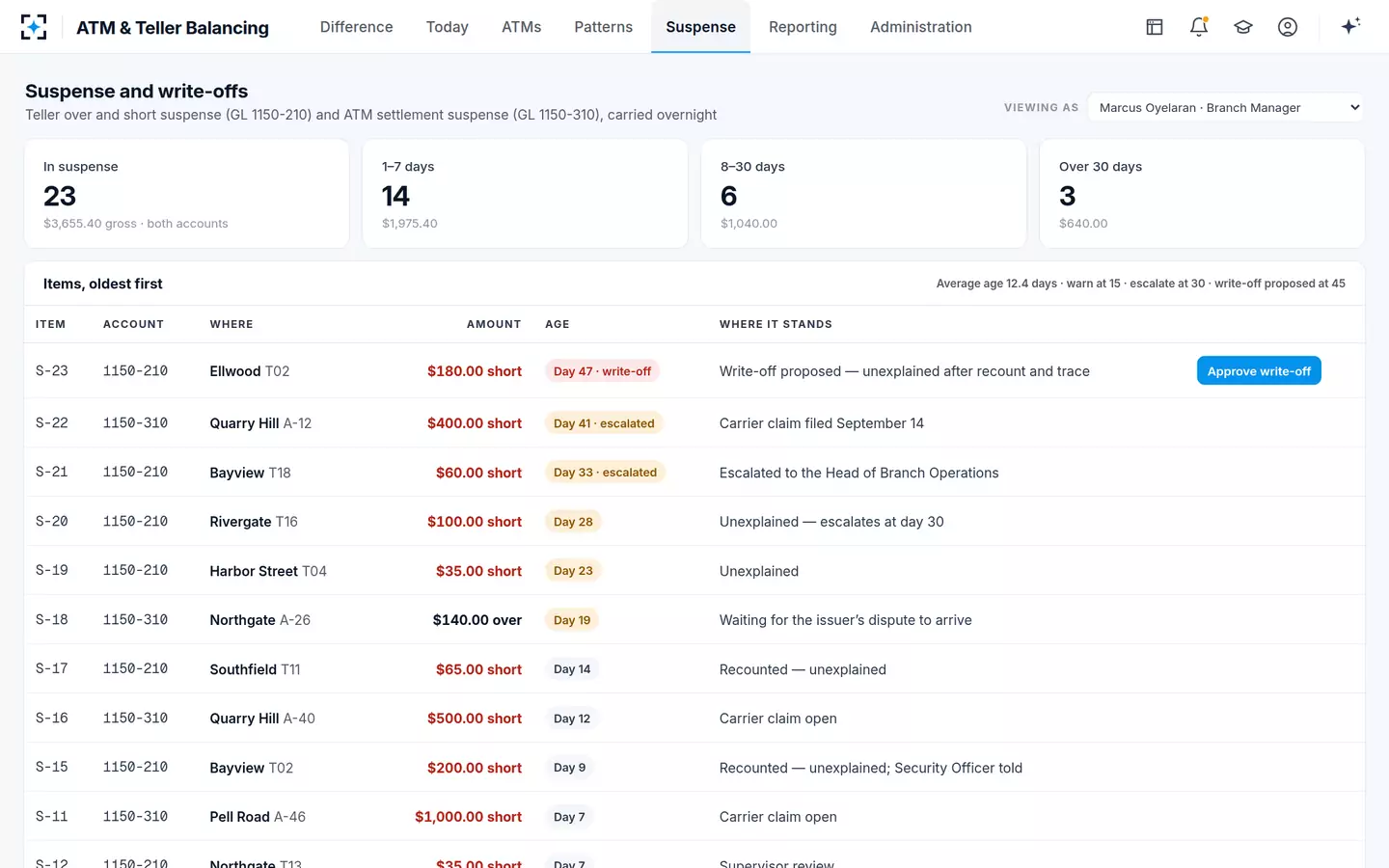
The figure below is the suspense picture at Tessaly Community Bank, a fictional bank whose sample data the solution runs on, on one evening in October: two suspense accounts, 23 items, $3,655.40 gross.
Teller and ATM suspense by age at one bank: most items are new, three are past 30 days
What is a suspense account in a bank?
The bank regulators' reporting instructions define it in one sentence: "Suspense accounts are temporary holding accounts in which items are carried until they can be identified and their disposition to the proper account can be made. Such accounts may also be known as interoffice or clearing accounts" (FFIEC Call Report instructions, Glossary). A bank can have several: for unposted deposits, for items in process between offices, for payments awaiting a matching account, and for cash differences.
For a branch, the cash suspense accounts are where the evening's unexplained differences go. A teller drawer that is $100.00 short at the close, and still unexplained at the posting deadline, is posted to the teller over and short suspense account so the drawer can be closed and the books can balance. The $100.00 is not written off; it is waiting. The same happens at the ATMs: a machine that is over or short after the morning settlement, with the cause not yet found, is carried in ATM settlement suspense.
Is a suspense account an asset or a liability?
It depends on the items in it, and the reporting instructions say not to treat the balance as either by default: "The balances of suspense accounts as of the report date should not automatically be reported as 'Other assets' or 'Other liabilities.' Rather, the items included in these accounts should be reviewed and material amounts should be reported in the appropriate accounts" of the Call Report. For cash differences, the logic is simple. An unexplained shortage is a debit waiting for its explanation, carried on the asset side; an unexplained overage is a credit that may belong to someone, carried on the liability side.
That is also why gross and net matter. A suspense account holding $400.00 of shortages and $360.00 of overages shows $40.00 net, and looks harmless. It holds $760.00 of unexplained cash movements. The Tessaly figure above is gross for that reason.
Why do examiners review suspense accounts?
Because a suspense account is the easiest place in the books to park something that should not exist. The FDIC's manual is direct about it, in the examination techniques it gives for uncovering fraud.
Suspense accounts are sometimes used to conceal shortages, worthless assets, and deposit diversions. Review suspense accounts for material, stale, or unusual items, especially noting the recurring use and aging of reconciling items.
FDIC RMS Manual of Examination Policies, section 4.2, Suspense Accounts
Each phrase in the second sentence is a test an auditor can run. "Material" is size. "Stale" is age. "Unusual" is an item that does not fit the account's purpose. "Recurring use" is the same drawer, machine or person appearing again and again, which a single month's balance hides. And "aging of reconciling items" is the clock: how long each item has been waiting for its explanation.
The same manual lists weak suspense records among the common recordkeeping deficiencies examiners find: "Cash item, overdraft, and suspense account records are deficient" (FDIC RMS Manual, section 4.2). And it tells examiners when to look: to "assess the validity of any reversing or correcting entries" and to select test periods such as "the date institutions were notified of upcoming examinations". A suspense account that empties the week before the examiners arrive is telling them something.
What causes items to go to suspense?
In branch cash, an item goes to suspense when the posting deadline arrives before the explanation does. Some of those are waiting for a record: a recycler log that has not arrived, a carrier's count of a reject bin, the card issuer's dispute. Some are waiting for a person: a recount booked for the morning, a claim filed with the armored carrier. And some have been recounted and traced and are still unexplained.
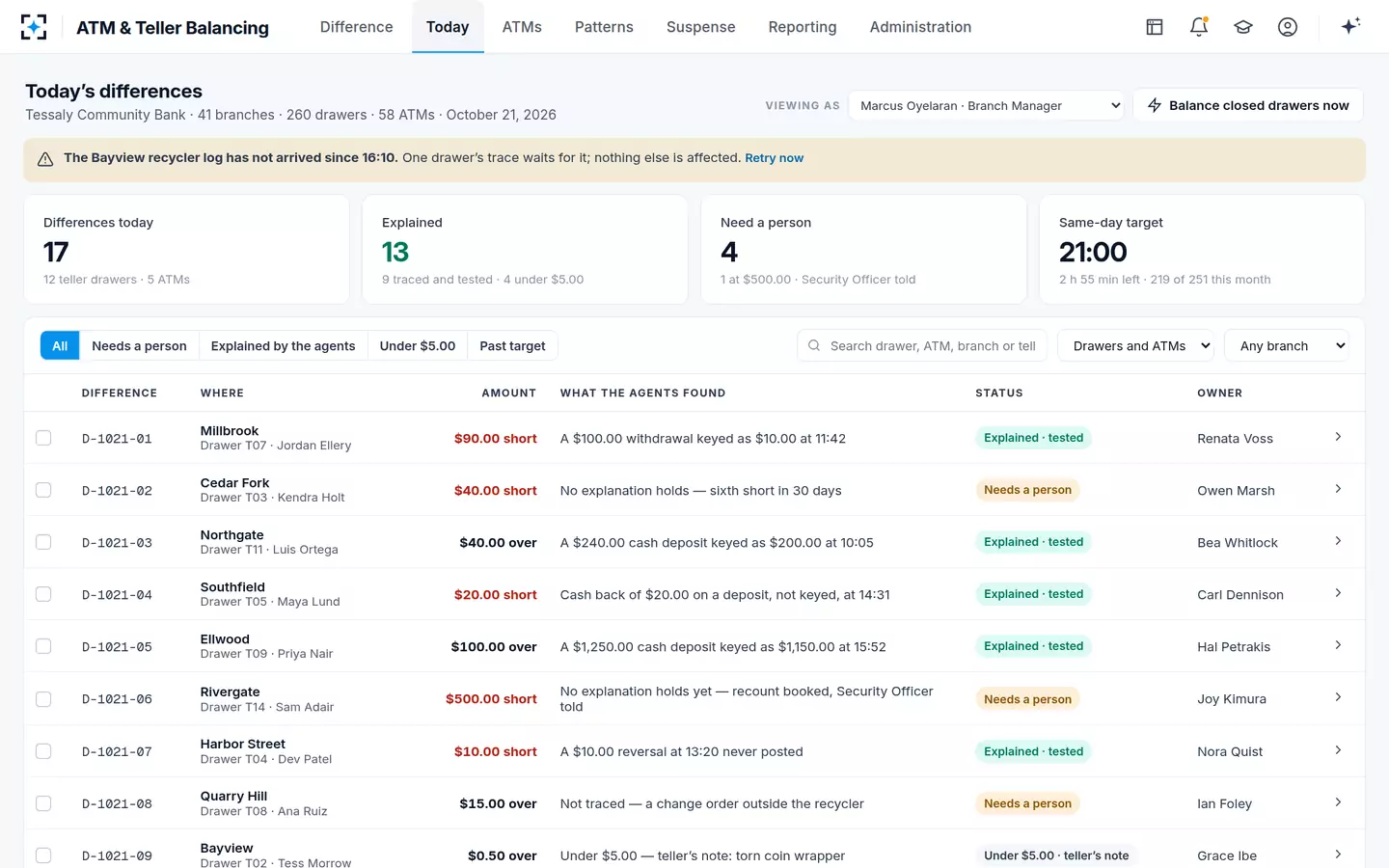
The first kind should be the most common and the shortest-lived, and it is the kind agents shrink. When the explanation is written at the close, from the teller journal, the recycler log and the slips, a difference never reaches suspense at all. At Tessaly, 219 of 251 teller and ATM differences in October were explained the same day, against 46% in May before the agents. Those are sample-data figures; the design target is every difference explained before the evening posting.
ATM settlement suspense fills differently from teller suspense, and the difference is worth knowing when reading the aging. A teller item waits for people: a recount, a supervisor, a trace through the day's slips. An ATM item can wait for someone outside the bank: the armored carrier's count of a reject bin, a claim against the carrier, or another bank's dispute about its cardholder's withdrawal. In the sample data, the three oldest ATM items were a carrier claim filed in September, an overage waiting for the card issuer's dispute, and another open carrier claim. None of them is forgotten while the outside party works, but each needs an owner who chases it, or it goes stale without anyone deciding that it should.
Today’s differences in ATM & Teller Balancing, before anything reaches suspense
How long can items stay in a suspense account?
No federal rule sets a maximum age for teller or ATM suspense items; the bank's policy does, and examiners judge whether the policy is followed and whether items are stale. The Federal Reserve's questionnaire asks a comparable question about cash items: "Is there a policy requiring that all cash items uncollected for a period of 30 days be charged off?" (Commercial Bank Examination Manual, section 2310.4, item 56). A cash suspense clock in a bank's own policy can follow the same logic: a fixed age at which an unexplained item stops waiting and goes to someone with authority to decide it.
A clock is only useful if it does something at each mark. Tessaly's policy, as configured in the solution, has three: a warning to the item's owner at 15 days, an escalation to the Head of Branch Operations at 30, and a write-off proposed at 45 to the approver whose limit covers it: the Branch Manager up to $250, the Head of Branch Operations up to $2,500, the CFO above.
The life of an unexplained teller shortage under one bank’s suspense clock
- In suspense, unexplainedDays 0 to 15
- Owner warnedDays 15 to 30
- Escalated; write-off proposedDays 30 to 47
Who reviews suspense account aging?
Someone who cannot post to it. The FDIC's examination module asks "whether in-process, suspense, and interoffice accounts related to deposit accounts are closely monitored by individual(s) who do not have posting or reconciling duties" (FDIC examination module, item 70). For cash suspense, that means the teller supervisor who proposes corrections should not be the only person watching the aging, and the Branch Manager who approves write-offs should see the items before the write-off arrives.
The useful view for a reviewer is not the balance but the list, oldest first, with where each item came from and what it is waiting for. That view answers the FDIC's "recurring use" question directly: if the same drawer or machine appears three times in the list, that is a pattern before it is a write-off. The teller balancing guide covers the cumulative over-and-short record that sits beside the suspense list for each person who handles cash.
Cash over and short suspense that ages in the open
How do you clear a suspense account?
One item at a time, by explaining it or by writing it off under authority, and never by netting items against each other. Each way out of suspense needs something different, and each leaves a different trail.
Four ways a cash difference leaves suspense, and what each needs
| Way out | What it needs | Who signs | What it leaves for the examiner |
|---|---|---|---|
| Explained and corrected | The transaction that caused it, proved from a record; a correcting entry to the customer or the general ledger | A maker and a different checker | The explanation, the records and both signatures |
| Returned to its owner | A traced overage: a customer credit, a reversal or a network adjustment to the card issuer | The analyst proposes; a manager approves | The match between the cash and the claim |
| Recovered from a third party | A claim against the armored carrier or the ATM servicer, with their count | Cash operations, under the bank’s policy | The claim and its outcome |
| Written off | An item unexplained after trace and recount, at the end of the policy clock | The approver whose limit covers it | Why it was not explained, and who decided |
The last row is where suspense meets the FDIC's warning. Small write-offs are the quiet end of many suspense items, and each one is reasonable on its own. The question an auditor asks is whether the write-offs come from the same places: one drawer, one ATM, one branch. A suspense account used to conceal shortages, in the FDIC's phrase, looks like an ordinary suspense account with a pattern in its write-offs. The four federal embezzlement cases show how cash theft was hidden in vault entries and count sheets, the books' other waiting rooms.
Suspense account vs clearing account: is there a difference?
In the regulators' reporting instructions, no: suspense accounts "may also be known as interoffice or clearing accounts". In practice a bank may use "clearing" for accounts that hold routine items expected to clear on a known schedule, such as a day's ATM network settlement, and "suspense" for items waiting for an identification or an explanation. The distinction is useful only if the clearing accounts actually clear: a clearing account with items older than its schedule is a suspense account under another name, and deserves the same aging review.
How ATM & Teller Balancing keeps suspense in the open
The solution works on both ends of the account. Upstream, agents explain differences at the close, so fewer reach suspense: the Balancing agent ties every drawer and every ATM, the Trace agent writes each explanation from the journal, recycler log and slips, and the Test agent tries to break it. The only entry the agents post is the policy's suspense entry for a difference still unexplained at the deadline. Downstream, every item in suspense is listed by age, oldest first, with its origin, its owner and what it is waiting for; the clocks warn, escalate and propose a write-off to the approver whose limit covers it, and a person approves or declines.
Nothing in suspense is hidden from the people who review it, and nothing about it is changed without a maker and a checker. An auditor reads one trail of every posting, explanation, approval and write-off, with the records behind each. The whole design is on the ATM & Teller Balancing page, and the way a difference is forced out of a drawer before it ever reaches suspense is in the guide to force balancing.
Questions people ask
What is suspense account in bank statement?
A "suspense" line on a customer's statement shows money the bank has received but not yet applied, held until it can be matched to the right account or loan. It is the same idea as an internal suspense account: a temporary place for an item whose proper home is not yet known.
Can a bank keep money in a suspense account forever?
No. Items in suspense should be identified and moved to their proper account, and examiners look for stale ones. Money that belongs to a customer and cannot be returned is subject to state unclaimed property rules, which a bank's policy must follow.
Should teller overages and shortages share one suspense account?
They can share an account, but they should be listed and aged as separate items, gross, never netted. Netting an overage against a shortage makes both disappear from the aging report without either being explained.
Is posting to over and short the same as posting to suspense?
No. Over and short is an income or expense account: posting there closes the difference. Suspense keeps it open. Under a policy like the fictional bank's, differences under $5.00 are posted with the teller's note, and larger unexplained ones go to suspense until they are traced or written off.
What is a reconciling item?
It is an item that explains why two balances that should agree do not, such as a deposit in transit or an unexplained teller shortage. The FDIC asks examiners to note the recurring use and aging of reconciling items in suspense accounts, because an old reconciling item is an unexplained one.