Force balancing a teller drawer means making the drawer agree with the teller platform by adjusting an entry, a count or a cash item until the difference disappears, instead of finding the transaction that caused it. The drawer then shows balanced, but the original error is still there, which can be a customer's money keyed wrong, and a second error has been added to hide it. Bank examiners treat it as a warning sign: the FDIC names "forced balancing" among the discrepancies to look for in tellers' daily cash records. Botminds' ATM & Teller Balancing is built against it. At every close, agents write each explanation that fits a difference exactly and try to break it against the journal, the recycler log and the slip, so a drawer balances only when the cause has been found and a person has confirmed it.
The comparison below takes one real-looking evening from the sample data of Tessaly Community Bank, a fictional bank: drawer T07 at the Millbrook branch, $90.00 short at 17:46. On the left is what forcing it would have looked like; on the right, what tracing it did.
The same $90.00 shortage, forced and traced
Forced balance: An adjusting entry of $90.00, a recount “to the expected figure”, or $90.00 carried as a cash item: the drawer shows zero.
Traced balance: The drawer shows $90.00 short and the difference is raised with its policy tier: two people must recount it.
Forced balance: Never found. A $100.00 withdrawal keyed as $10.00 at 11:42 stays in the books as $10.00.
Traced balance: Found in 53 seconds of agent time: the recycler paid out five $20 notes and the customer signed a slip for $100.00.
Forced balance: Keeps $90.00 that was never debited; nobody tells him.
Traced balance: Is called before a $90.00 correction posts, and confirms he received $100.00.
Forced balance: Hold two errors: the miskeyed withdrawal and the entry that hid it.
Traced balance: Hold one correction, proposed by the Teller Supervisor and approved by the Branch Manager.
Forced balance: Shows a clean day for the drawer, so a pattern can never form.
Traced balance: Shows a $90.00 difference, explained as a keying error, on the drawer’s record.
Forced balance: Finds an adjustment with no support, or a cash item nobody can explain.
Traced balance: Finds the explanation, the recount, the correction and the records behind each.
What is force balancing a teller drawer?
It is any step that makes the count and the records agree without explaining the difference between them. The common forms are an adjusting or offsetting entry with no source, a count sheet written to the expected figure, an unexplained item carried in the drawer as a "cash item", a vault or teller transfer entered to move the difference somewhere else, and cash pooled between tellers so that one drawer's shortage is covered from another's. Each of them turns an open difference into a closed one on paper.
It is different from posting a difference under the bank's over and short policy. A teller who reports a $3.00 shortage, writes a note and has it posted to over and short has not forced anything: the difference is on the record, attributed to the drawer, and visible in the cumulative history. Forcing removes the difference from the record. The first is a policy working as designed; the second defeats it.
Why is force balancing a red flag?
Because a forced drawer cannot be told apart from an honest one by its totals, and because it is how a theft or a customer's loss is hidden. The FDIC's guidance for examiners on tellers and cash puts it in one sentence.
When warranted, tellers’ daily cash records can be inspected for possible discrepancies such as mathematical errors, forced balancing, unusual charges or adjustments, and excessive total balances or number of cash items.
FDIC RMS Manual of Examination Policies, section 4.2, Tellers and Cash
Every item on that list is a way of making a drawer look right. A mathematical error on the proof sheet can be deliberate. "Unusual charges or adjustments" are the adjusting entries that do the forcing. An "excessive" number of cash items is the drawer carrying paper in place of money. The setting matters too: the sentence is one of the manual's examination techniques for uncovering fraud, which open with the warning that "numerous methods for concealing fraud exist".
Federal prosecutors have described forcing on a large scale. A teller at a branch in Pilot Mountain, North Carolina, took $150,450 from her drawer between December 2023 and May 2024. To hide it, according to the U.S. Attorney's Office, "she entered numerous fraudulent transactions into the Bank's computer system – fraudulent buy/sell transactions associated with the bank's vault and fraudulent withdrawal transactions from the accounts of two elderly customers" (U.S. Attorney's Office, Middle District of North Carolina, January 2026). Each of those entries made the drawer agree with the books. What gave it away in the end was an audit, which in late May 2024 found an imbalance in her drawer.
What should a teller do when the drawer is off?
Stop, recount, and report it; do not make it go away. A good procedure gives the teller four steps: recount once, alone, without changing anything; check the day's work for the obvious (a transaction keyed with the wrong amount, a reversal or void, cash back on a deposit, a strap miscounted); report the difference to the supervisor with a note of what was checked; and leave the drawer for the policy to decide whether a second person recounts it.
What the teller should never do is enter something to make the total come out. Even when the teller is sure the difference is a counting slip, an entry with no source document is exactly the kind of unusual adjustment an examiner looks for, and it destroys the drawer's honest history. The guide to a teller out of balance covers the other side of this: how a bank investigates a shortage without making tellers afraid to report one.
A difference in ATM & Teller Balancing opens on its reason, not its total
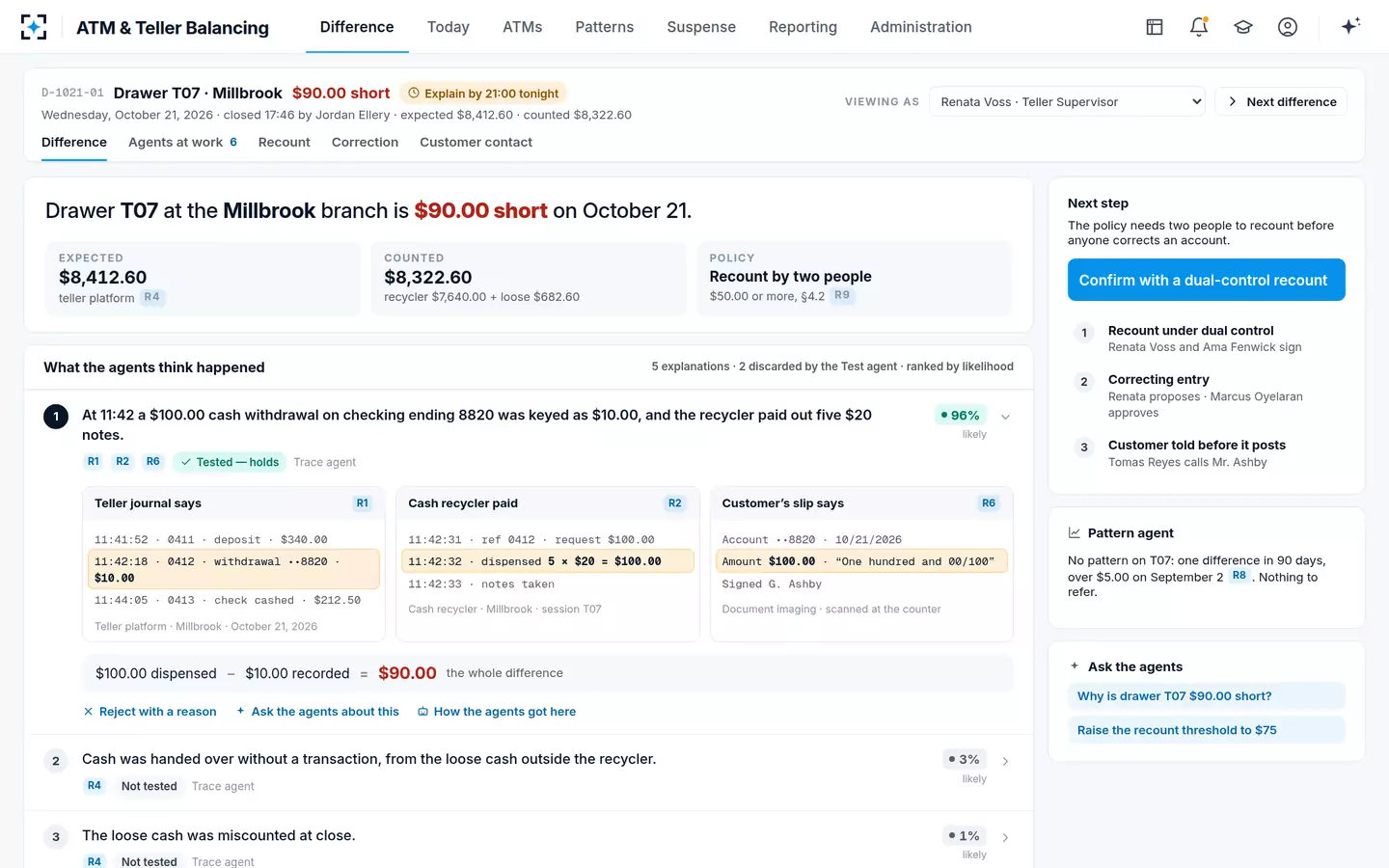
Valid is not accurate: a balanced total proves very little
A balancing check that compares totals answers one question: does the count equal the expected cash? A forced drawer answers yes. The questions that matter are different. Is there an explanation that fits the difference to the cent? Is it supported by a record the teller did not create? Is there a record that could have contradicted it, and was it checked? A drawer that passes those tests is right; a drawer that only passes the first is merely balanced.
That is the design of the agents in ATM & Teller Balancing. The Trace agent pulls every transaction on the drawer, 63 of them on T07, lines up each cash movement with the recycler log, reads the slip images, and writes every explanation that fits the amount exactly, each as one sentence naming the record behind it. The Test agent then looks for the record that could prove each explanation wrong, discards what fails and says why, and marks what cannot be tested yet. Below 80% confidence, nothing is called the leading explanation. Those are the fictional bank's settings, and a bank sets its own.
Five explanations for one $90.00 shortage, ranked after testing
How do you detect forced balancing?
By looking where a forced balance leaves marks: in the entries made near the close, in the drawer's history over weeks, and in the gap between the teller's records and records the teller does not control. None of the signs below proves forcing on its own, and most have innocent explanations; together they tell an auditor where to count.
Eight signs that a teller drawer may have been forced
- Adjusting entries close to the close
Offsets, corrections or miscellaneous debits and credits in the last minutes of the day, with no customer and no source document.
- Vault or teller transfers at the end of the day
Buy and sell entries with the vault, or transfers to another drawer, that match the day’s difference.
- Cash items that linger
Items carried in the drawer for days, which the FDIC lists alongside forced balancing as a discrepancy to inspect.
- A drawer that is never off
A busy drawer with no differences for months deserves a look. Compare it with drawers of similar volume.
- Differences that reverse
A shortage one day and an overage of the same amount the next suggests the difference was carried, not found.
- Records the teller does not control disagree
The recycler log, the slip images or the customer’s statement show an amount different from what the teller platform holds.
- Reversals without a matching dispense
A void or reversal that the recycler log cannot account for, or a dispense with no transaction at all.
- Customers who call about a balance
A customer who asks about a withdrawal or a deposit amount is sometimes the first record that does not agree.
Two of those signs need history, not a single day: the drawer that is never off and the differences that reverse. Both are visible only in a cumulative over-and-short history kept per person, the record the teller balancing guide is about. Forced balances also feed the suspense account from the other direction: a difference that is forced out of a drawer can reappear as an item nobody can explain, which is why the suspense account guide treats aging items as evidence rather than clutter.
How do examiners review teller cash records?
They count, they inspect the daily records, and they look at the controls that make forcing hard. The FDIC calls random drawer audits a basic control (FDIC RMS Manual, section 4.2), and the Federal Reserve's questionnaire asks whether an officer verifies each teller's cash by surprise from time to time and keeps a record of the count (Commercial Bank Examination Manual, section 2310.4, item 4). How to run those counts so the branch cannot see them coming is in surprise cash count.
A surprise count catches a forced drawer only on the day it happens, and only if the forcing left cash missing at that moment. The daily record catches it on every day, if the record is honest. That is the reason to test each explanation against records the teller does not create: the recycler log and the slip image cannot be forced from the teller line.
What the Test agent ruled out, and the record that broke each explanation
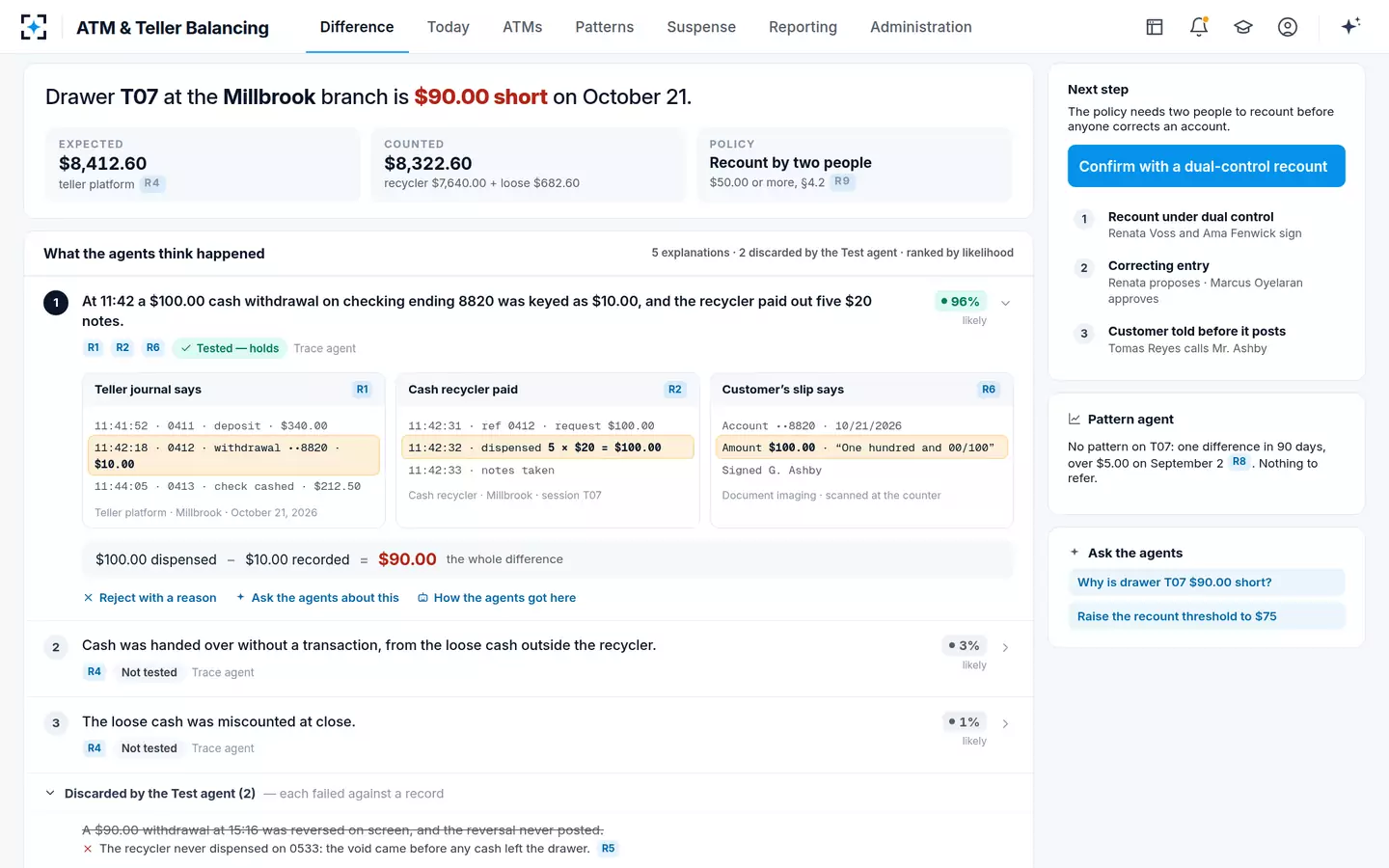
What are common teller errors, and what record tests each?
The explanations that fit a drawer difference come from a short list of honest mistakes, and each has a record outside the teller's control that confirms or rules it out. Knowing the list is what makes forcing unnecessary: a teller who knows the supervisor can find a miskeyed withdrawal in minutes has no reason to make it disappear.
Common teller errors and the record that confirms or rules out each
| Error | What the drawer shows | Record that tests it |
|---|---|---|
| Withdrawal keyed low | Short by the difference | Recycler dispense log; the customer’s signed slip |
| Deposit keyed low | Over by the difference, and the customer is under-credited | Deposit slip image; recycler deposit log; the customer’s receipt |
| Cash back on a deposit not keyed | Short by the cash back | Deposit slip showing less cash received; recycler log |
| Void or reversal after cash left the drawer | Short by the amount | Recycler log: was there a dispense on that reference? |
| Notes presented and not taken | Over by the notes taken back, if the withdrawal still posted | Recycler presentation and retract log |
| Change order or strap handled outside the recycler | Over or short by the order | Vault or teller transfer entry; the strap count |
| Miscount at close | Over or short | A dual-control recount |
Can a teller be fired for force balancing?
That is a matter of the bank's policy and employment law, not of banking regulation, and policies differ. What regulation does say is that forcing destroys the evidence that protects honest tellers: without an attributable difference, the bank cannot show who was responsible for a shortage and who was not. And where forcing hides a theft, it is part of a federal crime: embezzlement by a bank employee is punishable under 18 U.S.C. 656.
The better question for a bank is why a teller would force a drawer at all. Fear of a shortage on the record, a supervisor who reacts to every difference as misconduct, or a policy that charges shortages to the teller all push in that direction. A balancing process that finds the cause quickly, treats a pattern as a reason to look rather than a verdict, and leaves every judgement to a named person removes most of the reason. That is how ATM & Teller Balancing is set up, and the full design is on the ATM & Teller Balancing page.
Questions people ask
What is the difference between balancing and reconciling a teller drawer?
Balancing compares the cash counted at close with the expected cash the teller platform holds. Reconciling goes a step further and explains each difference against other records, such as the recycler log and the slips, until the cause is known. A forced drawer is balanced but not reconciled.
Is posting a small difference to over and short the same as forcing?
No. Posting a reported difference under the bank's policy keeps it on the record, attributed to the drawer, where the cumulative history can show a pattern. Forcing removes the difference from the record so that no history is left.
Do cash recyclers make forced balancing impossible?
They make it harder, because the recycler keeps its own log of what it dispensed, accepted and counted, and that log is outside the teller's control. Loose cash outside the recycler, change orders and transfers can still be forced, and the recycler's log only helps if someone reads it against the teller platform.
Does a surprise count catch a forced drawer?
Sometimes. A count proves the drawer matches its record at that minute, and forcing done last week has usually been covered by then. A surprise count earns its keep when the counter also reads the drawer's adjusting entries and cash items since the previous count, which is where a forced balance leaves its trace.
Who should review a drawer that balances every day?
Someone independent of the branch, such as internal audit or branch operations, comparing it with drawers of similar volume. A drawer that is never off is not proof of forcing, but it is a reason to count it by surprise and trace a sample of its days against the recycler log.