RPA in ATM reconciliation means software robots that do the analyst's clerical steps each morning: logging into the switch portal to download settlement reports, collecting each terminal's electronic journal, pulling the general ledger's ATM cash balances, keying the carrier's counts, and matching the totals machine by machine. It works well for those steps because they are the same every day. It stops where the analyst's real work starts: when a machine does not tie, a bot can report the difference but cannot say why, because the explanation is a hypothesis to test across several systems, not a rule to apply. Botminds' ATM & Teller Balancing puts agents at that point: they read the same journals, settlement reports, general ledger entries and counts, write the explanation that fits each difference, test it, and hand the adjustment to two people.
The map below is the stack behind one ATM settlement: seven systems, what each knows, and what a bot and a tracing agent each take from it.
The stack behind an ATM settlement: what bots fetch, what agents read
Knows: Every session at the machine: card, amount, notes picked per cassette, presented, taken or retracted, error codes
A bot: Collects the day’s journal files from each terminal
An agent: Reads the sessions behind a difference: the retract, the partial dispense, the pick failure
Knows: What each network approved and settled for the machine, transaction by transaction
A bot: Downloads the settlement reports and totals them by terminal
An agent: Finds the settled transaction that matches the journal session, or the reversal that never arrived
Knows: ATM cash, settlement suspense and over and short accounts, and the entries that moved them
A bot: Pulls balances and entries; posts what it is scripted to post
An agent: Checks the replenishment entry against the load, and drafts the correcting entry for people to approve
Knows: Cassettes and bins counted at replenishment, notes loaded, the purge and retract bins
A bot: Keys or imports the count sheet
An agent: Ties notes in a bin to the session that put them there
Knows: The cardholder’s account, debits, reversals, available balance
A bot: Looks up account activity on a screen
An agent: Confirms whether the customer was debited for cash not received
Knows: Customer claims about ATMs, with the date of notice and the decision due
A bot: Reached only if someone scripts it
An agent: Matches an overage to an open claim and readies the evidence
Knows: Drawer closes, expected cash, recycler dispense and deposit logs
A bot: Exports the close report
An agent: Explains teller differences with the same method as the ATMs
What is RPA in ATM reconciliation?
Robotic process automation is software that operates other software the way a person would. Researchers describe it as "a lightweight approach to automating business processes using software robots that emulate user actions at the graphical user interface level" (Laakmann, Ciftci and Janiesch, 2025). In ATM reconciliation, that means the bot logs into the systems the analyst uses, downloads what the analyst would download, copies values between screens and spreadsheets, and runs the matching rules the analyst would run.
The appeal is speed of delivery. A bot needs no change to the switch, the general ledger or the ATM monitoring system, so a bank can automate the morning's clerical work without an integration project. The cost is fragility and scope: a bot depends on screens and file layouts staying the same, and it can only do what its rules describe.
Which systems feed ATM reconciliation?
Four systems decide whether a machine balances, and three more decide whose money a difference is. The four are the terminal's electronic journal, the switch or network settlement, the general ledger and the physical count of the cassettes and bins. The three are the core banking system, which shows whether a cardholder was debited; the dispute system, which shows whether a customer has complained; and, for branches with recyclers, the teller platform and the recycler logs, which follow the same logic at the counter.
The FDIC's manual sets the standard that the whole stack has to meet together: "Recordkeeping systems should be designed to enable the tracing of any transaction as it passes through accounts" (FDIC RMS Manual, section 4.2). A retracted withdrawal passes through four of the seven systems: the journal records the retract, the switch records a settled withdrawal, the core records a debit, and the bin holds the notes. Tracing it means reading all four.
What is an ATM electronic journal?
It is the ATM's own record of everything it did, written by the terminal software: each card read, each amount requested, the notes picked from each cassette, the notes presented, taken or retracted, the receipts printed and the device errors. Paper journal rolls served the same purpose before; the electronic journal is collected from the machine or the monitoring system. The Federal Reserve's questionnaire asks the basic question about it: "Are transaction journals provided that enable management to determine every transaction or attempted transaction at the ATM?" (Commercial Bank Examination Manual, section 2310.4, item 52).
The journal is the system a bot handles worst and a tracing agent needs most. Its lines are written for the machine's maintainers, its format differs by manufacturer and software version, and the answer to an overage can be three lines in the middle of a session: notes presented, a timeout, notes retracted. A bot can collect the file. Reading it for the session that explains $200.00 is a different job.
Can RPA reconcile ATMs?
It can do the matching part of the reconciliation, and on a clean morning that is the whole of it: if every machine ties, the bot's report is the reconciliation. On a morning with differences, it produces the list, and the analyst starts work. The research literature describes RPA's sweet spot in those terms. A review of intelligent RPA notes that RPA "has gained popularity for its cost-effective and timely automation of rule-based, well-structured tasks", and goes on:
Its symbolic nature has inherent limitations when approaching more complex tasks currently performed by human agents.
Laakmann, Ciftci and Janiesch, A Nascent Taxonomy of Machine Learning in Intelligent Robotic Process Automation (2025)
Explaining a difference is that kind of task. The analyst forms a hypothesis (a retract with no reversal), looks for the records that would confirm it (the journal session, the settled transaction, the notes in the bin) and the records that would rule it out (a reversal that did arrive, a bin count that does not match), and only then proposes an adjustment. A rule can encode the first step for a known pattern; it cannot weigh five competing explanations against seven systems.
What is the difference between RPA and AI agents?
A bot follows a script over screens and files; an agent works towards a goal over the records, choosing what to read next from what it has found. In reconciliation, the difference shows up at the first exception. The bot's script ends at the exception; the agent's work starts there.
The same $200.00 overage, handed to a bot and to an agent
RPA bot: A script: download, total, compare, report breaks over a threshold.
Tracing agent: A goal: explain the difference to the cent, from records, and say how sure it is.
RPA bot: The fields its script names, on the screens it was recorded on.
Tracing agent: The journal session, the switch record, the core account, the bin count, whatever the explanation needs.
RPA bot: Reports “A-22: $200.00 over” and stops.
Tracing agent: Finds a withdrawal presented at 21:14, timed out, retracted, settled as approved, with ten $20 notes in the retract bin.
RPA bot: None: it has no hypotheses.
Tracing agent: Tests every other explanation that fits the amount, and shows why each one failed.
RPA bot: Breaks until someone re-records it.
Tracing agent: Reads the record by its content; a missing record is named, not skipped.
RPA bot: A list of breaks to research.
Tracing agent: An explanation, its records and a drafted network adjustment for two people to sign.
Where bots stop: one retract with no reversal, step by step
The sample morning at Tessaly shows the hand-off. The settlement at 05:31 tied 58 machines against the terminal journals, the switch settlement report and the general ledger; 53 balanced and five did not. A-22 at the Harbor Street drive-up was $200.00 over. The steps below are who did what with it.
One ATM overage in ATM & Teller Balancing: where matching ends and explaining begins
Agent
Balancing agent: collect and tieTies the terminal journal, the switch settlement, the general ledger cash and the carrier count for all 58 machines. A-22 is $200.00 over. This is the step a bot could also do.
Never: settles a machine or posts anything but the policy’s suspense entry.
Agent
Trace agent: explainReads A-22’s journal: at 21:14 on October 20 a $200.00 withdrawal by another bank’s cardholder timed out and the machine retracted the ten notes; the host link was down and no reversal was sent.
Never: writes an explanation without the record behind it.
Agent
Test agent: try to break itChecks the switch settlement (the withdrawal settled as approved) and the count (ten $20 notes in the retract bin). The three records agree, and the explanation holds.
Never: marks an explanation tested without a record that could have contradicted it.
Agent
Entry drafter: draftDrafts a network adjustment returning $200.00 to the card issuer, so its cardholder is credited before a dispute is needed.
Never: posts or sends it.
A person decides
Analyst proposes, manager approvesThe ATM Settlement Analyst reads the explanation and the three records and proposes the adjustment; the Cash Operations Manager, who did not prepare it, approves.
How do you automate ATM settlement without losing control?
Automate the reading and the drafting, and keep the posting and the approving with people who are accountable for them. Every correction that comes out of a settlement, whether a network adjustment, a general ledger correction or a customer credit, should carry its source records and a maker and a different checker. The FDIC's examination module asks "whether appropriate source documents support all general ledger entries" (FDIC examination module, item 50); a bot that posts an entry because its rule fired has created an entry whose only support is the rule.
The same applies to the bot itself. A bot that logs into the general ledger with a person's credentials, or with a shared service account, blurs who did what. Whatever automation a bank uses, each action should be attributable: this agent read these records and drafted this entry; this person proposed it; this person approved it. That attribution is what makes automated work defensible to an examiner.
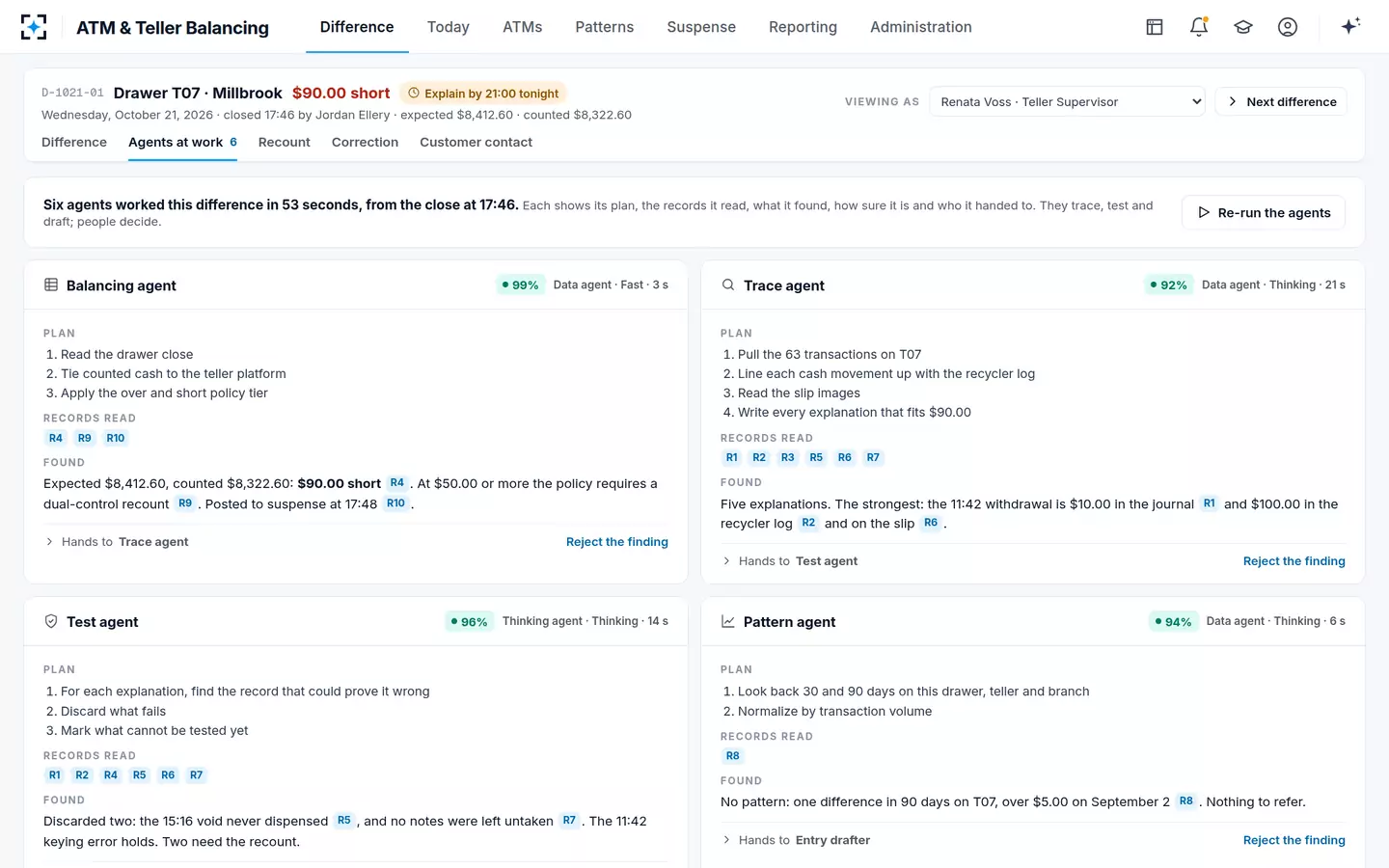
Six agents on one difference, each showing its plan, its records and its hand-off
What are the limits of RPA in banking?
Three limits matter for reconciliation. The first is brittleness: a bot recorded on a screen depends on that screen, and a vendor's upgrade to the switch portal or the ATM monitoring console can stop the morning run. The second is scope: a bot does what its rules describe, so every new kind of exception needs a new rule, and the long tail of rare exceptions stays with people. The third is choosing what to automate at all. Researchers who built a framework for the choice note that "organizations face the challenge of classifying process activities as viable automation candidates for RPA" (Wellmann, Stierle, Dunzer and Matzner, 2020).
None of that makes RPA the wrong tool for the clerical steps. It makes it the wrong tool for the explaining. A bank that already runs bots for the morning downloads does not have to retire them; it can let them keep fetching and let agents take over at the exception, where the bots' report ends.
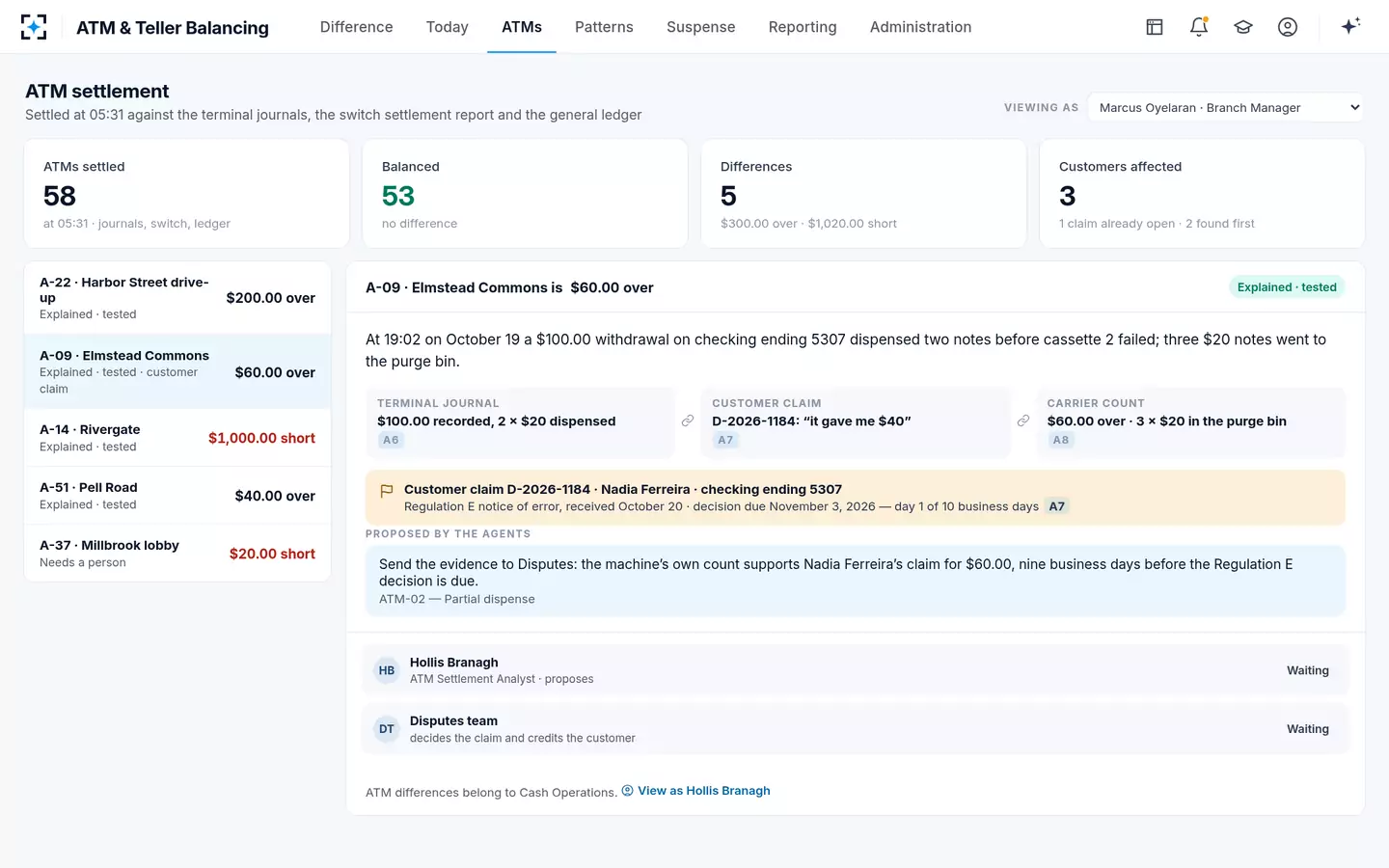
An overage the agents matched to a customer’s claim, from the journal, the claim and the count
What ATM & Teller Balancing adds to an RPA setup
It adds the part after the match. The Balancing agent ties every machine and drawer; the Trace agent writes each explanation from the journal, recycler log or slip; the Test agent tries to break it and shows what it discarded; the Pattern agent looks for repeats by machine, cassette, drawer and teller, normalized by volume; the Entry drafter prepares the adjustment or correction; and the Contact drafter writes the banker's call when a customer is behind a difference. People recount, decide, propose and approve. Agent versions are pinned, a confidence floor decides what may lead, and any finding can be rejected with a reason code.
How the work divides step by step is in the guide to reconciliation software for banks, and the questions to put to any product in ATM reconciliation software. The agents, their limits and the systems they connect to are on the ATM & Teller Balancing page.
Questions people ask
How do you reconcile ATM transactions?
Tie four records each business day: the terminal's electronic journal, the switch or network settlement, the general ledger's ATM cash and settlement accounts, and the physical count of the cassettes and bins. Then explain each difference from the journal sessions behind it, correct it with a maker and a checker, and age anything unexplained in suspense.
Is RPA the same as AI?
No. Classic RPA follows recorded steps and fixed rules over user interfaces. AI agents use models to read records, form and test explanations and draft outputs; they can be combined with bots, which keep doing the fetching while the agents do the reading and reasoning.
Can a bot post ATM settlement entries automatically?
It can be scripted to, but every general ledger entry should be supported by source documents and reviewed by someone other than the person, or process, that prepared it. In ATM & Teller Balancing the agents draft entries and adjustments, and two named people sign before anything posts.
Does an AI agent need a human in the loop for ATM reconciliation?
For every decision that moves money or changes a customer's account, yes. In ATM & Teller Balancing below 80% confidence nothing is presented as the leading explanation, and above it a person still confirms, proposes and approves; those thresholds are the fictional bank's own settings.
What happens when a journal file is missing?
It should be named, not skipped. In the sample data, when one branch's recycler log had not arrived, the day's list of differences carried a banner saying which trace was waiting for it and that nothing else was affected.