Reconciliation software for banks compares two or more sets of records that should agree, such as the general ledger against a subsidiary system, a correspondent statement against the bank's books, or an ATM's journal against the network's settlement, and lists what does not match. For cash, the hard part is not the match; it is the hour after it, when someone has to explain why a teller drawer or an ATM is over or short and correct it the same day. Botminds' ATM & Teller Balancing is reconciliation software for that hour: agents tie every drawer close and every ATM settlement, explain each difference with the journal, recycler log or slip behind it, and draft the correction, while the recount, the approval and the call to the customer stay with people.
The grid below takes the two daily cash reconciliations step by step and says which steps move to agents and which stay. It is drawn from how the solution runs on the sample data of Tessaly Community Bank, a fictional bank with 41 branches, 260 teller drawers and 58 ATMs.
ATM and teller reconciliation in ATM & Teller Balancing: which steps move to agents
Why: Fetching four files from four systems is the same every morning and needs no judgement.
Why: Arithmetic across every machine, every day; a difference is a number before it is a question.
Why: The teller platform, the recycler and the count already hold the figures.
Why: Lining up dispenses, retracts, reversals and slips is reading, and agents read every line.
Why: Testing is cheap for an agent and expensive for a supervisor at 18:00.
Why: A pattern is a reason to look; deciding what it means about a person is not an agent’s job.
Why: Cash is physical, and the recount is the dual-control step the examiner tests.
Why: The person who answers for the difference makes the call, with the evidence in front of them.
Why: Accounts, amount, reason code and the records behind it are known by now.
Why: The preparer never approves: the separation of duties every examiner checks.
Why: A Regulation E decision belongs to the people who own the claim.
Why: An agent drafts the script; a person makes the call.
What is reconciliation software for banks, and which types of reconciliation does it cover?
It is software that matches one set of records against another and reports the breaks, and in a bank it serves at least five different jobs. A buyer who asks for "reconciliation software" needs to know which job they mean, because a product built for one may be weak at another. Examiners ask for all of them: the FDIC's examination module tells examiners to "prepare correspondent account reconcilements and trace exception and open items" where the bank's own are missing, and asks whether each deposit category on the general ledger has a current reconcilement (FDIC examination module, items 56 and 67).
Five reconciliations a bank runs, and what a break can mean in each
| Reconciliation | What is matched | What a break can be | Covered by ATM & Teller Balancing |
|---|---|---|---|
| General ledger account reconciliation | General ledger balances against subsidiary systems | A timing difference, a misposting or an entry with no support | No: only the over and short, suspense and ATM cash accounts it posts to |
| Correspondent and due-from accounts | The bank’s books against the correspondent’s statement | An item in transit, a fee not booked, a cash letter delayed | No |
| Payment and card settlement | Network settlement files against the bank’s postings | A timing break or a reversal not matched | Only where it touches an ATM the bank owns |
| ATM settlement | Terminal journal, switch settlement, general ledger cash and the carrier’s count | A retracted withdrawal, a pick failure, a load keyed wrong, or a customer’s missing cash | Yes |
| Teller drawer balancing | Counted cash against the teller platform’s expected cash and the recycler | A miskeyed amount, cash given without a transaction, a reversal not posted, a miscount | Yes |
The two cash reconciliations differ from the rest in one way that matters for software. A break in a correspondent account is typically paper: an item in transit that will clear. A break in a teller drawer or an ATM is cash that is somewhere, and it can be a customer's: a withdrawal keyed low, a deposit keyed low, or notes the machine took back without sending the reversal. Cash still matters to customers: it was 14% of U.S. consumer payments by number in 2025 (Federal Reserve Financial Services, 2026 Diary of Consumer Payment Choice).
The morning ATM settlement: four ties and a hunt
The ATM reconciliation runs every morning in four ties and a hunt. The terminal's electronic journal records what the machine did; the switch settlement says what the networks settled; the general ledger holds what the bank booked as ATM cash; and the carrier's count says what was physically in the cassettes and the reject or purge bin when the machine was serviced. When all four agree, the machine balances. When they do not, someone hunts through the journal for the transaction that explains the difference.
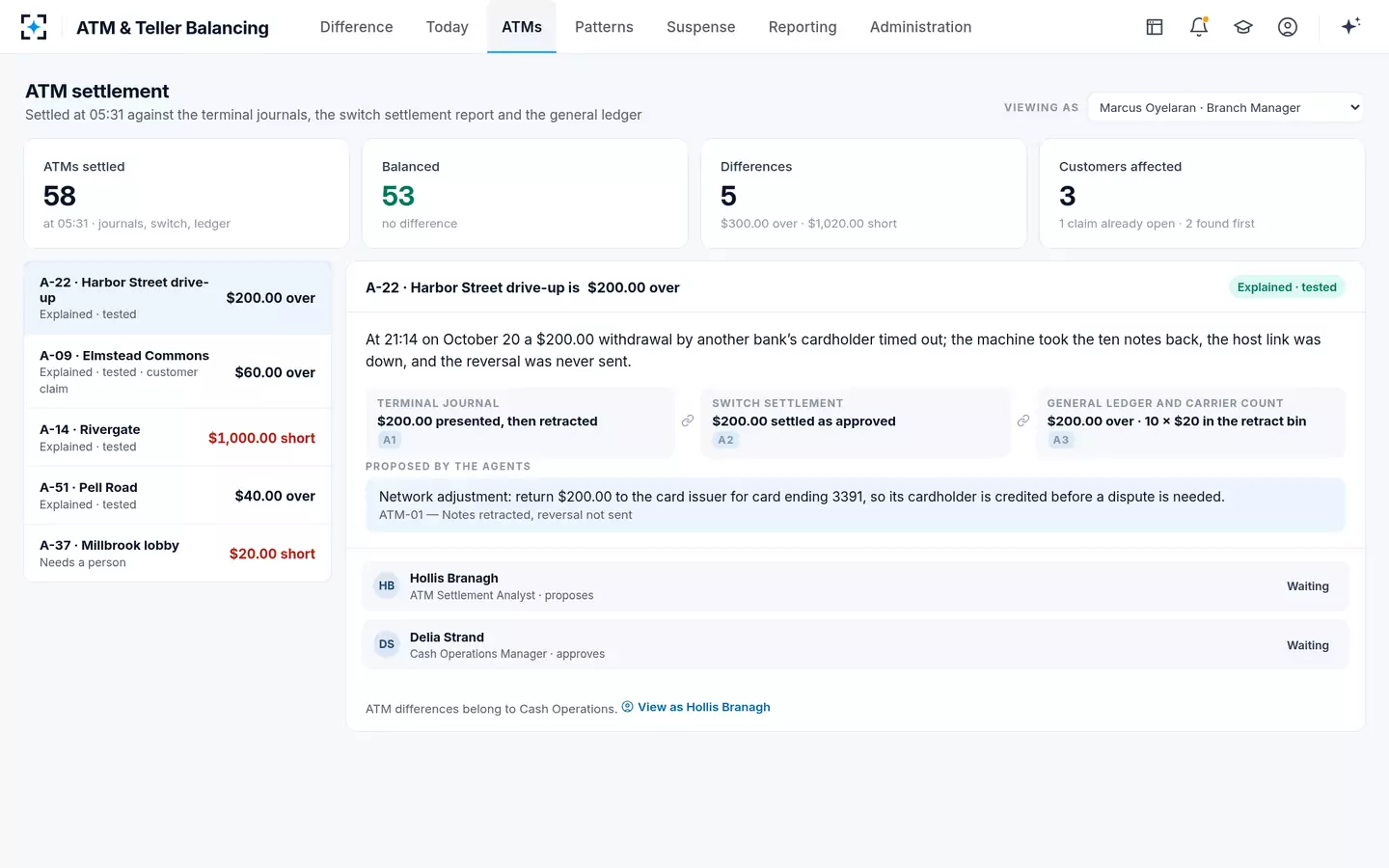
The ties are fast for software and slow for people, and the hunt is slow for both unless the software can read the journal. Time depends on the fleet and the number of differences; we found no published benchmark. In the sample data, the morning settlement tied all 58 of Tessaly's ATMs by 05:31: 53 balanced and five were different, three of them affecting a customer.
The morning ATM settlement as a three-way tie, with the overage explained
What does an ATM settlement analyst do?
The ATM settlement analyst owns the morning tie and the research behind every machine that does not balance. No federal occupation series isolates the role, so it is best described by the work: pull the journals and the settlement, tie them to the general ledger and the carrier's counts, research each difference, propose network adjustments and general ledger corrections, and hand customer claims to disputes with the evidence. At Tessaly, the analyst proposes and the Cash Operations Manager approves.
The hunt is where agents change the job. When the analyst starts from a difference already explained across the three-way tie, an overage matched to the cardholder or the claim behind it and an adjustment ready to propose, the analyst's time goes into judging the explanation rather than finding it. The guide to ATM overages follows one of those mornings through to the customer's Regulation E claim.
What moves to agents, measured in a supervisor's minutes
On the teller side, the gain is easiest to see in one supervisor's evening. Botminds estimates that a $90.00 shortage on one drawer takes about 140 minutes of a supervisor's and colleagues' time by hand, and about 24 with the agents, based on the sample case. More telling than the totals is what is left: by hand, two thirds of the time is reading printouts, pulling slips and filing paper; with the agents, most of what remains is the recount, the approval and the customer call.
Where a supervisor’s minutes go on one shortage, by hand and with ATM & Teller Balancing
By hand: about 140 minutes
- Reading transactions, recycler log and journal · 43%
- Pulling slips · 11%
- Recount · 7%
- Entry and approval · 14%
- Customer · 11%
- Filing for audit · 14%
With the agents: about 24 minutes
- Reading · 13%
- Slips · 4%
- Recount · 21%
- Entry and approval · 25%
- Customer · 33%
- Filing · 4%
Can bank reconciliation be fully automated?
The matching can be; the decisions should not be. The FDIC is not against automation in controls. Its manual says that "when properly designed, automated control methods are generally considered superior to manual procedures" (FDIC RMS Manual, section 4.2). What a cash difference needs after the match is a judgement about money that may belong to a customer, and a correction to the customer's account or the bank's books. Both carry accountability that a named person has to hold.
In cash, the decision that goes wrong is a plausible explanation posted as fact. A $90.00 shortage booked as a keying error closes the drawer and the question; if the cash was in fact handed over without a transaction, the customer who was short-changed is never called and the teller's pattern never builds. A tool that decides is a tool the bank has to defend decision by decision; a tool that explains, with a person deciding, leaves the bank with a person who can. The best-known public case of software deciding on its own comes from disputes, not balancing, and is told in how to test AI email triage.
The academic literature draws the same line for the older generation of automation. A systematic review of robotic process automation defines it as "the automation of rule-based routine processes to increase efficiency and to reduce costs" (Wewerka and Reichert, 2020). Tying four files is rule-based routine. Deciding that a shortage was a keying error and not cash handed over without a transaction is not, which is why the guide to RPA in ATM reconciliation separates the two.
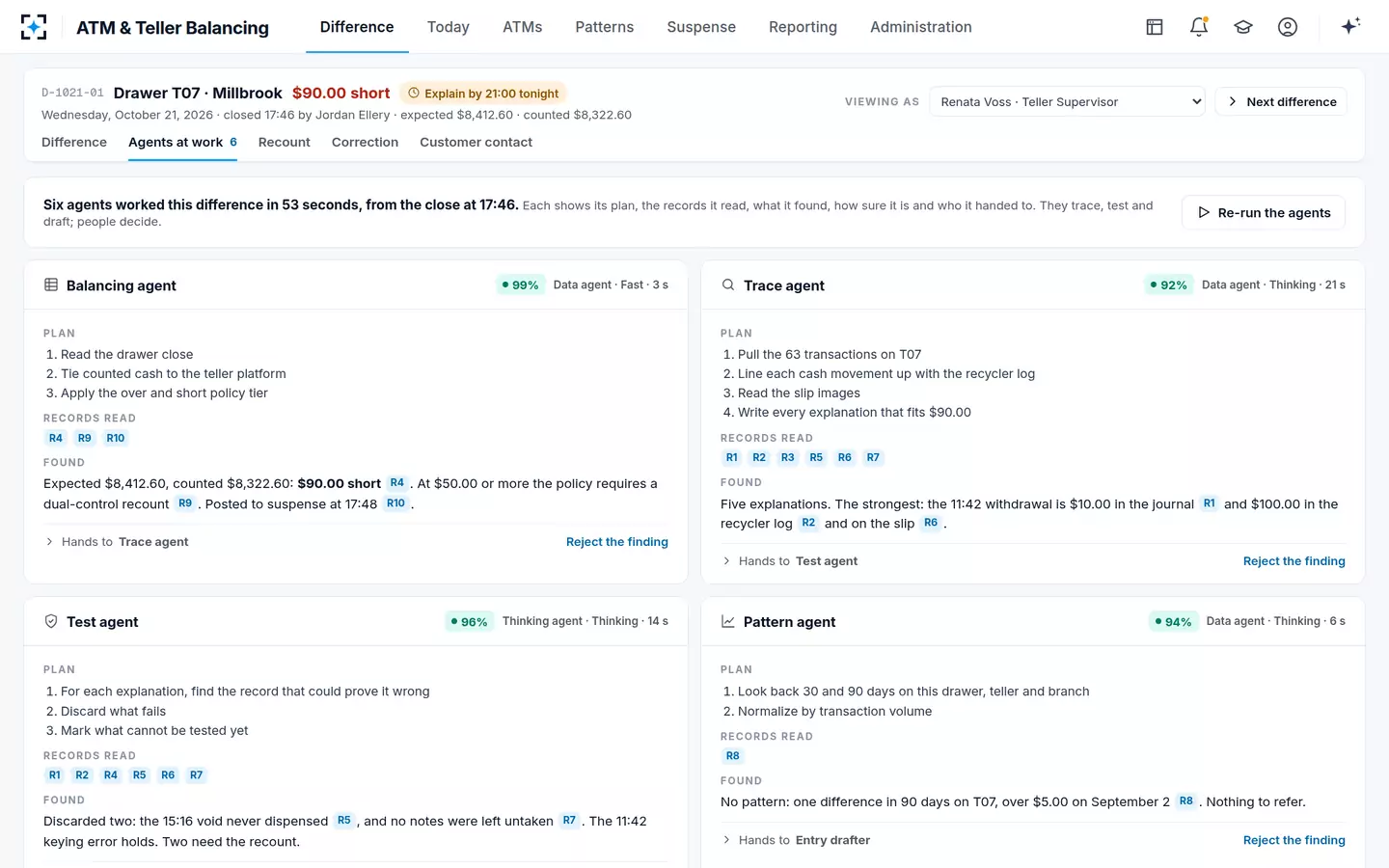
Six agents on one difference, each with its plan, its records and its hand-off
Who approves reconciliation adjustments?
A person other than the one who prepared them. The FDIC's examination module asks "whether all entries prepared by the general ledger or customer account department are reviewed by a supervisor other than the person preparing the entry" (FDIC examination module, item 48). For cash, the Federal Reserve's questionnaire adds a check on who proves the machine: for teller machines, "is the daily proof performed by someone other than the teller" (Commercial Bank Examination Manual, section 2310.4, item 21b).
Software changes who drafts, not who approves. At Tessaly, the Entry drafter prepares the correcting entry, write-off or network adjustment with its accounts, reason code and records, and routes it to the maker and checker the policy names: the Teller Supervisor proposes and the Branch Manager approves corrections, letters and write-offs up to $250; the ATM Settlement Analyst proposes and the Cash Operations Manager approves network adjustments. Larger write-offs go to the Head of Branch Operations up to $2,500 and to the CFO above. Those limits are the fictional bank's settings, not a benchmark.
What records are used to balance an ATM and a teller drawer?
For an ATM: the terminal's electronic journal, the switch or network settlement report, the general ledger ATM cash and settlement suspense accounts, the carrier's or the branch's count of the cassettes and bins, and any customer claim about the machine. For a teller drawer: the teller platform's expected cash and every transaction, the cash recycler's dispense, deposit and presentation logs, the slip images and the count at close. The examiner's version is shorter: the Federal Reserve tells examiners to "obtain teller settlement sheet recap or similar document as of the examination date and agree to the general ledger" (Commercial Bank Examination Manual, section 2310.3, item 5).
Software that can read only some of these will match what it can read and leave the rest to the supervisor. Ask each vendor which of the records above it reads directly, which it needs exported, and which it never sees. The questions to ask ATM reconciliation software turn that into a demonstration script.
One morning and one month at the fictional Tessaly Community Bank
58
ATMs tied to journal, switch, general ledger and carrier count by 05:31
53 balanced, 5 different
53 s
of agent time from a drawer’s close to a tested explanation of its $90.00 shortage
219of 251
teller and ATM differences explained the same day in October, against 46% in May
Where ATM & Teller Balancing fits, and where it does not
It fits a bank or credit union whose cash differences are the daily cost: many drawers, recyclers and ATMs, a supervisor's evening spent on printouts, a suspense account that ages, and overages that turn out to be customers' money. It connects to what the bank already runs: the teller platform, the cash recyclers, the ATM electronic journal and switch, the general ledger, the core and document imaging. The agents explain; the core and the general ledger still post, and only after people approve.
It does not replace general ledger account reconciliation, correspondent reconciliation or card settlement software, and a bank that needs those needs a product built for them. Nor does it decide a Regulation E claim: it puts the machine's evidence in front of the disputes team on the first day of the clock. And it does not discipline anyone. Repeated differences are referred to Branch Operations without the teller seeing the referral, and a person accepts or dismisses each one. The full description of the agents and their limits is on the ATM & Teller Balancing page.
Questions people ask
What is account reconciliation in banking?
It is the regular comparison of a general ledger account's balance with the detail that supports it, such as a subsidiary system, a statement from another bank or a physical count, with every difference explained or corrected. Examiners expect it to be current and done by someone independent of the transactions: the FDIC asks whether reconciliations are performed by a person not involved in accepting or preparing them.
Is ATM reconciliation the same as ATM balancing?
The words are used loosely. Balancing usually means counting what is in the machine and comparing it with what the machine says it dispensed; reconciliation usually means tying the journal, the network settlement, the general ledger and the count together and explaining each difference. A bank needs both every day.
How long does the daily cash reconciliation take?
We found no government or academic benchmark, and it depends on the fleet, the number of networks and how many machines are different on a given morning. The ties take minutes for software; the research behind each difference is what takes people hours, and it is what agents shorten.
Does reconciliation software post entries?
It should not post corrections on its own. In ATM & Teller Balancing the agents draft entries and adjustments and the only posting they make is the policy's suspense entry for an unexplained difference; every correction, write-off and adjustment needs a maker and a different checker before the core or general ledger posts it.
Can a small credit union use reconciliation software for teller drawers?
Yes, and the controls matter as much: credit unions are examined by the NCUA and state supervisors rather than the FDIC or the Federal Reserve, but the logic of sole-access drawers, daily proof and a reviewer independent of the teller is the same. At a small branch one person may hold two roles, never both maker and checker on the same item.