ATM reconciliation software ties each ATM's electronic journal to the network or switch settlement, the general ledger's ATM cash and the count of the cassettes and bins, and reports the machines that do not agree. Matching is what such software is built around, and it is not the expensive part of the job. The expensive part is the research behind each difference: finding the retracted withdrawal, the partial dispense or the replenishment keyed wrong, deciding whose money it is, and correcting it with the right approvals. So the question that separates products is whether the software explains a difference or only lists it. Botminds' ATM & Teller Balancing is built to explain: agents tie every machine each morning, write the explanation that fits each difference to the cent, test it against the records, match overages to the customer behind them, and draft the adjustment for two people to sign.
The ten questions below are the ones to bring to any demonstration, each with the reason it matters and the rule or examination item behind it. Ask to see each answered on a settlement of your own, not on the vendor's sample. The screens further down show ATM & Teller Balancing on the sample data of Tessaly Community Bank, a fictional bank.
Ten questions for ATM reconciliation software, and the rule behind each
Why: A list of machines that do not balance is where the analyst’s work begins, not where it ends.
Behind it: FDIC module item 8: differences cleared daily or documented
Why: Terminal journal, switch settlement, general ledger, carrier counts, recycler logs, slips. What it cannot read, a person still reads.
Behind it: Fed questionnaire item 52: journals of every transaction or attempted transaction
Why: An explanation without its record cannot be checked, by the analyst or the examiner.
Behind it: FDIC module item 62: transactions traced from initiation to final disposition
Why: A plausible explanation that nobody tested is how errors get booked as answers.
Behind it: FDIC manual 4.2: forced balancing and unusual adjustments
Why: An overage can be a customer’s cash, and an incorrect amount from an ATM is a Regulation E error.
Behind it: 12 CFR 1005.11(a)(1)(v)
Why: Patterns below the recount threshold never show on a single day.
Behind it: FDIC module item 9: cumulative over-and-short records
Why: Stale reconciling items are what examiners read first.
Behind it: FDIC manual 4.2: recurring use and aging of reconciling items
Why: Software that drafts and posts is one person dominating a transaction.
Behind it: FDIC module item 48: entries reviewed by someone other than the preparer
Why: Overrides are where judgement shows; they must be reviewable.
Behind it: FDIC module item 65: a sample of overrides reviewed
Why: Outsourcing the work does not outsource the responsibility.
Behind it: Interagency third-party guidance, 2023
What is ATM reconciliation software, and what is the ATM reconciliation process?
The ATM reconciliation process proves, every business day, that the cash in each machine and the money settled for it agree. It has four sources: the terminal's electronic journal, which records each transaction and each note counted out or taken back; the settlement from the switch or the networks, which records what was paid; the general ledger, which records the bank's ATM cash and settlement accounts; and a physical count of the cassettes and the reject or purge bins, made by the branch or the armored carrier when the machine is serviced. Software automates the ties between those four and flags the breaks.
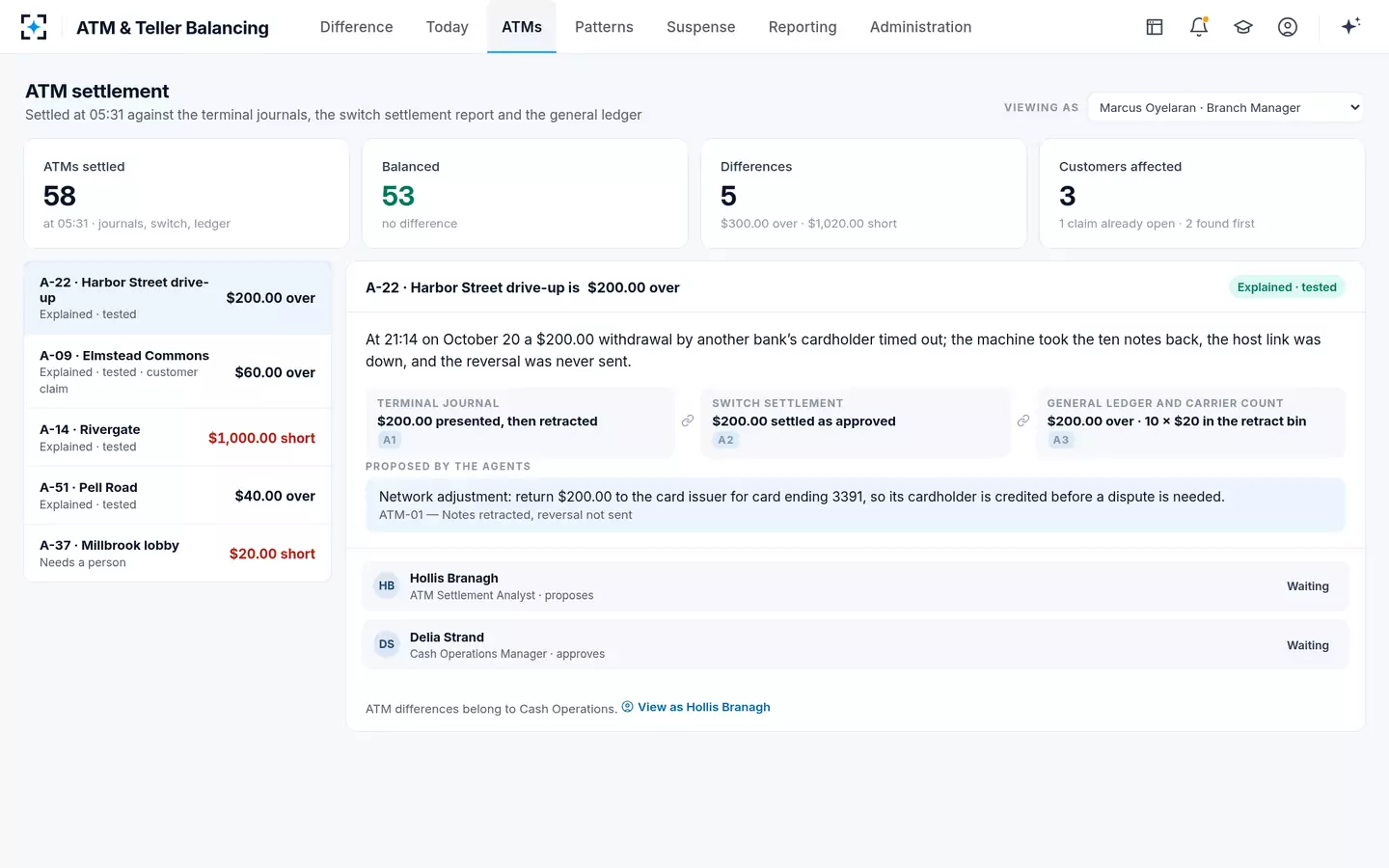
What happens after the flag decides the analyst's day. A break of $200.00 over at a drive-up machine might be a retracted withdrawal whose reversal never reached the card issuer, a load keyed $200.00 too low, or a count error. The first is another bank's customer's money and goes back through the network; the second is a general ledger correction; the third is a recount. Software that stops at the flag leaves all three to be told apart by hand, in the journal.
Can ATM reconciliation software read electronic journals?
It has to, or it cannot explain anything. The electronic journal is the machine's own account of each session: the card, the amount requested, the notes picked from each cassette, the notes presented, taken or retracted, and the error codes. The Federal Reserve's questionnaire treats it as a basic control: it asks whether the bank has journals that let management see every transaction or attempted transaction at the machine. Journal formats differ by machine and software version, and a product that reads only the settlement files leaves the journal, and every explanation in it, to a person.
Ask the vendor to show a retract and a partial dispense in your own journals, at the line, beside the switch record for the same transaction. If it cannot, its explanations of overages will be guesses or will not exist. The guide to RPA in ATM reconciliation maps the systems and where each kind of automation stops.
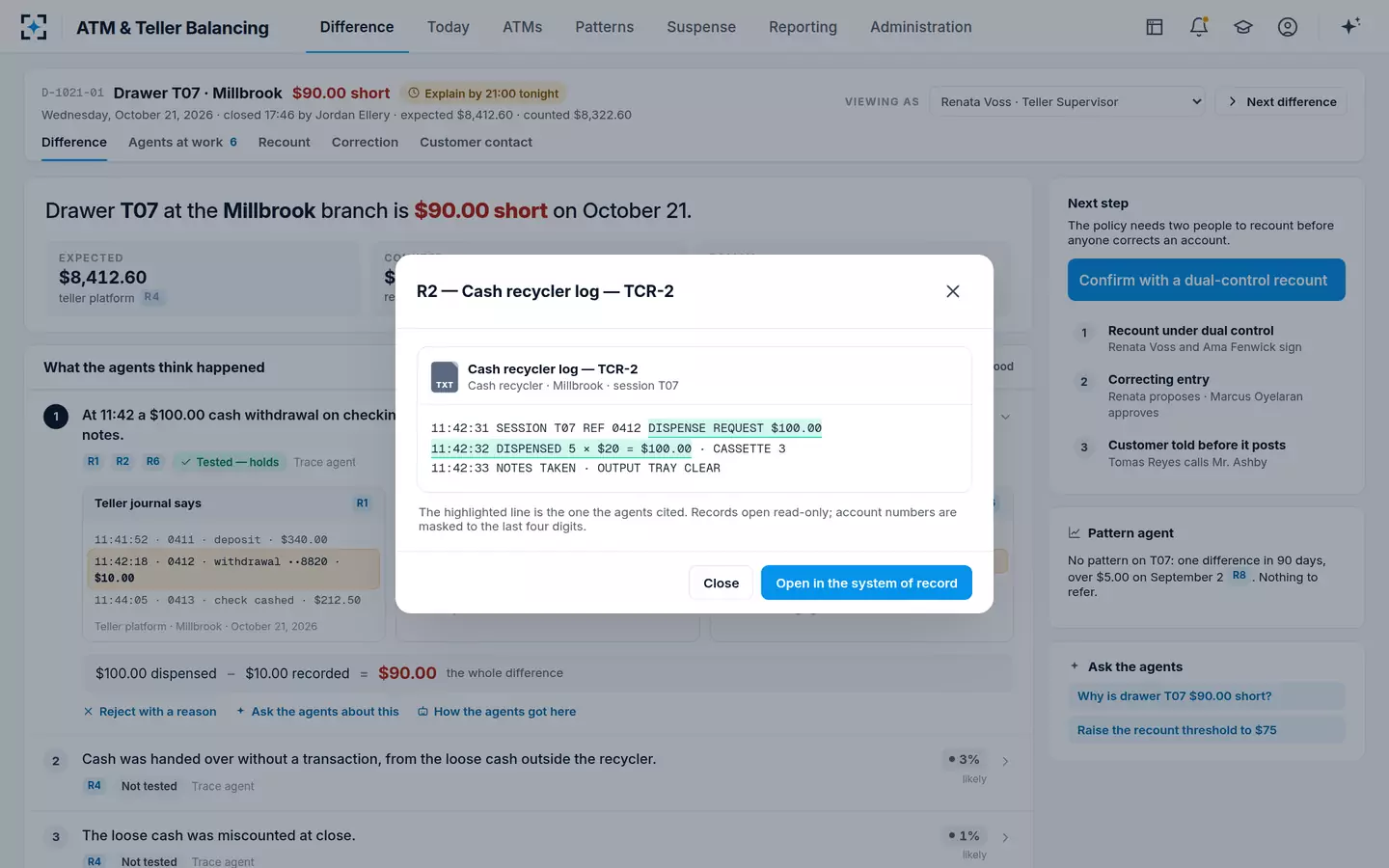
Every explanation in ATM & Teller Balancing opens to its record, at the cited line
Does ATM reconciliation software handle cash recyclers?
Only if it was built for branch cash as well as ATMs. A teller cash recycler keeps a log much like an ATM journal: dispense requests, notes dispensed by cassette, notes presented and taken, deposits accepted. A shortage on a teller drawer is then a reconciliation between the teller platform, the recycler log and the loose cash, which is the same problem as an ATM with a person in front of it.
Products that reconcile ATMs and leave the teller line to a spreadsheet split the bank's cash differences into two places, two histories and two suspense accounts that nobody reads together. ATM & Teller Balancing ties both: the teller platform's expected cash against the recycler and loose cash at every drawer close, and the terminal journal, switch settlement and general ledger against the carrier count at every ATM settlement.
How does ATM reconciliation software handle Reg E claims?
It should put the machine's evidence in front of the people deciding the claim on the first day, and never decide the claim itself. Regulation E counts a short dispense as an error in its own right (ATM overage quotes the rule), so a customer who says an ATM gave them $40 instead of $100 has started a clock. The reconciliation side holds the decisive records: the journal entry for that session, the cassette counts and the purge bin. Software that matches an overage to the claim lets the disputes team decide with the machine's own count instead of a request to the ATM team.
Deposits need care. Regulation E's official interpretation says that "with regard to deposits at an ATM, a consumer's request for the terminal location or other information triggers the error resolution procedures" (Supplement I to Part 1005, comment 11(a)-1). An ATM team that receives such a request from a customer service colleague needs to know it is part of a claim. The guide to ATM overages follows one claim through a morning settlement.
The morning settlement, tied three ways, with the adjustment ready for two people
What reports do examiners want from ATM reconciliation?
Examiners want evidence that differences are found, explained or documented, attributed and reviewed by someone independent, more than they want any particular report. The FDIC's examination module asks whether reconciliations "are performed by an individual who is not directly involved in accepting or preparing transactions or entries to customer accounts" (FDIC examination module, item 68), and, of deposit records, whether they "provide satisfactory audit trails (i.e., the transaction can be traced from initiation to final disposition)" (item 62). Each of the outputs below answers one of those.
What ATM reconciliation should be able to hand an examiner
| Output | What it shows | The question it answers |
|---|---|---|
| Daily settlement summary tied to the general ledger | Every machine, balanced or not, with the amount and the time tied | Is ATM cash proved daily against an independent control? |
| Difference history by machine and cassette | Repeated differences, normalized by volume | Are recurring errors noticed and acted on? |
| Suspense aging, item by item | Each unexplained item with age, owner and what it waits for | Are reconciling items stale or recurring? |
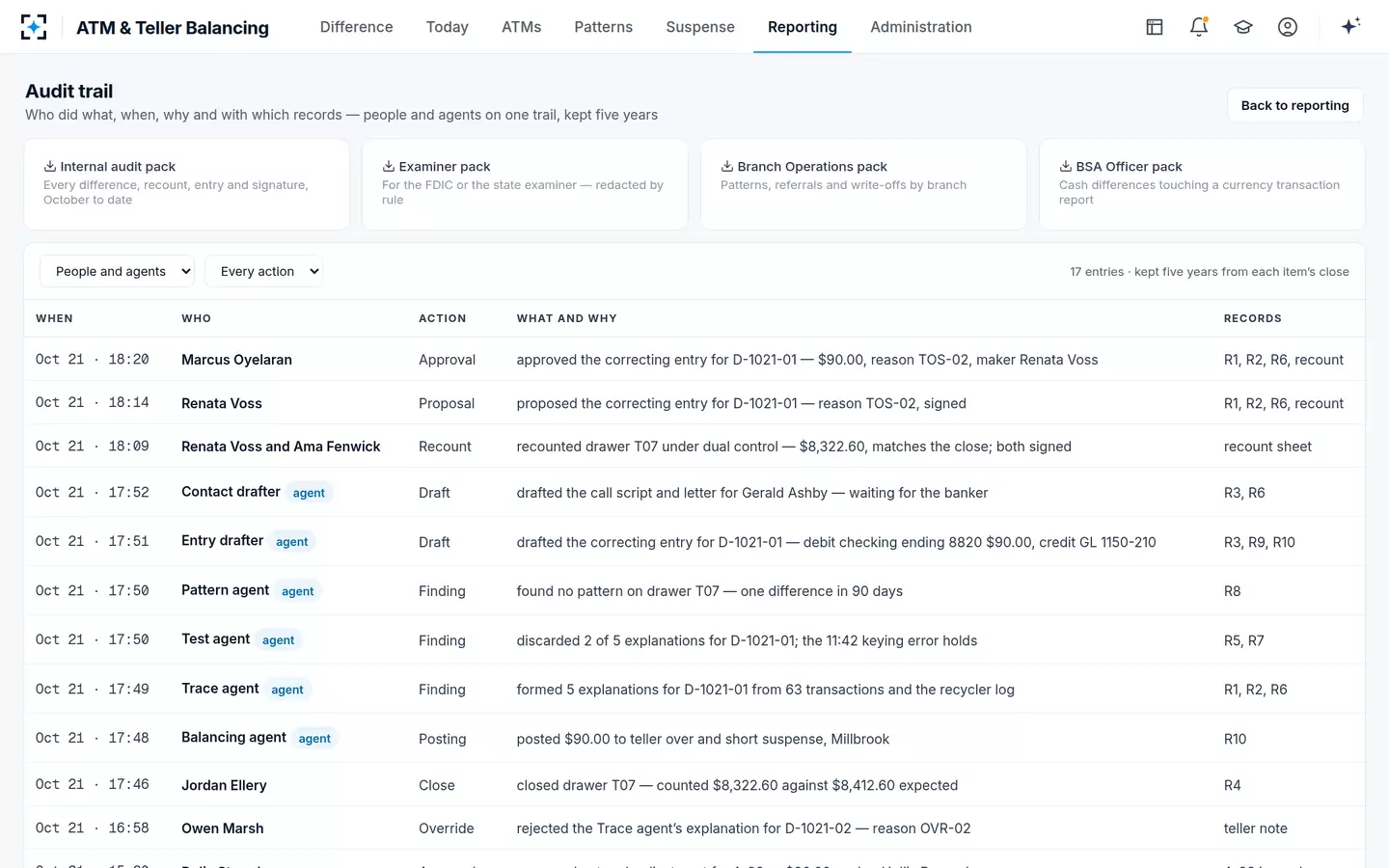
| Adjustments and corrections with maker and checker | Who proposed, who approved, the reason code and the records | Does one person dominate a transaction? |
| Overrides | Every rejected finding with its reason | Are overrides appropriate and approved? |
| Customer claims matched to machines | Claim, journal, count, decision date | Was the machine’s evidence used for Regulation E decisions? |
One audit trail, exportable for the examiner and for internal audit
How much does ATM reconciliation software cost?
No government, academic or non-profit source publishes prices, so the useful comparison is with the work the software takes over, priced in your own hours. Four things drive the price of any product here: the number of machines and drawers, the number of journal formats and networks it must read, the integration with the general ledger, core and dispute system, and whether teller recyclers are in scope. Budget separately for the bank's own work: read-only access to journals and settlement files, and the time internal audit or model risk will spend validating a tool whose findings decide what gets corrected.
On the teller side, Botminds estimates from its sample case that one $90.00 shortage takes about 140 minutes of people's time by hand and about 24 with the agents, with what remains being the recount, the approval and the customer call. The ATM side has no comparable public figure. Price both with the bank's own volumes, because the larger term may not be the hours: it is the cash that ends in write-offs, and the customers' money that ends in complaints. The step-by-step comparison shows which hours move.
A demonstration script for ATM reconciliation software
Bring a closed month of your own data and a list of what your team already found in it. The script below takes about two hours with a vendor, and each step produces something you can check.
Eight steps to run in any ATM reconciliation software demonstration
- Load one closed month of your own settlements
Journals, switch reports, general ledger extracts and carrier counts, with your team’s findings held back.
- Ask for the explanation of five differences you already solved
Compare with what your analysts found, line for line.
- Ask for one you never solved
See whether it finds a cause, says what record is missing, or invents one.
- Open a retract and a partial dispense at the journal line
In your machines’ own journal format, beside the switch record.
- Match an overage to a real customer claim
With the claim’s decision date, and the evidence ready for disputes.
- Propose and approve an adjustment as two different people
Then try to approve your own proposal, and watch it refuse.
- Reject a finding with a reason
And find the rejection afterwards in the audit trail.
- Export what the examiner would get
With account numbers masked and the redactions your policy requires.
Where ATM & Teller Balancing fits among ATM reconciliation products
It fits a bank or credit union that wants the morning ATM settlement and the evening teller close explained, not just matched: agents tie every machine and drawer, trace and test each difference, match overages to customers and claims, keep each person's and machine's history, age suspense in the open, and draft every adjustment for a maker and a different checker. It connects to the ATM electronic journal and switch, the cash recyclers, the teller platform, the general ledger, the core and dispute case management.
It is not a card settlement or general ledger reconciliation product, it does not decide Regulation E claims, and it never posts a correction or contacts a customer: people do. A bank that uses a vendor for any of this still owns the outcome; the interagency guidance on third parties leaves a bank that outsources a task as responsible for it as if it had kept the work in-house (Interagency Guidance on Third-Party Relationships, June 2023; read in full in interagency guidance on third-party relationships). The agents and their limits are listed on the ATM & Teller Balancing page.
Questions people ask
What features should ATM reconciliation software have?
It should read the electronic journals directly, tie journal, switch, general ledger and count each day, explain each difference with the record behind it, match overages to customer claims, keep difference histories by machine and cassette, age suspense items, and require a different person to approve every adjustment it drafts.
Can ATM reconciliation be outsourced?
The work can be, the responsibility cannot. Under the 2023 interagency guidance on third-party relationships, a bank that outsources an activity remains responsible for it as if it were done in-house, so it needs the same evidence of explanations, approvals and reviews from the vendor as from its own staff.
How long does it take to implement ATM reconciliation software?
It depends mostly on access to journals and settlement files and on the number of journal formats in the fleet. A sensible plan runs the software on past settlements first and compares its explanations with what analysts found before any live use.
Should ATM and teller reconciliation be in the same software?
It helps. Teller cash recyclers keep logs much like ATM journals, the same suspense accounts can receive both kinds of difference, and examiners ask for cumulative records for everyone who handles cash. One place for both means one history and one aging report.
Does ATM reconciliation software need to mask card numbers?
It should mask them by default and log any unmasking. In ATM & Teller Balancing, account and card numbers are masked to the last four digits, and unmasking is approved and logged.