Teller balancing is the daily proof that the cash in a teller's drawer equals what the teller platform says should be there: the teller counts the drawer at the end of the shift, by denomination, signs a proof sheet, and compares the total with the expected cash from the day's transactions. Any difference is recounted, reported, explained or posted under the bank's over and short policy, and the drawer is closed. That daily cycle is necessary but not enough, because each day is judged alone. Examiners also ask for a cumulative over-and-short record for everyone who handles cash, since a pattern of small differences, each under the recount threshold and each posted to expense, never shows on any single day. Botminds' ATM & Teller Balancing balances every drawer at the close, explains each difference from the journal, recycler log and slips, and keeps each drawer's and each teller's history so the pattern is visible.
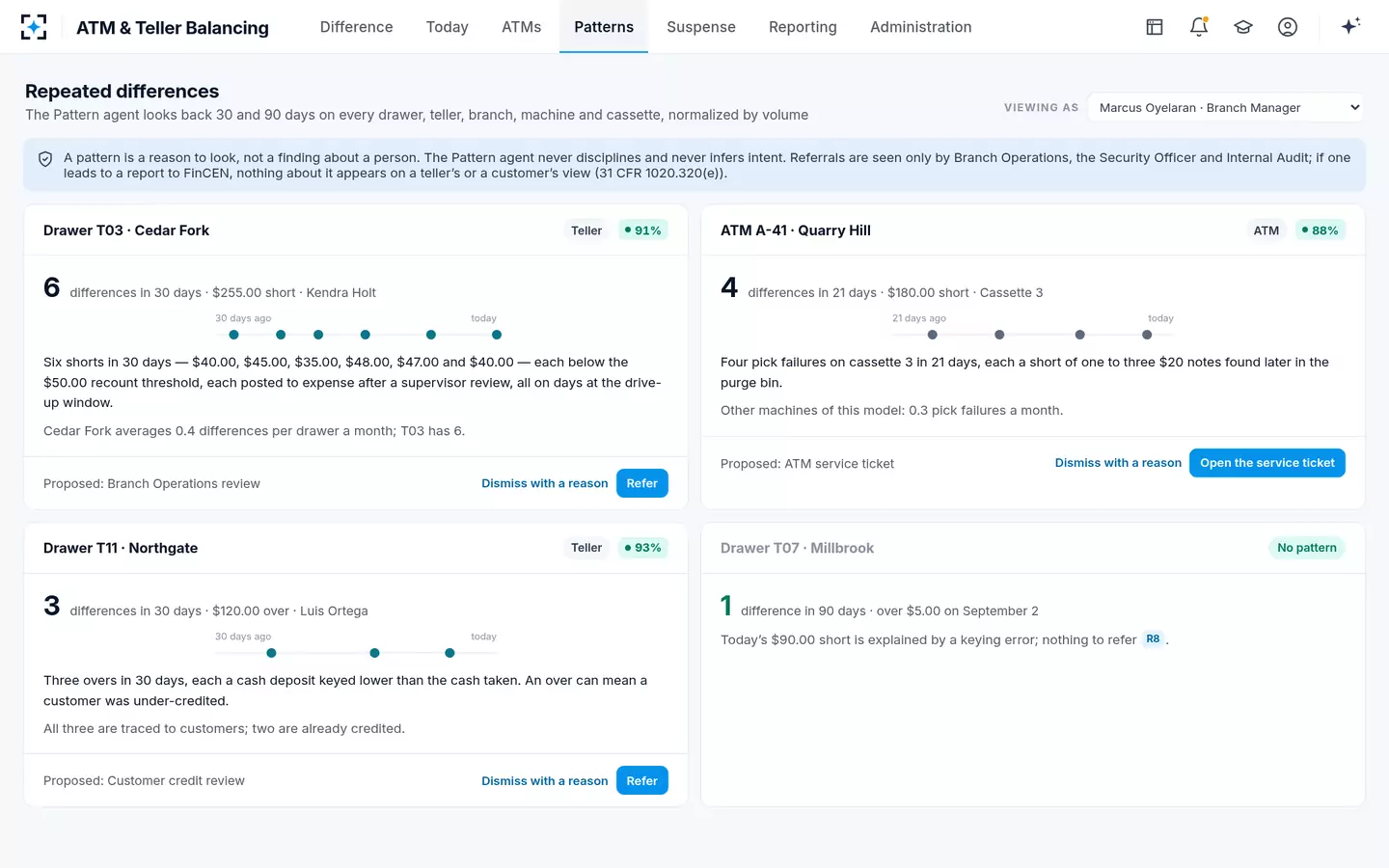
The figure below is one drawer's month from the sample data of Tessaly Community Bank, a fictional bank: drawer T03 at its Cedar Fork branch.
One drawer’s month: six shortages under the $50 threshold add up to $255
What is teller balancing?
It is the end-of-shift proof that a teller's cash agrees with the teller's transactions. The Bureau of Labor Statistics lists it among a teller's core duties: tellers "count the cash in their drawer at the start of their shift" and "count the cash in their drawer at the end of their shift and make sure the amounts balance", and during training they "learn how to balance cash drawers and verify signatures" (BLS Occupational Outlook Handbook, Tellers).
Balancing has two halves that are easy to run together. The teller's half is the count and the proof sheet. The bank's half is an independent comparison: the FDIC's examination module asks whether "daily procedures compare each teller's cash, in aggregate, to an independent control from the proof or accounting control department" (FDIC examination module, item 7). A drawer that the teller alone says balances has been counted, not proved.
How do you balance a teller drawer?
Count, sign, compare, and then deal with any difference by the policy rather than by adjusting anything. The steps below follow the order a supervisor should expect, and each one ends with something written that a reviewer can check later.
Teller balancing procedures at the close, step by step
- Clear the drawer of checks and transfers
Every check and teller transfer accounted for, so the count is cash only.
- Count by denomination
Notes, straps, coin and any recycler balance, each counted, not read off a label.
- Prepare and sign the proof sheet
Currency, coin, consignment items and cash items, signed by the teller.
- Compare with the teller platform’s expected cash
The difference, if any, is a number before it is a problem.
- If it is off, recount once and check the obvious
A withdrawal keyed with the wrong amount, a void after cash left the drawer, cash back on a deposit, a strap miscounted.
- Report the difference, never adjust it
With a note of what was checked. Large differences go to a responsible official.
- Follow the policy tier
Supervisor review, a recount by two people, or both, depending on the amount.
- Clear it today or document why not
Explained and corrected, posted to over and short with the note, or carried in suspense with an owner.
- Prove the branch against an independent control
Each teller’s cash, in aggregate, against the proof or accounting control department.
- Add the day to the cumulative record
Every difference, explained or not, against the person and the drawer.
What is a teller proof sheet?
It is the teller's signed statement of what was in the drawer at the close. The FDIC's module asks "whether each teller prepares and signs a daily proof sheet detailing currency, coin, consignment items, and cash items" (FDIC examination module, item 10). The detail matters: a proof sheet that lists only a total cannot be checked against a recount by denomination, and the FDIC's manual names "Teller cash records are inadequately detailed" among the common recordkeeping deficiencies examiners find (FDIC RMS Manual, section 4.2).
With a cash recycler at the teller line, part of the drawer is counted by the machine, which keeps its own log of every note dispensed and accepted. The proof sheet then has two parts, the recycler's count and the loose cash, and each should be shown separately. In the sample data, drawer T07's close shows exactly that: $7,640.00 in the recycler and $682.60 loose, $8,322.60 counted against $8,412.60 expected.
How often should tellers balance?
At least once a day, at the close, and whenever a drawer changes hands. The FDIC's checks are daily: cash compared with an independent control each day, and "teller differences are cleared daily or appropriately documented" (FDIC examination module, item 8). A drawer that passes from one teller to another during the day, for a shift change or a relief teller, should be counted at the hand-over, because a difference found after it cannot be attributed. A drawer left by a teller going on extended leave is counted under dual control before anyone else uses it.
Balancing more often than daily is a matter of volume and risk. A branch with heavy cash days, a drive-up window with a separate supply, or a teller in training may balance at midday as well; the policy should say when.
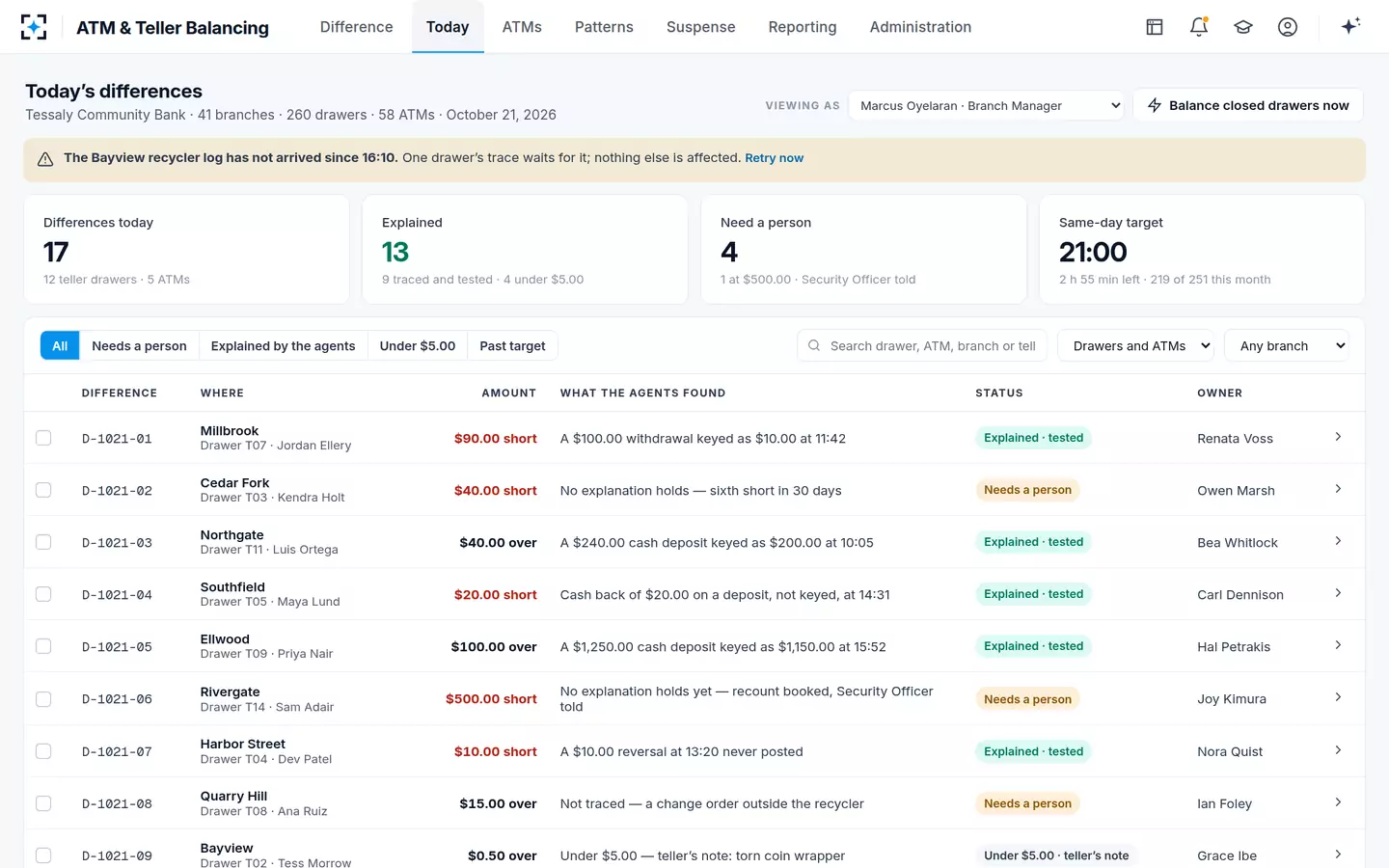
Today’s teller and ATM differences in ATM & Teller Balancing, with the same-day target
What is a cumulative over and short record?
It is a running history of every difference, over or short, explained or not, for each person who handles cash. The FDIC's examination module asks "whether cumulative over-and-short records are maintained for all persons who handle cash" (FDIC examination module, item 9). The Federal Reserve's questionnaire asks the same question and adds who reads it: "Is an individual, cumulative over and short record maintained for all persons handling cash, and is the record reviewed by management?" (Commercial Bank Examination Manual, section 2310.4, item 9).
Three words in those questions do most of the work. "Cumulative" means the record runs across days, so a pattern can form. "All persons" means supervisors, head tellers, vault tellers and anyone else who touches cash, not only the teller line. "Individual" means per person, which only works if each person has sole access to their own cash; a shared drawer produces a shared history that protects no one.
Why a single day never shows the pattern
Because every rule that runs on a single day is a threshold, and the pattern sits below it. Drawer T03 at Cedar Fork was short six times in 30 days, by $40.00, $45.00, $35.00, $48.00, $47.00 and $40.00. Each shortage was under the $50.00 recount threshold, so none was recounted by two people; each was reviewed by a supervisor and posted to expense; each day closed. The running total, $255.00, appears only when the days are added up, and the detail that every one fell on a drive-up day appears only when the days are compared.
The Federal Reserve tells its examiners to look exactly there: "Review tellers' over and short accounts for recurring patterns and any large or unusual items and follow up as considered necessary. Investigate differences centered in any one teller or banking office" (Commercial Bank Examination Manual, section 2310.3, item 9). A bank that reads its own cumulative records first finds the pattern before the examiner does, and can find its cause: a teller who needs help, a window that needs a different procedure, or something that needs the Security Officer. How to look at a pattern without prejudging the person is the subject of the guide to a teller out of balance.
Patterns below the recount threshold, normalized by volume and handled fairly
What is a teller recount threshold?
It is the amount above which a difference must be recounted by two people before anything is corrected. No regulation sets one; it is a line in the bank's over and short policy, alongside the tiers for supervisor review and for telling the Branch Manager and the Security Officer. At Tessaly, in the sample data, the tiers are: under $5.00, posted with the teller's note; $5.00 to $49.99, a supervisor reviews the explanation; $50.00 or more, a recount by two people; $500.00 or more, the Branch Manager and the Security Officer are told at once.
A threshold decides how much attention a single difference gets; it says nothing about a series of them. That is why the cumulative record has to include every difference below the threshold too, and why a threshold should be reviewed against the history it would have changed. The recount itself, and what each signature on it proves, is in dual control in banking.
What the FDIC and the Federal Reserve ask about teller balancing
| Control | FDIC examination module | Federal Reserve questionnaire |
|---|---|---|
| Daily proof against an independent control | Item 7 | Item 7 |
| Differences cleared daily or documented | Item 8 | Item 8: cleared daily |
| Cumulative over-and-short record for everyone handling cash | Item 9 | Item 9, reviewed by management |
| Signed daily proof sheet with currency, coin and cash items | Item 10 | Item 10 |
| Large differences reported to a responsible official | Item 11 | Item 11 |
| No pooled “kitties” | Item 12 | Item 12 |
| Each teller’s cash verified on a surprise basis | Covered by random drawer audits in the FDIC manual | Item 4, with a record of the count kept |
Who reviews teller over and short reports?
Management, according to the Federal Reserve's question, and in practice someone outside the branch as well. The teller supervisor reviews each day's differences; the cumulative record needs a reader who is not part of the branch's daily routine, such as branch operations or internal audit, because a pattern can involve the people who review the days. The examiner reads it too, looking for "recurring patterns" and differences "centered in any one teller or banking office".
A cumulative record that nobody reads is a file. To be read, it needs to be normalized by volume, because a busy teller has more differences than a quiet one, and compared across drawers at the same branch. In the sample data, Cedar Fork's average of 0.4 differences per drawer a month is the context that makes T03's six stand out.
Teller balancing still matters to customers
Fewer households use a teller than in 2019, but most still do, and those who rely on the teller line most depend on it being right. The FDIC's household survey counts the change.
Who still uses a bank teller
67.9%
of banked households used a bank teller at least once in 2023
76.4%
did in 2019
28.9%
used an in-person channel, ATMs or tellers, as their primary way to reach their account in 2023
A teller difference can be a customer's money: a withdrawal keyed low leaves the customer under-debited, a deposit keyed low leaves the customer under-credited. In the sample data, all three overages on one drawer in a month were traced to customers' deposits keyed lower than the cash received. Balancing that stops at the drawer total never finds them; balancing that explains each difference does.
How ATM & Teller Balancing keeps the cumulative record
It builds the record as a by-product of explaining each day. At every close, the Balancing agent ties the drawer to the teller platform and the recycler and raises any difference with its policy tier; the Trace and Test agents explain it from the records; and the difference joins the drawer's and the teller's history whether it was explained, corrected, posted to over and short or carried in suspense. The Pattern agent reads that history over 30 and 90 days, normalized by volume, on every drawer, teller, branch, machine and cassette, and drafts a referral when a pattern appears. It never infers intent and never disciplines anyone; a named person accepts or dismisses the referral, and the teller never sees it.
The same record covers the ATMs, by machine and cassette, so that a cassette with repeated pick failures is found the same way as a drawer with repeated shortages. Unexplained items age in the open, as the suspense account guide describes. The full set of agents, limits and settings is on the ATM & Teller Balancing page.
Questions people ask
What is a teller balancing sheet?
It is the form, paper or on screen, on which a teller records the close: cash by denomination, coin, cash items and the recycler's count, the expected cash from the teller platform, and the difference. Examiners call the signed version the daily proof sheet and expect it to detail currency, coin, consignment items and cash items.
Does a difference the teller explains still go on the cumulative record?
Yes. The record is of every difference, explained or not, because the pattern is in the count of small ones; a teller who recounts, finds a keying error and corrects it with the supervisor's approval has a corrected difference on the record, not a blank day. What a teller must never do is make the drawer balance by adjusting an entry or the count, which is force balancing.
Is there a standard tolerance for teller differences?
No regulation sets one, and no government, academic or non-profit source publishes typical teller over-and-short rates. Each bank sets its own tiers in its over and short policy and should judge differences against its own history and volumes.
Do supervisors and vault tellers need a cumulative record too?
Yes. The FDIC asks for cumulative over-and-short records for all persons who handle cash, and the Federal Reserve for an individual record for all persons handling cash, which includes head tellers, vault tellers and supervisors who keep a cash supply.
How long should over and short records be kept?
The bank's record retention policy decides, and it should cover at least the period between examinations and any audit look-back. In the sample data, Tessaly keeps every difference, recount and correction five years from each item's close.