A surprise cash count is an unannounced count of a teller's cash drawer, the vault or other cash at a branch, performed by someone independent of the cash and compared with the record of what should be there. Its purpose is to find a shortage before it can be covered: a teller who is short can borrow from the vault, from a colleague or from tomorrow's deposits if they know a count is coming, and a predictable count measures only how well they prepared. Examiners expect it. The FDIC's procedures ask whether "all currency is counted on a surprise basis including verification of all strapped cash packets", and the Federal Reserve's ask whether each teller's cash is "verified periodically on a surprise basis by an officer or other designated official". What decides whether a surprise count works is who chooses the day and the drawer, who knows in advance, and who counts. Botminds' Branch Self-Assessment takes the choice away from the branch: the drawer for the surprise count is picked at random when the branch manager starts the review's walk, and nobody at the branch sees it before.
Examples on this page come from a fictional sample credit union in the solution, Norrell Federal Credit Union, and its sample review of a branch called Cedar Hollow. Its people and figures are sample data. The criminal cases cited are real and taken from Justice Department press releases.
A surprise cash count log: what each line should record, with one sample entry
What was counted
Why it mattersA drawer, the vault, a vacation drawer or consigned items: each has its own limit and its own record to match.
Sample entryTeller drawer 3, at the start of the walk
Who chose it, and when
Why it mattersIf the branch chose, the count tests the branch’s preparation, not its control.
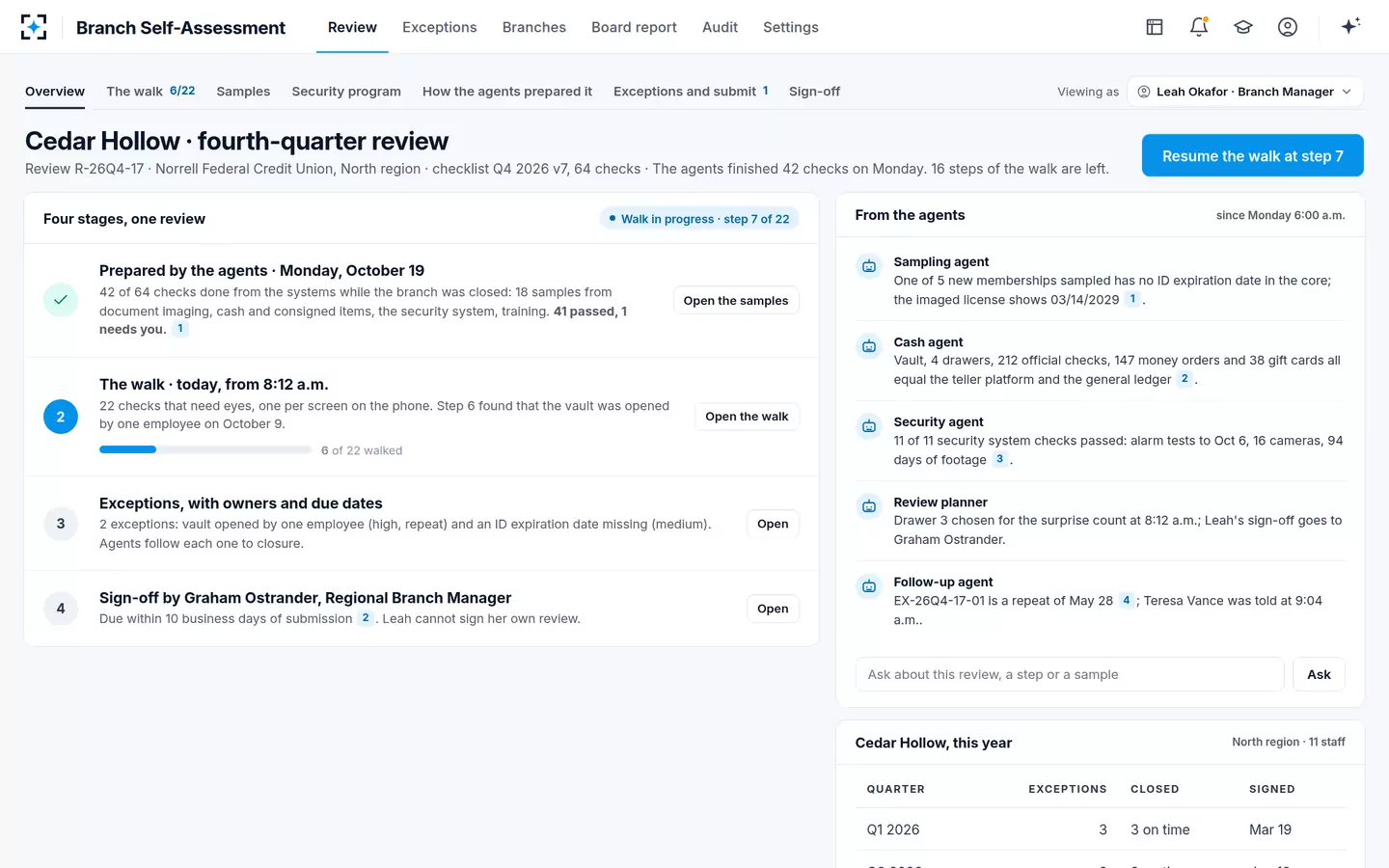
Sample entryChosen at random by the Review planner at 8:12 a.m., when the branch manager started the walk
Who knew in advance
Why it mattersThe whole value of the count depends on this line.
Sample entryNobody at the branch; the setting never shows the drawer before the walk
Who counted, and who witnessed
Why it mattersTwo people, at least one independent of the cash being counted.
Sample entryThe branch manager and a second employee, both signing the count sheet at 8:33 a.m.
Strapped packets verified
Why it mattersA strap with the right band and the wrong count passes any count that trusts the band.
Sample entryNumber of straps opened and counted, recorded per count (set by policy)
Result against the record
Why it mattersThe count means nothing until it is compared with the teller platform and the general ledger.
Sample entry$11,482.00, equal to the teller platform
Difference, and who was told
Why it mattersA large difference goes to a responsible official the same day.
Sample entryNone
What is a surprise cash count?
A surprise cash count is a count of cash the custodian did not know was coming, by someone who does not control that cash, matched to the record. All three parts matter. A count the custodian expected is a count of prepared cash. A count by the custodian alone is a balancing, not a test. And a count that is not compared with the teller platform and the general ledger proves only that the money was counted, not that it was all there.
Banks and credit unions use surprise counts at three levels. Teller drawers are counted at random, so every teller knows any day might be the day. The vault is counted in full, including the bundles and straps that usually sit unopened. And cash that changes hands for other reasons, a teller going on vacation or leaving, is counted at the handover. The FDIC's examination procedures cover the last case directly: the whole cash supply of a teller on vacation or a long absence is to be counted under dual control (FDIC RMS Manual, section 22.1, item 3; see dual control in banking).
Determine whether the vault cash is appropriately controlled and that all currency is counted on a surprise basis including verification of all strapped cash packets.
FDIC RMS Manual of Examination Policies, section 22.1, expanded procedures for cash on hand, item 20
Why are surprise cash counts conducted?
Because a shortage that can be predicted can be hidden. The FDIC's internal controls section puts lapping, covering one day's shortage with the next day's receipts, at the head of the cash frauds examiners look for, and is direct about the remedy: "Random cash drawer audits are also a fundamental control process" (FDIC RMS Manual, section 4.2). Lapping, borrowing from the vault and pooling cash between tellers all work only as long as the person doing it knows when they will be checked.
The same logic applies to staff rotation. The FDIC says rotations "should be planned by auditors and senior officers to ensure maximum effectiveness, but should not be announced ahead of time to the involved personnel". A surprise count is a rotation of a different kind: for a few minutes, someone else stands where the custodian stands and looks at the cash with no time to prepare.
When the count was expected: what the federal cases show
Counts that were expected, or that were signed rather than performed, appear again and again in federal embezzlement cases. In Spokane, Washington, a bank branch manager took at least $345,664 from the vault, the ATM and her own cash drawer; according to the U.S. Attorney's Office, she "falsified documents to reconcile the cash and directed bank employees to sign falsified count sheets in order to hide her theft and embezzlement" (U.S. Attorney's Office, E.D. Wash., 2024). In Elk City, Oklahoma, three tellers with vault access took $427,632 between mid-2014 and 2016 and hid it with false vault balancing sheets (U.S. Attorney's Office, W.D. Okla., 2018; the case is one of four in how to prevent embezzlement at a bank branch).
Both cases turn on the same weakness. A count sheet with two signatures records that two people signed, not that two people counted, and certainly not that the second person chose the moment. When the person who controls the cash also controls when it is counted and who signs, a surprise count becomes a ceremony. The control that breaks the pattern is a count chosen outside the branch, performed by someone who does not report to the custodian, against a record the custodian cannot edit. How dual control works when it does, and fails when it does not, is covered in our sister series on balancing, dual control in banking.
A count on a predictable schedule against a count chosen at random, outside the branch
Predictable schedule: The branch, or a calendar everyone at the branch can see.
Chosen at random outside the branch: Someone or something outside the branch, at the moment the count starts.
Predictable schedule: Borrow from the vault or a colleague the day before; carry the shortage forward in the deposits.
Chosen at random outside the branch: Nothing: there is no notice in which to borrow.
Predictable schedule: Often the custodian and a colleague who reports to them.
Chosen at random outside the branch: A person independent of the cash, with the custodian present.
Predictable schedule: That the cash was in place on a day the custodian knew about.
Chosen at random outside the branch: That the cash was in place on a day nobody at the branch knew about.
Predictable schedule: Date, total and signatures.
Chosen at random outside the branch: Who chose, when, who knew, who counted, straps verified, matched to the record.
How often should surprise cash counts be conducted?
No federal rule sets a frequency; the examination manuals ask for counts "on a surprise basis" and "periodically", and leave the schedule to the institution's policy. Frequency also matters less than unpredictability. A count every month on the first Monday is less of a surprise than a count four times a year on days nobody can guess. A sound policy sets a minimum for every drawer and the vault in each cycle, and makes the timing within the cycle random.
Random selection has one trap: it can leave a drawer uncounted for a long time. If a branch with four drawers counts one drawer a quarter, chosen at random, any given drawer has a 25% chance of being picked each quarter, and by our arithmetic a 32% chance of going a whole year uncounted (0.75 to the fourth power). The fix is to combine the two: a random drawer at each review, and a full count of every drawer and the vault at an unannounced visit at least once in the cycle. The fictional sample credit union does both, with a surprise drawer at every quarterly review and one unannounced review per branch a year.
Chance a given drawer goes uncounted, if one of four is picked at random each quarter
Who should perform a surprise cash count?
An officer or other designated official independent of the cash, with the custodian present, and at least two people in all. The Federal Reserve's internal control questionnaire puts it as a question examiners ask: "Is each teller's cash verified periodically on a surprise basis by an officer or other designated official (if so, is a record of such count retained)?" (CBEM 2310.4, item 4). The FDIC's items add that vault opening and closing and shipments of currency must be under dual control, and that tellers who are absent for an extended period have their cash counted under dual control.
The branch manager can perform surprise counts of teller drawers, because the manager does not control a teller's cash. The branch manager should not be the only person who decides when the vault is counted, because the manager does control the vault, and the Spokane case shows what a manager in control of count sheets can do. That is the case for having the vault count, at least sometimes, chosen and witnessed by someone from outside the branch: a regional manager, internal audit or a security officer.
What is counted in a surprise cash count, and should strapped currency be counted?
Everything the record says should be there: currency by denomination, coin, cash items and consigned items, and in the vault every strapped packet, not just the band labels. The FDIC's item 20 is explicit about "verification of all strapped cash packets", and for a good reason: a strap is the easiest place to hide a shortage, because a count that adds up straps by their bands never opens them. Verification can mean counting each strap, or counting a sample of straps in full and checking the rest for the right thickness and band; the policy should say which, and the log should record how many straps were opened.
The count is then compared with the record. For a drawer that is the teller platform's balance at the moment of the count; for the vault, the teller platform and the general ledger, by denomination. The Federal Reserve's questionnaire asks, "Is a record maintained showing amounts and denominations of reserve cash?", and the FDIC asks the same of vault cash; without that record a count has nothing to be compared with.
The review in four stages in Branch Self-Assessment: the surprise drawer is chosen when the walk starts
How do you document a surprise cash count?
With a count log that records the choice as well as the count, and with the count sheet itself kept as evidence. The Federal Reserve's question ends with "if so, is a record of such count retained", and the record examiners want shows more than a total. The log at the top of this page lists the lines worth keeping: what was counted, who chose it and when, who knew in advance, who counted and witnessed, straps verified, the result against the record, and any difference and who was told.
A surprise cash count, step by step
- Choose the drawer or the vault outside the branch, at the moment of the count
Record who chose and when. A choice made a day ahead is an announcement.
- Count with the custodian present and an independent person counting
The custodian watches; they do not count their own cash for the test.
- Count every denomination, the coin, cash items and consigned items
And, in the vault, open the straps the policy requires.
- Compare with the teller platform and the general ledger on the spot
By denomination for the vault, so a swap between denominations is visible.
- Both people sign the count sheet with the time
Then photograph it, so the sheet that was signed is the sheet that is kept.
- Report any large difference to a responsible official that day
The FDIC expects tellers to report large differences for clearance.
- Keep the log and the sheet with the review
Where internal audit and examiners can find both.
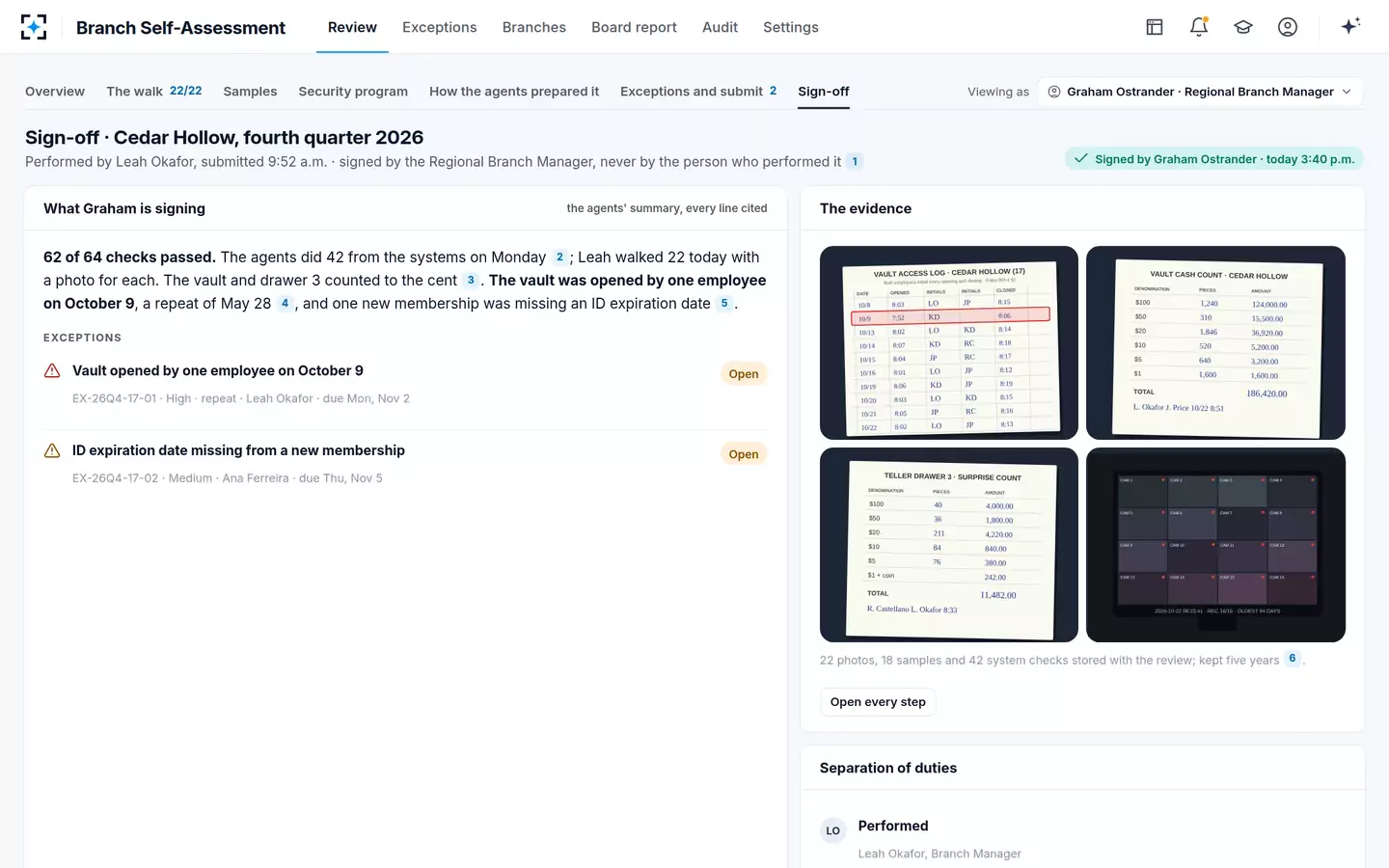
In the sample review, the Review planner chose drawer 3 at 8:12 a.m., the moment the branch manager started the walk. The drawer counted $11,482.00 and the count sheet was signed by the manager and a second employee at 8:33; the vault, counted later that morning by the manager and a second employee, came to $186,420.00. Both equalled the teller platform. The photographs of both count sheets went into the review, and the regional manager saw them before signing.
What if a surprise count finds a shortage?
Recount at once with a second person, compare again with the record, and if the difference stands, report it to a responsible official the same day and open an exception with an owner. The FDIC's items expect large differences to go to a responsible official and every difference to be cleared or documented the same day (how to trace one fairly is in teller out of balance). What a branch must not do is let the custodian make up the difference and close the matter: that is exactly what a surprise count exists to catch.
A shortage is not proof of theft, and a fair process protects the teller as much as the institution. The FDIC gives that as the reason tellers keep sole access to their own drawer: without it, nobody can say whose difference it was, and an innocent teller can be shamed or wrongly dismissed. If the difference suggests something more than an error, the matter goes to the security officer, not to branch colleagues; in Branch Self-Assessment the Security agent refers a possible internal incident to the security officer only and never contacts staff. Where a credit union has a substantial basis for identifying an employee, the NCUA's rule requires a suspicious activity report for insider abuse whatever the amount (12 CFR 748.1(d)). The steps that come before and after a count, from the walk to the regional signature, are told in one branch's quarterly self assessment, and the items that sit around it are in the branch audit checklist.
In Branch Self-Assessment the signed review carries the surprise count sheet, not just its total
Questions people ask
Can the branch manager schedule surprise counts?
The branch manager can perform surprise counts of teller drawers but should not be the only one who decides when the vault is counted, because the manager controls the vault. Having the choice made outside the branch, at the moment of the count, keeps the count a surprise for everyone at the branch, including the manager.
Is a surprise cash count the same as daily teller balancing?
No. Daily balancing is the teller proving their own drawer against an independent control at the end of the day. A surprise count is a test by someone else, at a time the teller did not choose, which is why examiners ask for both.
Should ATMs and cash recyclers be included in surprise counts?
Yes, where they hold branch cash. The Tampa and Spokane prosecutions both involved cash taken from a branch ATM, and examiners ask whether a bank representative is present when an ATM is serviced. Counting an ATM or recycler against its journal is a different procedure from a drawer count, and should be in the policy.
How long should surprise count records be kept?
No rule sets a period specifically for surprise count logs; the institution sets it, and it should cover at least the time to the next examination and the internal audit cycle. The fictional sample credit union keeps all review evidence, count sheets included, for five years.
What is the difference between a surprise count and a cash audit?
A surprise count is one test: cash counted without notice and matched to the record. A cash audit covers the whole cash process, including limits, differences, cumulative over-and-short records, dual control and the general ledger, and usually includes surprise counts as one of its procedures.